

Your japa may be regular while your heart still feels dry. Or you may have felt tears during kirtan and wondered whether that emotion was genuine spiritual progress. Both concerns point to the same practical question: how do you move toward prema-bhakti without forcing an experience or pretending to possess a love that has not yet matured?
The Bhagavad Gita gives you a grounded answer. Refine the intention behind action, learn to see beyond the demands of the conditioned ego, and direct your life toward loving service to Sri Krishna. Prema cannot be manufactured, but the conditions in which love ripens can be cultivated every day.
Read the Gita as a change in relationship
Karma-yoga, jnana-yoga, and bhakti-yoga are sometimes treated as separate compartments. For daily practice, it is more useful to see their connected work. Karma-yoga cleanses intention, jnana-yoga clarifies vision, and bhakti-yoga personalizes realization by placing knowledge and action in loving relation with Krishna.
Karma-yoga begins with what you are already doing. The question is not merely whether an action looks religious. Ask what is driving it. Work, family responsibility, temple service, study, and public duty can all become entangled with recognition, control, resentment, or fear of failure. Offering an action means exposing those motives rather than covering them with devotional language.
Jnana-yoga then helps you see why the attachment has such force. A role, possession, opinion, success, or defeat does not exhaust the truth of the self. This discernment creates room between your duty and the ego’s demand to own the outcome. Bhakti fills that room with relationship: the action is no longer simply detached from personal reward; it is consciously rendered for Krishna.
Before an important action, write or silently answer three questions:
- What is my actual duty here, apart from convenience and reputation?
- Which result am I trying to control because I want it to confirm my identity?
- What would change if I performed this action as seva rather than as a claim on the world?
This makes surrender concrete. The surrender taught in Bhagavad Gita 18.66 is not passivity but courageous alignment with dharma and service. It does not give you permission to abandon a clear responsibility, neglect someone who depends on you, or label indecision as transcendence. It asks you to stop treating independent control as your refuge while continuing to act in a spirit of devotion.
That distinction matters when practice feels dry. You do not have to wait for a devotional mood before making a loving offering. Perform the next duty with cleaner intention, clearer vision, and conscious remembrance. The relationship deepens through the offering itself.
Test devotion by its direction, not its drama
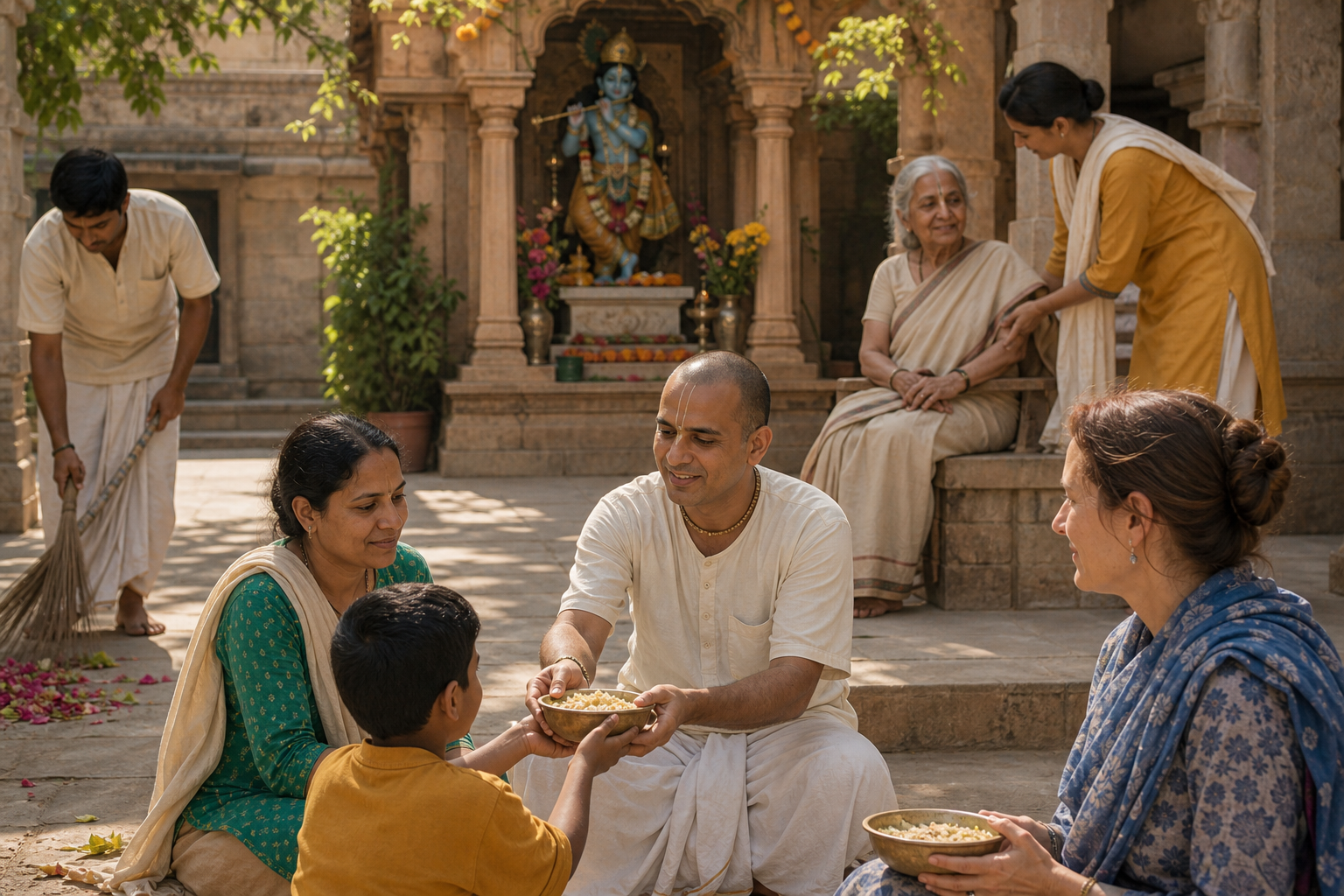
Advanced devotion can overflow through tears, laughter, ecstatic singing, dancing, direct address to the Lord, or reverent re-enactment of lila. These expressions have meaning when they arise naturally from deep absorption. They are not techniques for producing prema, and reproducing their outward appearance does not reproduce the consciousness from which they come.
Do not make the opposite mistake by becoming suspicious of every sincere emotion. If tears come during nama-smarana or kirtan, you need neither advertise them nor suppress them. Receive the moment with gratitude, return your attention to the holy name, and let the experience issue in service. The important question is what remains when the feeling passes.
For a sober assessment, look for changes that are harder to perform for an audience:
- Softness of heart: Another person’s pain interrupts your self-absorption and moves you toward compassionate action.
- Unmotivated service: You can serve when no recognition, influence, emotional reward, or repayment is available.
- Steady remembrance: Krishna is remembered not only in an intense gathering but also during an ordinary duty, irritation, delay, or disappointment.
- Ethical clarity: Devotional language does not become a shield for dishonesty, cruelty, vanity, or neglect.
- Sobriety: A meaningful experience makes you more teachable and responsible rather than eager to claim an advanced status.
This gives you a practical safeguard against imitation. If an experience increases self-importance but does not deepen compassion, remembrance, or seva, do not treat intensity itself as evidence of prema-bhakti. Return to japa, study, sat-sanga, and responsible action. Genuine advancement does not need a theatrical certificate.
Let Krishna’s flute teach you how to become receptive

Krishna’s vamsi offers a precise image for inner practice. A hollow reed has no song of its own, yet it becomes eloquent when divine breath moves through it. For a seeker, that emptiness does not mean erasing personality, intelligence, duty, or moral judgement. It means removing the obstructions that make every action revolve around possession and self-display.
Humility loosens the demand to be the centre. Aparigraha, or non-grasping, loosens the attempt to possess results, status, experiences, and even a particular image of oneself as a devotee. Gentle attention to the breath can help gather a scattered mind before chanting, but breath is not the object of bhakti. It is a doorway into attentive hearing.
Use the vamsi reflection at the beginning of your next practice:
- Sit without immediately reaching for a devotional feeling. Take several natural, unforced breaths and allow the body to settle.
- Name one thing you are gripping: an outcome, grievance, fear, role, possession, or desire to appear spiritually accomplished.
- Offer that attachment to Krishna without pretending it has already disappeared. Honesty is more receptive than performance.
- Begin japa or nama-smarana and listen to the sound you are actually making. When attention wanders, return to the next name without turning distraction into a verdict on your worth.
- End by choosing one concrete act of seva through which the remembrance can enter the rest of your day.
The final step keeps the flute image from becoming private sentiment. Receptivity must eventually take form as service. That service may be quiet: completing a neglected responsibility, listening without preparing a rebuttal, helping someone who cannot advance your interests, or correcting a wrong without demanding praise for the correction.
If breath awareness starts drawing all your attention toward technique, let it go and return directly to the name. The metaphor and the preparatory practice are servants of remembrance. They should not displace Krishna from the centre.
Build a daily rhythm that love can inhabit

The common trap is waiting for ideal conditions: a quiet mind, an inspiring gathering, more time, or a stronger desire to chant. Prema-bhakti is described as ripened devotion because ripening assumes continuity. Your immediate task is not to claim the fruit. It is to tend the practice through ordinary days.
Within Gaudiya practice, sravana, kirtana, smarana, and seva provide a workable structure. They reinforce one another when each is given a definite place:
- Sravana, hearing: Read one passage of the Bhagavad Gita attentively. Identify the instruction, the attachment it confronts, and the action it asks of you. Do not measure study only by pages completed.
- Kirtana and japa: Keep a regular appointment with the holy name. Choose a time you can preserve on an ordinary day, not merely on an unusually peaceful one. During chanting, favour attentive hearing over the search for a dramatic state.
- Smarana, remembrance: Attach remembrance to a recurring transition, such as beginning work, entering the home, preparing food, or facing conflict. The cue helps devotion enter the parts of life where habit normally takes over.
- Seva: Give remembrance a visible consequence. Choose a needed action, define what completion means, and do it without making appreciation a condition.
- Sat-sanga: Return regularly to the company of serious practitioners. Bring an honest question about application, not only a report of information acquired or experiences enjoyed.
You can use a simple Gita journal to connect these practices. After reading, record three short lines: “duty,” “attachment,” and “offering.” Under duty, name what must be done. Under attachment, name the result or self-image you are gripping. Under offering, name how the action will become seva. This prevents reflection from ending as an agreeable thought.
Dharmic traditions preserve distinct teachings and should not be blurred into a single system. Still, you can recognize a practical family resemblance among Hindu kirtan and nama-smarana, Sikh simran and shabad-kirtan, Buddhist devotional chanting and mindfulness, and Jain stavan offered in reverence to the Tirthankaras. Each belongs within its own theological and disciplinary setting. The shared lesson is narrower and useful: repeated sacred attention can educate the heart toward compassion, restraint, reverence, and service.
Respecting those differences also protects your own practice from spiritual shopping. You do not need to gather techniques whenever discipline becomes uncomfortable. Go deeper into the commitments you have undertaken, learn from qualified association, and judge adaptation by whether it strengthens attention, ethical clarity, and service.
Key takeaways for your next practice session
- Do not wait for emotion before offering an action to Krishna; clean intention and responsible seva are already part of the path.
- Use karma-yoga to examine motive, jnana-yoga to loosen false identification, and bhakti-yoga to direct action toward loving relationship.
- Read Bhagavad Gita 18.66 as courageous surrender, not as permission to avoid a clear duty.
- Welcome sincere devotional emotion without displaying it as proof of advancement or trying to reproduce it on demand.
- Measure progress by softness of heart, unmotivated service, remembrance, sobriety, and ethical clarity.
- Keep japa, Gita study, sat-sanga, and seva steady enough to shape an ordinary day, not only a spiritually intense occasion.
At your next sitting, begin with one Gita passage and one honest attachment. Chant without demanding a mood, then complete one specific act of seva that the reflection calls for. You cannot command prema to appear, but you can stop feeding the habits that obstruct attentive, loving service.
References
