
If you are deciding when to complete an Ekadashi fast or how to observe Pradosh on November 17, the first thing to notice is that the date does not remain under one tithi. The important change occurs early in the morning.
For most regions, the broad Panchang reading for Monday, November 17, 2025 is Krishna Paksha Dwadashi until 5:28 AM, followed by Krishna Paksha Trayodashi. That timing is a general guide, not a universal local muhurta. Your city, regional tradition, and Panchang calculation method still matter.
Read the date as a transition, not a single tithi
The early transition changes how you should use the day. Dwadashi is relevant to the completion of an Ekadashi observance. Trayodashi shapes most of the remaining day and brings attention to the evening Pradosha period associated with Shiva worship in many traditions.
| Part of November 17 | General Panchang position | What to do |
|---|---|---|
| Early morning until 5:28 AM | Krishna Paksha Dwadashi in most regional reckonings | If you kept Ekadashi, check the locally published parana window before breaking the fast. |
| From 5:28 AM onward | Krishna Paksha Trayodashi | Orient the day toward steadiness, restraint, study, japa, meditation, or quiet seva. |
| Around local sunset and twilight | Trayodashi during the period commonly associated with Pradosh | Confirm the local Pradosh window and reserve it for Shiva worship if you observe the vrata. |
Do not convert 5:28 AM into a universal alarm for every location. A tithi endpoint can shift with geography and computational settings. It is adequate for understanding the day’s overall rhythm, but it is not enough by itself for a formal vrata, sankalpa, samskara, or other time-sensitive ritual.
If you kept Ekadashi, verify parana before you eat
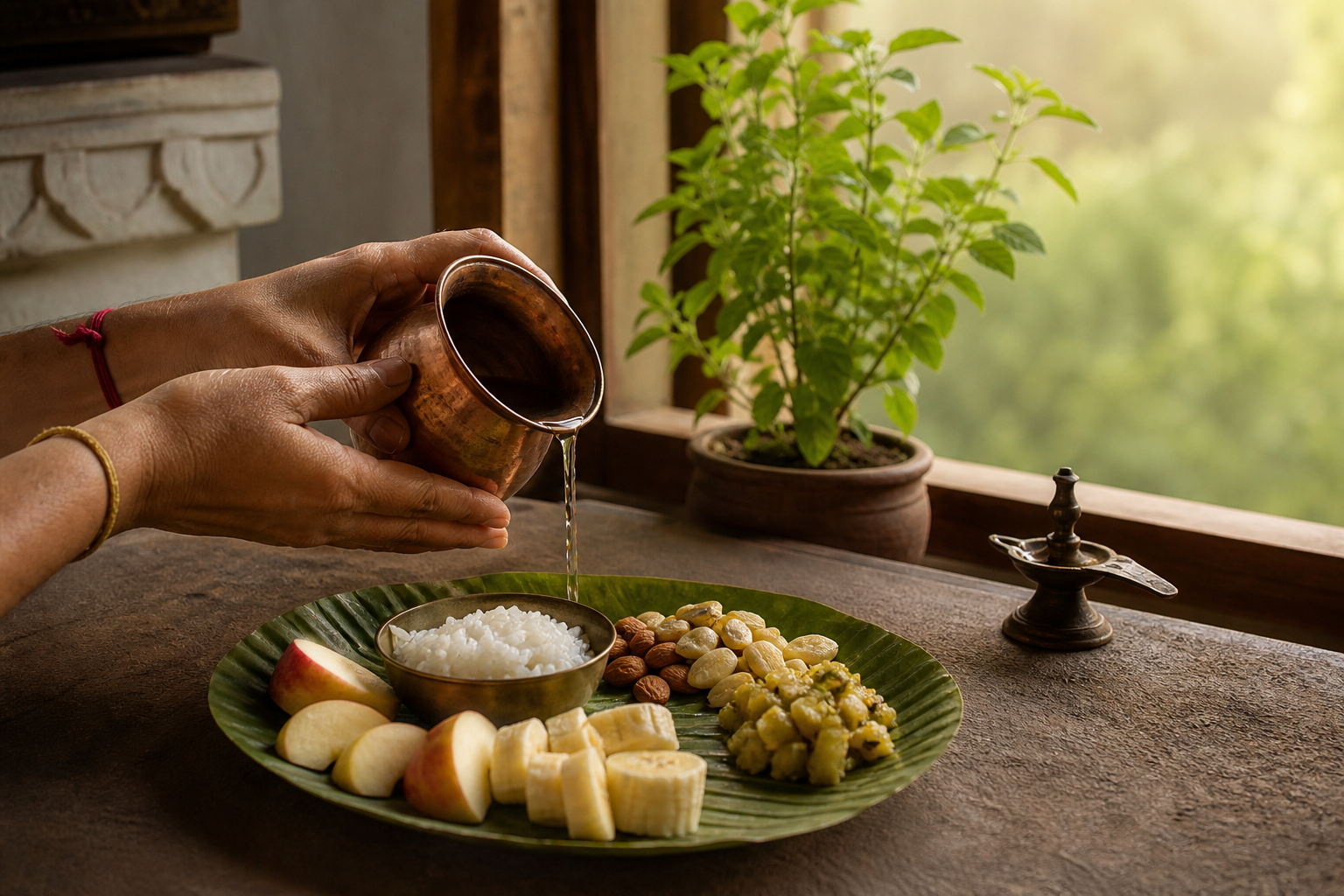
Parana is the disciplined completion of the Ekadashi fast, not merely the moment when you decide to resume eating. It is generally performed in the morning while Dwadashi is operative. Because the general Dwadashi endpoint on this date is early, you should not infer your parana time from the 5:28 AM figure alone.
- Set your trusted Panchang to the city where you will actually perform parana.
- Check the entry specifically labelled as the Ekadashi parana window. Do not substitute the displayed Dwadashi ending time for that window.
- Follow the regional or family tradition under which you began the vrata. Mixing timings from Panchangs that use different conventions can create unnecessary confusion.
- If the local entry is unclear, ask the temple or priest whose calendar you normally follow, especially when the vrata was taken with a formal sankalpa.
- Complete the observance with simple sattvic nourishment, gratitude, and steadiness rather than treating parana as an abrupt return to indulgence.
If you did not keep Ekadashi, there is no need to manufacture a Dwadashi obligation. You can still use the pre-dawn period for prayer, japa, or meditation and then let Trayodashi provide the devotional frame for the rest of the day.
How to observe the Trayodashi evening without overcomplicating it
In many regional traditions, Trayodashi at evening twilight is observed as Pradosh Vrat, with worship directed toward Shiva. The exact Pradosha window follows local sunset and must therefore be checked for your location. A timetable copied from another city may place your worship outside the locally calculated period.
If your family or sampradaya has an established procedure, follow it. If it does not, a modest home observance can still be coherent and sincere:
- Find the Pradosh period in a city-specific Panchang and protect that time from avoidable errands or entertainment.
- Prepare a clean, quiet place before twilight so that the observance does not begin in haste.
- Light a deepa and offer dhupa if these are part of your normal home practice.
- Perform the Shiva prayer, puja, mantra-japa, or meditation that you already know. Do not invent a complicated ritual from disconnected instructions.
- Carry the worship into conduct by restraining harsh speech, settling an avoidable quarrel, or completing a quiet act of seva.
The waning phase supports an inward emphasis. A short passage from the Bhagavad-Gita or an Upanishad, followed by silent reflection, is more useful than accumulating ceremonial steps you cannot perform attentively. You can also write down one habit, resentment, or neglected duty that needs to be released or corrected. The aim is not a dramatic spiritual mood; it is greater steadiness after the lamp is extinguished.
Which details require a local Panchang
The tithi transition does not establish every other element of the day’s Panchang. Nakshatra, Rashi, and shubha muhurta depend on precise local calculation. Panchangs can also differ because they apply different drik or regional rules and ayanamsha choices. Two applications showing different transition times are not necessarily describing the sky for the same place under the same settings.
Use the level of precision that matches the decision in front of you:
- For ordinary prayer, scripture study, meditation, or seva: you can proceed without waiting for a complete astrological profile. Brahma Muhurta before dawn and the local Trayodashi twilight are traditionally supportive periods.
- For Ekadashi parana: obtain the city-specific parana window, not merely the tithi name or endpoint.
- For Pradosh Vrat: confirm that your local Panchang assigns the observance to this evening and use its stated Pradosha period.
- For Nakshatra or Rashi: consult one reliable local almanac and keep its location and calculation settings consistent.
- For a samskara or formal ritual: ask a trusted regional priest or temple for the applicable muhurta rather than deriving it from Trayodashi alone.
This distinction keeps calendar accuracy in its proper place. Precise timing matters when a vrata or ritual depends on it. Compassion, self-discipline, truthful conduct, and service do not need to be postponed while you search for an auspicious minute. These values also provide a meaningful point of kinship across Hindu, Buddhist, Jain, and Sikh life even though their particular observances remain distinct.
Key takeaways for November 17, 2025
- Monday begins under Krishna Paksha Dwadashi and moves into Trayodashi at 5:28 AM in the general timing supplied for most regions.
- The 5:28 AM transition is not automatically your local Ekadashi parana time.
- If you kept Ekadashi, look for a city-specific parana window and follow the tradition under which you undertook the fast.
- Use the local sunset and twilight calculation when planning Pradosh worship.
- Do not infer Nakshatra, Rashi, or a formal shubha muhurta from the tithi alone.
- A simple deepa, dhupa, familiar prayer, japa, meditation, scriptural reflection, and restrained conduct are sufficient for a grounded home observance.
Before November 17 arrives, record only the two timings you may actually need: your local parana window if you kept Ekadashi, and your local Pradosh period if you observe the Trayodashi vrata. Then keep the practice small enough to perform with full attention and carry one part of it into your conduct the following day.
References
