

You may complete a puja, chant Naam, sit in meditation, or listen to kirtan and still carry irritation into the next conversation. A difficult desire returns. A sharp remark escapes. The sacred hour feels sincere, but ordinary life seems untouched.
Do not judge your practice only by the feeling it produces while you are doing it. A more useful test is what happens when pleasure, anger, fear, pride, or impatience makes its next demand. Devotion begins to open into inner freedom when remembrance changes that decision.
Inner freedom begins when desire stops being a command

Inner freedom does not require you to become numb, abandon your duties, or eliminate every preference. It means that an impulse can arise without automatically becoming your action. You still notice attraction and aversion, but you gain enough clarity to decide what deserves obedience.
This distinction matters because desire is not treated as an isolated enemy within the Hindu vision of life. Kama and artha have legitimate places, but they need the guidance of dharma and the larger orientation of moksha. When desire loses that guidance, achievement can multiply wants instead of satisfying them. More convenience then produces more distraction, and more acquisition produces more anxiety. The machinery improves while the mind remains bound.
Samsara can therefore be noticed before it is discussed as a vast cycle of birth and death. It is present in the smaller cycle that repeats during an ordinary day: wanting, grasping, briefly enjoying, fearing loss, and wanting again. Dharmic disciplines address this restlessness through discernment, restraint, contemplation, ethical conduct, remembrance, and service. Their methods differ, but each asks you to stop treating every movement of the mind as an instruction.
When a desire becomes insistent, ask three direct questions: Is fulfilling it consistent with dharma? What consequence will it create for another being? What habit will I strengthen by obeying it? The point is not to condemn yourself for wanting. The point is to see the whole action before the impulse narrows your field of view.
Offer character along with flowers, words, and ritual

External worship gives devotion a body. A lamp, garland, bow, mantra, or carefully prepared offering trains attention through action. Yet the outer act reaches further when it carries an inner offering into the rest of the day.
Madhvacharya’s worship, remembered in the fourteenth sarga of the Sumadhva Vijaya, joins the adornment of Lord Narayana to eight bhava pushpa, or inner flowers. These are not substitutes for temple or household worship. They show what worship is meant to cultivate in the worshipper.
| Inner flower | What to notice | A concrete offering |
|---|---|---|
| Ahimsa, non-harm | The wish to wound, humiliate, exploit, or retaliate | Refuse the needless injury while still addressing the wrong clearly. |
| Kshama, patience and forbearance | The moment a delay or mistake becomes a personal insult | Correct what needs correction without making another person carry your frustration. |
| Daya, compassion | Suffering that is easy to ignore because it is inconvenient | Give useful help without turning the recipient into a display of your goodness. |
| Shanti, inner calm | The rush to speak while anger is controlling the pace | Become steady enough to choose the next word; calm does not require pretending that no wrong occurred. |
| Tapas, disciplined effort | The urge to abandon a sound commitment when enthusiasm fades | Keep the reasonable discipline you chose without using austerity to punish yourself or others. |
| Jnana, understanding | A slogan, assumption, or emotion being mistaken for knowledge | Examine the motive and facts before repeating a claim or making a consequential choice. |
| Satya, truthfulness | The temptation to lie, conceal, exaggerate, or use truth as a weapon | Say what is accurate, necessary, and compatible with daya. |
| Indriya-nigraha, restraint of the senses | A sight, taste, sound, screen, or comfort deciding your next action by reflex | Choose when and how to engage instead of surrendering the choice to appetite. |
Use this teaching literally at your next practice. Look ahead to the friction you are likely to face and select the inner flower that meets it. If an argument is waiting, offer kshama. If you are avoiding an inconvenient truth, offer satya with daya. If distraction is consuming the attention needed for your duty, offer indriya-nigraha.
Name the action as you make your external offering: Today I will offer satya by correcting the misleading statement when the matter returns. This turns a beautiful intention into a recognizable test. When the test arrives, you will know what your worship has asked of you.
Choose a doorway without erasing the differences between paths
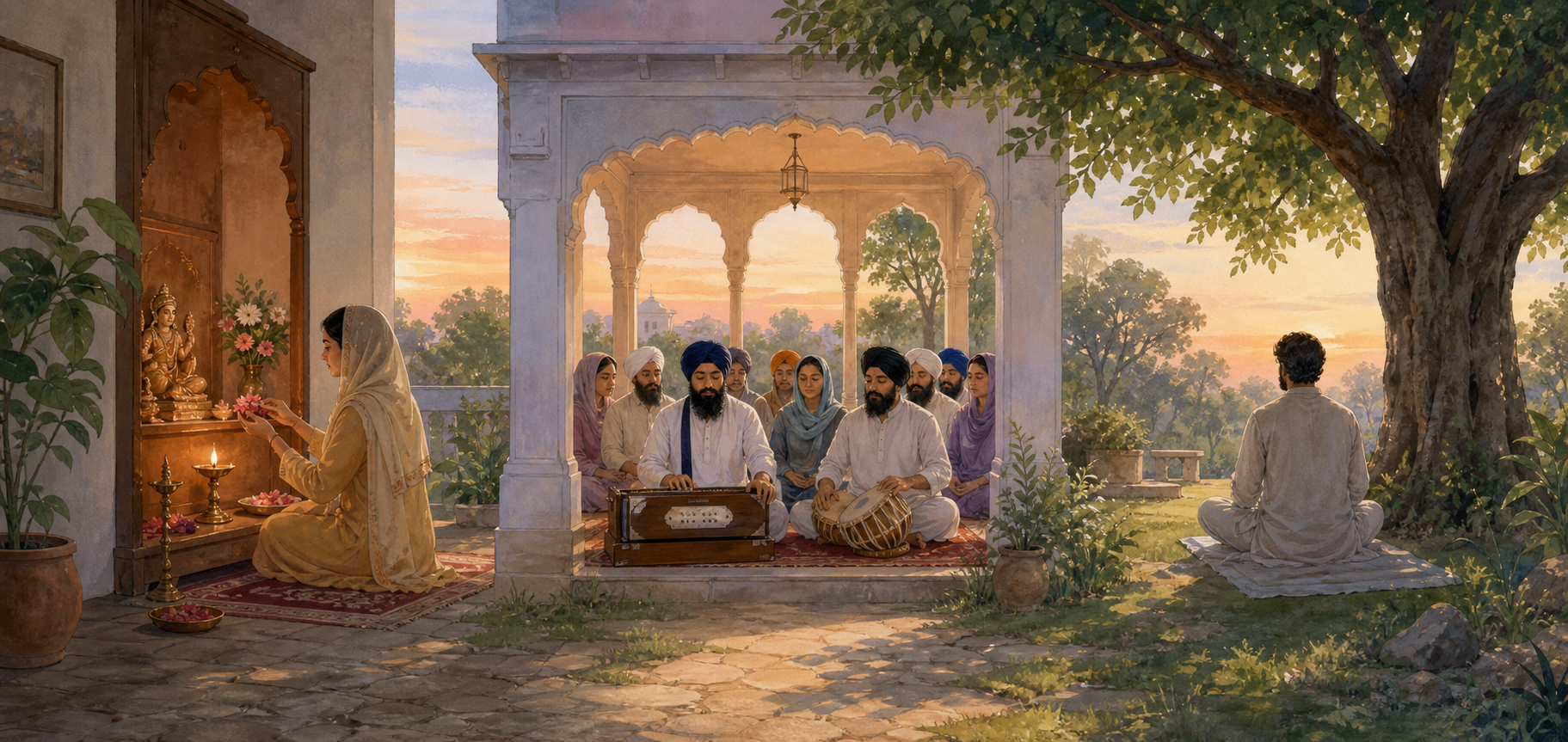
The dharmic traditions share ethical and contemplative affinities, but they do not become interchangeable because they value compassion or restraint. Hindu, Buddhist, Jain, and Sikh paths use distinct accounts of bondage, selfhood, karma, liberation, and ultimate reality. Respectful harmony does not require flattening those distinctions. It requires recognizing a shared moral seriousness while allowing each path to speak in its own spiritual grammar.
- Within Hindu practice, puja, japa, contemplation, devotion to an Ishta, viveka, vairagya, pranayama, and pratyahara can all orient desire toward dharma and moksha. If bhakti is your doorway, connect remembrance of the Divine to the virtue you will embody when the next test comes.
- Within Buddhist practice, anapanasati and insight disciplines can expose craving and reactivity, while karuna and upekkha train compassionate and balanced responses. Devotional forms also exist within Buddhist traditions, but they need not be forced into a Hindu theological frame.
- Within Jain practice, samayik, ahimsa, vows, and careful restraint direct attention toward equanimity, purification, and reduced harm. The practical question becomes precise: which available action creates less injury and less bondage?
- Within Sikh practice, Naam simran, kirtan, seva, and truthful living bring remembrance into conduct. Devotion cannot remain confined to recitation if pride, self-absorption, or indifference continues to govern your dealings with others.
The family resemblance among these meditative, devotional, ethical, and service-based disciplines gives you a basis for fellowship, not a reason to assemble a spiritual sampler. Let your own path provide the primary discipline. Let the shared virtues provide a clear test of whether you are becoming less harmful, less compulsive, more truthful, and more capable of service.
If you already belong to a living tradition, depth is usually more useful than novelty. Repeat the discipline carefully enough to discover what it demands of your character. If you are still finding your way, begin with the practice you can approach honestly and consistently rather than borrowing the most attractive feature of every path at once.
Build a daily loop that survives work, family, and distraction
A practice becomes durable when it is attached to moments that already occur. You do not need to wait for an ideal retreat, a silent house, or an uninterrupted mood. Use a simple loop that carries the sacred anchor into a foreseeable choice.
- Begin with remembrance. At your first intentional pause, turn toward your Ishta, Naam, mantra, breath, or established contemplative object. Do the practice your path actually gives you, not merely the one that feels easiest that morning.
- Predict the test. Identify where desire, anger, fear, pride, or distraction is most likely to govern you. Name an event, not a vague aspiration: the difficult message, the tempting purchase, the family disagreement, the neglected duty, or the screen you open without deciding to.
- Select the inner offering. Match the test to ahimsa, kshama, daya, shanti, tapas, jnana, satya, or indriya-nigraha. State the link plainly: When this trigger occurs, I will offer this virtue through this action.
- Interrupt the reflex. When the trigger arrives, take a conscious breath and ask what you are about to serve. This brief recollection is the hinge between ritual and freedom. You may still feel the impulse strongly; the victory is recovering the ability to choose.
- Turn remembrance into duty or seva. Complete the required action. Tell the truth, restrain the harmful response, finish the neglected responsibility, or help where help is genuinely needed. Inner freedom becomes visible through conduct, not through private self-description.
- Review and repair. At the close of the day, identify where you remembered and where compulsion took over. Repair a concrete injury when possible: correct the falsehood, acknowledge the harshness, return what was wrongly taken, or complete the duty you evaded. Then carry the unfinished inner flower back into practice.
This loop prevents two common separations. The first is devotion without ethical change: the sacred act is performed, but its demand is left at the altar. The second is self-discipline without devotion: conduct becomes a project of pride, control, or self-condemnation. Remembrance gives discipline its center; disciplined conduct gives remembrance a place to become real.
Measure devotion by what gradually loses its grip

A moving experience in prayer, worship, meditation, or kirtan may be sincere and valuable. It does not, by itself, show that a binding habit has weakened. The more demanding evidence appears under pressure: how quickly you notice the impulse, whether you can postpone gratification, whether truth survives inconvenience, and whether you repair harm without protecting your pride.
Do not turn this examination into another form of ahankara. Spiritual bookkeeping can become self-congratulation when the day goes well and self-hatred when it does not. Both keep attention fixed on an image of yourself. The useful question is simpler: what must be seen, offered, corrected, and practised now?
Key takeaways
- Inner freedom appears in the space between an impulse and your response, not in the permanent absence of desire.
- Keep one primary spiritual discipline as your home base; respect other dharmic paths without collapsing their teachings into a single system.
- Pair each sacred practice with an inner flower and a foreseeable real-world trigger.
- Look for change where it costs something: truthfulness, non-harm, restraint, patience, compassion, disciplined duty, and service without recognition.
- After a lapse, repair what can be repaired and return to practice. Guilt that produces no correction is not an offering.
At your next prayer, puja, recitation, or meditation, do not ask for a perfect inner state. Choose the inner flower your day will require and name the decision through which you will offer it. The next moment of friction will then become part of the path rather than an interruption of it.
References
- DharmaRenaissance Blog – Eight Extraordinary Flowers of Bhava: Madhvacharya’s Devotion and Dharmic Harmony
- DharmaRenaissance Blog – Life as Transmigration: Profound Hindu Wisdom on Samsara, Desire, and Inner Freedom
