

If a message about the Greater Noida arrest has reached your family, neighbourhood, or temple group, your first decision is not whether to be angry. It is whether you know enough to describe the case truthfully.
The allegations deserve serious scrutiny because they concern a large suspected financial offence, undocumented migrants, and possible hostility toward Hindus. But seriousness does not reduce the need for precision. You can demand protection for Hindus, a rigorous investigation, and proportionate punishment for proven wrongdoing without converting allegations against one person into a verdict against an entire community.
What the arrest establishes, and what it does not

Police in Greater Noida arrested an individual in connection with an alleged Rs 11 crore money-laundering scheme. Additional allegations concern housing undocumented migrants and circulating material that may incite hostility against Hindus. The investigation remains ongoing, so these claims have not yet become proven findings.
That procedural distinction matters. An arrest confirms that police have acted; it does not confirm that every allegation is true. An investigation seeks and tests evidence; it is not a conviction. Even when one part of a case appears strong, it does not automatically prove every other part.
Keep the accusations in three separate lanes: the alleged financial transactions, the alleged housing of undocumented migrants, and the alleged circulation of anti-Hindu material. Each lane requires its own evidence. A disputed message cannot establish a financial trail, and evidence of suspicious money movement cannot authenticate a message or prove the status of people staying at a property.
Several consequential questions therefore remain open: Who controlled the money? What records connect the accused to it? Has the migration status of the people allegedly housed there been verified? Is the disputed material authentic, attributable to the accused, and presented in its full context? Until those questions are answered through evidence, do not fill the gaps with assumptions supplied by a viral caption.
Defend Hindu safety without accepting collective guilt
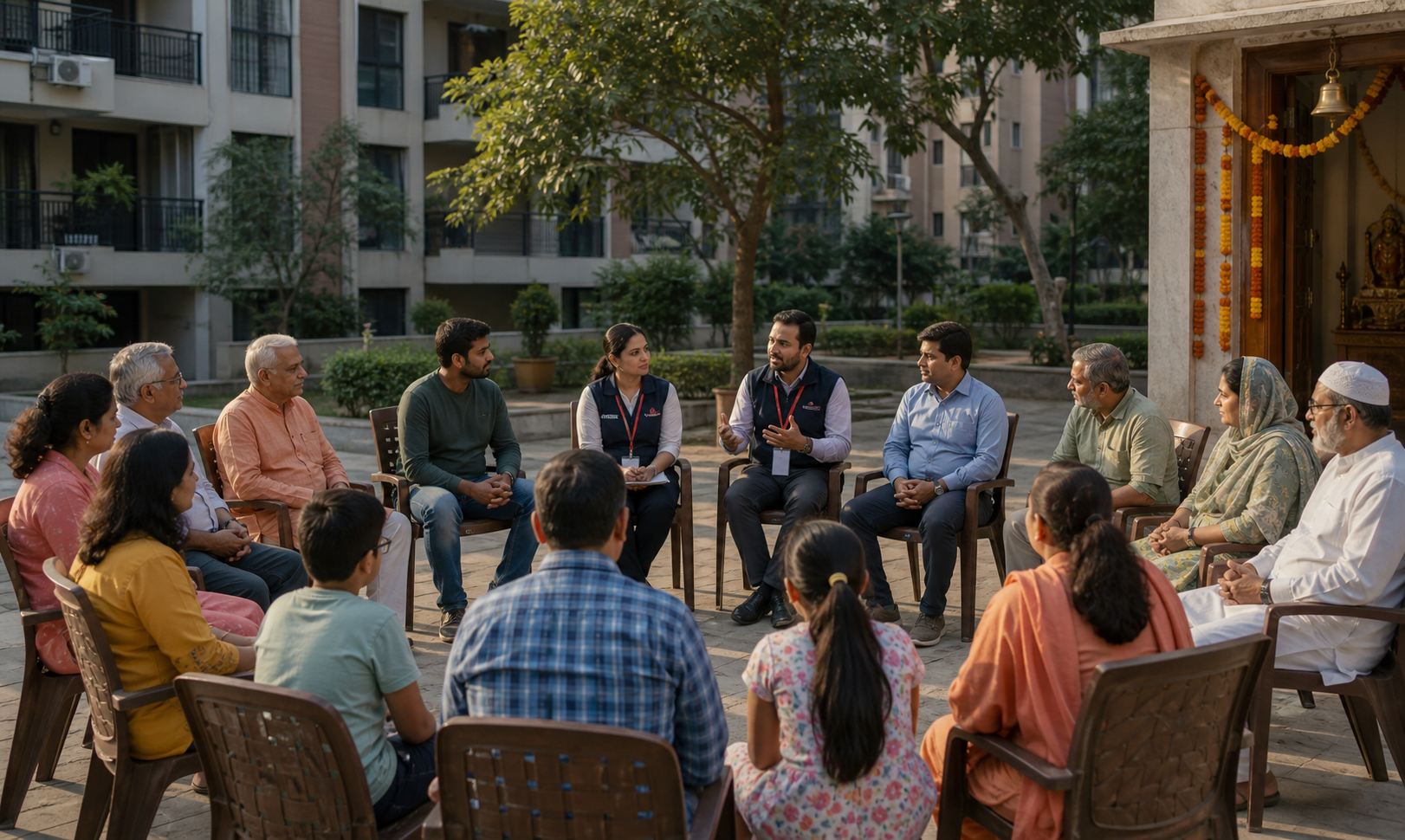
Concern about anti-Hindu incitement is legitimate. Hindus should not be expected to dismiss threats, targeted hostility, or organised propaganda merely to appear conciliatory. If the material is authenticated and its distribution is proved, the people responsible should face impartial legal accountability.
There is an equally important boundary: the Muslim identity of an accused person is not evidence against Muslims as a class. Identity becomes relevant to the case only when evidence connects it to motive, organisation, recruitment, funding, or targeting. Repeating the accused’s religion without making that evidentiary connection turns identity into insinuation.
Two failures often reinforce each other during a communal controversy. One side minimises possible hostility toward Hindus before examining the material. Another side treats the allegation as permission to accuse unrelated Muslim neighbours, workers, or families. The first response denies a possible wrong; the second creates new wrongs and makes the original case harder to discuss honestly.
A pro-Hindu civic standard should be firmer than either shortcut: document anti-Hindu targeting, demand that authorities investigate it, insist on transparent adjudication, and refuse claims that outrun the evidence. Equal protection is not collective revenge. It is the assurance that an offence against Hindus will be treated seriously under the same rules that protect every citizen.
This is also where Dharmic ethics become practical rather than ornamental. Satya requires accuracy even when an exaggerated claim appears politically useful. Ahimsa prohibits turning suspicion into harm against uninvolved people. Compassion does not cancel accountability; it sets a boundary around whom accountability may justly reach. Hindu, Buddhist, Jain, and Sikh traditions express these duties differently, but none requires passivity in the face of wrongdoing or indulgence toward falsehood.
Use a five-step test before forwarding any claim

A tense case rarely reaches you as a clean statement of verified facts. It arrives as a bundle: a headline, a cropped image, an angry caption, and conclusions about an entire community. Before you forward it, run the message through this test.
- Name the procedural stage. Use “arrested” or “under investigation” where that is all that has occurred. Do not replace those words with “proved,” “guilty,” or “convicted.”
- Separate the bundled allegations. Ask what specifically supports the financial allegation, the migration allegation, and the anti-Hindu-content allegation. Corroboration of one claim does not validate the other two.
- Inspect what the evidence can actually show. A screenshot may establish that certain words appeared on a screen, but not necessarily who created them, when they were published, or whether context was removed. Look for the original account, full text, date, and surrounding material before attributing it.
- Test whether identity is doing the work of evidence. Remove the words “Hindu” and “Muslim” from the sentence. If the factual claim collapses, the message may be using communal identity to bridge an evidentiary gap. Restore identity only when it is necessary to describe a verified target, motive, or relationship.
- Share the smallest defensible statement. At this stage, a careful formulation is: “Police in Greater Noida arrested an individual in connection with an alleged Rs 11 crore laundering case; additional allegations remain under investigation.” Add further details only when you can verify them independently.
If you discover that something you forwarded was false or overstated, correct it in the same group and with comparable visibility. Quietly deleting a message does not reach the people who already read or copied it. A direct correction protects your credibility and interrupts the rumour’s next round.
Act carefully if the tension reaches your community

Online discipline is important, but local tension can create immediate safety and legal risks. If a message contains a direct threat, preserve the original URL, account name, complete screenshot, and visible date or time. Keep the uncropped file. Report credible threats to the platform and the appropriate authorities rather than summoning an online crowd.
Do not publish an address, telephone number, identity document, or family details merely because someone claims that undocumented migrants are staying at a location. Do not visit the property, organise a confrontation, or pressure neighbours to identify residents. If you have concrete information, give it privately to the authorities or obtain advice from a qualified lawyer. Public accusations can endanger uninvolved people, contaminate evidence, and create legal exposure for the person making them.
If danger appears imminent, contact local emergency authorities. A neighbourhood or messaging group is not an emergency-response system, and a crowd attracted by a forwarded allegation can make the situation less safe.
Community and temple-group administrators can reduce escalation with a simple rule: no communal accusation without a traceable link and clear procedural language. Temporarily restrict posting if threats, addresses, or unverified identities begin circulating. Designate one administrator to post verified case updates so that members are not interpreting dozens of competing forwards.
When officials provide an update, ask narrow questions. Which allegation is being addressed? What evidence has been authenticated? What remains disputed? Has any claim been withdrawn or corrected? These questions keep attention on state performance and individual responsibility instead of inviting a contest over which community can produce the angriest narrative.
Key takeaways
- An arrest warrants scrutiny, but it is not a finding of guilt.
- The laundering, migration, and anti-Hindu-content allegations must each be proved with evidence specific to that claim.
- Possible incitement against Hindus should be documented and investigated seriously, not dismissed for the sake of superficial harmony.
- The accused person’s religious identity does not justify suspicion of unrelated members of that religion.
- Preserve and report direct threats; do not dox people, organise confrontations, or turn an allegation into a crowd action.
- If a claim is disproved, correct it as publicly as you first shared it.
For the next development in this case, ask one question before reacting: what has moved from allegation to verified evidence? If the answer is nothing, your vocabulary should not move either. Calm vigilance gives Hindus more protection than careless outrage because it keeps attention on real threats, credible evidence, and accountable institutions.
References
