
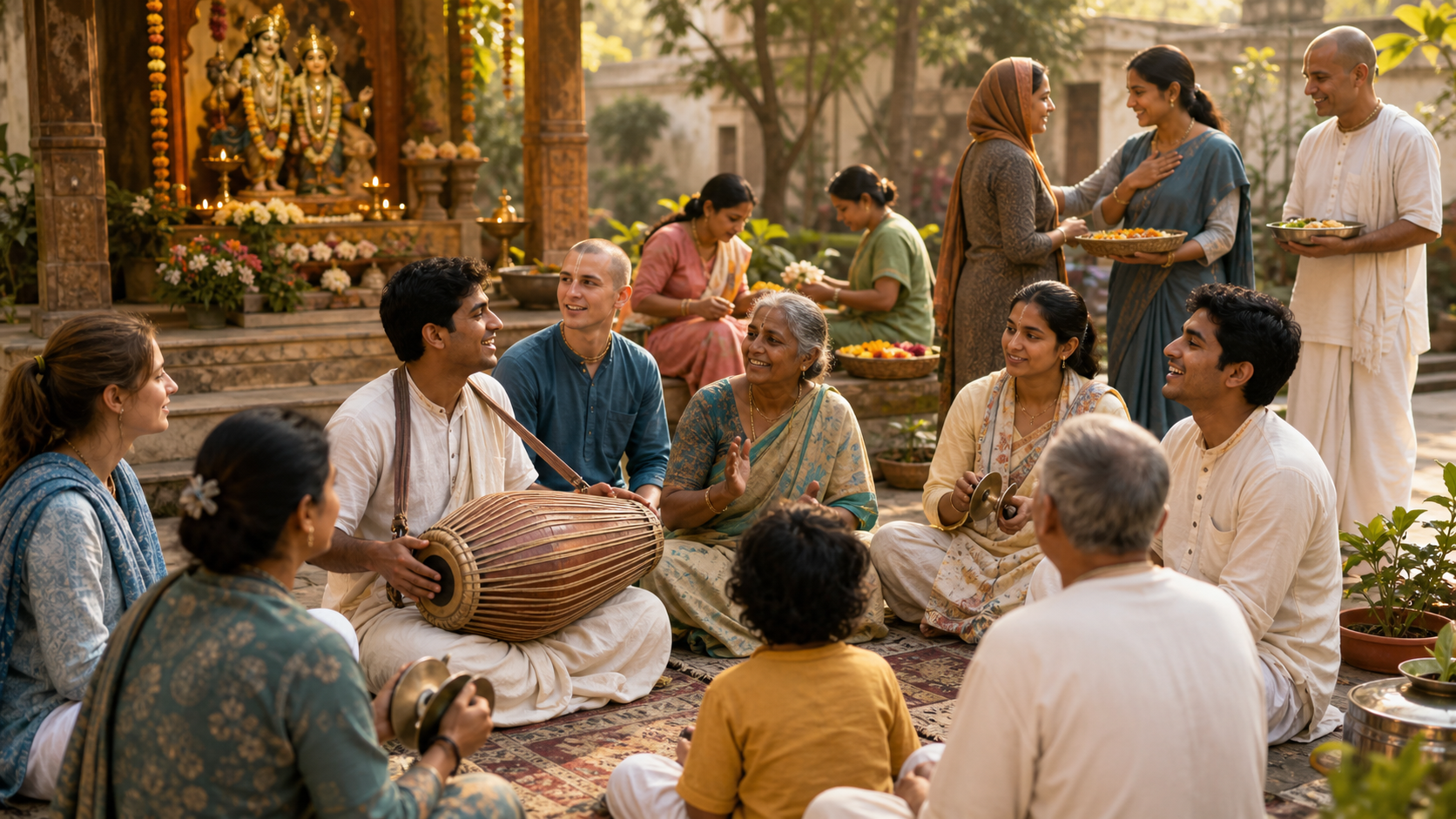
You may know Krishna, the Hare Krishna chant, or an ISKCON gathering and still wonder what Gaudiya Vaishnavism actually asks you to believe and do. The clearest answer is practical: it asks you to understand yourself in relation to Krishna, then cultivate that relationship through sacred sound, scriptural reflection, service, ethical conduct, and devotional community.
If you are deciding whether to explore this path, keep three questions in view. What makes its theology distinct? What does devotion look like after the music stops? And how can you tell the difference between a sustainable spiritual discipline and a passing emotional high?
Gaudiya Vaishnavism grew from Bengal’s bhakti renewal
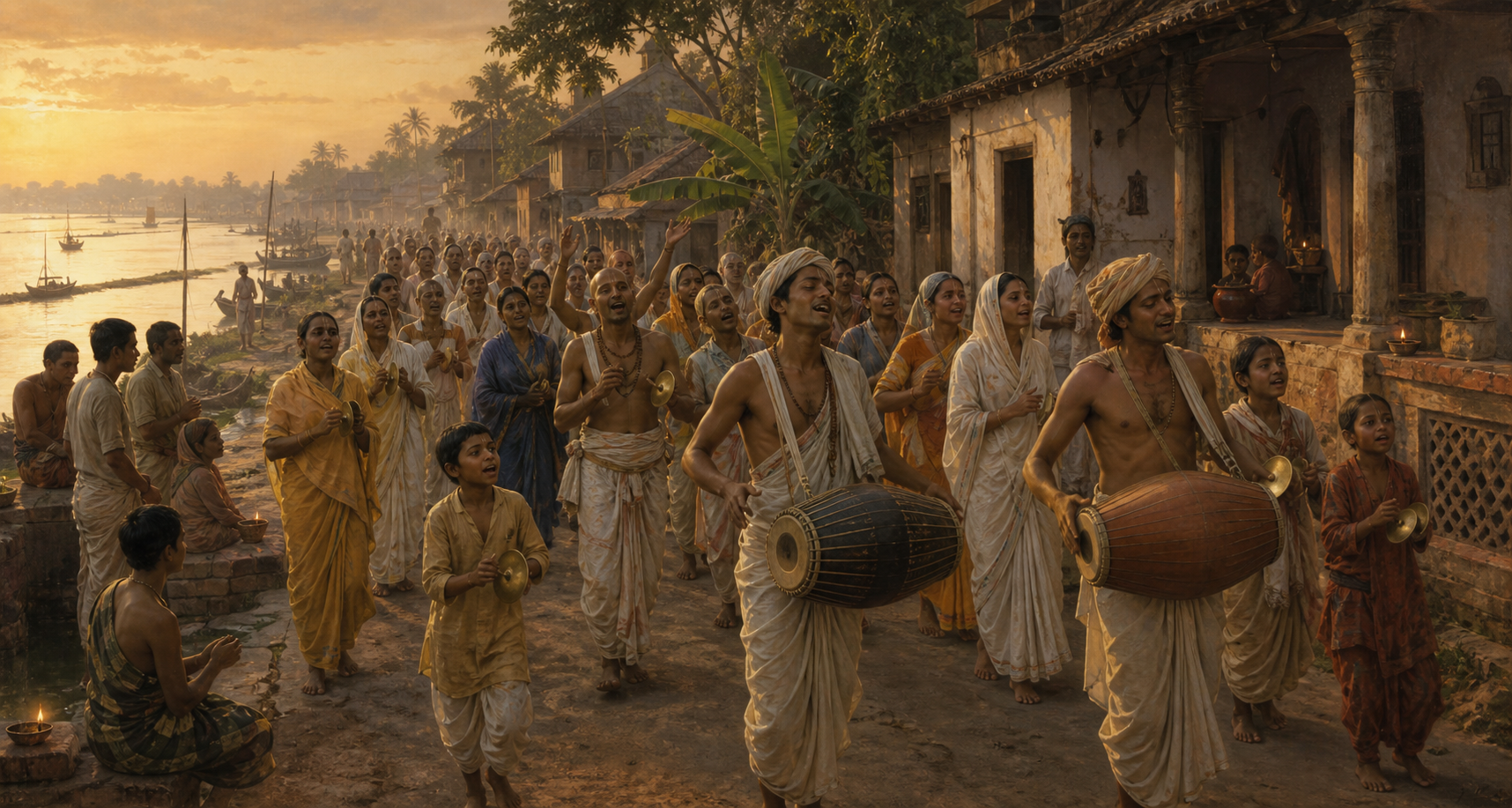
Gaudiya Vaishnavism took recognizable shape in the devotional culture surrounding Chaitanya Mahaprabhu in Bengal. It belonged to the wider bhakti resurgence that unfolded roughly from the eleventh through sixteenth centuries, but it developed a distinctive combination of Krishna-centered theology, congregational chanting, intimate devotional feeling, scriptural study, and public participation.
Chaitanya did not stand alone. Advaita Acharya, an elder contemporary, helped prepare the devotional ground in Santipur and Navadvipa. He united study of the Bhagavad Gita and Bhagavata Purana with prayer, hospitality, sankirtana, and ordinary household responsibilities. Nityananda likewise became central to the movement’s public and compassionate character. This matters because Gaudiya devotion was never intended to be only a private emotion or a specialist’s philosophy. Its early social form joined learning, worship, shared food, outreach, and community.
Gaudiya memory describes Advaita worshipping with Tulasi and Ganga water and appealing so intensely for divine intervention that Chaitanya descended in response. You do not have to confuse devotional testimony with a modern historical claim. Read the account on its own theological register: the suffering of the world calls for more than detached observation, and the devotee answers by praying, serving, teaching, and gathering others around the Divine Name.
That origin corrects two common misreadings. Gaudiya Vaishnavism is not anti-intellectual emotionalism, because scripture and theological reasoning anchor its devotion. It is also larger than any one modern institution. ISKCON can be a person’s doorway into Gaudiya practice, as campus chanting, discussion, prasad, and fellowship have been for seekers, but an institution and the entire tradition are not synonyms.
Acintya-bheda-abheda makes relationship the center

The compact theological key is acintya-bheda-abheda: inconceivable simultaneous difference and non-difference. Krishna is the supreme personal reality. The individual soul is truly related to Krishna and dependent upon Krishna, yet the soul is not reduced to an illusion or erased into undifferentiated identity. Difference is real, and connection is real.
The word acintya, or inconceivable, does not prohibit thought. It marks the point at which a finite conceptual model cannot exhaust divine reality. Gaudiya theology therefore resists two reductions at once: Krishna and the soul are not entirely separate, but neither are they simply interchangeable. The point of holding both truths together is not to win a metaphysical puzzle. It is to preserve the possibility of love. Relationship requires genuine connection as well as a genuine lover and beloved.
- Krishna remains personal. The Divine is not merely an impersonal force onto which devotees project human feeling.
- The soul remains a participant. Spiritual fulfillment does not require the devotee’s distinctiveness to become meaningless.
- Bhakti is more than an instrument. Devotion is not performed only to obtain calm, merit, liberation, status, or extraordinary experience. Loving service is itself the fulfillment being sought.
- The world becomes a field of relationship. Daily obligations, speech, food, learning, and service can all be oriented toward remembrance rather than divided into sacred and spiritually irrelevant compartments.
This theology gives Goloka Vrindavan its importance. The goal is pictured not as anonymous escape but as perfected relationship with Krishna. The Brajvasis, Nanda, and Gopa Kumara embody a devotion so absorbing that longing, guidance, intimacy, and even silence become forms of remembrance. Krishna’s relationships are therefore not decorative episodes around an abstract doctrine. They disclose what ultimate fulfillment means within the tradition.
When you hear a Gaudiya teaching, use three questions to keep its center clear. Does Krishna remain someone to know, remember, love, and serve? Does the soul remain a real participant in that relationship? Is bhakti being treated as the goal, or only as a technique for getting something else? Those questions will tell you more than unfamiliar vocabulary alone.
Sacred sound becomes credible through a complete practice
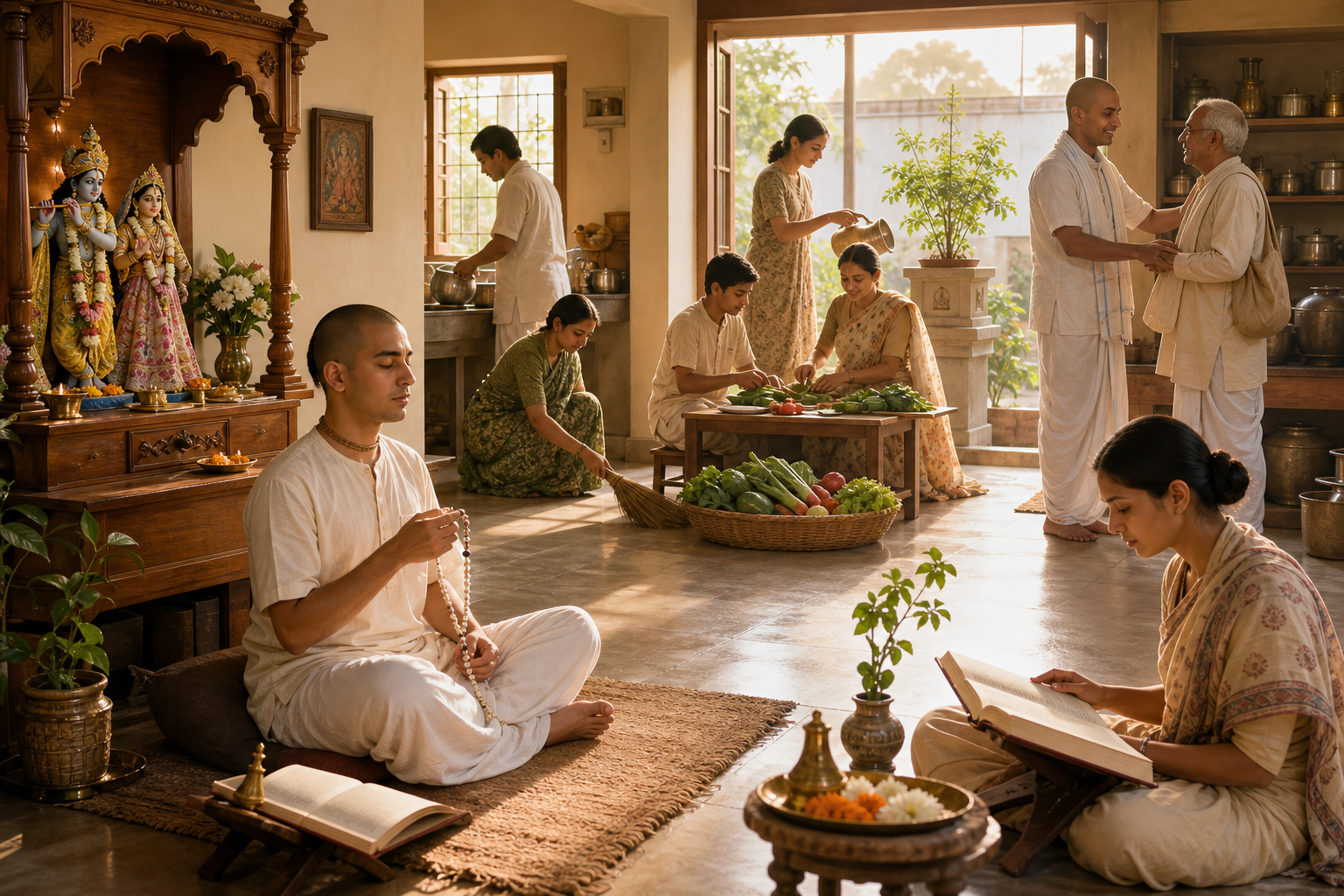
The best-known Gaudiya practice is remembrance through the Divine Names. Japa is personal repetition, usually undertaken quietly and attentively. Sankirtana is shared chanting, often in a musical call-and-response form. The two practices support different needs. Japa reveals how readily your attention wanders; sankirtana lets a community carry the rhythm of remembrance together.
Chanting can steady attention and soften agitation, but Gaudiya practice does not stop at a pleasant state. Sacred sound belongs beside scripture, satsang, prasad, seva, and ethical responsibility. If the chant feels uplifting while your speech becomes harsher, your duties become less reliable, or your concern for others contracts, the experience has not yet matured into the kind of bhakti the discipline is meant to cultivate.
A sustainable daily rule
- Choose a dependable cue. Attach a brief period of japa to something that already happens each day, such as waking, bathing, or settling before evening study. Consistency is more useful than choosing an ambitious routine you repeatedly abandon.
- Listen instead of racing. Give attention to each repetition of the Hare Krishna mantra. When the mind wanders, return to the sound without turning distraction into self-condemnation.
- Read a small unit of scripture. Use the Bhagavad Gita or Bhagavata Purana to give intellectual and ethical shape to the devotion. Stop after one passage if that is all you can reflect on honestly.
- Convert remembrance into one act. Complete a specific duty, offer practical help, share food, or correct an avoidable harshness in your conduct. This keeps seva concrete.
- Join others regularly. Kirtan, satsang, guidance from experienced practitioners, and shared prasad prevent private practice from becoming isolated or entirely self-interpreted.
Do not use intensity as your main measure. A loud kirtan can be sincere, and quiet japa can be distracted. The reverse can also be true. Look instead for a longer arc: are you remembering Krishna more readily, carrying responsibilities more carefully, recovering from distraction more honestly, and becoming more available for service?
This also explains why household life was important to the early devotional culture. A home can become a place of study, chanting, hospitality, shared meals, and service. You do not need to wait for a retreat, temple visit, or unusually elevated mood before bringing bhakti into the day already in front of you.
Choose community by its conduct, not its atmosphere alone
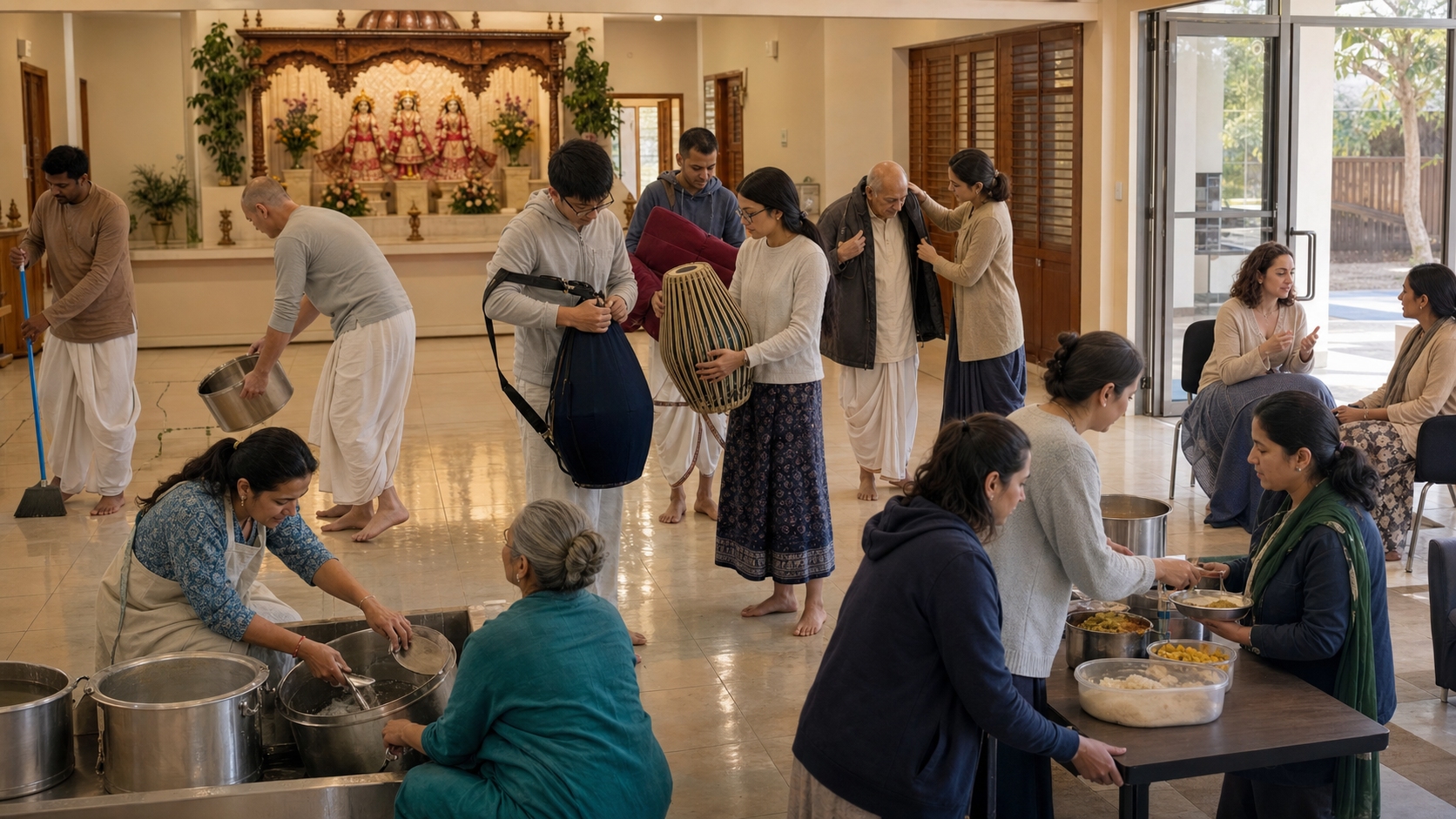
Music, welcome, and prasad can make a first gathering memorable. They are not enough by themselves to establish trustworthy guidance. Before committing deeply to a teacher or community, notice what the group produces when no performance is underway.
- Scripture and practice remain connected. The Bhagavad Gita and Bhagavata Purana are studied rather than used only as sources of isolated slogans.
- Questions are permitted. A sound guide can explain a teaching, distinguish doctrine from custom, and admit when an issue needs further study.
- Service is visible. Hospitality, kindness, responsible work, and care for community accompany claims about elevated devotion.
- Household duties retain dignity. Family life and honest obligations are not dismissed as spiritually worthless merely because they are ordinary.
- Access is not restricted by social background. The public character of sankirtana loses its meaning if participation becomes a tool for humiliation or exclusion.
- Emotion is not coerced. Singing, tears, stillness, and silence may all occur, but no display should be demanded as proof of realization.
- Particular devotion does not require casual contempt. Commitment to Krishna can be definite without turning every encounter with another Dharmic path into a contest.
The last point needs precision. Gaudiya japa and kirtan can be compared with Naam Simran in Sikhism, mantra recitation in Buddhist traditions, or concentrated remembrance in Jain discipline because each gives attention an ethical and spiritual direction. That is a family resemblance in practice, not proof that their doctrines, goals, or understandings of ultimate reality are identical. Respect becomes stronger when difference is acknowledged accurately.
The same precision applies within Hindu traditions. You may approach a Gaudiya community with an existing Ishta or inherited practice. Honest guidance should help you understand what a specifically Krishna-centered commitment entails rather than pressuring you to pretend that meaningful differences do not exist. Inclusion is not vagueness; it is the ability to explain conviction without hostility.
Nor should you assume that visible ecstasy is the highest or only sign of devotion. Gaudiya depictions of the Brajvasis include a fullness in which speech itself falters. That image is a useful safeguard: profound remembrance may sing, serve, tremble, wait, or fall silent. You cannot reliably rank inner realization by outward volume.
Key takeaways for beginning without confusion
- Gaudiya Vaishnavism arose within Bengal’s bhakti culture around Chaitanya, with Advaita Acharya and Nityananda helping establish its scriptural, communal, and public character.
- Acintya-bheda-abheda holds unity and difference together so that the soul’s eternal relationship with Krishna remains meaningful.
- Bhakti is not merely a technique for calm or liberation; loving remembrance and service are themselves central to the goal.
- Japa, sankirtana, scripture, satsang, prasad, ethical conduct, and seva work as a connected discipline rather than interchangeable spiritual accessories.
- A healthy community can sustain conviction, questions, household responsibility, inclusion, and respect without demanding theatrical emotion or contempt for other paths.
For the next seven days, keep one repeatable triad: a brief period of attentive japa, one small passage from the Bhagavad Gita or Bhagavata Purana, and one deliberate act of service. At the end of the week, do not ask whether every session felt extraordinary. Ask whether remembrance became easier to return to and whether it made your conduct more responsible. Then attend one kirtan or satsang and evaluate the community by the same standard. That is a modest beginning, but it places theology, practice, and daily life on the same path.
References
- DharmaRenaissance Blog – Advaitacharya and the Bhakti Renaissance: Devotion’s Unifying Power Across Traditions
- Dandavats – Journey to Goloka Vrindavan: Transformative Bhakti, Silent Ecstasy, and Dharmic Unity
- Dandavats – From Familiarity to Krishna Consciousness: How a Mystical Chant Sparked Lasting Hope
