
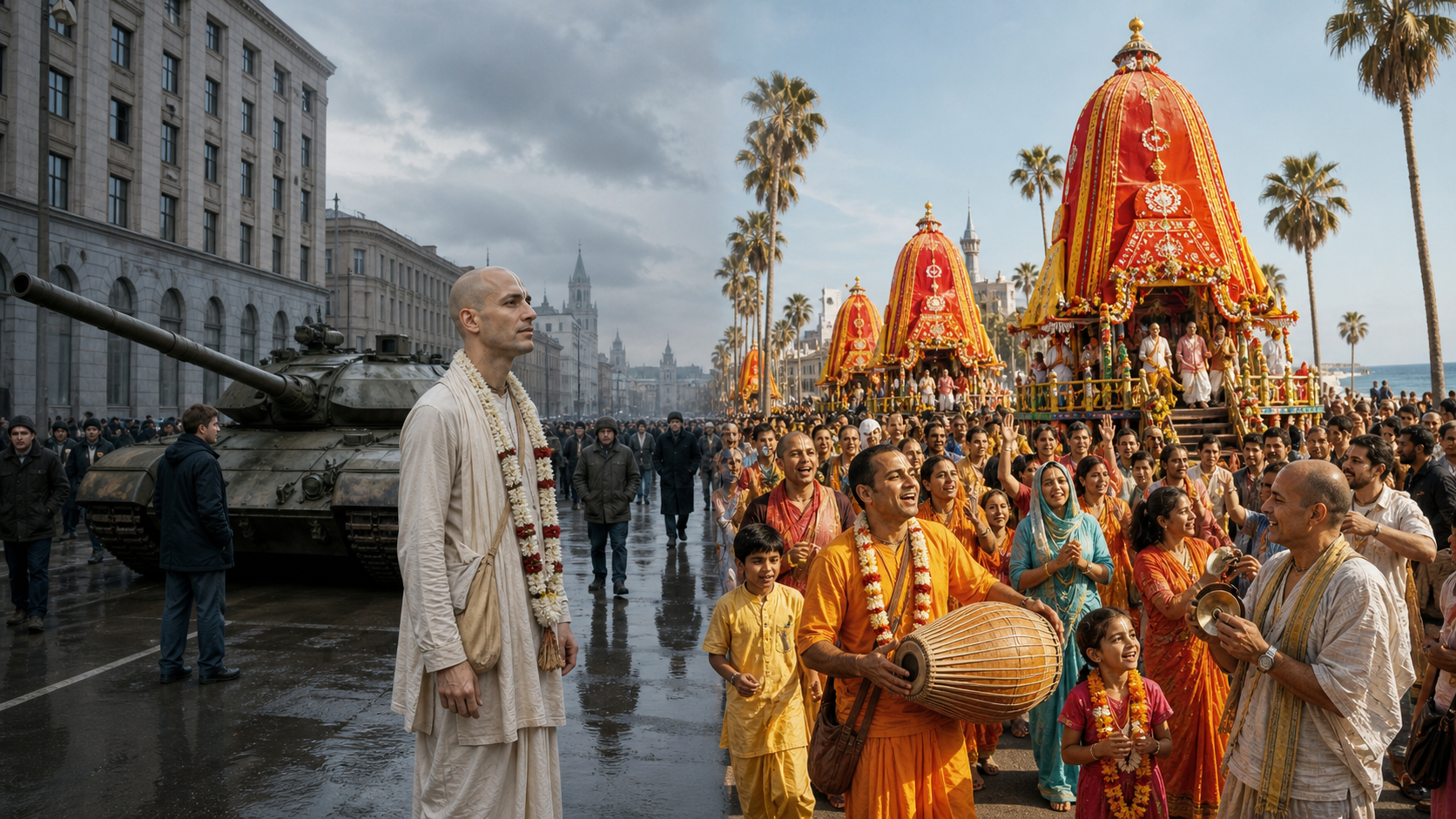
If you know ISKCON mainly through cheerful chariot processions, place two public moments beside each other. On one street, a devotee poses against a Soviet tank during the August 1991 coup in Moscow. Nearly 35 years later, thousands gather around Lord Jagannatha’s chariots in Los Angeles.
The connection isn’t a claim that one event caused the other. It is a lesson about public dharma: a devotional tradition can remain recognizably itself under radically different conditions. You don’t have to romanticize danger or equate a large crowd with spiritual success to see what that continuity requires.
Moscow: a devotee in a street claimed by political power
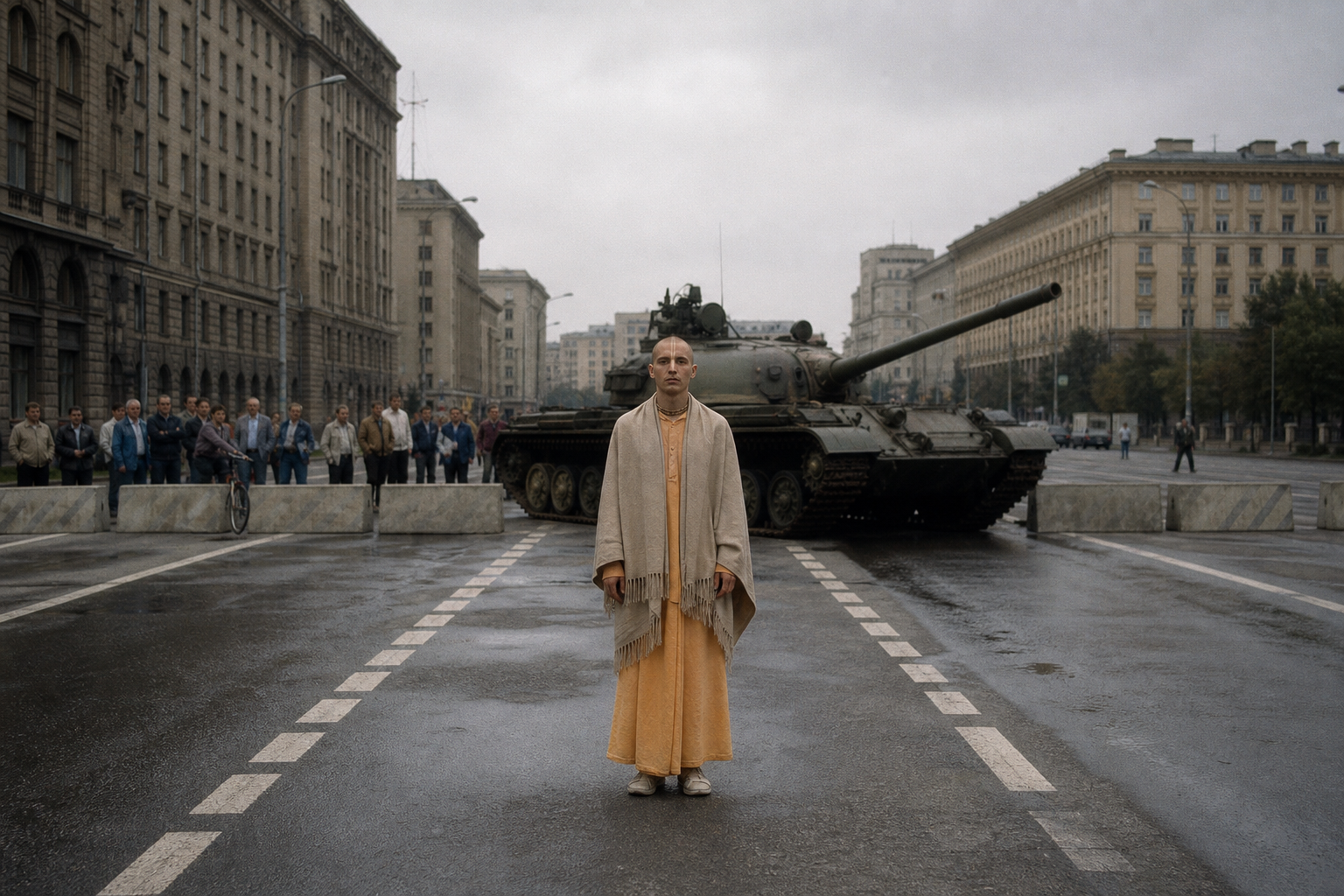
On August 20, 1991, Kirtiraj Das and Haripuja were in Moscow after traveling from Sweden to Leningrad, now St. Petersburg, for the city’s first Jagannatha Rathayatra. They reached Moscow by overnight train and learned from local devotees that a coup had removed Mikhail Gorbachev from the Soviet presidency and placed the country under military control.
The first reaction wasn’t heroic theater. The two householders worried about whether they would see their children, who had remained in Sweden, again. That detail matters. Courage is easily distorted when fear and family obligations are edited out of the story.
At the Moscow temple, they joined Niranjana Maharaja, Krishna Kaumara Dasa and Vaidyanatha Dasa, who later became Bhakti Vijnana Maharaja. The Moscow Society for Krishna Consciousness had only recently been registered by the Soviet government. A BBC broadcast carried unconfirmed reports of tanks near the Kremlin, so the devotees went toward Red Square to see the situation for themselves.
Tverskaya Street, a broad avenue leading toward Red Square, had been closed to ordinary traffic. The group passed several police checkpoints by saying that they needed to reach the National Hotel. The hotel was not actually theirs; it mattered to them because A.C. Bhaktivedanta Swami Prabhupada had stayed there during his visit to Moscow about 20 years earlier.
Near the hotel, the devotees found tanks waiting on a side street and Muscovites confronting the soldiers. Some older women struck the tanks with their umbrellas. Kirtiraj leaned against one vehicle as though he were holding it back, creating the photograph that now carries the scene beyond its original moment.
Read the pose literally and it becomes absurd: one person cannot stop a tank with his hands. Read it as public witness and its meaning sharpens. An unarmed devotee stood visibly in a place dominated by machinery, checkpoints and political uncertainty. He didn’t become powerful by imitating the state. He remained identifiable as a devotee.
That distinction should govern how you retell the episode. Don’t say that a Hare Krishna devotee stopped a Soviet tank. Say that he made a symbolic pose beside one while citizens confronted soldiers during the coup. Accurate memory is more durable than an inflated legend.
Nor should the scene be treated as a general instruction to approach military vehicles or cross security lines. Its value lies in the documented human decision to remain present, not in turning a dangerous and highly specific situation into a devotional stunt.
Los Angeles: public devotion becomes recurring civic memory
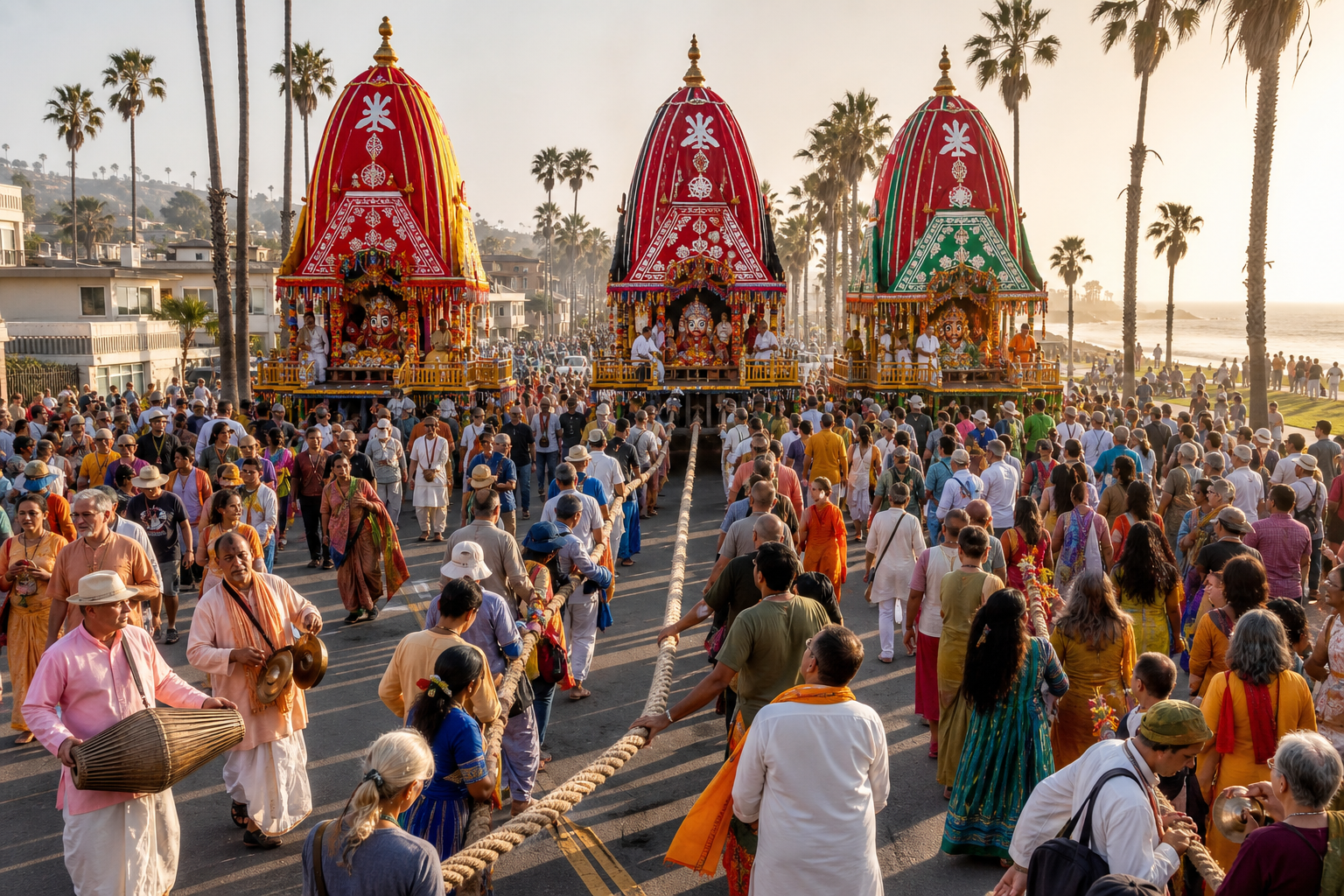
The Los Angeles scene belongs to a different social world. On August 2, 2026, ISKCON New Dvaraka held its 50th annual Festival of the Chariots. Thousands of devotees and visitors lined the streets of Santa Monica and Venice as Lord Jagannatha, Lord Baladeva and Subhadra Devi appeared in procession.
Here, visibility works through repetition rather than sudden confrontation. An annual procession can become part of a city’s remembered rhythm. Devotees know what they are returning to, organizers can prepare a public route, and visitors can encounter a Dharmic tradition through a concrete act of worship rather than an abstract description.
The phrase “Festival of the Chariots” helps a new visitor recognize the form, but the names of the Deities preserve its center. This isn’t simply a parade that happens to use Indian imagery. It is Rathayatra: Lord Jagannatha, accompanied by Lord Baladeva and Subhadra Devi, comes into public view. Accessibility doesn’t require anonymity.
A 50th annual celebration also gives you a better measure of cultural strength than a single day’s attendance. Thousands along a route demonstrate reach, but repetition demonstrates transmission. A tradition becomes part of public memory when people receive it, preserve its identity and bring it forward again.
The continuity is devotional, not theatrical
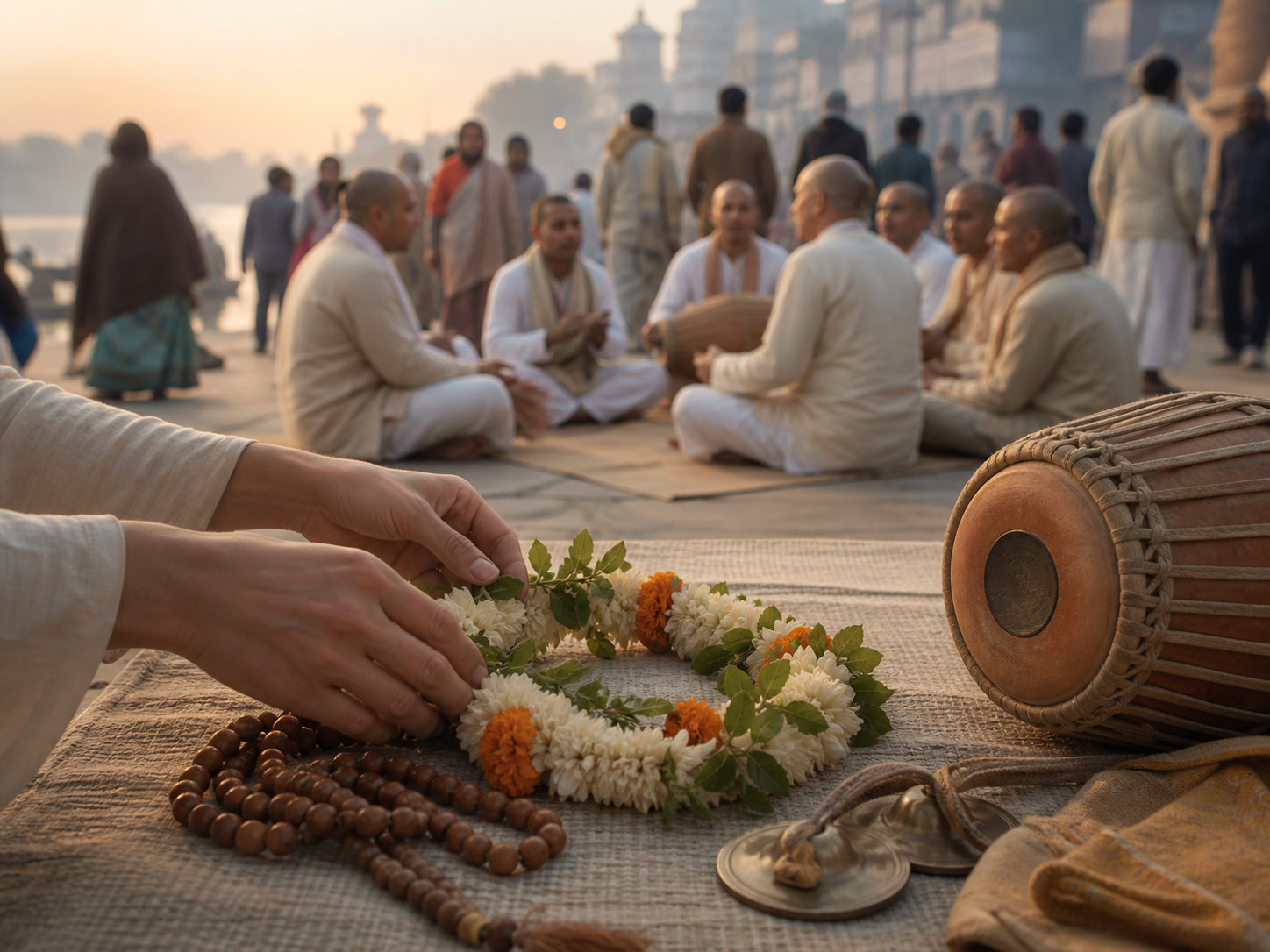
Moscow and Los Angeles shouldn’t be flattened into equivalent scenes. One occurred amid a political emergency and military deployment. The other was a large recurring festival. Their relationship lies in two different modes of public witness: presence under uncertainty and celebration through continuity.
Public witness means making a religious commitment visible in shared space through conduct, symbols and worship. It is more demanding than publicity. Publicity asks whether people noticed. Public witness asks whether they could tell what the community served.
If you are evaluating, documenting or helping organize a Dharmic public event, use four tests:
- Can a first-time visitor identify the sacred center? In Rathayatra, the answer should lead to Lord Jagannatha, Lord Baladeva and Subhadra Devi, not merely to costumes, crowds or chariots.
- Does the setting change the expression without replacing the purpose? Moscow called for alertness in an extraordinary political moment. Los Angeles allowed an established procession. Neither setting defines the theology.
- Is the memory precise enough to resist mythmaking? Record names, places, dates and circumstances. The National Hotel matters because of Prabhupada’s earlier stay; the tank matters because it stood near Red Square during the coup; Los Angeles matters because New Dvaraka marked its 50th annual festival.
- Does visibility create a path toward participation? A passerby should be able to learn what the procession is, whom it honors and how to approach respectfully. Otherwise, sacred imagery can be seen without being understood.
These tests prevent two common errors. The first is timidity: treating dharma as something that must remain indoors to avoid misunderstanding. The second is dilution: making an event so generically “cultural” that its devotional subject disappears. A strong public expression is hospitable and unmistakable at the same time.
Key takeaways
- The Moscow photograph represents symbolic presence, not a literal victory over a tank. Retell it accurately.
- The Los Angeles celebration shows what repeated public practice can build: a recognizable festival carried into its 50th annual observance.
- Crowd size measures visibility, not devotional depth. Look for the named Deities, the worship and the community’s ability to transmit their meaning.
- Public dharma works when newcomers can enter without requiring practitioners to conceal the tradition’s identity.
- Courage is contextual. Honor the Moscow moment without copying conduct that could place you or others in danger.
How you can take part without reducing it to spectacle
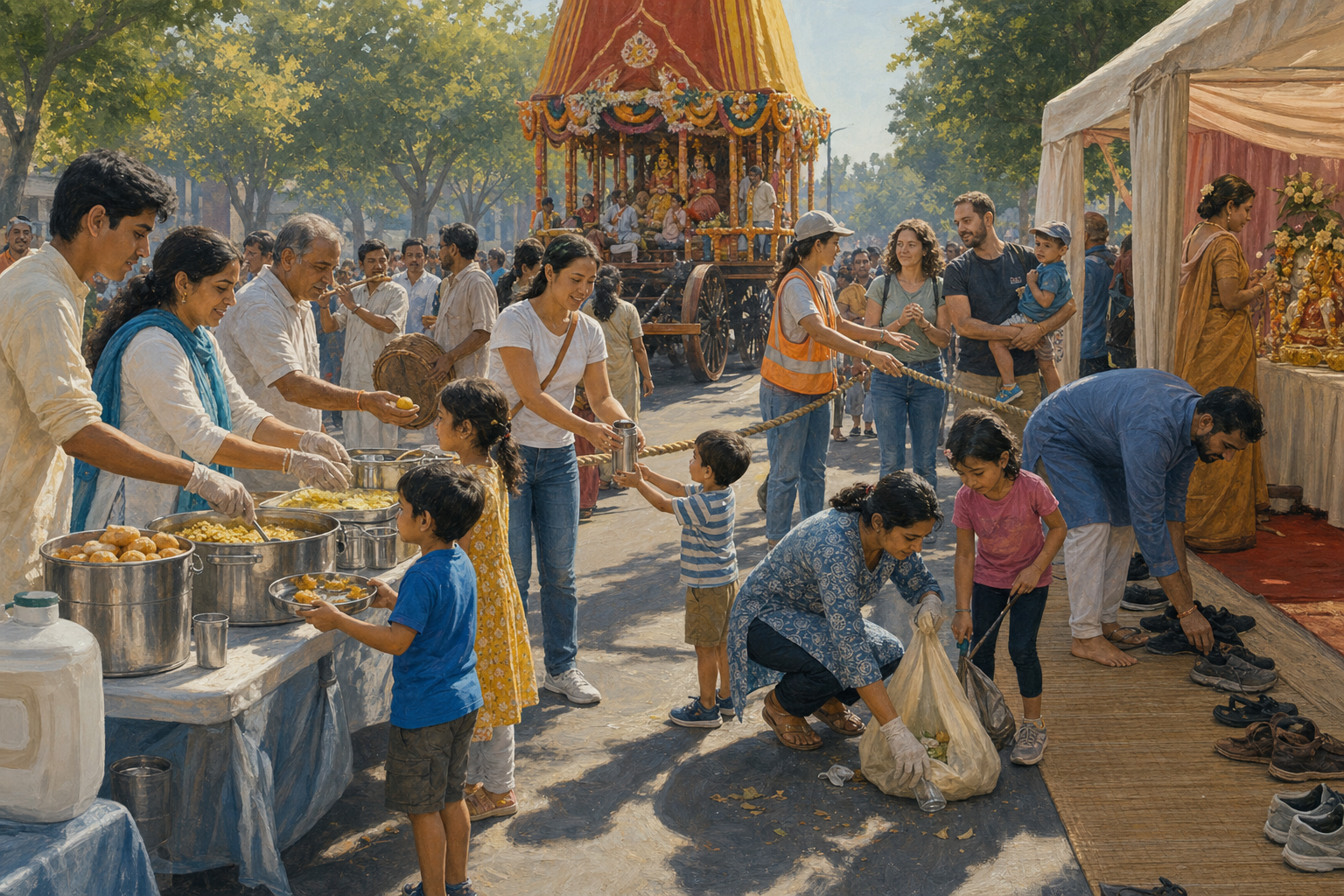
You don’t need to organize a major festival to strengthen this form of public witness. Your choices as an attendee, photographer, parent or community volunteer affect what survives after the chariots leave the street.
- Learn the center before you arrive. Know that the procession honors Lord Jagannatha, Lord Baladeva and Subhadra Devi. That one step changes the event from an exotic visual display into an encounter with a living tradition.
- Use verified event information. Follow the local temple or organizing community’s current announcement for the date, route and participation guidance. The Los Angeles observance occurred on August 2 in 2026; an annual tradition doesn’t guarantee the same calendar date every year.
- Follow the procession’s practical boundaries. Respect route instructions, leave working space around chariots and volunteers, and don’t create a safety problem while trying to secure a better view.
- Photograph people with dignity. Wide views can document the public celebration. For close portraits, especially of children or people absorbed in worship, ask before treating a private devotional expression as your image.
- Caption what happened, not what would make a better legend. Include the correct place, date and names. For Moscow, distinguish a symbolic pose from the false claim that one devotee physically stopped a tank.
- Carry one accurate memory forward. Tell someone why the Deities travel in public, help a newcomer identify them, or preserve a properly described photograph. Cultural continuity is built through many small acts of faithful transmission.
If you help organize a Rathayatra, apply the same standard to signs, announcements and volunteers: a newcomer should be able to learn, in plain language, whom the procession honors and how to participate respectfully. The explanation need not be long. It does need to keep the Deities, rather than the spectacle, at the center.
The next time you encounter an ISKCON procession, don’t stop at asking how many people came. Notice whether devotion remains visible, whether strangers are given a genuine point of entry, and whether the event’s memory is being handed on accurately. Then contribute one action that helps the next person see more than a crowd.
References
- Dandavats — Leaning Against History: A Hare Krishna Devotee in Moscow During the Soviet Coup
- Dandavats — 2026 Los Angeles Rathayatra slideshow from Dvarakarani Mataji
