

You sit before a murti, repeat a sacred name, or enter a temple hoping to meet Bhagavan. Then a difficult thought intrudes: if the Divine is infinite and beyond speech, how can any name, form, verse, or ritual bring you near?
You do not have to choose between transcendence and devotional intimacy. The choice appears only when we confuse encountering the Divine with containing the Divine. Once that confusion is removed, mantra, darshan, scripture, silence, and seva fit into one coherent path.
The Infinite can be encountered without being contained

A complete definition places a boundary around its object. That works for ordinary things. It cannot work in the same way for the Infinite. The Upanishadic discipline of neti, neti acknowledges where mind and speech reach their limit. It prevents you from mistaking a concept of Brahman for Brahman itself.
But the failure of exhaustive description is not the failure of all meaningful speech. A sacred name does not need to define everything about Bhagavan in order to address Bhagavan. A prayer does not need to explain the Infinite before it can express surrender. A hymn can disclose a real divine quality without claiming that this quality is the whole of divine reality.
This distinction changes how you approach devotional language. Instead of asking whether a mantra captures the Divine, ask whether it rightly orients your attention, desire, and conduct toward the Divine. Words become a means of relationship rather than a cage made of concepts.
- Treat a divine name as an address, not an exhaustive definition.
- Treat a theological statement as a truthful pointer within a tradition, not a measurement of everything that the Divine is.
- Treat silence as reverence for what remains beyond expression, not as proof that prayer is useless.
- Treat disagreement as a reason for careful discernment, not immediate contempt for another path.
This also protects devotion from two opposite mistakes. The first reduces Bhagavan to the devotee’s preferred image, vocabulary, or emotional experience. The second makes transcendence so remote that worship becomes impossible. Bhakti avoids both. The Divine exceeds every finite representation while remaining capable of genuine relationship.
Sound, form, and vulnerability open distinct doors

Sacred sound gathers scattered attention
Your mind rarely arrives at prayer in a collected state. It carries unfinished conversations, bodily discomfort, anticipation, and resentment. Beginning with kirtan, japa, or a familiar hymn gives that scattered movement a single devotional direction. In a traditional bhakti setting, kirtan softens attention before scriptural reflection gives it a clear object.
Use sacred sound deliberately. Hear the name as you pronounce it. When the mind wanders, return to the sound without turning distraction into a verdict on your worthiness. Do not keep changing practices merely because repetition has stopped feeling novel. The loss of novelty may be the moment when devotion begins exposing your habits instead of entertaining them.
If you have received a mantra or discipline through a lineage, follow its guidance. If you have not, use a public prayer, hymn, or divine name from the tradition you actually understand. Devotional encounter deepens through fidelity and attention; it does not require inventing an esoteric technique.
Darshan makes relationship visible
A murti does not need to function as a finite diagram of everything divine. In darshan, form becomes a meeting place. You offer attention and receive the deity’s presence through the theological and ritual grammar of the temple. Form makes relationship concrete without implying that the Infinite has been exhausted by what your eyes can see.
The Sarangapani Temple at Kumbakonam expresses this principle with unusual clarity. Bhagavan Vishnu appears there as Sarangapani, lovingly called Aravamudhan. The reclining-yet-rising posture suggests readiness to respond to the devotee, while the name Aravamudhan conveys nectar that never brings satiation. The form does not make divine love small. It makes inexhaustible grace approachable.
When you receive darshan, resist the urge to evaluate the moment immediately. Notice the deity’s name, posture, gaze, and the mood created by worship. Offer what is actually present in you, including distraction or grief. Then carry one implication of the encounter into conduct. If you pray before a compassionate Lord but leave determined to humiliate someone, you have admired the form without accepting its claim on your life.
Vulnerability can reveal what comfort conceals
Srimad Bhagavatam 3.31.14 presents a jiva praying from within the womb. The soul recognizes its spiritual nature while constrained within a body composed of earth, water, fire, air, and ether. The setting matters. Lucidity appears not after every limitation has disappeared, but within an intensely confined condition.
Your own enclosure may be bodily appetite, fear, social pressure, resentment, or a role that has become indistinguishable from your identity. The practical question is not merely how to escape it. Ask what can be remembered, offered, and purified while you are still inside it. Embodiment then becomes a field of sadhana rather than an excuse for either self-indulgence or self-hatred.
This does not romanticize suffering. Constraint can distort perception and narrow your choices. Yet it need not possess your deepest identity. Naming the enclosure accurately lets you stop calling it the whole self. You can then use the body for worship and seva rather than allowing habit to use the body without resistance.
Move from attention to remembrance, then to seva
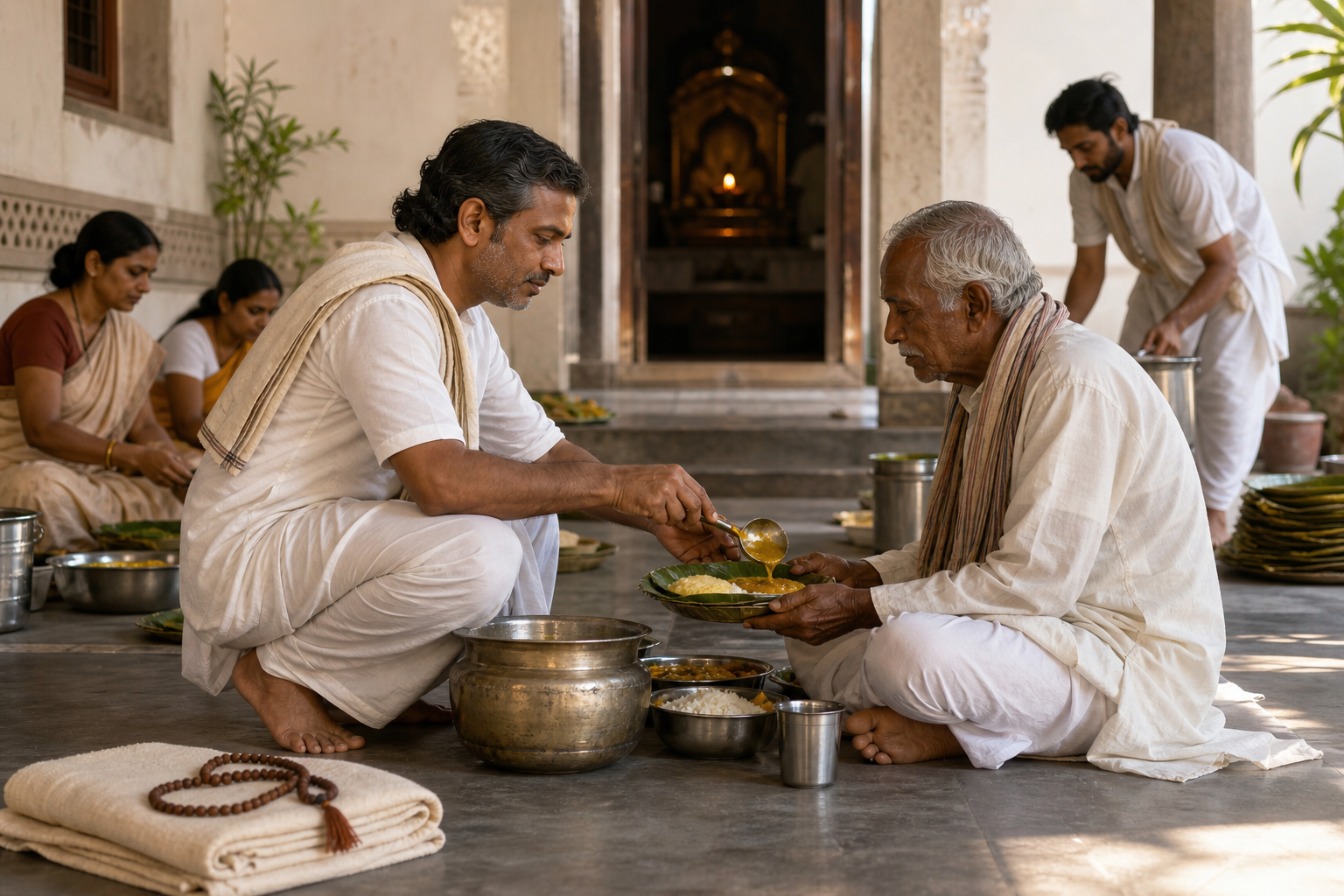
A dependable devotional practice should do more than produce a mood. It should gather attention, expose the obstacle to remembrance, reopen relationship, and send you back into life with a clearer duty. The following sequence can be used at home, adapted to temple darshan, or followed when Bhagavan feels absent.
- Cross a deliberate threshold. Put aside the device or task competing for your attention. Wash, sit, stand, light a lamp where appropriate, or pause before entering the sanctum. The physical action tells the mind that you are no longer drifting between activities.
- Begin with received sacred sound. Chant the mantra, divine name, or hymn that belongs to your practice. Listen instead of racing toward completion. When distraction appears, return to the next audible repetition.
- Bring in a short scriptural passage. Read Srimad Bhagavatam 3.31.14 if the experience of confinement speaks to your condition, or use a verse already established in your sadhana. Stay with one clear teaching rather than collecting many passages that you will not digest.
- Name the enclosure without dramatizing it. Complete this thought plainly: What obstructs remembrance in me right now is… The answer might be anger, craving, fear, exhaustion, vanity, or the need to control an outcome. Precision is more useful than calling yourself spiritually weak.
- Ask for remembrance and right action. Do not make emotional intensity the condition for believing you were heard. Ask to remember Bhagavan within the present circumstance and to see the duty that follows from that remembrance.
- Leave a little room for silence. Stop producing words. Notice what remains when explanation falls away. Silence keeps prayer from becoming a monologue in which you hear only your own preferred conclusions.
- Complete the encounter through seva. Choose a concrete action already within your dharma: repair a harsh exchange, perform neglected work carefully, serve at the temple, assist someone without display, or restrain speech that would cause needless injury. Do it before devotional resolve becomes another pleasant memory.
The order matters more than emotional success. Sacred sound collects the mind. Scripture corrects self-invented spirituality. Honest self-observation identifies the bondage. Silence prevents language from pretending to total knowledge. Seva tests whether remembrance has entered the will.
Some days this practice will feel vivid; on others it will feel dry. Do not use vividness as the only measure of divine nearness. A dry practice performed faithfully can reveal attachment to spiritual sensation. That discovery may be less pleasant than consolation, but it is often more useful.
Judge an encounter by the life it produces
Bhakti traditions preserve accounts in which the deity responds visibly to unwavering devotion. Such narratives should not train you to hunt for omens in every coincidence. They train perception toward a relational truth: devotion is addressed to One who is not inert, and grace calls for a response from the devotee.
The devotional memory surrounding Thirumazhisai Azhwar presents divine responsiveness through miracle, loyalty, and steadfast love. At the level of daily practice, the same devotional grammar appears as a clarified mind, softened heart, and more resolute ethical life. You need not manufacture a marvel in order to recognize grace.
After prayer, kirtan, meditation, or darshan, look for durable fruit:
- Remembrance returns under pressure. The sacred name or teaching comes back when anger, fear, or appetite begins to take control, not only when the atmosphere is devotional.
- The ego becomes less central. You feel less need to advertise an experience, claim spiritual rank, or make others validate what happened.
- Speech becomes more disciplined. Truth is not abandoned, but contempt, exaggeration, and needless injury lose some of their appeal.
- The body becomes more available for seva. Worship leads to responsible action rather than using transcendence as an excuse to neglect embodied duties.
- Devotion increases relational responsibility. Patience, gratitude, fidelity, and accountability become more visible in ordinary dealings.
- Mystery becomes easier to bear. You can remain devoted without forcing every uncertainty into a confident explanation.
Also learn what not to sanctify. A supposed revelation does not become trustworthy merely because it arrived during an intense state. If it flatters your superiority, excuses dishonesty, demands cruelty, or encourages abandonment of legitimate duty, do not call it grace. Pause. Test the impression against dharma, scripture, and the counsel of a trustworthy teacher or mature community.
This kind of discernment honors transcendence. It admits that your interpretation is finite even when the encounter feels profound. It also honors devotion by refusing to reduce Bhagavan to a projection of your impulses.
Questions that keep transcendence and devotion together
If words fail before the Divine, is mantra pointless?
No. Mantra is pointless only if its value depends on verbally containing the whole Divine. Sacred sound can address, remember, praise, and orient you without exhausting its object. Its limitation as a definition is compatible with its power as devotional practice.
Must a genuine devotional encounter feel dramatic?
No. Darshan may be stirring, serene, or apparently uneventful. The more reliable question is what survives after the feeling changes. If remembrance becomes steadier and conduct more dharmic, the encounter has borne fruit. Intensity without transformation deserves caution; quiet fidelity should not be dismissed.
What should you do when nothing seems to happen?
Notice the expectation hidden inside the word happen. You may be waiting for emotion, certainty, relief, or an unusual sign. Return to the sacred name, the chosen verse, honest self-observation, and the next act of seva. Do not pretend to feel presence, but do not equate the absence of sensation with the absence of the Divine.
Do all Dharmic traditions mean the same thing by transcendence?
No. Unity does not require metaphysical sameness. Hindu reflection on Brahman and bhakti, Buddhist teachings on shunyata, Jain anekantavada, and Sikh remembrance of Ik Onkar through Naam retain distinct meanings within their own traditions. Their converging disciplines of humility, contemplative attention, careful speech, and ethical refinement can support mutual respect without flattening genuine differences.
When speaking across these traditions, describe the parallel before claiming identity. Ask how a teaching changes perception and conduct within its own path. This lets you recognize a shared liberation-oriented concern while allowing each tradition to speak in its own spiritual grammar.
At your next practice, bring a sacred name, a short verse, an honest account of what confines you, and a concrete act of seva. Let the Infinite remain infinite. Your task is not to finish describing the Divine, but to become more capable of remembrance, relationship, and right action.
References
- DharmaRenaissance Blog – Soul’s Prayer in the Womb: Transformative Insights on Jiva and the Five Elements (SB 3.31.14)
- DharmaRenaissance Blog – Why Words Fail the Divine: Dharmic Wisdom on Embracing the Infinite with Humility
- DharmaRenaissance Blog – Unwavering Devotion at Kumbakonam: Sarangapani’s Grace and Thirumazhisai Azhwar’s Miracle
