
You may be drawn to Naciketas because death has stopped feeling abstract, or because success, comfort, and duty no longer answer your deepest question. His example becomes useful when you stop treating him as a remarkable boy from an ancient narrative and start examining whether you can make the choices he makes.
The path placed before him is not a shortcut, an escape from family life, or a promise that ritual alone will produce liberation. It moves through ethical repair, disciplined action, discernment, mastery of the senses, contemplation, and knowledge of the indwelling Self. If you want to approach moksha through the Katha Upanishad, that sequence is the map.
Begin where Naciketas begins: with the question you cannot evade
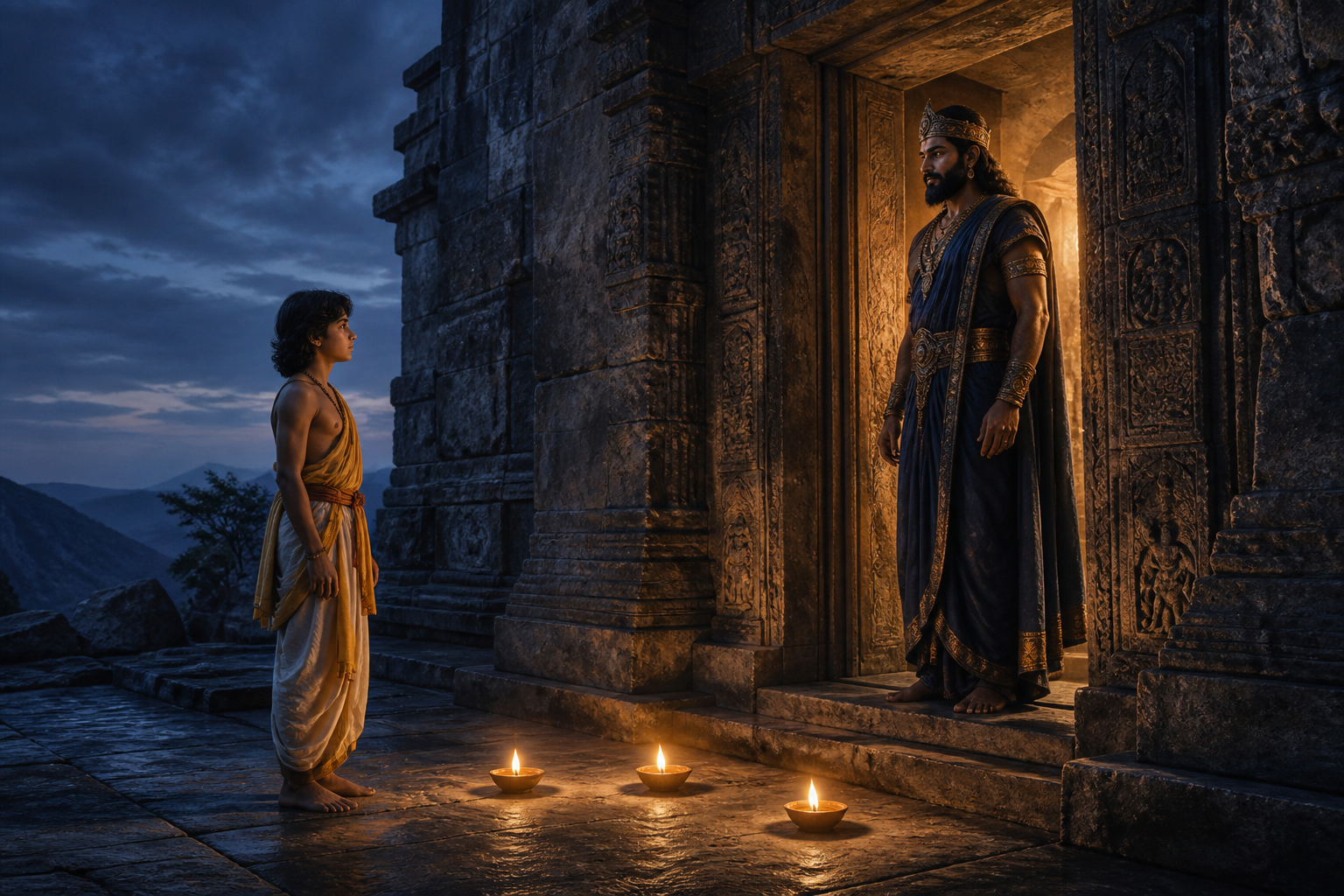
Naciketas notices a contradiction during his father’s sacrifice. An outwardly sacred act is being performed, yet the offerings do not appear worthy of the purpose. Instead of letting ceremony silence his discrimination, he asks where he himself will be given. His father’s angry answer sends him to Yama, the lord of death. After waiting for three nights in Yama’s absence, he is granted three boons.
The important beginning is not rebellion for its own sake. It is Naciketas’s refusal to let religious appearance replace truth. He respects sacrifice enough to ask whether it is being conducted with integrity. That distinction matters in your own sadhana. Doubt that merely seeks an excuse to abandon discipline is different from a question that protects dharma from becoming mechanical.
Bring that honesty to the question of death. You do not need to manufacture fear or pretend to possess certainty. Ask what actually troubles you. Is it the body’s ending, the loss of someone you love, the disappearance of your identity, or the suspicion that everything you pursue is temporary? A vague anxiety produces vague spirituality. A precise question can reorganize a life.
Naciketas also shows you how to remain with a question. He does not fill Yama’s absence with an easy answer. His waiting dramatizes an essential capacity: truth cannot always be forced to arrive on your preferred schedule. When the question of death arises, resist the urge to cover it immediately with entertainment, slogans, or borrowed certainty. Hold it steadily enough to discover what it is asking of you.
A useful inquiry is: If everything I can possess, display, remember, or lose belongs to change, what in me is aware of that change? Do not hurry to answer with the word atman. A remembered term is not realization. Let the question expose where you still identify the rider entirely with the chariot.
The three boons form a sequence, not three separate rewards
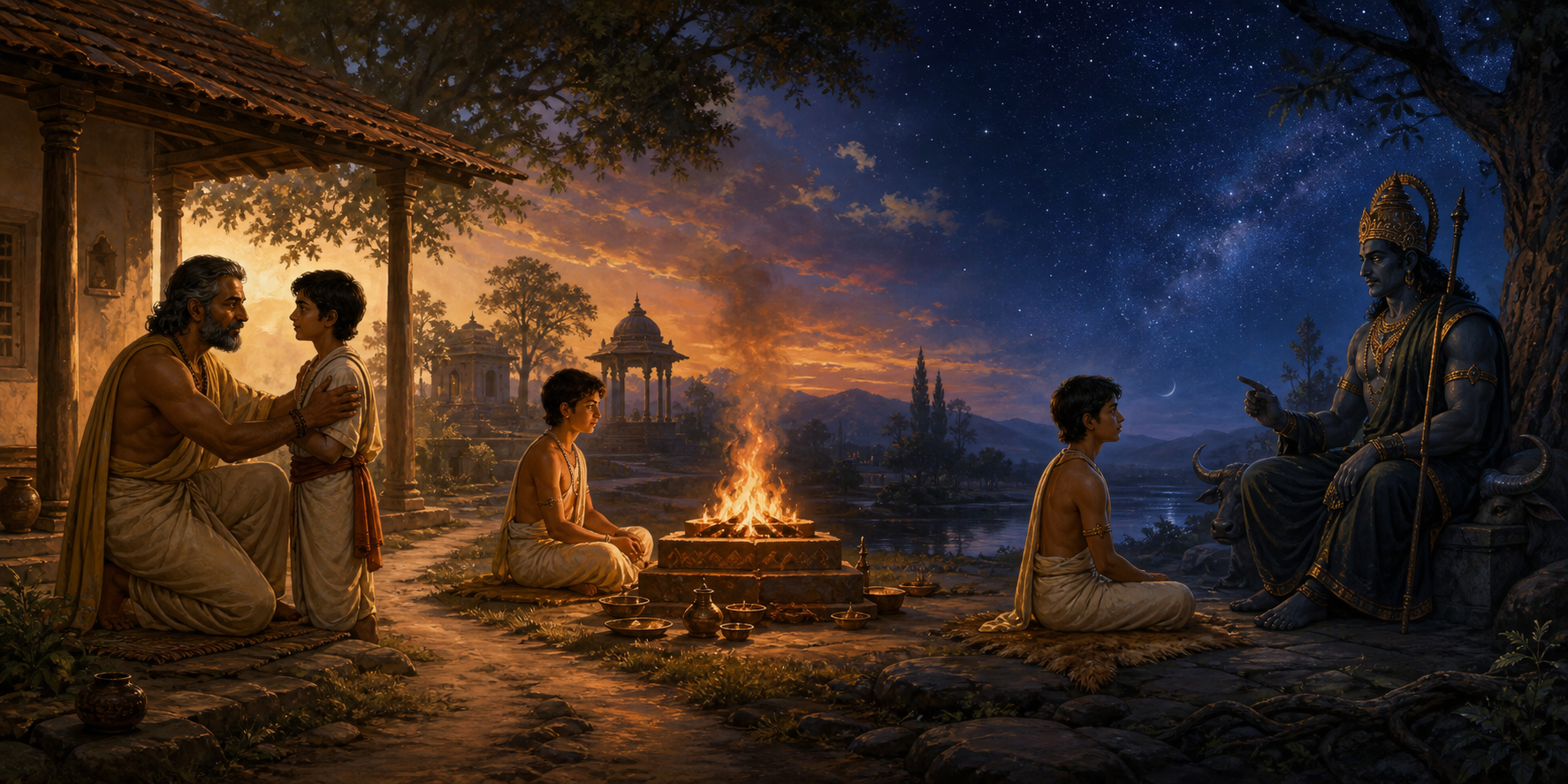
The boons move from relationship to disciplined action and then to ultimate knowledge. This ordering prevents two common mistakes. One is using spirituality to avoid the disorder you have helped create. The other is mistaking religious merit or a desirable afterlife for moksha.
The first boon: restore what anger has disturbed
Naciketas first asks that his father’s anger be pacified and that he be welcomed home without resentment. He does not request power over his father or vindication for having been right. He asks for reconciliation. The quest for the deathless therefore begins with responsibility inside mortal life.
This does not mean that every strained relationship must be restored on unsafe or dishonest terms. It means that you should not call avoidable disorder detachment. Where repair is appropriate, make the apology, keep the promise, return what is owed, or state the truthful boundary. Attend to the part that is yours without making another person’s response a condition of your practice.
Use a simple test: if your spiritual routine makes you less truthful, less dependable, or more willing to leave preventable harm behind you, it is not yet refining your understanding of dharma. The first boon asks whether your search for freedom is making your conduct cleaner.
The second boon: train intention through ordered action
Naciketas next asks to learn the sacred fire associated with attaining heaven. Yama teaches him the yajna that comes to bear the name Nachiketagni. Its placement is deliberate: ordered action, correct intention, and disciplined performance prepare the seeker for a question that cannot be settled by action alone.
Do not erase the yajna by turning it into nothing more than a psychological metaphor. It is presented as sacred action with a heavenly fruit. But do not confuse that fruit with moksha either. Heaven is still a reward sought through action; the third boon reaches beyond reward toward knowledge of what does not die.
The practical lesson is to establish an inner architecture worthy of the question you are asking. Choose a discipline that has a clear purpose, a clean means, and a stable place in your life. It may be worship, study, meditation, service, restraint, or another practice consistent with your sampradaya. Then examine the motive. Are you practising to be admired, to bargain for an outcome, or to make the mind fit for truth?
Nachiketagni teaches consistency without reducing liberation to habit. Repeated right action can train the will and purify motive, but repetition becomes spiritually useful only when attention remains alive. If your practice has become automatic, recover its purpose before adding more complexity.
The third boon: ask for knowledge that comfort cannot replace
Only after asking for reconciliation and sacred discipline does Naciketas ask what truly happens when a person dies. Yama tests the depth of that desire by offering longevity, wealth, pleasure, and dominion. Naciketas refuses the exchange. He understands that an enlarged collection of temporary experiences cannot answer a question about the eternal.
This is the hinge of the path. You may value family harmony, ritual, virtue, learning, and beneficial results, yet still avoid the final inquiry into who you are. The third boon does not discard the first two. It prevents you from stopping with them.
Ask what could persuade you to postpone the search indefinitely. More status, greater comfort, another achievement, or the promise of security may all be legitimate within dharma. They become obstacles when you accept them as substitutes for truth. Naciketas is ready for Yama’s teaching because his central question is no longer for sale.
Śreya and preya turn liberation into a decision you can make
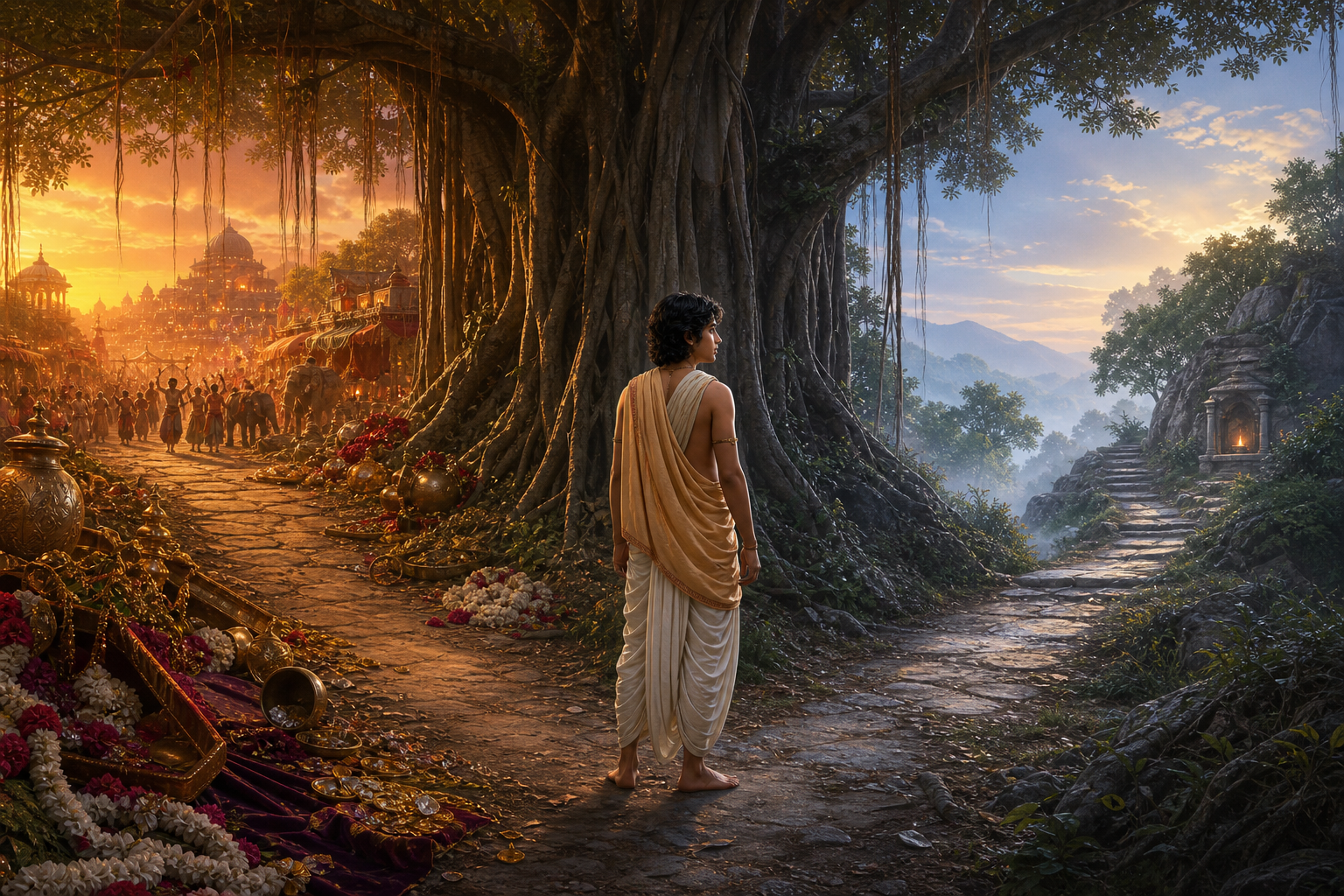
Yama’s test distinguishes śreya, what is genuinely beneficial, from preya, what is immediately pleasing. Moksha may sound remote while this distinction is present in ordinary choices. Every time you prefer clarity over compulsion, integrity over convenient self-deception, or sustained practice over distraction, you strengthen the capacity Naciketas displays.
Do not flatten this teaching into the claim that pleasure is evil or difficulty is holy. A pleasant choice can support dharma, and a painful choice can arise from pride or confusion. The decisive question is whether the choice governs desire intelligently or allows desire to govern you.
| Question to ask | A preya warning | A śreya direction |
|---|---|---|
| What is driving me? | I want immediate relief from discomfort. | I am serving a good I can still affirm after the impulse passes. |
| What happens to my agency? | The choice strengthens compulsion or dependence. | The choice leaves the mind easier to guide. |
| What happens to dharma? | I must hide, rationalize, or neglect a duty. | I can act truthfully and accept responsibility. |
| What happens to inquiry? | The choice keeps me too distracted to examine myself. | The choice protects attention for study, contemplation, and practice. |
| What fruit am I demanding? | I will act only if I receive the pleasure, recognition, or result I expect. | The action remains worth doing because its means and purpose are sound. |
When a choice is live, name the offer plainly. Then name its hidden price. A distraction may offer relief while costing attention. Status may offer approval while costing honesty. Even a religious activity may offer identity while allowing self-examination to disappear. You do not need to condemn the offer; you need to see the exchange clearly.
Next, choose the smallest action that keeps śreya available. Close the distraction, complete the neglected duty, sit for the practice you have already accepted, or decline the reward that would corrupt the purpose. Discernment becomes stable through use. Waiting for perfect dispassion before making the better choice gives preya another disguise.
This is why Naciketas’s refusal matters more than an abstract declaration that worldly things are temporary. He demonstrates freedom at the point of temptation. Your understanding of śreya becomes credible in the same place: where a pleasing alternative is actually available and you can still remember what you seek.
Use the chariot teaching to govern attention without hating the senses
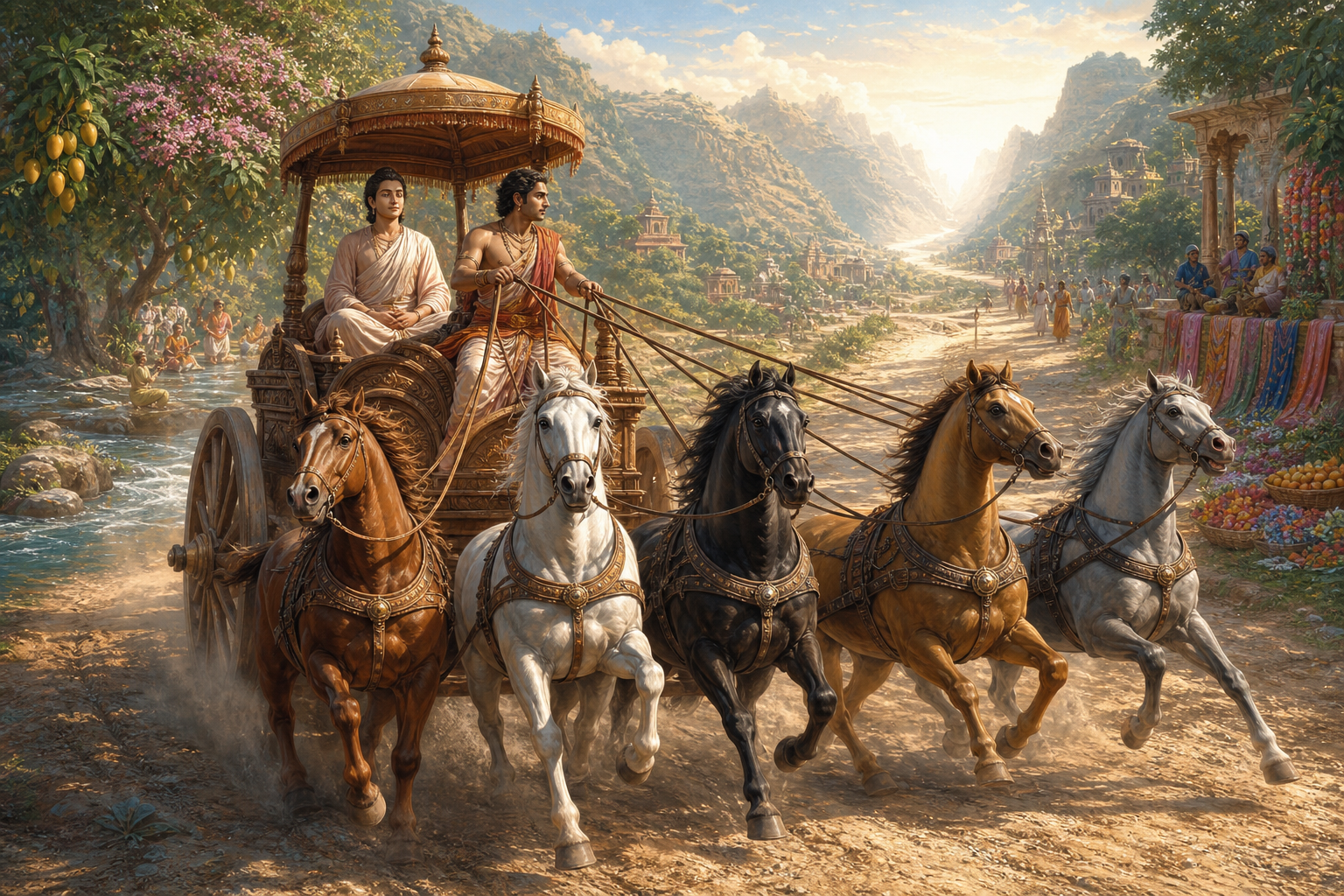
Yama gives Naciketas a precise model of the human being: the body is the chariot, the senses are its horses, the mind is the reins, the intellect is the charioteer, and the Self is the rider. Liberation requires more than possessing each part. They must stand in the right relationship.
The senses are not enemies. Horses supply movement; without guidance, however, they pull toward whatever attracts them. The mind receives and coordinates their impulses, but reins cannot choose a destination. The intellect must discriminate, remember the aim, and guide the mind. When intellect is inattentive and mind is slack, the senses decide the route by default.
You can use this map whenever attention is captured. First identify the horse: sight, sound, taste, touch, smell, or an associated desire. Then notice the reins: is the mind repeatedly carrying attention toward the object? Bring in the charioteer by asking whether following that movement serves śreya or preya. Finally, redirect the mind instead of merely arguing with the sense.
This is restraint without self-hatred. Violently condemning the horses does not create a competent charioteer. Better governance comes from reducing needless stimulation, keeping the mind responsive, strengthening discrimination, and remembering the destination before an impulse takes command.
Let Om support recollection of the highest
Om is offered as a dependable support for contemplation. Use it as more than decoration or a device for obtaining a pleasant state. Its purpose here is to gather attention around the highest aim and help the seeker move beyond identification with passing sensory objects.
- Settle the body so that the chariot is not creating needless disturbance.
- Notice which sense impressions, memories, or anticipated rewards are pulling at the mind.
- Invoke Om in the manner taught within your practice, allowing attention to collect rather than chase each movement.
- When attention wanders, let the intellect recognize the movement without drama and guide the mind back.
- Ask what is aware of the changing body, sensation, thought, and desire.
- Carry the contemplation into one concrete act of śreya after the practice ends.
The final step protects contemplation from becoming a private mood. If the intellect appears serene during practice but repeatedly surrenders to the same avoidable compulsion afterward, the reins still require training.
Do not confuse the immortal Self with an improved personality
Yama’s central teaching concerns ātman: unborn, undying, and not slain when the body is slain. This does not make every preference, role, memory, or personal story eternal. Those belong to the changing equipment represented in the chariot. The teaching directs attention to the Self that cannot be reduced to that equipment.
Moksha therefore cannot be manufactured as one more experience for the personality to collect. Experiences begin, alter, and end. Self-knowledge concerns the reality by which change is known. Ethical living, disciplined action, sense restraint, a steady mind, discriminating intellect, and contemplation prepare you to recognize what was never produced by them.
This is a specifically Upanishadic articulation and should be understood on its own terms. Restraint, right conduct, and interior clarity resonate across Hindu, Buddhist, Jain, and Sikh paths, but shared disciplines do not require us to erase the distinct language and metaphysical commitments of each tradition.
The chariot model also gives you a sober way to assess progress. Do not rely only on unusual experiences. Notice whether an attractive object can still overrule discrimination, whether the mind can be redirected, whether duty survives inconvenience, and whether your central inquiry remains intact when comfort is offered. These are practical signs that the charioteer is becoming fit to guide the journey.
Key takeaways for walking the path toward moksha

- Naciketas begins with truthful discrimination: sacred appearance cannot excuse ethically empty action.
- The first boon places reconciliation and responsible conduct at the foundation of spiritual inquiry.
- Nachiketagni shows how ordered action and purified intention prepare the will, while heavenly reward remains distinct from moksha.
- The third boon asks for knowledge of death and the deathless, a question no amount of temporary pleasure can replace.
- Śreya is the truly beneficial choice; preya is the merely pleasing choice that can divert you from the highest aim.
- The chariot teaching assigns the senses, mind, and intellect their proper roles while distinguishing all of them from the Self.
- Om supports contemplation, but contemplation must be carried into conduct and restraint.
- The teaching about immortality concerns ātman, not the endless preservation of every feature of the familiar personality.
Begin with your next live choice. Write śreya beside the option that preserves clarity, dharma, and command of attention; write preya beside the option that purchases immediate satisfaction by weakening them. Take the smallest honest action toward śreya, then watch whether the mind becomes easier to govern. That is not yet moksha, but it is how you stop repeatedly walking away from it.
References
