

If the air outside your home looks grey, it is tempting to reach for one explanation: traffic, construction, factories or crop fires. That shortcut leads to weak solutions. The same city can have road dust, combustion particles, waste smoke and sunlight-driven smog in the same airshed, but each requires a different response.
The useful question is not simply, “What causes pollution?” It is: “Which pollutant is rising here, where is it coming from, and what action will prevent it from entering the air?” Once you ask the question that way, cleaner air becomes an operating problem that residents, builders, industries and governments can actually solve.
Identify the pollutant before choosing the remedy

Air pollution is a mixture, not a single substance. Visible haze can alert you to a problem, but visibility alone cannot reveal the most dangerous component. Coarse dust, fine combustion particles and invisible gases behave differently in the body and respond to different controls.
| Pollutant | What it does | Common urban origins | First control to examine |
|---|---|---|---|
| PM10 | Coarse particles tend to lodge in the upper respiratory tract and cause irritation or congestion. | Road dust, excavation, demolition, uncovered materials, agriculture and exposed soil. | Cover, contain, wet, collect and stabilize loose material. |
| PM2.5 | Fine particles can penetrate deep into the lungs and enter the bloodstream. | Combustion, power generation, industry, solid-fuel use, waste burning and atmospheric formation. | Prevent combustion emissions and capture particles at the source. |
| Ultrafine particles | These very small particles can travel beyond the lungs into other organs. | Combustion and other high-temperature processes. | Reduce or enclose the emitting process rather than relying on visible-dust controls. |
| Ground-level ozone | It irritates the respiratory system and can aggravate asthma. | It forms when nitrogen oxides and volatile organic compounds react in sunlight. | Cut the precursor gases; ozone cannot be swept or sprayed away. |
The distinction between PM10 and PM2.5 is especially important. A mist cannon can suppress coarse dust near a demolition site, but it does not replace a baghouse on an industrial stack. Street sweeping can remove deposited grit, but it cannot solve fine particles forming in the atmosphere from gaseous emissions. Fine particles penetrate more deeply into the body than coarse dust, so a city must not confuse what is most visible with what carries the greatest health risk.
Gases also matter. Nitrogen oxides from combustion help produce urban smog, ground-level ozone and secondary particles. Volatile organic compounds from paints, solvents, consumer products, industrial evaporation and storage leaks participate in the same chemistry. Sulfur dioxide from coal combustion, smelting and refining contributes to respiratory harm and acid deposition. Ammonia from decomposing waste, sewage treatment, peri-urban agriculture and certain industrial processes can combine with other pollutants to form fine aerosols.
Carbon monoxide deserves separate caution because it is odorless and toxic. You cannot use smell or visible smoke to rule it out. A suspected indoor combustion leak is an immediate safety problem requiring a proper detector, departure from the affected space and qualified emergency assistance.
Key takeaways
- Visible dust usually points you toward exposed soil, roads, construction or material handling, but it does not measure the full PM2.5 risk.
- Dust suppression works only while it prevents loose material from becoming airborne; permanent paving, covering and stabilization are more durable.
- Fine-particle pollution requires cleaner combustion, emission capture, an end to open burning and control of gases that form particles later.
- Ground-level ozone is a secondary pollutant. Reduce nitrogen oxides and volatile organic compounds instead of treating the ozone after it forms.
- A credible clean-air plan names the source, responsible operator, required control, compliance evidence and consequence for failure.
Trace the source by place, activity and season
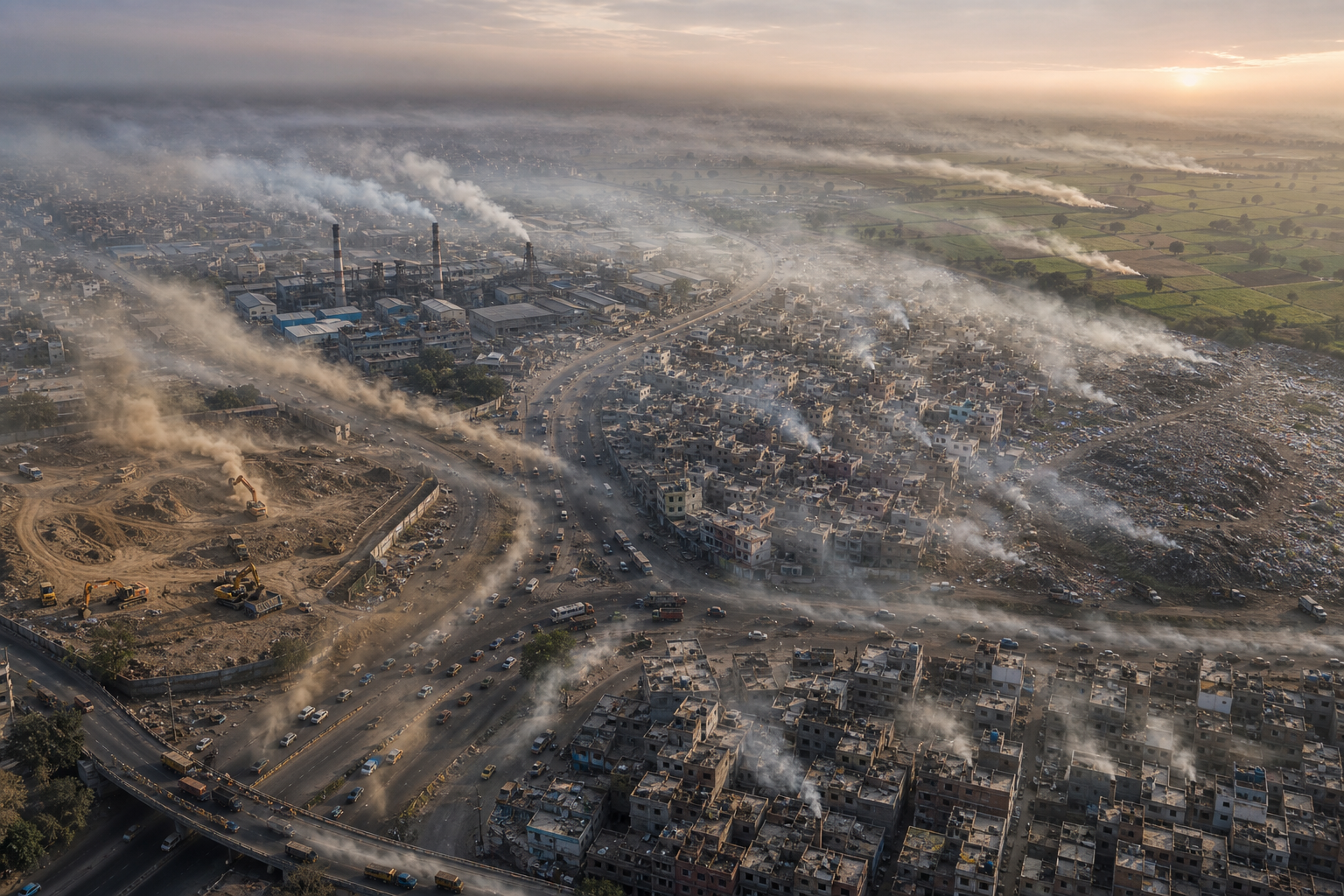
An air-quality reading can tell you that pollution is elevated. It cannot, by itself, tell you which excavator, road, boiler, waste pile or cooking fuel caused it. Source control begins with a simple field discipline: connect the pollution to a place, an activity and a recurring condition.
- Dust beside a construction site: Look for uncovered sand or debris, dry cutting, open excavation, vehicles moving quickly over bare ground and mud carried through the gate. The practical demand is not merely “reduce pollution”; it is covered stockpiles, active dust suppression, a wheel wash, a stable exit road and enclosed debris transport.
- Dust along a busy road: Check whether the road shoulder is unpaved, soil is exposed in the median, construction material occupies the verge or deposited silt is repeatedly lifted by tyres. The remedy is surface stabilization and collection, not occasional spraying alone.
- Smoke near a waste point: Identify whether mixed waste is being burned, whether bins are uncovered or whether loose material is escaping during collection. Demand contained storage, reliable pickup, sealed transport and enforcement against burning.
- Pollution around an industrial cluster: Distinguish fugitive yard dust from stack emissions. Yard controls include enclosure, covered stockpiles and paved movement routes. Stack emissions require functioning capture equipment, cleaner combustion and monitored operating conditions.
- Pollution inside and around dense settlements: Household solid fuels can add to both indoor exposure and the neighbourhood burden. Cleaner cooking and heating energy therefore produces a benefit on both sides of the wall.
- Winter haze across northern India: Crop-residue burning in Punjab and Haryana can make a major seasonal contribution to downwind pollution. That regional influence does not erase local sources such as road dust, traffic, waste burning, industry or household combustion. Seasonal and year-round controls must operate together.
If you are documenting a neighbourhood hotspot, record the exact location, activity, wind direction if apparent, time, recurrence and responsible site or facility. Photographs are useful when they show the control failure: an uncovered load, a dry demolition face, a smoking waste pile or mud spread across a public road. A complaint tied to an observable breach is much harder to dismiss than a general statement that the air feels bad.
Do not turn one observation into a citywide source claim. A dusty balcony near an excavation identifies a local lead, not the full urban emissions inventory. Distributed sensors, regulatory monitors and repeated field observations are needed to separate a persistent pattern from a single event.
Stop dust before wind and wheels can spread it
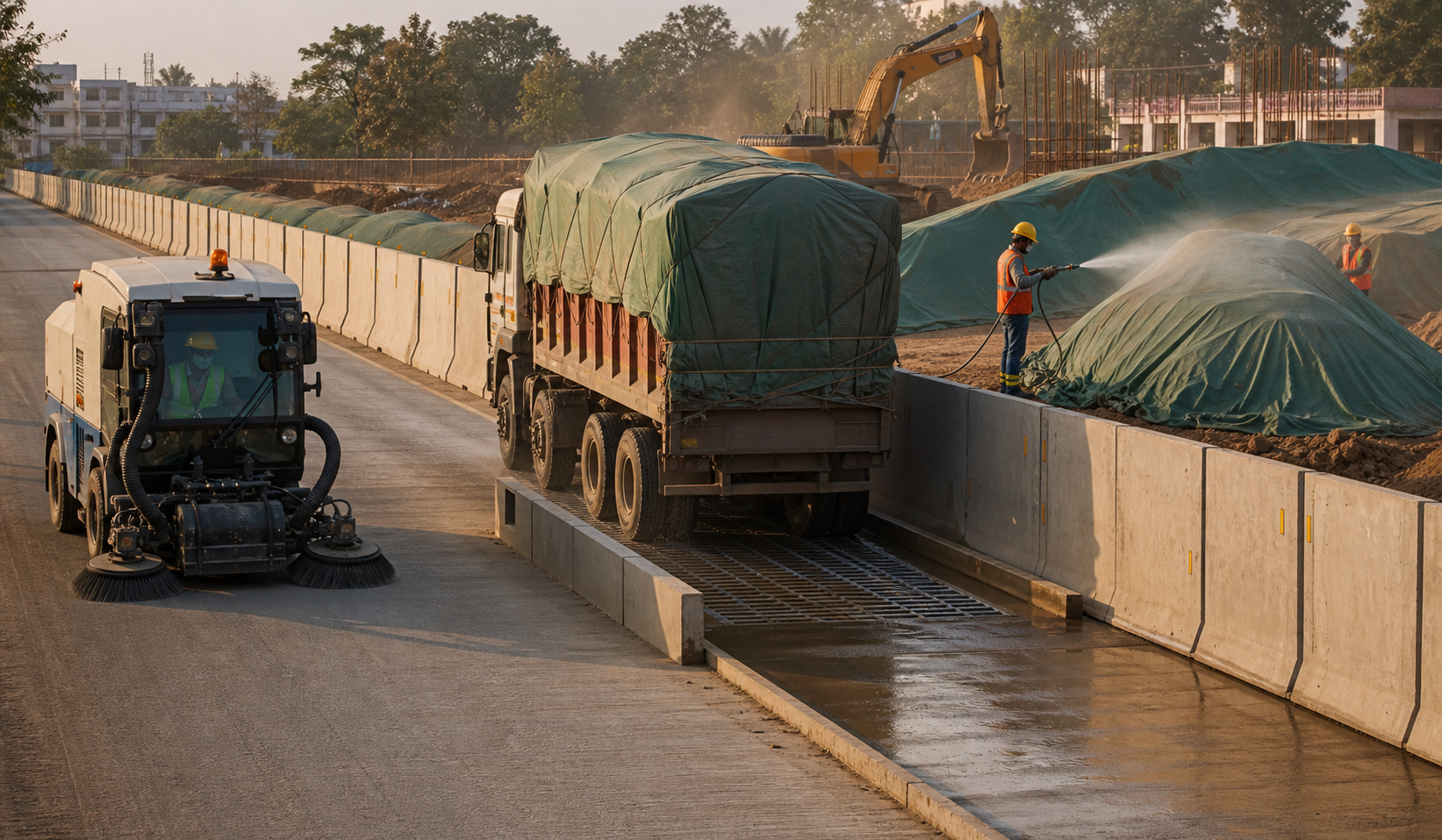
In many Indian cities, coarse dust is the most immediate operational failure. Long dry periods harden and loosen exposed surfaces, while wind and vehicle movement repeatedly resuspend material that has already settled. Cleaning the same road without stopping new deposits creates an expensive loop.
The strongest dust programme follows the material from storage to final disposal:
- Reduce the exposed area. Phase excavation and demolition so the entire site is not left open at once. Stabilize or cover completed sections promptly.
- Enclose the generating activity. Use barriers and suitable enclosures around cutting, crushing, demolition and other dusty work. A site boundary that does not contain the plume is only a visual screen.
- Keep loose material covered. Tarps and closed containers should remain in place during storage and transport, not appear only during inspections.
- Suppress dust at the point of generation. Water sprinklers, fine mist systems and appropriate suppressants can keep particles from becoming airborne. Aim the control at the activity or stockpile rather than spraying indiscriminately into the open air.
- Control vehicle movement. Low on-site speeds reduce resuspension. Stable internal routes prevent trucks from grinding bare soil into finer material.
- Clean wheels before exit. A maintained wheel-wash keeps mud and fine material off public streets. The captured residue must be contained so the wash does not simply transfer pollution into drains.
- Collect what reaches the road. Regular mechanical sweeping or vacuuming removes deposited material before traffic lifts it again. Dry sweeping that raises a new cloud defeats the purpose.
- Stabilize the surrounding land. Pave unpaved stretches where appropriate, repair broken shoulders and establish groundcover, hedges or other erosion controls on exposed soil.
These controls work as a chain. A covered truck is of limited value if it leaves the site with dirty wheels. A wheel-wash cannot compensate for an uncovered demolition face. Road vacuuming will not keep pace if every construction gate deposits another layer of soil. The permit should therefore specify the whole operating system, not one conspicuous machine.
Water-based suppression also needs judgement. The objective is a damp, controlled surface, not flooding. Excess water can carry sediment toward drains, damage the work area and waste a scarce resource. Permanent measures such as paving, groundcover, enclosure and smaller exposed work zones should reduce how often water is needed.
Greenery helps most when it solves a defined physical problem. Groundcover prevents erosion. A dense hedge can intercept some locally transported particles. Trees can improve shade and microclimate. None of these substitutes for controlling an uncovered truck, a dry cutting operation or a non-compliant industrial stack.
Treat combustion, waste and smog as separate systems
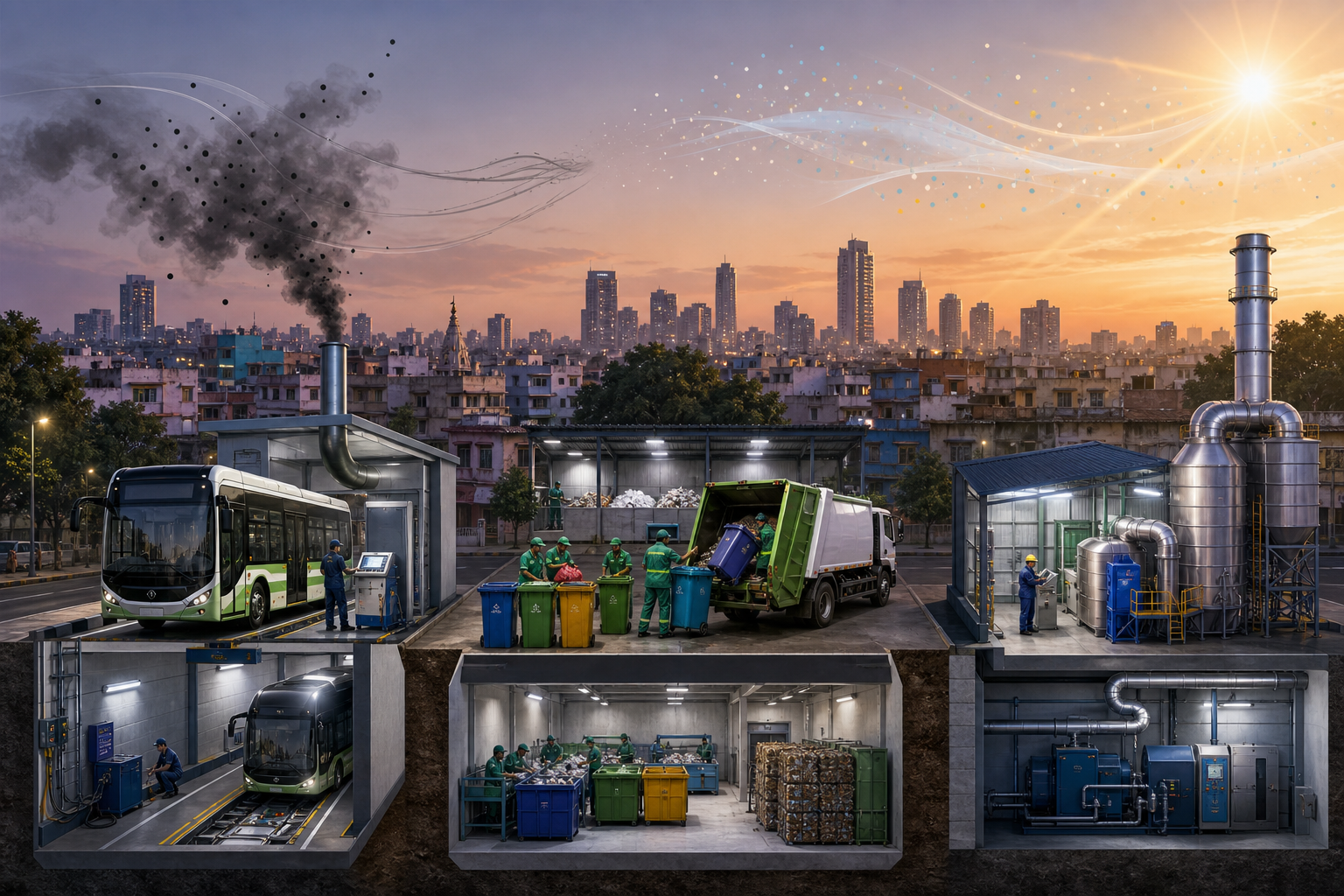
Once coarse dust is under control, the city still has to deal with PM2.5 and gaseous precursors. Sprinklers and green belts cannot capture pollutants that should never have escaped a chimney, tailpipe, cooking fire or waste pile.
Industrial facilities need controls matched to their process. Baghouses filter particle-laden gas through fabric. Electrostatic precipitators charge and collect particles. Optimized combustion reduces products of incomplete or inefficient burning. These systems matter only when they are correctly operated and maintained, so compliance must include operating evidence rather than the mere presence of equipment.
Waste management is equally direct. Open burning turns a collection failure into a public-health exposure and can release fine particles, volatile compounds, polycyclic aromatic hydrocarbons and other hazardous pollutants. Covered bins, dependable collection, sealed or well-maintained compactor vehicles, material recovery and engineered landfill practices prevent waste from becoming fuel or wind-blown debris. A prohibition without a functioning collection alternative merely moves the burning out of sight.
Crop residue requires a regional logistics solution as well as enforcement. Farmers need a workable destination for material that would otherwise be burned. Controlled facilities can procure parali as fuel, but they must be equipped with appropriate combustion management, particle filters and emission controls. Moving biomass from an open field to a poorly controlled furnace would relocate the pollution rather than solve it.
Transport policy must address exhaust and non-exhaust pollution together. Electrifying buses and other urban fleets removes tailpipe emissions at the point of use and can reduce some braking emissions. It does not eliminate tyre wear or road-dust resuspension. Cities still need clean road surfaces, smoother traffic flow, less idling at signals and bottlenecks, and dependable public transport that reduces unnecessary vehicle movement.
Smog control requires attention to chemistry. Ground-level ozone forms from nitrogen oxides and volatile organic compounds in sunlight. Paints, solvents, cleaning products, industrial evaporation and leaking storage can therefore matter even when they produce no dark smoke. A serious plan inventories these precursor sources and controls leaks, evaporation and combustion emissions. It does not wait for ozone to appear and then search for a filter.
Cleaner household energy belongs in the same city plan. Replacing solid fuels with gas, electricity or renewable options cuts pollution where people breathe it first and reduces what homes release into surrounding lanes. This is not only an indoor-air intervention; dense neighbourhoods share the same air.
Make clean air an enforceable civic duty
A city can buy sensors, sweepers and mist cannons while leaving its emissions almost unchanged. Equipment is useful only when it sits inside a system that assigns responsibility, checks performance and corrects failure quickly.
Use five tests when judging a municipal, industrial or neighbourhood clean-air proposal:
- Does it name the pollutant? A plan for “pollution” is too vague. It should distinguish coarse dust, fine particles and precursor gases.
- Does it identify the source and owner? Every hotspot needs a responsible operator, department, contractor or facility. Shared air cannot mean unassigned duty.
- Does it state the operating requirement? “Control construction dust” is not enough. The permit should specify covering, enclosure, wheel cleaning, vehicle speed, suppression and road maintenance where applicable.
- Does monitoring trigger action? Distributed sensors and real-time analysis can identify hotspots, but data must lead to inspection, process correction and transparent enforcement. A dashboard that nobody acts on is decoration.
- Does it prevent exposure through planning? Separating heavy industry from dense residential areas, preserving wetlands and water bodies, limiting unnecessary soil disturbance, mapping wind flow and protecting ventilation corridors reduce the burden before emergency measures are needed.
Penalties must be credible, but speed and clarity matter as much as severity. Builders and facility operators should know the standard before work begins. Inspectors should be able to document a breach consistently. Disputes should be resolved quickly enough that a months-long violation cannot become the profitable option.
Dharmic ethics give this civic discipline a deeper reason. Ahimsa asks us to prevent avoidable harm. Seva asks institutions to serve beyond their gates. Reverence for the interdependence of life makes air, soil and water matters of duty rather than scenery. These principles become real when a temple, gurdwara, Jain centre, Buddhist vihara or community association refuses waste burning, controls dust during renovation, covers stored materials, adopts cleaner kitchen energy and reports neighbourhood violations with evidence.
That is the practical standard for a Dharmic response: do not moralize about the sky while releasing preventable pollution at ground level. Begin with one recurring hotspot near you. Classify it as loose material, combustion, waste, traffic or chemical precursors. Record the control failure, identify who owns it and ask for the specific remedy. Cleaner Indian cities will be built through thousands of such visible duties performed consistently.
References
