
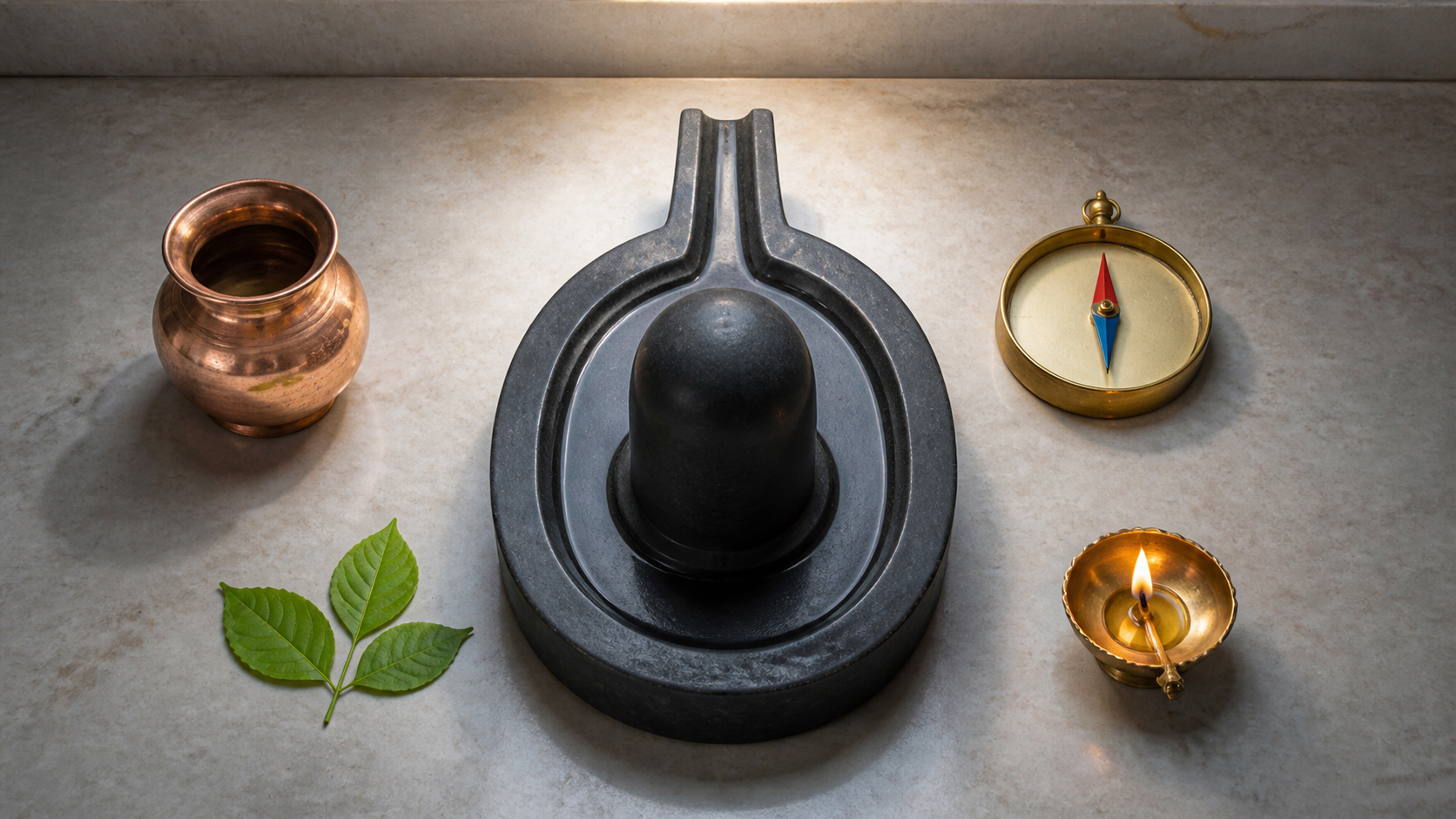
If you are placing a Shivling in a home shrine, the practical question is not simply, “Which way should the Shivling face?” You need to identify the projecting outlet in its base. That outlet—not the rounded top of the Linga—is the part traditionally directed toward the north.
This distinction prevents the most common placement error. It also reveals why the orientation matters: the arrangement brings Shiva and Shakti symbolism, abhisheka, drainage, darshan and respectful movement into one coherent sacred space.
Which part of the Shivling must point north?
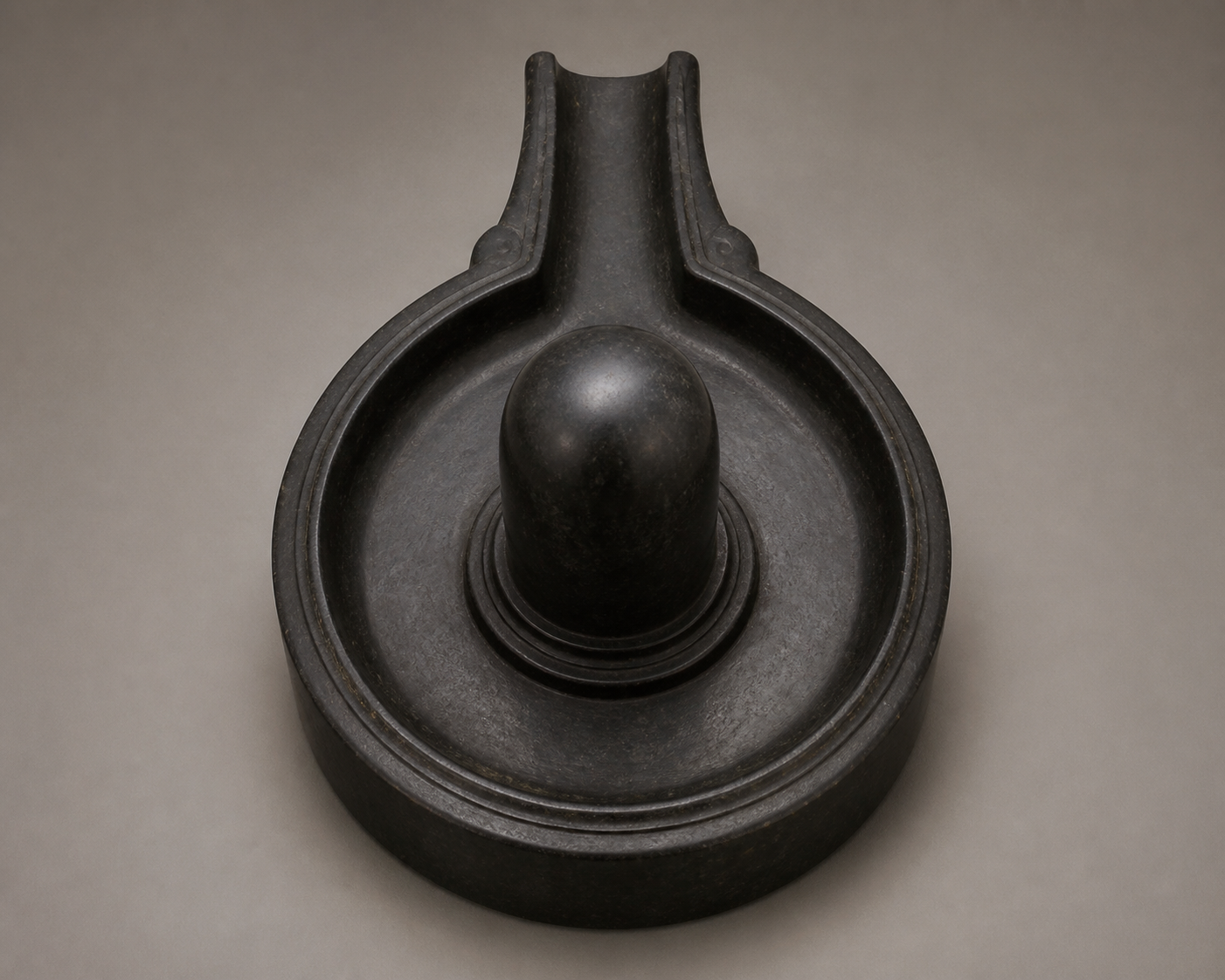
The Gauripatta is the base surrounding and supporting the Linga. It is also known as the yoni or argha and represents the divine feminine principle associated with Goddess Parvati. The Linga and Gauripatta together express the inseparability of Shiva and Shakti rather than two unrelated sacred objects.
A channel extends from the Gauripatta so that liquids offered during abhisheka can leave the base in a controlled direction. This channel or outlet is commonly called the Somasutra or gomukha. When someone says that the Gauripatta should face north, the instruction ordinarily refers to this projecting outlet.
Do not confuse three separate questions:
- Gauripatta orientation: The Somasutra or gomukha is normally directed north.
- Devotee orientation: This instruction does not by itself mean that you must face north while worshipping.
- Shrine placement: The position of the entire altar within a room may be governed by additional family, Agamic or Vastu considerations.
That separation is important. Rotating an entire shrine because of a rule concerning one component can disturb an otherwise established arrangement. First locate the outlet. Then determine its direction.
Why north unites symbolism with ritual function
The northward orientation operates on several levels at once. Its meaning is not exhausted by a single Vastu slogan, nor should it be reduced to a promise of material gain.
In the sacred geography of Sanatana Dharma, north evokes the Himalaya, the realm closely associated with Parvati and Shiva. It therefore suits a form in which the Gauripatta represents Shakti joined with Shiva. The direction can remind you that the base is not merely a plumbing fixture beneath the “main” object of worship. It is integral to the form and its meaning.
North also carries associations with Dhruva, the fixed pole star, and thus with steadiness, orientation and ascent. Kubera, the guardian associated with wealth, belongs to the same directional symbolism. These associations make north auspicious, but they should not be turned into a mechanical claim that rotating a Shivling will automatically produce wealth. The deeper invitation is toward stability, disciplined aspiration and properly ordered worship.
The ritual reason is immediately visible during abhisheka. Water, milk or another prescribed offering descends over the Linga, gathers in the Gauripatta and leaves through the Somasutra. A fixed outlet gives the sacred liquid a deliberate course toward a suitable tirtha or receptacle. It prevents uncontrolled runoff around the shrine and makes regular worship easier to maintain with care.
The customary northward outlet also preserves the east–west darshan line between Nandi and the Linga. Devotees can approach without treating the consecrated channel as an ordinary drain or repeatedly stepping across its path. Sacred symbolism and practical circulation reinforce one another.
Shaiva Agamic practice commonly supports this northward arrangement, while Vastu connects the north with auspicious movement, balanced light and manageable use of the space. The rule therefore belongs to an architectural system as well as a contemplative one. Direction organizes attention, movement and ritual action around the deity.
How to align a movable Shivling in a home shrine

If you are arranging a new home shrine and have not received a different instruction from your sampradaya, family tradition or purohit, use north as the default direction for the outlet. Work in this order:
- Identify the actual outlet. Look for the projecting channel through which abhisheka liquid leaves the Gauripatta. Do not infer direction from the shape of the upper Linga.
- Establish north in the room. Use a reliable compass rather than guessing from a window, road or wall. Check from more than one position if nearby metal or electronics make the reading unstable.
- Turn the complete movable assembly. Position the Gauripatta so that the outlet extends northward. Do not twist only one loosely fitted part into a strained or unstable position.
- Provide a suitable receptacle. The liquid should enter a deliberate container or drainage arrangement rather than spreading across the altar or floor.
- Test the flow with a small amount of plain water. Confirm that the liquid reaches the outlet gently and does not pool, splash onto sacred objects or run toward an electrical lamp.
- Check the worship route. Arrange lamps, vessels and seating so that you do not need to step across the Somasutra or reach awkwardly over the Shivling.
The water test is especially useful before the first full abhisheka. Direction alone does not guarantee good ritual function. An uneven surface, an undersized vessel or a blocked channel can defeat the purpose of the arrangement even when the outlet points north.
During worship, pour the offering gently enough for the Gauripatta to collect and direct it. More liquid is not inherently more reverent. A controlled stream keeps the altar orderly and lets you attend to the act of offering rather than cleaning an avoidable overflow.
You can also use the flow as a contemplative cue. As the offering descends and moves northward, recall the sacred Himalaya, the presence of Parvati, the descent of Ganga and the movement from restlessness toward steadiness. Physical alignment then supports inner alignment without turning the compass direction into superstition.
What to do when an established shrine faces another direction

Not every east-facing or otherwise differently aligned outlet is an error. Regional temple traditions may follow a local shakha, respond to site constraints or preserve an established pilgrimage route. Some temples direct the outlet eastward. The governing concern remains the sanctity of abhisheka, orderly movement and a clear darshan arrangement.
Use the context to decide what to do:
- A new, movable household Shivling with no inherited instruction: Direct the outlet north and test its flow.
- An established family shrine: Ask why it was arranged that way before changing it. A lineage-specific instruction may be operating.
- A fixed or consecrated installation: Do not rotate or dismantle it on the strength of a general rule. Seek guidance from the responsible purohit, acharya or temple authority.
- A temple you are visiting: Follow that temple’s route and etiquette. A local variation is not an invitation for a visitor to correct the installation.
- A renovation or new temple plan: Resolve the orientation together with the Nandi–Linga axis, abhisheka outlet, receptacle and devotee circulation. These are parts of one design decision.
At any Shivling, notice where the Somasutra runs before approaching. Avoid stepping over it. Stand where you do not obstruct the line of darshan, and let offerings follow the outlet rather than spill into the path. This etiquette remains useful even when the local orientation differs from the northern norm.
Key takeaways for placement and worship
- “North-facing Gauripatta” normally means that the Somasutra or gomukha points north.
- The Gauripatta represents Parvati or Shakti and is an integral part of the Shivling’s sacred form.
- North carries associations with the Himalaya, Dhruva, Kubera, stability and spiritual ascent.
- The outlet directs abhisheka liquid to a proper receptacle while protecting the darshan path and devotional movement.
- Do not step over the Somasutra or treat it as an ordinary drainage channel.
- Regional, Agamic and site-specific variations can be legitimate; consult the responsible tradition before altering an established installation.
If you are setting up a movable Shivling, begin with one precise action: find the outlet and align it north. Then test the flow and arrange your worship space around it. If the shrine is already established, begin instead by understanding its tradition. Reverence lies not only in following a direction, but in knowing what the direction is meant to protect.
References
