

You may know how to make a temple, vihara, gurdwara, Jain centre, or community event visibly greener. The harder question comes next: does the plan also protect the people whose lands, labour, and knowledge bear the cost of environmental damage?
That is where environmental stewardship becomes climate justice. If you are deciding what your institution should fund, build, purchase, teach, or publicly support, use the framework below to connect Dharmic ethics with Indigenous solidarity without reducing either to a slogan.
Stewardship becomes justice when power changes
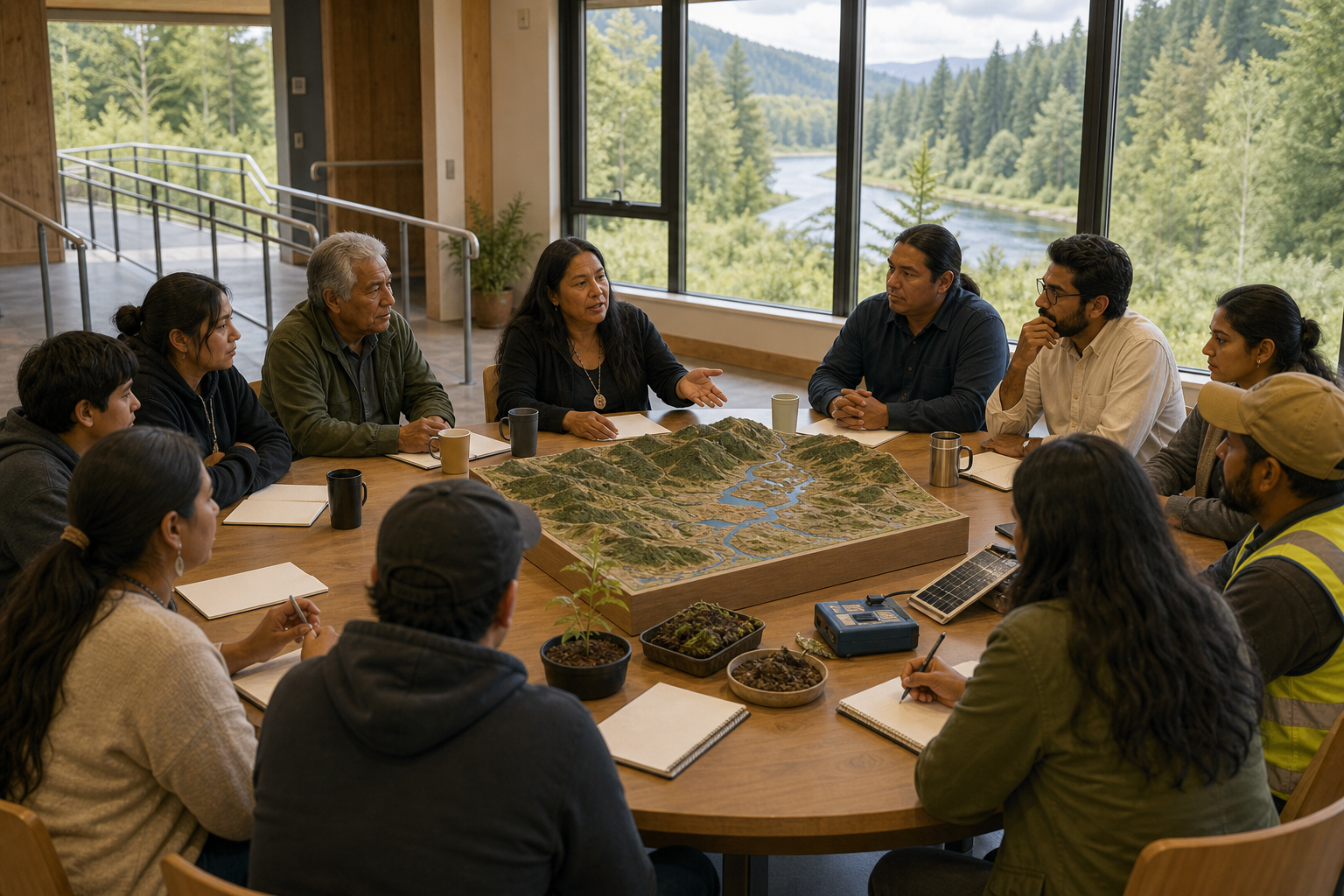
A clean-up, solar installation, tree-planting drive, or plastic-free festival may reduce harm. Climate justice asks whether the action also changes who carries the burden, who receives the benefit, and who has authority over the decision. A project can be environmentally useful yet remain unjust if it displaces a community, ignores customary relationships with land, or treats affected people as recipients rather than decision-makers.
Put three questions at the beginning of every ecological proposal:
- Harm: Who is exposed to pollution, displacement, water loss, livelihood disruption, or cultural damage?
- Power: Who can approve, reject, redesign, pause, or monitor the project?
- Repair: If harm occurs, who is responsible for correcting it, and through what process?
These questions prevent a common mistake: measuring only the improvement visible at your own gate. A temple can eliminate disposable plates while ignoring how its food, flowers, fuel, stone, timber, electricity, or festival materials are produced. A renewable-energy project can reduce emissions while transferring land and livelihood costs to a community that had no meaningful voice. Justice requires you to follow the consequences beyond the institution’s premises.
This concern is not theoretical. People defending land and ecosystems face documented threats and killings. The words carried by Indigenous protesters at COP30, “Our land is not for sale,” identify the missing centre of many climate discussions: land is not merely an asset to be reassigned in pursuit of someone else’s environmental target.
Use a direct decision rule: if the people most affected cannot influence the scope, terms, safeguards, and monitoring of a project, do not call their involvement partnership. Consultation after the plan is fixed is usually a request for endorsement. Bring rights-holders and affected communities into the process before the institution commits money, publicity, or prestige.
Dharmic principles are disciplines, not decorative language

Dharmic traditions give ecological action a moral vocabulary deeper than efficient resource management. They do not offer one identical theology, and their differences should not be blurred. They do, however, provide complementary disciplines for testing how we live within a larger order of life.
The Atharva Veda expresses the relationship with striking intimacy: “The Earth is my mother; I am her child.” Once Earth is approached through kinship rather than ownership, the first question changes. You no longer ask only how much can be extracted without collapse. You ask what conduct is fitting within a relationship that sustains you.
The Bhagavad Gita links food, rain, yajna, and right action in an interdependent cycle of sustenance. In an ecological application, yajna is not a licence to perform a ceremony while leaving destructive habits untouched. It directs attention to reciprocity: what you receive must be met with restraint, duty, and an offering back to the conditions that make life possible.
- Ahimsa asks you to trace harm. Do not stop at the final product. Examine the extraction, labour, transport, waste, habitat damage, and community disruption behind it.
- Aparigraha asks you to reduce demand. Replacing one disposable product with another may improve a material choice, but restraint asks whether the purchase is necessary at all. Refuse and reduce before searching for a greener substitute.
- Buddhist inter-being asks you to widen the boundary. A decision that looks efficient inside one building may shift costs to another watershed, neighbourhood, species, or generation.
- Seva asks you to serve without taking control. Service should strengthen the agency of the people concerned, not turn them into scenery for an institution’s public image.
- Sarbat da bhala asks who is included in the good. A benefit cannot be called universal when its hidden costs are imposed on communities excluded from the decision.
- Dharma asks what duty the situation creates. When conduct damages the relationships that sustain life, ecological harm becomes a form of adharma rather than a minor policy failure.
These principles become useful when they are allowed to reject a convenient proposal. If a supposedly green plan depends on displacement, ahimsa has not been applied. If it leaves extravagant consumption untouched, aparigraha has not been applied. If it invokes the welfare of all while excluding affected people from governance, sarbat da bhala has not been applied.
A Dharmic institution can make this discipline durable by forming an Eco-Dharma Council with a real mandate. Include people responsible for religious teaching, facilities, food, finance, purchasing, festivals, community service, and public advocacy. Give the council access to budgets and contracts, not merely permission to organise an annual awareness event. Its task should be to test material decisions against both ecological impact and justice.
Solidarity must protect communities, not borrow their symbols
There is no single Indigenous worldview, spokesperson, or set of protocols. Indigenous peoples have distinct histories, political circumstances, spiritual traditions, and relationships with territory. In Bharat, engagement may involve Adivasi and other forest-dependent communities, but the appropriate name, status, representative body, and decision process vary by place. Ask rather than assign an identity from outside.
Shared spiritual language can open a relationship, but it cannot substitute for rights. Indigenous elders and Dharmic leaders met at Kiva Kumbh during the Maha Kumbha Mela in Prayag Raj through prayer, song, meditation, and pledges. The operational lesson is not that ceremony is sufficient. It is that a public pledge should lead to an accountable commitment involving land, water, forests, livelihoods, or the protection of defenders.
Before announcing a coalition or inviting an Indigenous representative to an event, apply this partnership screen:
- Invitation: Who initiated the relationship, and has the community chosen the people authorised to speak?
- Consent: Can the community refuse the proposal, restrict publicity, change the scope, or end the partnership without retaliation?
- Authority: Which decisions are shared, and which remain under the community’s control?
- Resources: Is community expertise treated as skilled work, with agreed support for time, travel, translation, and participation?
- Information: Who owns recordings, photographs, ecological knowledge, maps, and other material created through the partnership?
- Benefit: Does the work strengthen land protection, cultural continuity, livelihoods, ecological restoration, or community-defined priorities?
- Accountability: Where can concerns be raised, who must respond, and what happens if the institution breaks its commitment?
Do not publish the locations, identities, strategies, or internal disagreements of threatened land defenders without clear permission. Visibility can increase danger. If a proposed action touches a contested land claim or could expose participants to legal or physical risk, let the community determine what can be disclosed and involve appropriate local legal counsel before making public commitments.
Also resist the temptation to extract a teaching while ignoring the people who carry it. Quoting kinship with Earth while remaining silent about land dispossession turns reverence into decoration. Respect becomes credible when your institution is willing to share resources, accept limits, support community authority, and remain present after the public event has ended.
Run a five-part climate-justice audit

You do not need to solve the whole climate crisis before acting. You do need to define one area of responsibility clearly enough that people can see what will change, who will decide, and how progress will be checked.
- Choose a decision your institution actually controls. Start with a facility, kitchen, festival, pilgrimage, construction project, investment, purchasing category, educational programme, or advocacy commitment. Name the decision precisely. “Care for Mother Earth” cannot be audited; reducing a defined waste stream or changing a defined procurement practice can.
- Build a baseline before selecting the solution. Gather current bills, purchase records, contracts, waste records, menus, transport arrangements, and construction plans relevant to that decision. Record quantities in the units already used by the institution. Without a baseline, a green label can replace evidence.
- Map impacts and decision rights. Identify who supplies the activity, who works in it, who lives near its effects, who carries unpaid burdens, who receives the benefit, and who currently has authority. Speak with affected people before drafting the final target. Record what they can approve, alter, monitor, or refuse.
- Apply restraint before substitution. Work through the sequence: refuse what is unnecessary, reduce demand, repair or reuse what already exists, and then replace the remaining harmful inputs. This is where aparigraha changes the plan. A new product is not automatically the answer to overconsumption.
- Assign accountability. Give the commitment a baseline, a measurable target, a responsible person or committee, a budget, a review date, a public reporting method, and a way for affected people to raise concerns. If the result is poor or harm appears elsewhere, revise the plan rather than defending the original announcement.
The first project should be material enough to matter and narrow enough to govern. A temple kitchen or gurdwara langar can examine food sourcing, serviceware, water, fuel, and waste. A festival committee can address vendor rules, transport, temporary structures, clean-up, and the treatment of neighbouring communities. A monastery or community centre can examine electricity, water, construction, purchasing, land care, and investment. A teaching programme can connect scripture with a specific institutional commitment rather than ending with personal lifestyle advice.
Watch for five failure modes while you conduct the audit:
- The badge without the baseline: “Green” or “zero-waste” language appears before the institution has measured the relevant activity. Correct it by publishing the starting point and the boundary of the claim.
- The substitute without restraint: One disposable material is exchanged for another while total consumption stays unexamined. Correct it by applying refusal, reduction, reuse, and repair first.
- The consultation after commitment: Affected people are invited once the budget, design, and public announcement are fixed. Correct it by involving them while refusal and redesign are still possible.
- The spiritual event without governance: A prayer, lecture, or clean-up creates attention but no budget owner or review date. Correct it by attaching every public pledge to an institutional decision.
- The local improvement with exported harm: The institution’s premises look cleaner because extraction, waste, or risk has moved elsewhere. Correct it by tracing suppliers, disposal routes, land impacts, and community consequences.
A usable institutional resolution can fit into one sentence: We will reduce [defined impact] from [documented baseline] through [specific action], developed with [affected people], who will hold [named decision or monitoring right], and we will publish the result on [review date] with a process for correcting harm. If your committee cannot fill those fields, the commitment is not ready for public launch.
Key takeaways
- Environmental stewardship becomes climate justice when affected people share meaningful power over decisions.
- Ahimsa, aparigraha, inter-being, seva, sarbat da bhala, yajna, and dharma should function as tests that can change or reject a proposal.
- Indigenous solidarity requires community-defined representation, consent, authority, resources, information safeguards, and accountability.
- Reduce unnecessary demand before buying a greener substitute, and trace harm beyond your institution’s property line.
- Give every commitment a baseline, measurable target, budget owner, review date, reporting method, and route for remedy.
Take one environmental decision already approaching your committee and place the audit beside it. Do not begin by asking which technology or product to buy. Begin by asking whom the decision affects, what duty follows, and how those people will share authority.
Then make one commitment that your institution can measure and keep. Sacred stewardship becomes credible through disciplined action: less harm, less possession, wider responsibility, stronger community power, and a relationship with Earth expressed in conduct rather than sentiment.
References
- Hindu Human Rights – Indigenous Wisdom and Hindu Dharma: A Sacred, Just Path to Lead the Climate Era
- Global Witness – Land and Environmental Defenders
- Atharva Veda – Full-text PDF
- Holy Bhagavad Gita – Chapter 3, Verse 14
- Yale Forum on Religion and Ecology – 10 Hindu Environmental Teachings
