

You see Vishnu reclining upon a serpent and face an apparent contradiction. Why would the Lord who preserves cosmic order rest on a creature that many people instinctively associate with danger?
The image becomes clearer once you stop treating “the serpent” as a single, generic symbol. Identify the Naga, notice what the figure is doing, and observe the relationship to Vishnu. Those three details distinguish Ananta’s steady service from Vasuki’s transformative effort and from the protective, fertility-oriented worship found at local Naga shrines.
First identify which sacred serpent you are seeing
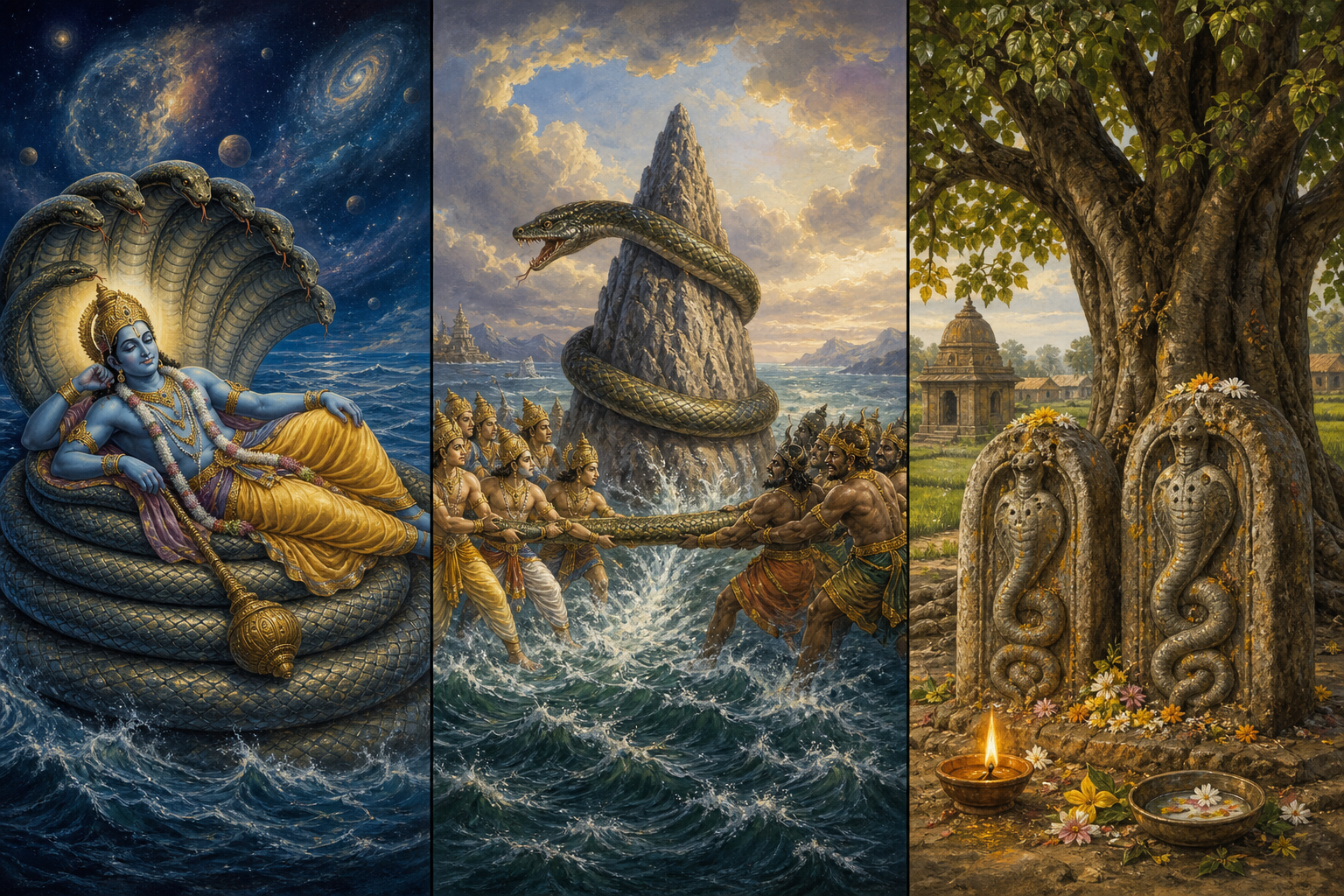
Vaishnava serpent imagery is not a catch-all code in which every Naga means the same thing. Ananta, also called Adi Sesha, is the infinite serpent upon whom Vishnu reclines. His presence conveys continuity, order, patient strength, and the stillness at the heart of creation. Vasuki appears in a different sacred action: the churning of the ocean, or Samudra Manthana. He therefore directs attention toward courage, transformation, and the difficult work accomplished through collective effort.
| Sacred figure | Primary setting | What to notice | Contemplative response |
|---|---|---|---|
| Ananta or Adi Sesha | Vishnu’s divine repose | Infinite strength becoming stable support | Cultivate steadiness, humility, and sustained service |
| Vasuki | Samudra Manthana | Power engaged in a demanding process of transformation | Accept disciplined effort and cooperate in work larger than yourself |
| Naga Devatas in local worship | Temple groves, serpent shrines, vows, and offerings | Protection, fertility, well-being, and reverence for life | Follow the temple’s custom and join devotion to ecological care |
The distinctions overlap without disappearing. Kerala’s Mannarasala Nagaraja Temple associates its sacred landscape with both Ananta and Vasuki. Ananta brings the meaning of cosmic support; Vasuki brings the meaning of courageous transformation. Their presence in one tradition does not make them interchangeable.
This helps you avoid two common errors. The first is importing a moral scheme in which a serpent must represent evil. That reading cannot explain why Ananta serves as Vishnu’s support. The second is assuming that every serpent image is merely another version of Ananta. A reclining Vishnu, a scene of cosmic churning, and a grove filled with Naga shrines establish different relationships and therefore carry different emphases.
When the identity is not obvious, begin with context rather than guesswork. Is Vishnu resting upon the serpent? Is the figure participating in the churning? Are you standing before a local Naga shrine where people undertake vows for family welfare or fertility? Read the action and setting before assigning a meaning.
Why Ananta can bear the weight of divine repose

Ananta is not decorative furniture placed beneath Narayana. He belongs among the Nityasuris, the eternally liberated attendants of Vaikuntha. Their service is not a bargain performed to acquire status or reward. It is the natural expression of devotion. Within this company, Adi Sesha represents patient strength and the sustaining ground of cosmic order.
The image therefore places power in a precise relationship to dharma. Ananta possesses immense capacity, yet his greatness appears through support rather than self-assertion. He does not compete with the Divine for the center of the image. His strength becomes sacred because it is wholly available to Narayana.
That is a demanding spiritual standard. You may possess knowledge, authority, endurance, wealth, or physical ability. Vaishnava symbolism asks a sharper question than whether you possess those powers: what do they uphold? Strength that feeds ahankara becomes restless. Strength placed in seva becomes dependable enough to support others without constantly demanding recognition.
Vishnu’s repose also should not be mistaken for passivity. The stillness of the scene is the stillness of order securely grounded. Ananta’s support allows repose without collapse. For a devotee, this offers a practical distinction between spiritual steadiness and inertia. Steadiness remains alert, faithful, and ready to serve; inertia avoids responsibility and calls the avoidance peace.
The Nityasuri setting sharpens the point. Garuda and Adi Sesha are both counted among Narayana’s eternal attendants, although their forms and modes of service differ. Vaishnava worship does not evaluate them by ordinary zoological categories. Their standing comes from devotion, fidelity, and the way their distinctive powers serve the Divine.
You do not need to force every coil or visual detail into a rigid secret code. The central relationship is already sufficient: the infinite serpent is ordered around the Divine and becomes a seat of stability. Let that relationship guide contemplation before looking for elaborate interpretations.
Let the symbol change the way you worship
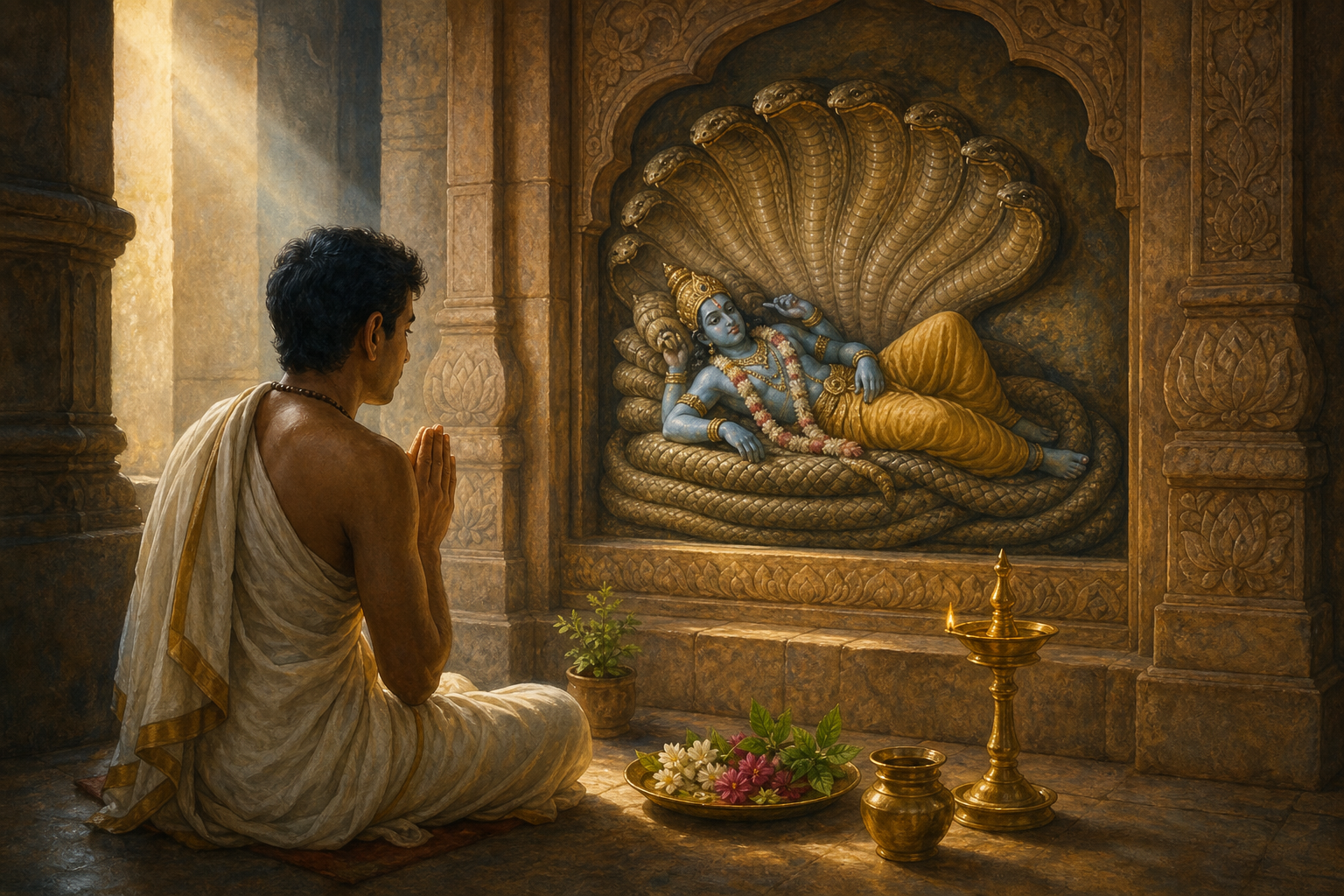
Sacred symbolism becomes useful when it changes attention and conduct. Ananta can serve as a visual anchor during Vaishnava practice, while Vasuki can help you interpret periods of demanding change. Neither requires inventing a new ritual.
At home: use a four-part contemplation
- Look at the relationship before the ornament. Notice Narayana in repose and Ananta in support. Hold the whole arrangement in mind instead of isolating the serpent as an object of fear or fascination.
- Name one quality you need to practise. Choose patient strength, steadiness, humility, or disciplined service. Keep the choice concrete. “I will complete the duty I have been postponing without seeking praise” is more useful than a vague wish to become spiritual.
- Return to the image when attention wanders. During japa, kirtana, or recitation of the Vishnu Sahasranama, recollect Ananta’s unwavering orientation toward Narayana. The purpose is not to analyse the picture throughout the practice. It is to let the image bring your attention gently back to the Divine.
- End with one act of seva. Choose something small enough to complete that day: relieve a family member of a task, fulfil a neglected responsibility, support temple work, or care for a shared space. This joins contemplation to the Nityasuri ideal of service.
Vasuki offers a different cue. When family, community, or professional life enters a period of “churning,” do not assume that spiritual composure means withdrawing from the work. Ask whether the process has a dharmic purpose, whether everyone is bearing responsibility, and whether your effort is producing transformation rather than endless agitation. Vasuki’s symbolism dignifies difficult cooperation; it does not sanctify chaos for its own sake.
Avoid turning either figure into an omen-decoding system. Seeing a serpent image is not, by itself, a prediction about your future. In Vaishnava worship, the dependable question is relational: how does this power stand in relation to Narayana and dharma? That question produces a spiritual discipline. Speculation about luck often produces only anxiety.
At a Naga shrine: follow the place, not an assumption
Temple practice belongs to a living custodial tradition. At Mannarasala, devotees commonly bring turmeric, milk, and lamps while seeking blessings connected with fertility, family harmony, protection, and the removal of obstacles. The annual Ayilyam observance brings pilgrims into collective prayer and procession. The grove, its many serpent icons, its custodians, and its prescribed worship form one sacred environment.
Do not treat those details as a universal instruction for every Vishnu temple or every Naga shrine. Ask what the particular temple permits, obtain guidance from its priests or custodians, and offer only in the designated manner. A practice received within a managed shrine is not permission to improvise with an image, a habitat, or a living animal elsewhere.
If fertility concerns bring you to Naga worship, understand the vow accurately. It is a prayer for grace, not a guaranteed medical outcome. Devotion can accompany medical evaluation and treatment, but it should not delay them. Keeping that distinction protects both the dignity of worship and your practical well-being.
The same clarity applies to living snakes. Reverence does not require touching, capturing, or feeding a wild snake. Keep a safe distance and use trained local help if an animal must be removed from a home or public space. Ahimsa protects the animal as well as the people nearby.
The sacred grove adds an ethical dimension that an isolated icon can be made to lose. If devotees seek protection from the Naga Devatas, they should also protect the conditions in which living beings can flourish. Respect temple vegetation, do not litter, do not damage serpent stones, and do not disturb animals for a photograph or display of piety. In this setting, ecology is not decoration around worship; care for the grove is part of understanding what the worship asks of you.
Key takeaways
- Identify the serpent and the scene before interpreting the symbol: Ananta in divine repose is not the same as Vasuki in Samudra Manthana.
- Ananta represents infinite capacity disciplined into patient support, cosmic order, and selfless service to Narayana.
- Vasuki directs attention toward courage, transformation, and cooperative effort during a demanding process.
- Use Ananta’s image during japa or recitation as a cue to return your attention to the Divine, then embody the contemplation through a specific act of seva.
- Temple offerings are governed by local tradition. Follow custodial guidance rather than copying a practice into a different setting.
- Fertility worship is prayer, not a medical guarantee, and reverence for Nagas never requires unsafe contact with a living snake.
The next time you stand before reclining Narayana, do not stop at the strangeness of the serpent. Notice the strength that has become support. Then choose one capacity of your own and place it in service of a person, duty, temple, or living environment before the day ends.
References
- DharmaRenaissance Blog — Mannarasala Nagaraja Temple: Vasuki and Ananta’s Sacred Grace in Fertility and Protection
- DharmaRenaissance Blog — Nityasuris of Vaikuntha: Profound Symbolism of Eternal Service, Grace, and Freedom
