
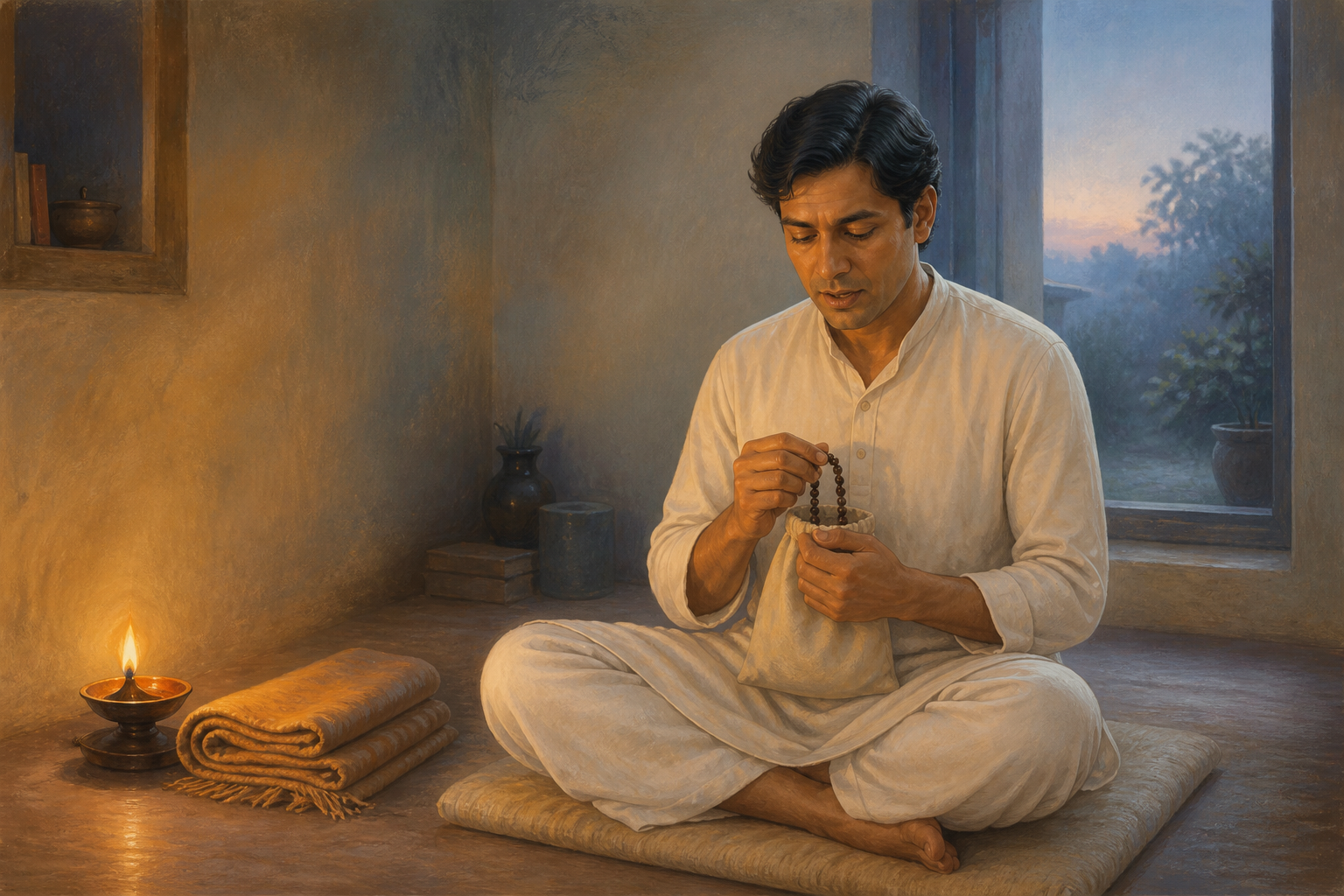
Your rounds may be getting done, yet you barely remember hearing them. The fingers move, the lips continue, and the mind composes messages, revisits conversations, or plans the day. By the final bead, completion has replaced communion.
If that has become your normal japa, do not wait for inspiration to repair it. Repeated distraction teaches the mind that japa is a suitable background for everything else. The way out is equally practical: prepare the beginning, give attention one clear task, and correct drift before it consumes the whole session. You are rebuilding a habit of meeting the Name.
Reset the practice before you touch the first bead

Poor japa often begins before the mantra begins. You arrive carrying digital stimulation, unfinished decisions, physical tension, and pressure to finish quickly. Then you expect the first bead to produce immediate absorption. A better transition removes some of that momentum before it enters the practice.
Use the same short preparation whenever possible:
- Go to a designated place. Keep it clean, uncluttered, and associated with sadhana rather than work, entertainment, or messaging.
- Put the phone beyond reach. Muting it is weaker than removing it. If you can still see or touch it, part of the mind remains available to it.
- Set the body. Keep the spine upright without becoming rigid. Release unnecessary tension in the face, shoulders, and hands.
- Take a few relaxed, even breaths. Let breathing settle restlessness, but do not turn it into a second meditation competing with the mantra.
- Make a sankalpa. Use one honest sentence, such as: “For this round, I will serve by hearing the Name.” A Krishna-bhakta may also pray directly for help to chant with sincerity.
- Begin the first mantra deliberately. Pronounce it clearly and hear it from beginning to end before moving the bead.
This preparation need not become elaborate. Its purpose is to mark a boundary: ordinary activity has paused, and attentive seva has begun. A simple recurring cue, such as lighting a lamp, can strengthen that boundary.
Early-morning japa is especially worth protecting because it can come before messages, news, and other demands have occupied the mind. If family or work duties make that time impossible, choose the earliest stable window you can actually defend. Consistency matters more than imagining an ideal schedule and repeatedly missing it.
Give the mind one job: hear the mantra you are chanting

Attentive japa does not require you to prevent every thought from appearing. That demand quickly becomes another distraction. Your practical duty is narrower: produce the mantra clearly enough to hear, listen to its sound, notice when listening has stopped, and return.
The basic loop is simple:
- Say the entire mantra distinctly.
- Hear the sound rather than merely confirming that the lips are moving.
- Move the bead with awareness.
- When the mind wanders, return to the sound currently being chanted.
Do not hold an inquiry into every distraction. If the mind starts planning a task, you do not need to finish the plan, condemn the thought, or argue with yourself. Recognize that hearing has stopped and come back. The return is part of the training, not evidence that the practice has failed.
Your voice should be audible enough for your own ears and gentle enough to sustain. If syllables merge or disappear, slow down. If the voice fades into inaudible mouth movement, raise it slightly. If louder chanting creates strain, soften it without sacrificing clarity. Pace is serving attention; attention is not serving pace.
Avoid combining japa with messages, household browsing, or mental scheduling. Multitasking does more than interrupt a particular round. It repeatedly associates the mantra with divided attention. In the same way, clear and heartfelt chanting can make attentive chanting more familiar. What you rehearse becomes easier to repeat.
Breath can support this loop without becoming its object. When agitation is high, pause before a round for a few even breaths, then let breathing proceed naturally while you listen. Do not force every mantra into a rigid breathing pattern. The sound of the mantra remains central.
Correct drift after one round, not after the whole session

A distracted first round does not have to dictate every round that follows. The critical skill is making a small correction while you are still chanting. After each round, pause briefly and ask:
- Did I actually hear the mantra?
- Where did clarity weaken?
- What one change will I make in the next round?
The third question matters most. A checkpoint without an adjustment becomes self-judgment. Choose one correction rather than redesigning the entire practice between rounds.
| What you noticed | Change for the next round |
|---|---|
| Syllables became blurred | Slow the pace and articulate the complete mantra. |
| The voice became too faint to follow | Chant slightly louder while keeping the tone gentle. |
| The mind kept returning to tasks | Remove any visible prompt, restate the sankalpa, and return to hearing. |
| Physical restlessness took over | Reset the posture and take a few relaxed breaths before continuing. |
| The rhythm became dull or automatic | Refresh attention with clearer audible japa; at an appropriate break, use kirtan to renew engagement. |
| Self-criticism became the main mental activity | Drop the commentary and return to the next audible mantra without punishment. |
These checkpoints prevent one mechanical stretch from becoming the unquestioned standard. They also give you a more useful measure than mood. You may not feel profound absorption, but you can know whether you heard more clearly, noticed distraction sooner, or recovered without losing several more beads.
Do not chase novelty every time attention weakens. Constantly changing place, posture, volume, or technique can itself become avoidance. Make the smallest correction that addresses the problem you actually noticed, then stay with it for the next round.
Protect the vrata without turning japa into arithmetic
Count and quality become enemies only when the practice is poorly arranged. If you have accepted a vrata of sixteen rounds, do not use the desire for perfect concentration as a reason to abandon the commitment. Do not use the commitment as a reason to race through indistinct mantras either. Protecting the vrata means protecting enough time to chant it honestly.
For practitioners formed by Srila Prabhupada’s teaching and the sixteen-round discipline, the count is not a casual target to renegotiate according to the day’s mood. Begin early enough that every delay does not create panic near the end of the day. If postponement has become regular, treat the start time as the first problem to solve. Late rounds often inherit both fatigue and the pressure to finish.
If you have not accepted that vrata, establish an honest baseline suited to your present commitment and increase it steadily under appropriate spiritual guidance. A dramatic increase that collapses after a short burst does not build the same trust as a sustainable daily practice. Whatever your level, decide the commitment before the mind becomes tired and starts bargaining.
When completion is repeatedly difficult, bring the problem into satsanga rather than hiding it. Gentle accountability can be concrete: tell a trusted practitioner whether you started at the intended time, completed the accepted count, and made one quality correction. This is more useful than making grand claims about devotional feeling.
Attention also needs nourishment. Before japa, briefly remember why you are chanting. A verse from the Bhagavad-Gita or Srimad-Bhagavatam can turn the mind toward humility, gratitude, and service. Kirtan may restore taste when solitary repetition has become dry. Neither should become a way to evade japa; they prepare the heart to meet the mantra more sincerely.
Related disciplines across the dharmic family – including naam jap, simran, and forms of mindful recitation in Hindu, Buddhist, Jain, and Sikh traditions – also value recollection, steadiness, and the return from distraction. Their theological meanings are not interchangeable. The shared practical lesson is narrower and valuable: sacred repetition deserves undivided presence, not a leftover corner of attention.
Key takeaways for your next japa session
- Put the phone out of reach before taking the mala.
- Use a brief sankalpa so the first bead begins as seva rather than momentum.
- Chant clearly enough to hear every syllable, at a pace that preserves the whole mantra.
- Treat wandering as a cue to return, not an occasion for self-attack.
- After each round, identify one problem and make one specific correction.
- Protect an accepted vrata with adequate time, a reliable start, satsanga, and honest accountability.
You do not need to repair months of distracted japa in one heroic sitting. At your next session, prepare the first bead, listen through one complete round, and make one correction before beginning the next. That is how inattentiveness stops being the default and attentive chanting becomes familiar again.
References
