
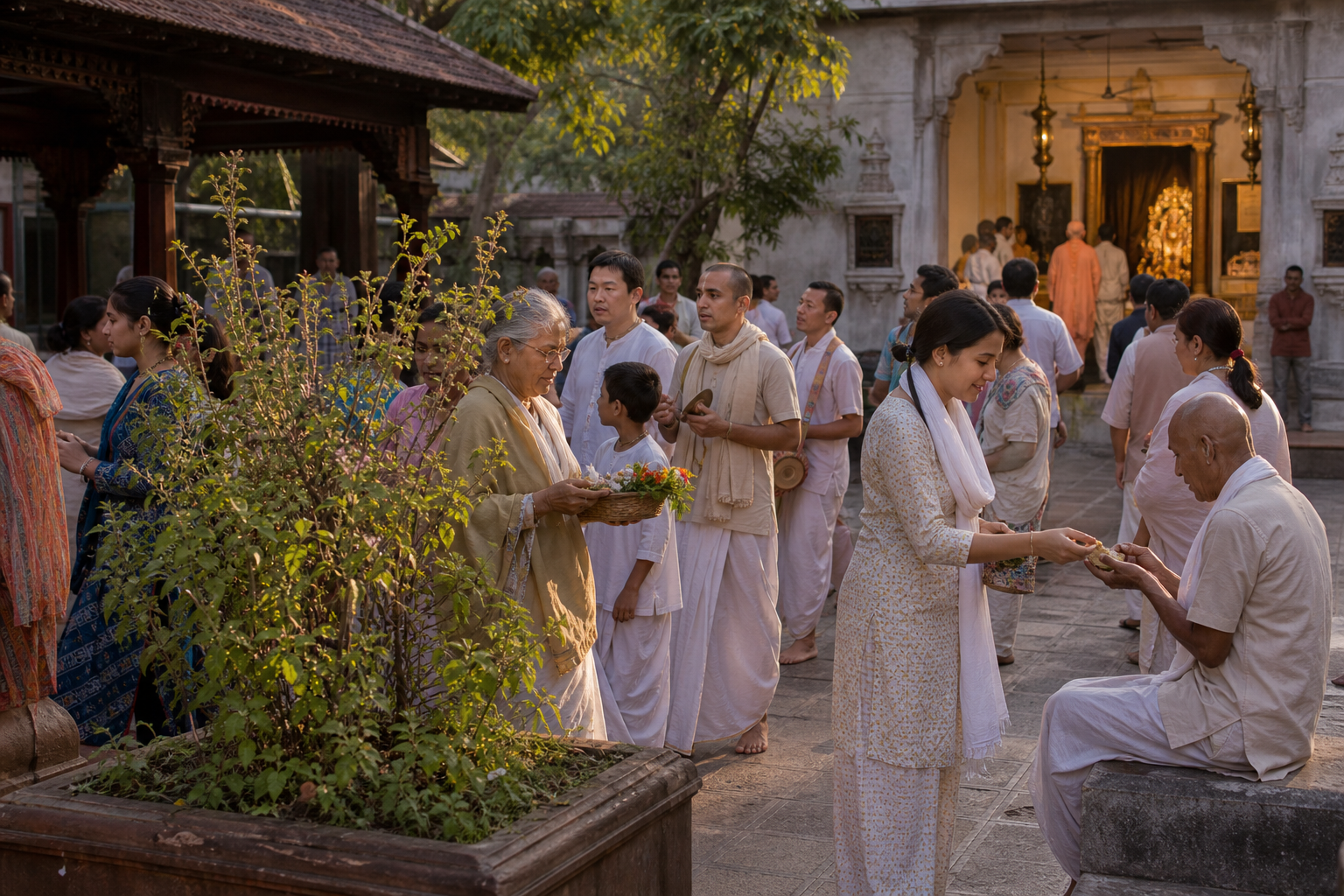
You may arrive at a Vaishnava temple knowing the deity’s name, the architectural highlights and the festivals associated with the place, yet still leave unsure whether you encountered anything beyond a beautiful monument. The missing element is usually not more information. It is participation in the place’s devotional rhythm.
A sacred place becomes legible when you notice how people hear, remember, serve and receive the Divine there. Prepare for those practices before you travel, enter them respectfully while present, and carry one of them into ordinary life. That is how a destination becomes a pilgrimage.
Sacredness is a relationship, not a backdrop
Vaishnava sacred geography cannot be reduced to the location of an old temple. Its real unit is relationship: Bhagavan is worshipped in a particular form; devotees approach through a particular lineage and devotional mood; hymns give language to that relationship; ritual gives it a recurring shape; and the surrounding community keeps it present across generations.
Srivilliputtur makes this visible. Its sacred centre consists of the Andal Temple and the Vatapatrasayi Perumal Temple, two Divya Desams shaped by the legacies of Andal and Periazhwar. The town is not merely a container around those sanctuaries. Tamil hymns, domestic recitation, temple worship, festival processions, food offerings and streets used by generations of devotees form one devotional environment.
New Vrindaban reveals the same principle through a very different landscape. Its Vaishnava identity grew through rural community life: modest accommodation, care for cows, cultivation, shared labour and devotion centred on Krishna. During Srila Prabhupada’s visits, cool well water, fresh milk and an austere way of living became part of the community’s spiritual formation. Sacredness was expressed not only in formal worship but also in how necessities were obtained, offered and shared.
This gives you a useful test for any pilgrimage. Ask what relationships sustain the place when no visitor is taking photographs. Look for the presiding form of Bhagavan, the local sacred voices, the recurring acts of worship and the work that supports them. Those elements tell you what the place is asking you to learn.
Prepare for the local grammar of devotion
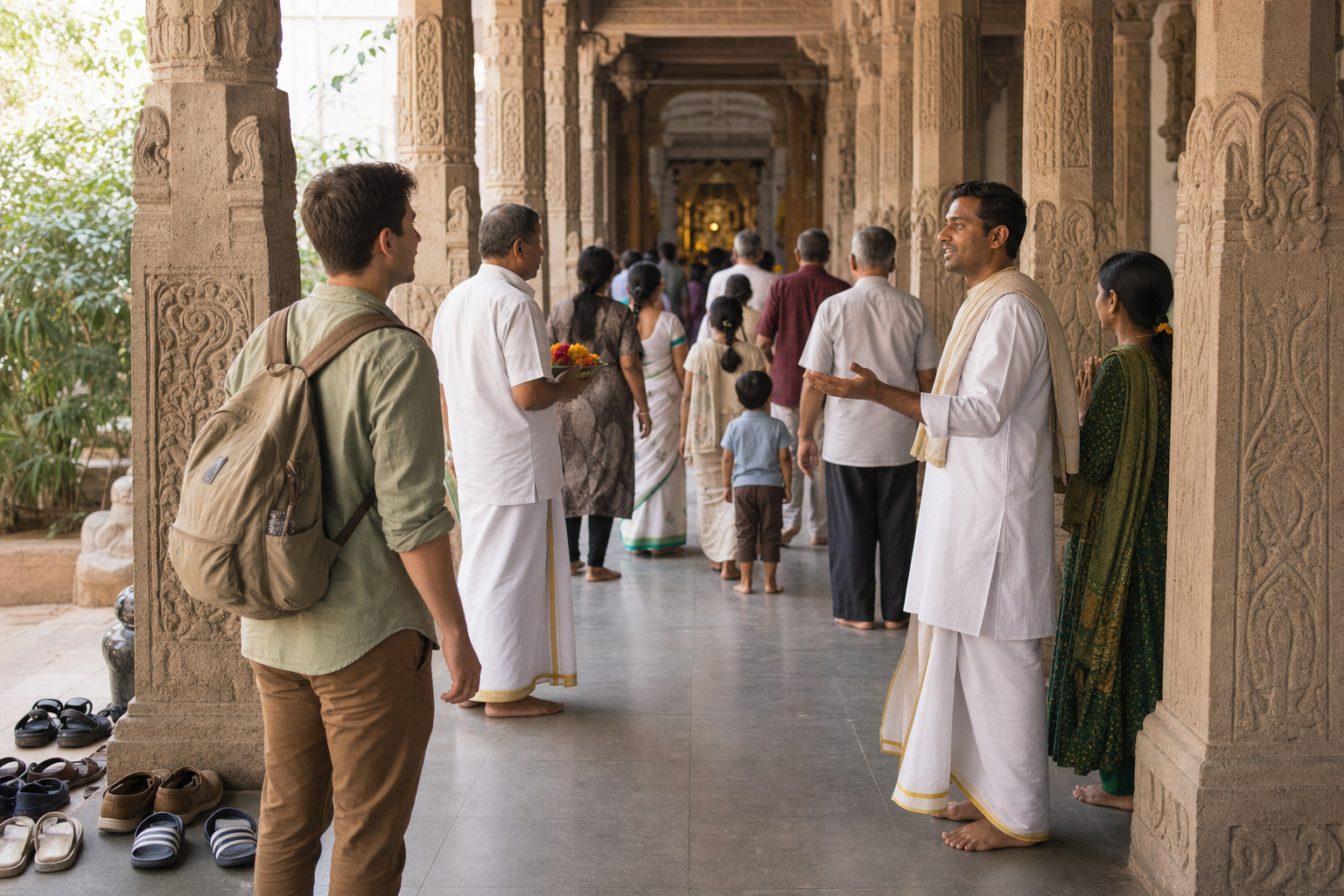
Preparation should help you participate without pretending to belong to a lineage or role you do not hold. A short, focused preparation is more valuable than collecting disconnected facts.
- Identify the devotional centre. Learn which form of Bhagavan presides, which devotees or acharyas are inseparable from the place, and which local practice expresses that relationship most clearly. In Srivilliputtur, Andal and Periazhwar are not optional historical background; their devotional voices are central to understanding the town.
- Read the text that the community actually uses. For Srivilliputtur, begin with a reliable translation of Andal’s Tiruppavai or Nachiyar Tirumoli, or with hymns of Periazhwar preserved in the Nalayira Divya Prabandham. Read enough to recognise the devotional mood when you hear it in worship. You do not need to master the corpus before arriving.
- Check the current temple and festival schedule locally. Daily worship and seasonal observances create different experiences. Margazhi brings collective Tiruppavai recitation, while Aadi Pooram and Vaikuntha Ekadashi draw public participation through their own liturgical rhythms. Confirm present arrangements rather than assuming that customary observances guarantee a particular visitor schedule.
- Ask what participation is appropriate. Temple access, photography, offerings and volunteer service can be governed by local rules. Follow posted instructions and the guidance of authorised temple or community representatives. Respect is shown by accepting limits without treating them as obstacles to your experience.
- Choose your purpose before you arrive. Write down one question you are bringing to the place. It may concern surrender, disciplined service, family affection, simplicity or ethical consumption. A clear question gives you something more substantial to notice than a checklist of sights.
Do not build your visit around architecture alone, even when the architecture has public importance. Srivilliputtur’s temple tower is an emblem of the Government of Tamil Nadu, but its cultural visibility does not exhaust its sacred meaning. The tower points toward a living centre of worship; it is not a substitute for entering that life attentively.
Move through hearing, seeing, serving and receiving
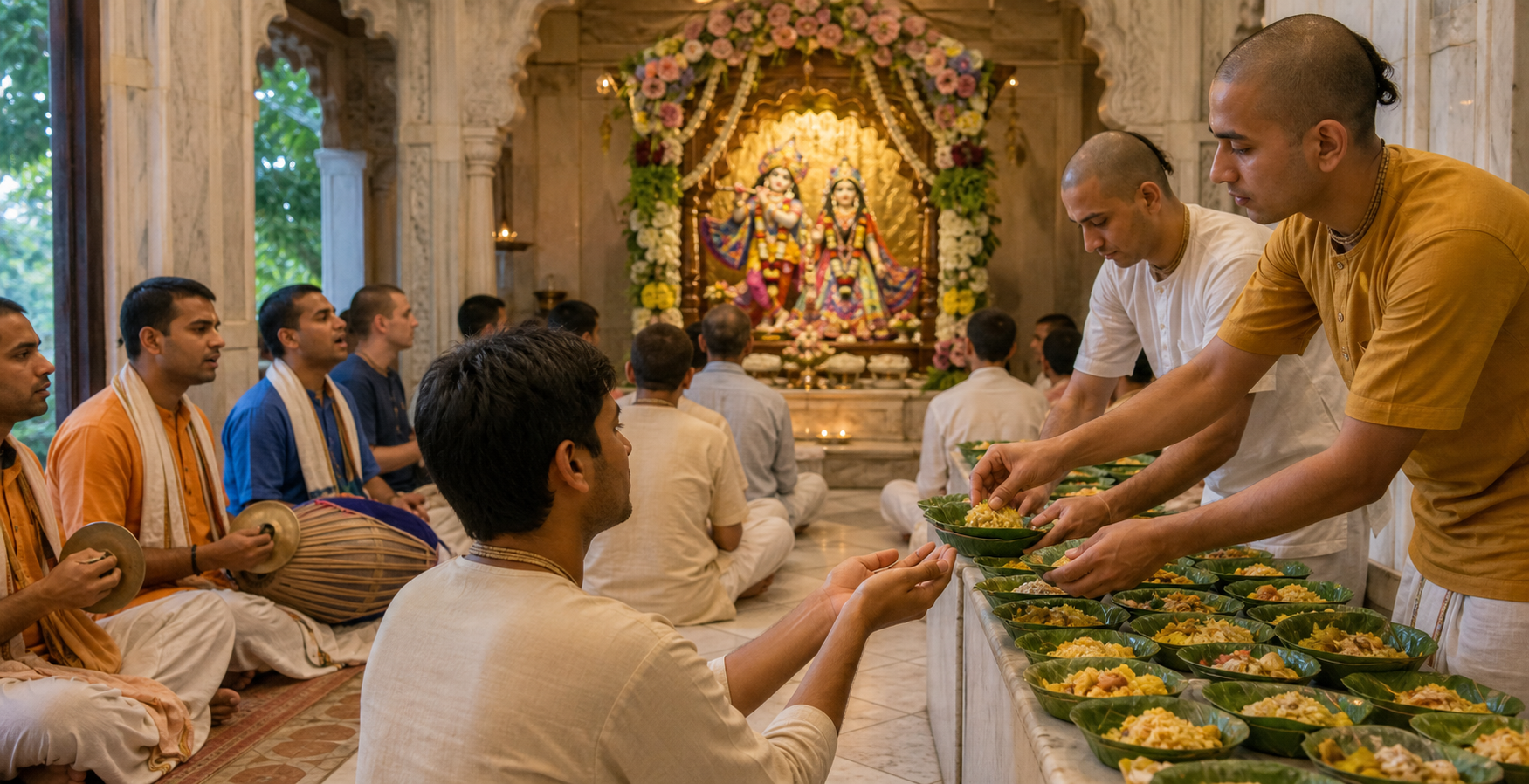
A useful pilgrimage has a sequence. Begin by hearing. Then allow darshan to focus your attention. Serve where service is invited. Finally, receive what the community gives through teaching, hospitality or prasada. Each movement corrects a different tourist habit.
Hear before you interpret. In Srivilliputtur, the recitation of Tamil hymns is not decorative sound around the supposedly important visual experience. The words transmit a way of approaching Vishnu. During Margazhi, the shared recitation of Tiruppavai joins temple and household practice. Listen for how an individual composition becomes communal discipline. If you know a passage, join only where participation is welcomed; otherwise, attentive silence is already meaningful.
Let darshan resist haste. Darshan is not simply viewing an object. It is a devotional encounter in which seeing is joined to being present before the Divine. Put the phone away for part of the visit, even where photography is permitted. Notice the order of worship, the movement of devotees and the way attention changes when the processional deity enters public space. Srivilliputtur’s bells, dawn recitation and processions through long-used streets show how temple worship can gather an entire town into sacred memory.
Serve without making yourself the centre. Seva may involve supporting an authorised activity, helping with community work or simply reducing the burden your visit creates. Ask what is needed. At a rural community, service may be inseparable from agriculture, food preparation, animal care or maintenance. In a temple town, it may mean following processional arrangements, preserving cleanliness or supporting heritage through proper channels. The governing question is not, “What unusual experience can I obtain?” but, “What form of care sustains worship here?”
Receive prasada as instruction. Sacred food binds theology to the senses. Srivilliputtur’s association with akkaravadisal and Andal’s devotional memory shows how taste can carry a story of offering and belonging. New Vrindaban places similar emphasis on the moral and devotional conditions behind food: land, labour, cows, restraint and gratitude. Do not consume prasada as a regional novelty. Pause long enough to remember what was offered, to whom it was offered and whose service made it possible.
These practices also help you recognise different devotional moods without flattening them. Andal gives voice to intense love, surrender and ethical commitment. Periazhwar approaches Krishna through vatsalya bhava, the tenderness and protective concern of parental affection. Srila Prabhupada’s guidance at New Vrindaban places disciplined service, contentment and simple living near the centre of community formation. Each answers the question of lived devotion differently, and each deserves to be encountered on its own terms.
Plurality is not vagueness. You can respect several Vaishnava lineages, and the wider family of dharmic traditions, without mixing unfamiliar mantras or practices into a private synthesis. Learn the local form first. Ask how its theology becomes conduct. Respectful dialogue grows from clear identities, not from erasing distinctions.
Key takeaways
- A Vaishnava sacred place is sustained by relationships among Bhagavan, lineage, hymn, ritual, community and service; architecture is only one part of that whole.
- Prepare by learning the presiding form, the local devotional voices, the worship schedule and the rules governing visitor participation.
- Organise your visit around hearing, darshan, permitted seva and the respectful reception of prasada.
- Notice the devotional mood the place cultivates. Love and surrender, parental affection, disciplined service and simple living are related expressions of bhakti, not interchangeable slogans.
- Measure the pilgrimage by the practice it changes after you leave, not by the number of places you managed to see.
Carry the place home through one durable practice
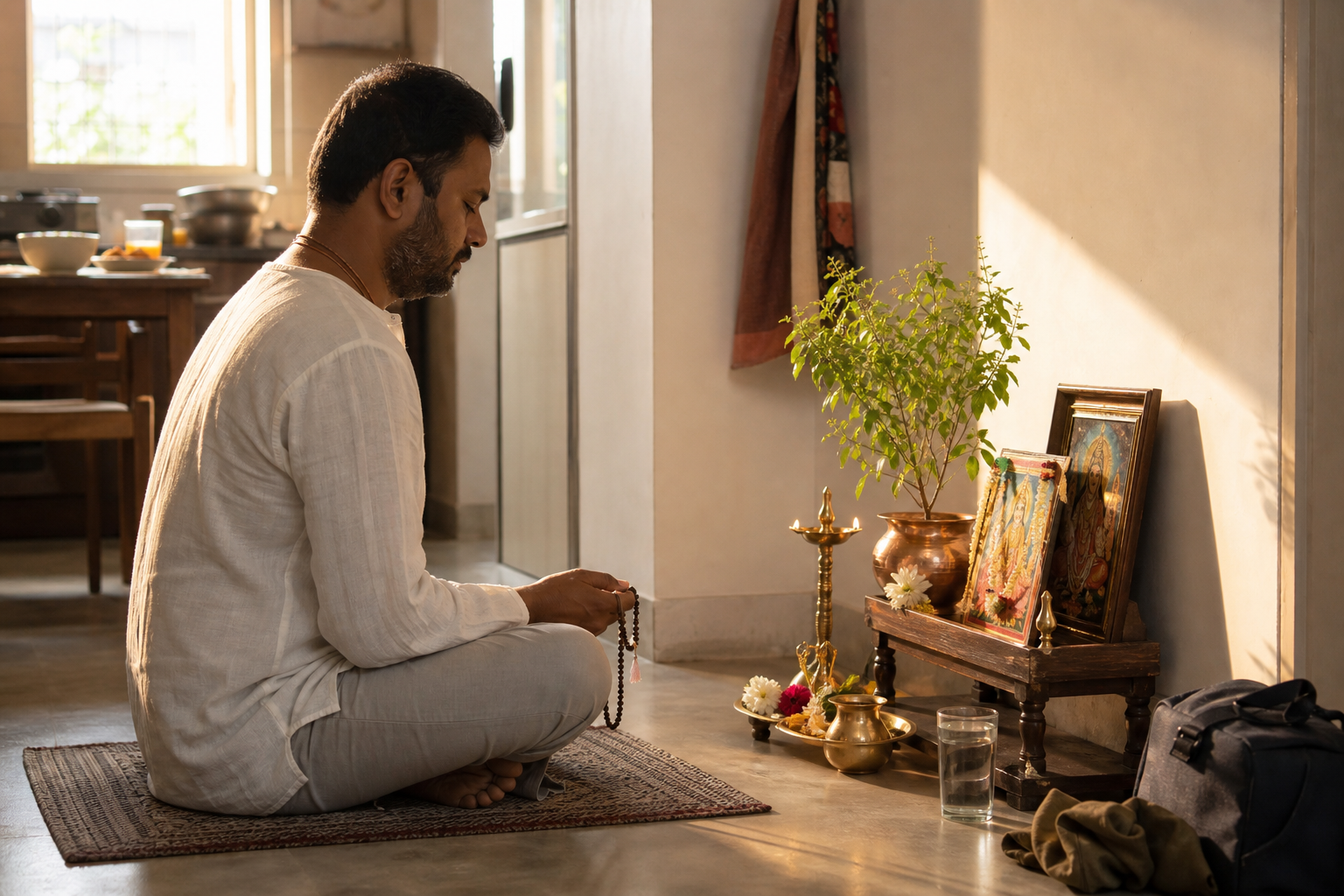
The decisive part of a pilgrimage begins when its atmosphere is no longer around you. Choose one local lesson that can survive in your real circumstances. Do not imitate the visible surface of another community’s life. Translate its principle into a discipline you can actually keep.
Srivilliputtur may lead you to join or establish a regular Tiruppavai recitation during Margazhi, provided that you approach the text with respect for its Sri Vaishnava setting. Periazhwar’s vatsalya may change how you perform care in your household: not as an interruption to spiritual life, but as a devotional responsibility. Andal’s vision may ask whether surrender is visible in your choices rather than confined to emotion.
New Vrindaban poses a different examination. Simple living is not nostalgia for discomfort, and austerity is not a performance of hardship. Its practical question is whether food, consumption, labour, land and care for living beings can be brought into closer alignment with devotion. Your response might be less wasteful food preparation, steadier support for cow protection, more conscientious consumption, or regular service in a community project. Choose the form that connects principle to conduct.
Write your commitment using a cue, an action and a devotional purpose. For example: “During Margazhi, when the household gathers in the morning, we will recite from Tiruppavai so that Andal’s discipline shapes the day.” Or: “When preparing an offering, we will account for waste and remember the labour and living beings involved in bringing food to the table.” A vow stated this clearly is easier to practise and harder to reduce to sentiment.
Your conduct as a pilgrim also affects whether sacred places remain living inheritances. Observe rules on access and photography, avoid creating waste or noise, use authorised channels for offerings, and remember that conservation includes rituals, recitation, food traditions and community knowledge as well as stone and sculpture. Heritage stewardship fails when it preserves a structure while displacing the devotional life that gave the structure meaning.
Before your next journey, make a small pilgrimage note with these headings: deity, local sacred voice, permitted seva and home discipline. If you can fill them in honestly, you are preparing to meet a sacred place rather than merely pass through it.
References
- DharmaRenaissance Blog – Srivilliputtur’s Sacred Legacy: Andal’s Tamil Nadu Temple City and Vaishnava Devotion
- Dandavats – Sacred Footsteps in New Vrindaban: Srila Prabhupada’s Timeless Guidance on Simple Living
