
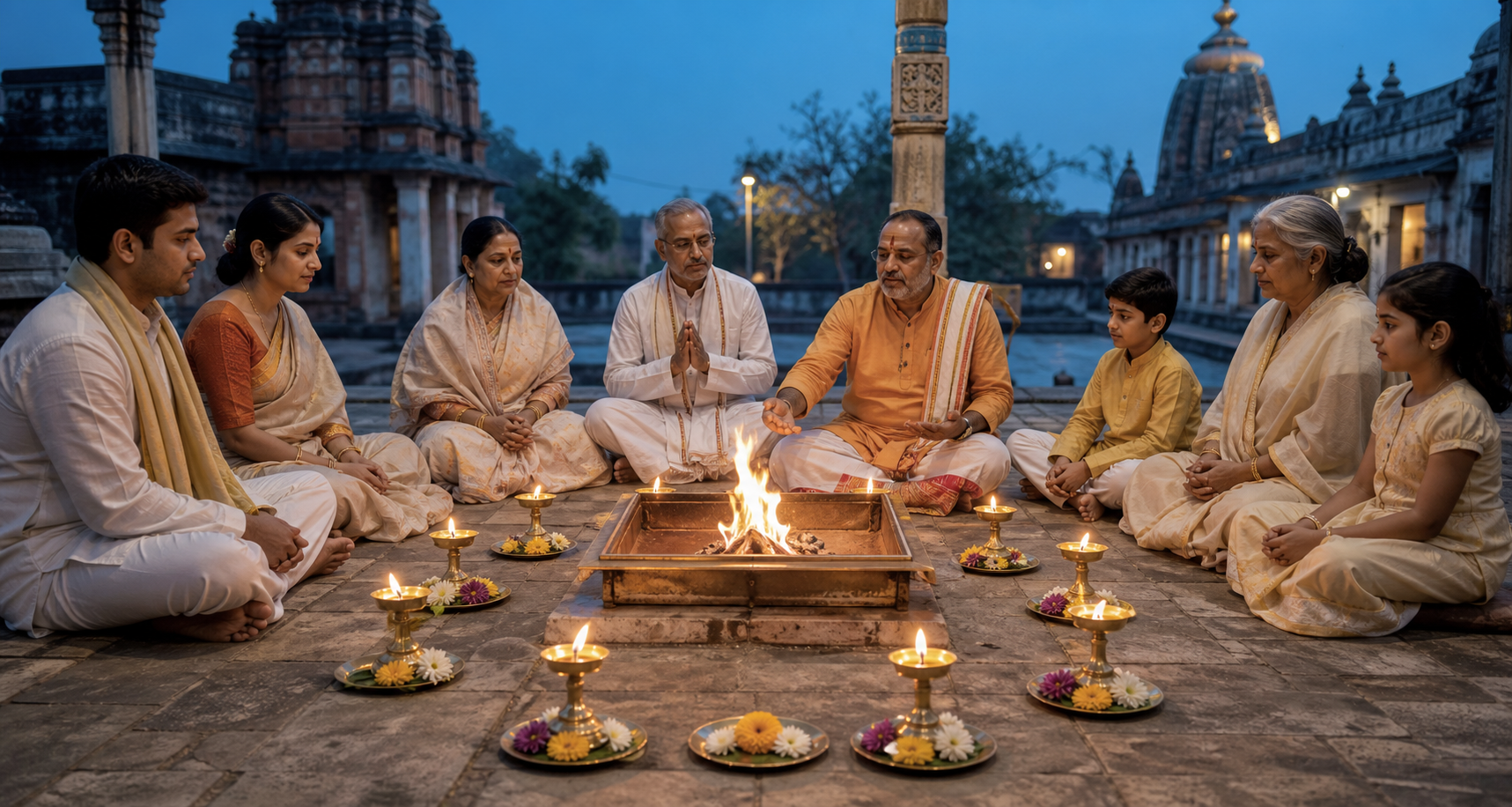
If you have been told that Shani, Rahu, or another graha is influencing a difficult period, your first decision is not which offering to buy. It is whether your response will be ruled by fear or organized around dharma.
Grahayajna gives you a disciplined way to respond through worship, mantra, fire offerings, charity, restraint, and service. It does not guarantee that every difficulty will disappear. Its deeper purpose is to turn anxiety into a clear sankalpa, a properly guided practice, and conduct you can sustain after the havan kund has cooled.
Understand what Grahayajna can and cannot do
Within Jyotish Shastra, a graha is more than a physical object in the sky. The Navagrahas represent patterns of temperament, timing, learning, and lived experience. The nine are Surya, Chandra, Mangala, Budha, Guru, Shukra, Shani, Rahu, and Ketu.
This framework does not require you to regard yourself as a helpless victim of the planets. A graha may describe a pressure, tendency, opportunity, or lesson, but it does not relieve you of responsibility for what you say and do. Jyotish is most useful when it helps you notice a pattern and choose a more dharmic response to it.
Grahayajna is a structured ritual response to that pattern. Depending on lineage and circumstance, it may include homa or havan, mantra-japa, puja, offerings associated with particular grahas, daana, vrata, and seva. Its traditional purposes include pacifying difficult influences, strengthening auspicious tendencies, expressing gratitude, and restoring clarity.
The crucial distinction is between remedy and transaction. A remedy disciplines your attention and conduct. A transaction imagines that an offering purchases immunity from karma. Grahayajna belongs to the first category. It may support steadiness, but it does not make dishonesty harmless, negligence wise, or an avoidable consequence disappear.
Ask a better question than, “Will this remove my problem?” Ask, “What pattern am I being called to address, and what form of worship and conduct will help me address it responsibly?” That question leaves room for grace without abandoning agency.
The same boundary applies when the concern involves health, severe emotional distress, legal exposure, or money. Navagraha worship may accompany appropriate professional care and sound decision-making, but it must not replace them. Do not postpone urgent help while waiting for a muhurta or a promised astrological change.
Choose a form of practice that matches the need
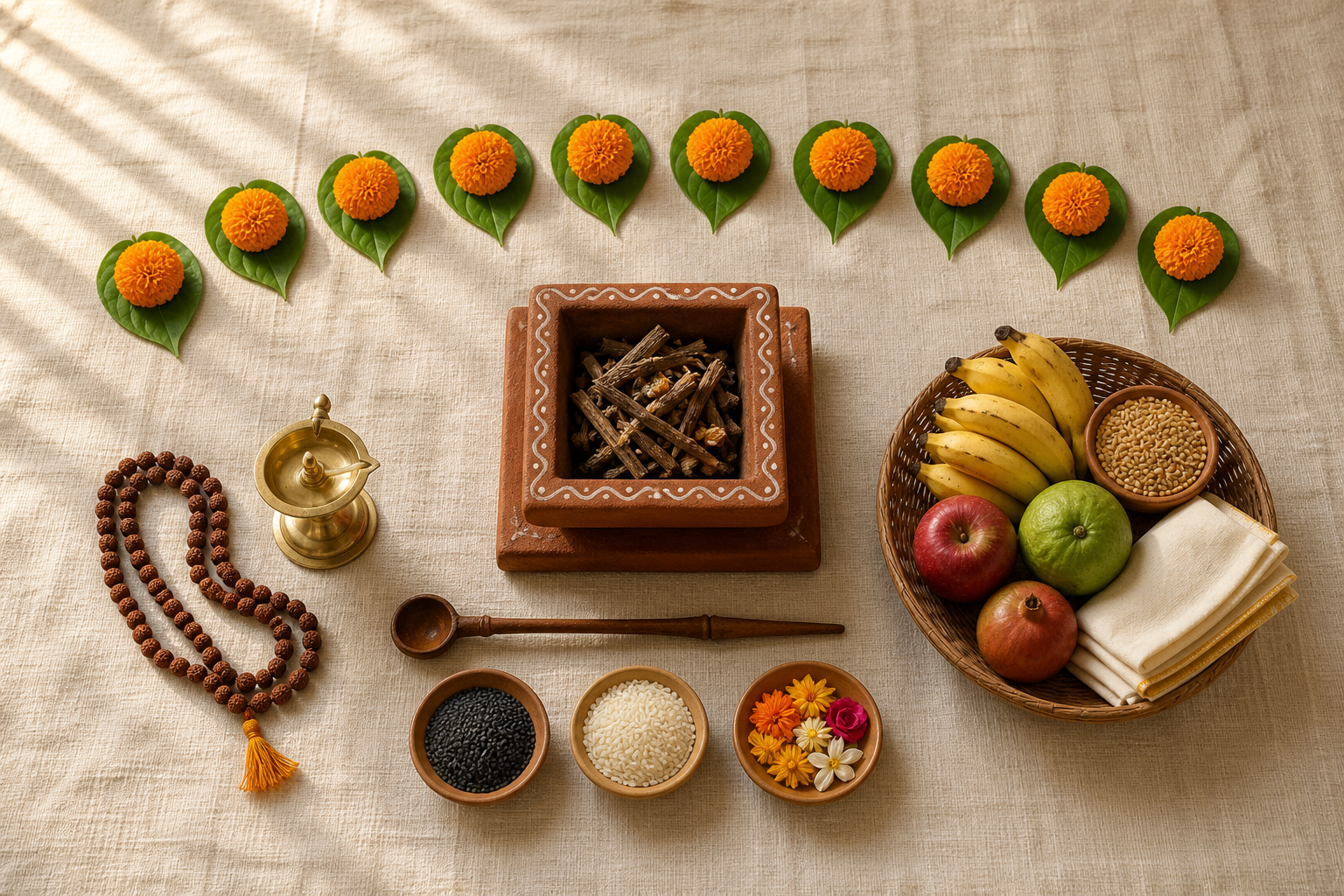
Not every concern requires the largest possible ceremony. Grahayajna appears as a family rite at home, a temple-based Navagraha shanti, or a community observance connected with an important milestone. Regular Navagraha practice may also emphasize japa, puja, daana, vrata, or seva without attempting to reproduce a complete fire ritual.
When a formal yajna is appropriate
A formal rite may make sense when your family is approaching a major transition, when a competent Jyotisha has identified a specific concern, or when your lineage ordinarily marks the occasion through Navagraha shanti. Homa is not merely a collection of objects placed into a flame. Mantra, sequence, intention, fire discipline, and the role of the officiant belong together.
If you are not trained in the rite, work with a trusted priest or established temple. Do not improvise a havan from a generic list, and do not assume every regional offering belongs in every lineage. Fire also creates an ordinary safety responsibility: use an appropriate kund and venue, keep the area ventilated and controlled, and follow the officiant’s directions.
Before agreeing to a ceremony, ask for plain answers to these questions:
- Is this a general Navagraha shanti or a practice directed toward a particular graha?
- What concern is the rite intended to address?
- Which lineage or regional procedure will be followed?
- What should you and your family do during the puja or homa?
- Which daana, vrata, japa, or seva is part of the observance?
- Which requirements are essential, and which are customary or optional?
- What conduct should continue after the ceremony?
A responsible explanation should connect the recommendation to its purpose. “Perform this because you must” is not enough. You should understand whether the practice is meant to cultivate restraint, repair neglect, reinforce generosity, steady the mind, or prepare the family to meet a transition with reverence.
When a simpler practice is the better beginning
If your real need is to rebuild discipline, a modest practice you can maintain may serve you better than an elaborate ceremony you immediately forget. That practice could include a mantra taught within your tradition, a simple puja, a suitable vrata, charitable giving, or regular seva. The exact mantra, offerings, and observances vary, so obtain those particulars from a trustworthy lineage rather than treating an unsourced online list as universal.
Do not measure sincerity by expense or spectacle. A large havan without truthful conduct leaves the central work undone. A smaller observance joined to non-harm, restraint, generosity, and responsible effort may penetrate daily life more deeply.
Make sankalpa, muhurta, and conduct work together
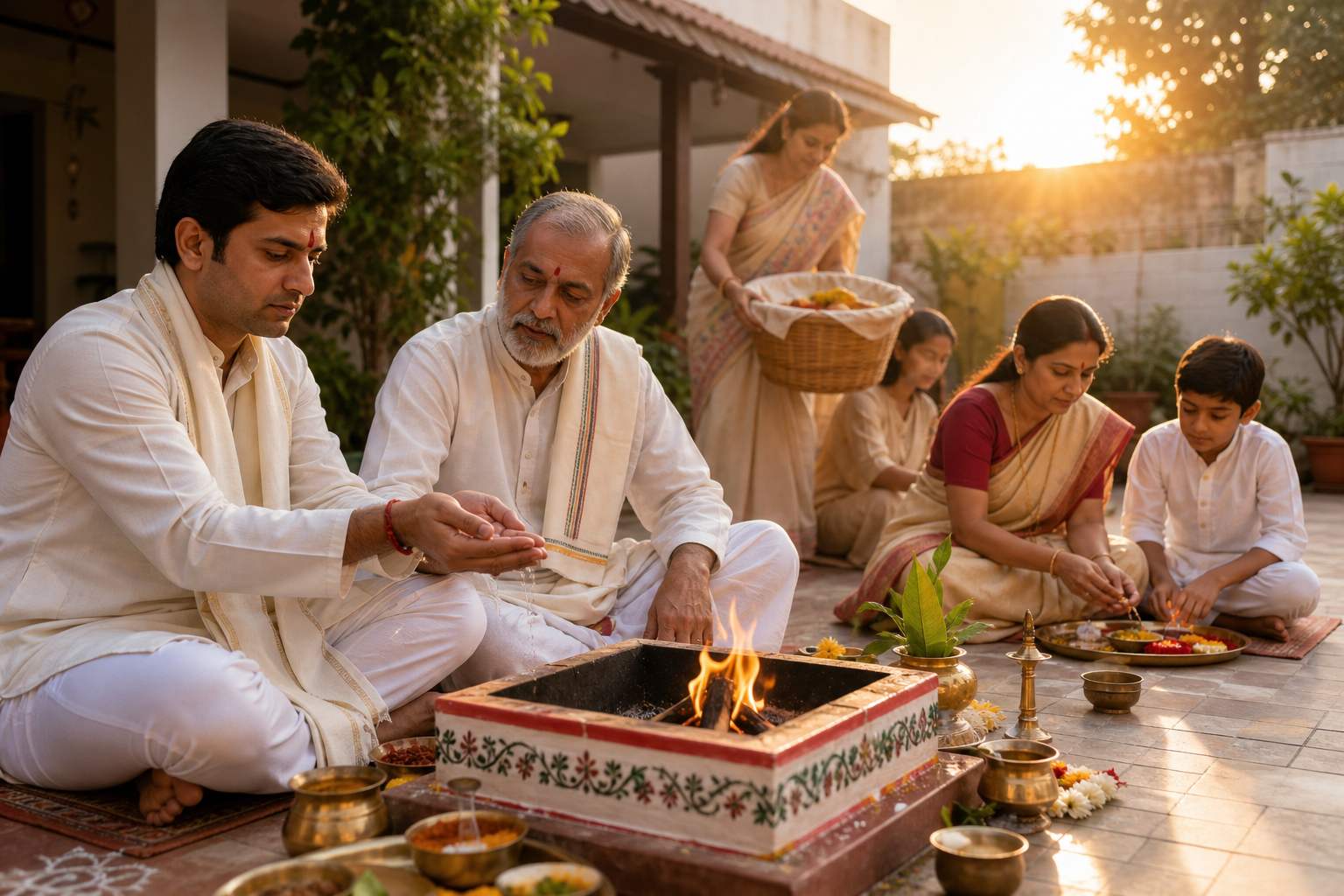
The three parts answer different questions. Sankalpa states what you are undertaking. Muhurta identifies a suitable time to begin or perform it. Conduct determines whether the intention survives beyond the ritual.
You can prepare for a Grahayajna in the following order:
- Name the concern without dramatizing it. Write one plain sentence describing the difficulty, decision, transition, or recurring tendency. Separate what has actually happened from what you fear might happen.
- Clarify the Jyotish reasoning. If the recommendation comes from a horoscope, ask which pattern is relevant and why the proposed practice fits it. You do not need technical fluency, but you should be able to restate the reasoning in ordinary language.
- Form a sankalpa within your agency. Tie the worship to a dharmic response such as truthful speech, disciplined effort, restraint, compassion, gratitude, or generosity. Do not frame the vow as a demand that the universe produce a particular result.
- Select the ritual form. Decide whether the situation calls for a formal homa, temple puja, family observance, or a smaller continuing discipline. Follow your lineage for wording, mantras, materials, and sequence.
- Confirm the muhurta and practical arrangements. Jyotish may consider weekday correspondences, lunar phases, and the individual’s horoscope when choosing a time. Treat the selected time as support for attentive action, not as permission to neglect responsibilities before or after it.
- Define the follow-through. Know what japa, daana, vrata, seva, or change in conduct you are accepting. If the commitment is vague before the rite, it is likely to disappear afterward.
A useful planning template is: “I am undertaking this worship in response to this concern; I will meet it through this dharmic quality; and I will complete this continuing practice as instructed.” This is not a substitute for the formal sankalpa used by your priest. It is a way to make sure your inner intention and the ritual words point in the same direction.
Muhurta deserves respect, but not magical thinking. The tradition may use weekdays, lunar phases, and horoscope-specific considerations to identify a suitable time. That can gather attention and place the rite within a meaningful rhythm. It cannot turn an unethical choice into a righteous one or guarantee the outcome of a decision.
If qualified practitioners recommend different timings or details, first ask whether the difference comes from lineage, regional custom, or the scope of the rite. Variation is part of the living tradition. Do not keep consulting people merely until someone gives you the most comforting prediction. Choose a competent guide whose reasoning is clear and whose practice does not depend on frightening you.
Judge the practice by what follows the ceremony
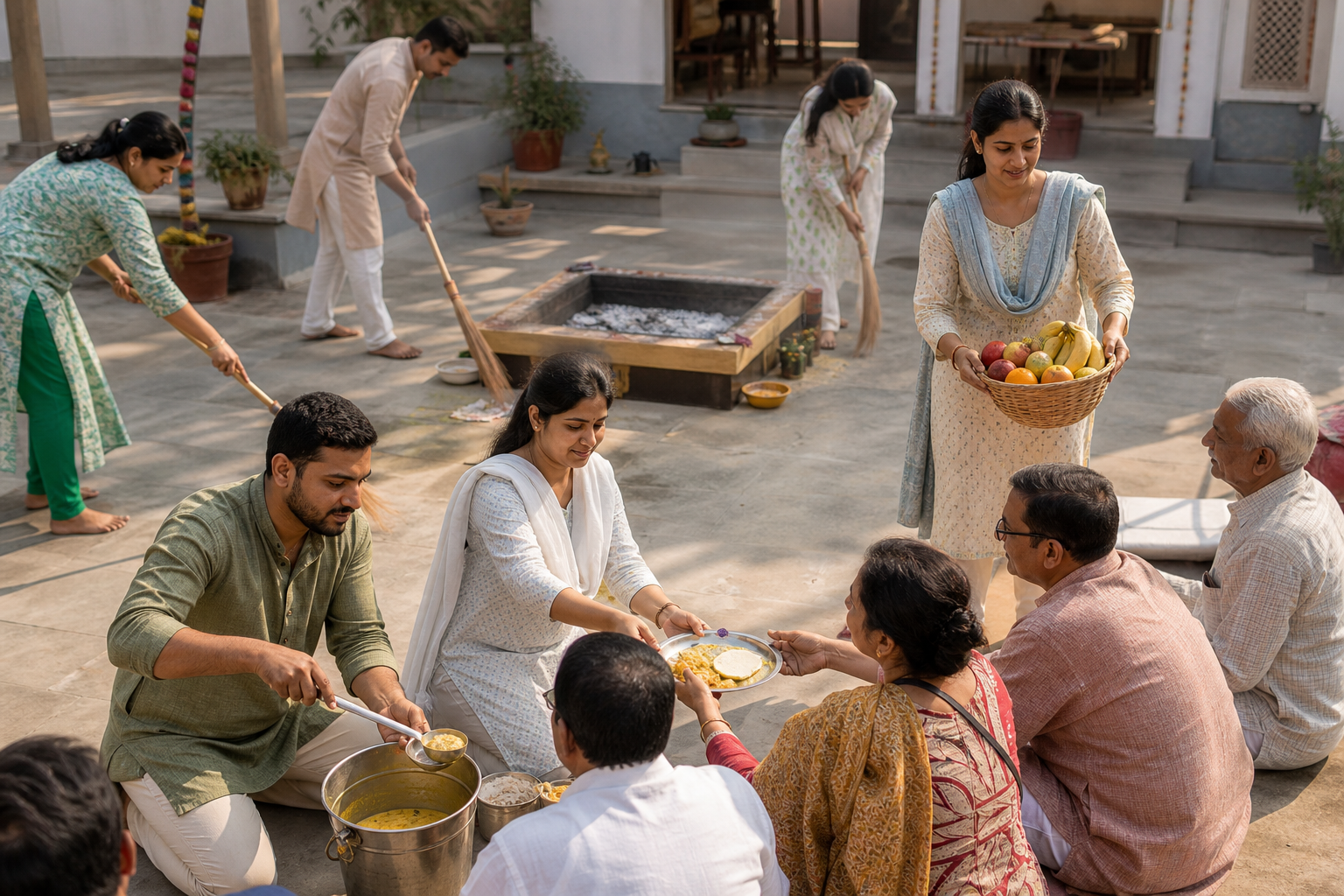
The first test of Grahayajna arrives after the final offering. Can you carry its sattvic intention into speech, work, family duty, and decision-making? If the ritual ends when the fire goes out, its ethical force has been left at the kund.
Keep the follow-through concrete. Complete the agreed daana or seva. Continue the instructed japa or observance. Select one behavioral commitment that directly addresses the concern named in your sankalpa. If conflict is the problem, attend to truthful and restrained speech. If indiscipline is the problem, repair the neglected duty. If self-absorption is the pattern, make generosity and service visible in your schedule.
A brief written record can help. Note whether you completed the practice, whether your decisions became clearer, and where the same reactive pattern returned. This is not a scorecard for measuring a graha. It is a way to see whether worship is changing your participation in the situation.
The cadence of mantra and offerings may foster calm, attention, emotional resilience, and a renewed sense of priority. Receive those effects with gratitude, but do not treat a calm feeling as proof that every external problem has been solved. Steadiness is valuable because it helps you respond better, not because it abolishes uncertainty.
Watch for signs that the practice is slipping into fatalism:
- Every setback is blamed on a graha while avoidable choices go unexamined.
- Fear keeps escalating, and each new prediction creates pressure for another remedy.
- Someone guarantees immediate or mechanically certain results.
- Ritual is used to avoid medical care, necessary professional advice, honest conversation, or practical work.
- Offerings multiply, but daana, seva, restraint, and truthful conduct disappear.
When those signs appear, return to the dharmic center of the practice. Grahayajna is meant to strengthen responsibility, not dissolve it.
This ethical center also helps us recognize kinship across the Dharmic family without erasing real differences among traditions. The stress on non-harm and karmic responsibility resonates with Jain ahimsa. Intention, right effort, and right action find a parallel in Buddhist discipline. Seva and remembrance have a clear affinity with Sikh practice. Grahayajna remains a Vedic and Hindu ritual form, while these shared commitments reveal a wider Dharmic insistence that spiritual practice must shape conduct.
Key takeaways
- Approach Grahayajna as a disciplined response to a planetary pattern, not as a purchase of guaranteed results.
- Choose between a formal homa, temple observance, family rite, or simpler continuing practice according to the actual need and your lineage.
- Ask the priest or Jyotisha to explain the purpose, scope, tradition, and expected follow-through in language you understand.
- Use muhurta to support attentive action, never to postpone an urgent duty or excuse a harmful decision.
- Join mantra and offerings to daana, seva, restraint, truthful speech, and non-harm.
- Evaluate the practice by greater clarity and responsibility, not by fear-driven monitoring of every event.
Before arranging a ceremony, write one sentence naming the concern and one sentence naming the dharmic quality you intend to cultivate. Take both to a trusted priest or Jyotisha. If the proposed practice helps you connect those sentences through worship and sustained conduct, you have found a sound place to begin.
References
