

Perhaps a school-board deck, workplace training, or newspaper column has placed an Indian American statistic in front of you and treated it as a verdict on Hindu life. Before you quote it or challenge it, ask two questions: Who was counted, and what behavior was used as the stand-in for identity?
That small pause changes the discussion. It lets you defend Dharmic communities without denying unwelcome data, and it keeps a broad diaspora result from being turned into a claim about a faith subgroup the number may not actually describe.
Key takeaways
- Indian American is a national-origin category, not a synonym for Hindu American. Check whether a result comes from the full sample or a religious subgroup.
- Attendance at formal services measures one kind of participation. It does not fully capture home puja, meditation, vrata, festival observance, seva, satsang, or intergenerational teaching.
- A reported experience, support for a general principle, and approval of a particular policy are three different findings. Do not substitute one for another.
- Compare discrimination figures only when they use the same population, question form, and time period. A lower percentage is not zero, while a high policy-support percentage is not proof of high prevalence.
- When a public claim concerns Hindus, Buddhists, Jains, or Sikhs specifically, ask for disaggregated data and practice-sensitive questions before accepting a diaspora-wide conclusion.
Start with the population the number actually describes
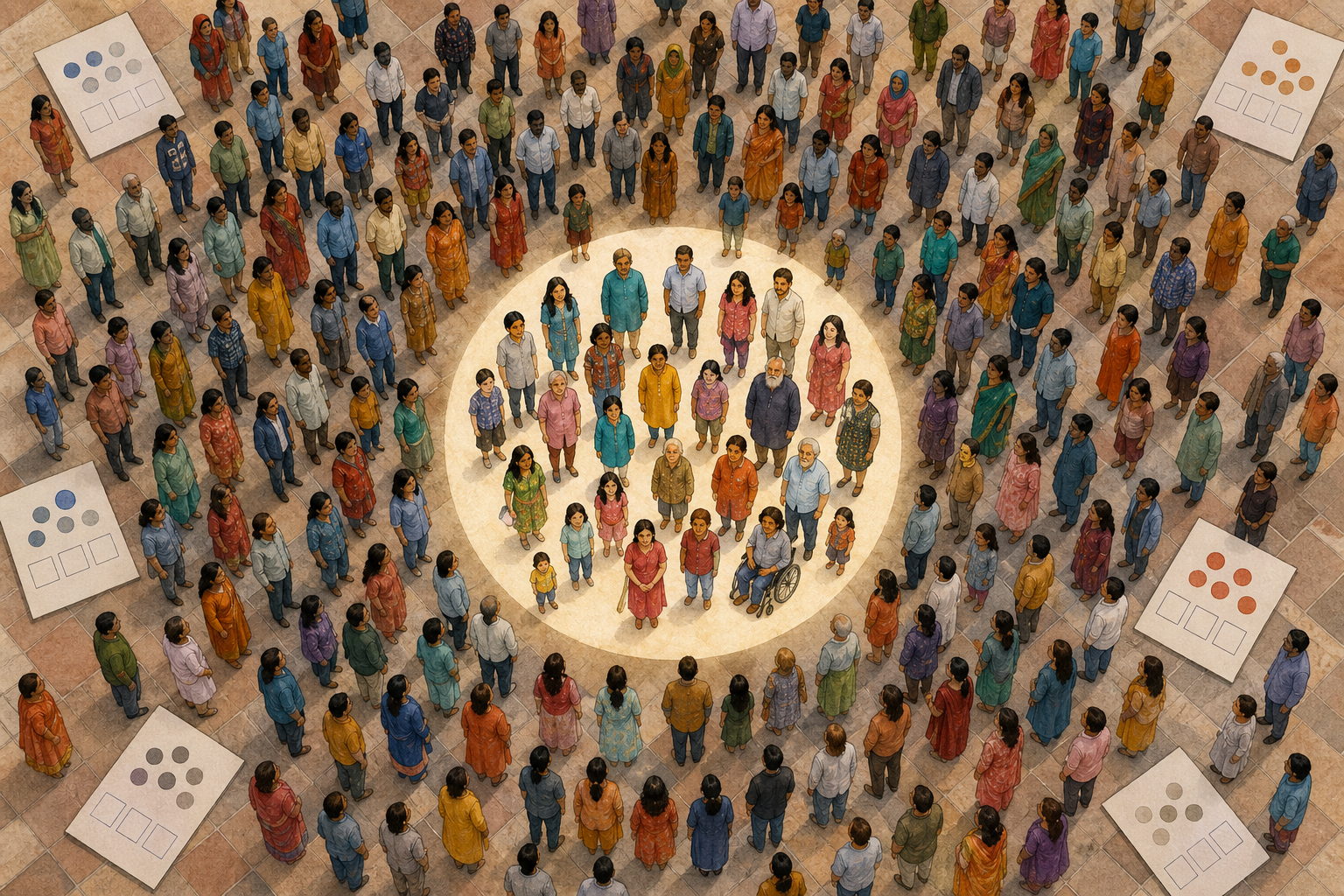
In the 2024 Indian American Attitudes Survey, released in July 2025, 55 percent of Indian American respondents identified as Hindu, compared with roughly 80 percent in India. The immediate lesson is not that Hindu identity has weakened by a particular amount. The two percentages describe different populations. The useful lesson is that an Indian American sample contains enough religious diversity to make Indian American and Hindu American analytically non-interchangeable.
That distinction becomes decisive when a number enters a curriculum debate, civil-rights discussion, media report, or institutional training. A finding from the entire Indian American sample may describe Hindus, Sikhs, Jains, Buddhists, Muslims, Christians, people with other affiliations, and people with none. Unless the responses are separated by religion, it cannot tell you what Hindu respondents alone believe.
| Label attached to a result | What you may safely conclude | Shortcut to reject |
|---|---|---|
| Indian American | The result describes the defined national-origin sample. | Hindus hold the same view at the same rate. |
| Hindu American | The result describes Hindu respondents if they were separately identified and adequately sampled. | The result represents every Indian American or every Dharmic tradition. |
| Dharmic communities | The term can support discussion of a shared civilizational family that includes Hindu, Buddhist, Jain, and Sikh traditions. | The traditions have identical doctrines, institutions, histories, or patterns of practice. |
| South Asian | The term identifies a broader regional frame when that is how the sample was defined. | It is a precise substitute for Indian, Hindu, or Dharmic. |
Use a three-level check whenever you encounter a headline. First, identify the sample universe: Who was eligible to answer? Second, identify the subgroup: Was religion actually recorded and cross-tabulated? Third, inspect the conclusion: Does it stay within that subgroup, or does it silently change Indian into Hindu?
If no religious cross-tabulation is available, the honest answer is that the Hindu-specific position cannot be determined from that result. If a cross-tabulation exists, ask for the unweighted number of respondents in the subgroup and the uncertainty around the percentage. Weighting can improve the representativeness of a sample, but it cannot create additional Hindu, Sikh, Jain, or Buddhist respondents where very few were interviewed.
Identity wording also matters. A growing preference for an Indian label over a broad South Asian label can express a desire for national and cultural specificity. It does not, by itself, establish religious affiliation. A well-designed questionnaire therefore lets a person describe national origin, regional identity, religion, sect or tradition, language, and degree of practice as separate dimensions. People may hold several of these identities at once.
This gives you a simple editorial rule. If the evidence says Indian Americans, retain those words. Do not retitle the claim as Hindus unless Hindu respondents were separately measured. Conversely, if a question concerns temple vandalism, portrayals of Hindu traditions in schools, or the interpretation of a Hindu ritual, request Hindu-specific evidence rather than assuming that a mixed-faith national-origin sample can answer it.
Measure religious life where Dharmic people actually practice it
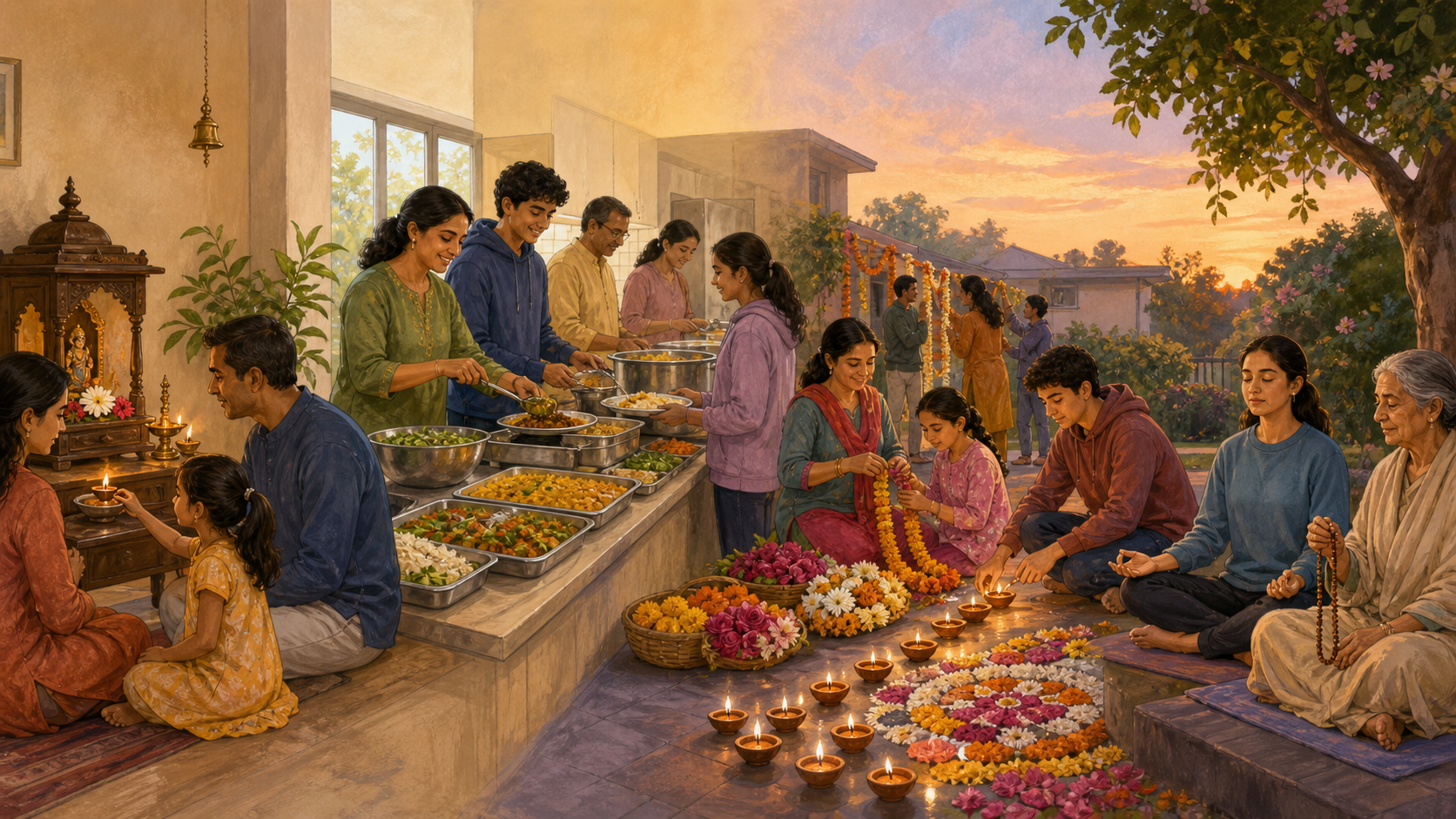
A second error appears when a survey uses a familiar institutional measure but gives it an expansive label. Frequency of attending religious services is a valid measure of attendance. It is not a complete measure of religiosity.
The survey measure at issue counted attendance at religious services while excluding weddings and funerals. That can work reasonably well when weekly congregational worship is the expected center of religious life. It captures only one channel of Dharmic practice, however. A Hindu may perform puja at home, keep a vrata, participate intensely in annual festivals, visit a temple according to a parva calendar, or learn through satsang without attending a weekly service. Buddhist and Jain practice may include home observance and meditation. Sikh life includes the gurdwara, but seva and other forms of disciplined practice are not exhausted by a weekly attendance count.
The correction is not to discard attendance data. It is to label the variable narrowly and add the dimensions it misses. If you are reviewing or commissioning a survey, ask for separate questions covering:
- Home practice: puja, prayer, meditation, recitation, or another personal discipline, measured within a clearly stated period.
- Calendar observance: vrata, parva, festival, pilgrimage, or other periodic participation during a defined year.
- Community participation: temple, gurdwara, derasar, vihara, sangha, satsang, or tradition-specific gatherings without assuming that all operate like a weekly church service.
- Seva: religiously grounded service performed inside or outside a place of worship.
- Household transmission: teaching children a language, story, text, practice, song, or ritual connected with the tradition.
- Self-understanding: how important the tradition is to the respondent, kept separate from how frequently a particular institutional activity occurs.
Each dimension should be reported on its own before anyone compresses the answers into a single religiosity score. Combining unlike practices requires judgments about which activities count more, and those judgments can quietly favor one religious structure over another. If a composite score is used, its components and weights should be published.
For an existing dataset, the wording of your conclusion should match the wording of its question. Say that respondents reported a particular frequency of formal service attendance under the stated exclusions. Do not translate that into less religious, secularized, or disconnected from Dharma unless other measures support those claims.
This precision matters for institutions as well as individuals. Temples and gurdwaras can function as cultural and community hubs even for people whose weekly attendance is irregular. Festival participation, language transmission, home practice, and seva may carry identity across generations through a rhythm that a weekly-service question was never designed to see.
Keep discrimination, policy support, and legal design separate

Discrimination findings require the same discipline. Within the same past-year frame, 7 percent reported caste-based discrimination, 31 percent discrimination based on skin color, 20 percent based on country of origin, and 19 percent based on religion. These figures support a limited but important statement: caste-based discrimination was reported less frequently than those other listed forms of bias in that sample and period.
Seven percent is neither nothing nor most. Treating it as nothing dismisses people who reported harm. Treating it as the defining experience of Indian Americans ignores the survey’s own comparative pattern. Do not add the percentages or assume that the categories are mutually exclusive unless the questionnaire and coding rules explicitly allow that calculation.
A different question produced a different kind of number: 77 percent supported laws banning caste discrimination. That is an attitude toward a broadly stated protective principle. It is not a measure of how many people experienced caste discrimination, and it does not establish support for every definition, enforcement method, training module, or legislative draft that might later carry the same label.
This distinction is easy to lose because a ban on discrimination presents respondents with a morally clear goal. Many people can support that goal while disagreeing about the wording or side effects of a particular policy. Using the 77 percent figure as approval for legal text respondents were never shown would claim more than the answer establishes.
When you review a policy claim, place the evidence into three separate boxes:
- Experience: What conduct did respondents report, during what period, and under what definition?
- Attitude: What exact proposition did respondents support or oppose?
- Policy design: What does the proposed rule define, prohibit, investigate, and require in practice?
A sound Dharmic position can protect anyone subjected to caste-based mistreatment while rejecting language that portrays caste as the unique essence of Hinduism. Those aims are compatible. Caste has social and regional histories that should be addressed precisely; turning Hindu identity itself into a marker of suspicion merely replaces one stereotype with another and can cast an unwarranted shadow over other Dharmic communities as well.
For a workplace training or educational program, ask whether examples focus on prohibited conduct or presume guilt from a person’s religion or origin. Check whether Hindu, Buddhist, Jain, and Sikh stakeholders reviewed the terminology. Require claims about prevalence to retain their population and time period. Ask whether the program distinguishes a social hierarchy from the doctrines and practices of an entire religion.
For an actual ordinance, lawsuit, or employer policy, the survey percentage is not legal analysis. Existing general anti-discrimination protections form part of the context, but their coverage and procedures vary by jurisdiction. Read the operative text and obtain qualified local legal advice before making a decision with legal consequences.
Turn a misleading headline into a defensible public statement

You do not need to answer every misuse of data with a long ideological dispute. A five-step correction is usually stronger because it shows exactly where the inference broke.
- Copy the exact claim. Preserve its wording so the disputed leap remains visible.
- Name the denominator. State whether the respondents were Indian American generally or members of a religious subgroup.
- Name the measure and period. Attendance is attendance; a past-year experience is not a lifetime prevalence figure.
- Identify the missing variable. This may be religious affiliation, home practice, subgroup sample size, question wording, or the text of a proposed policy.
- Rewrite the claim at the strength the evidence permits. Keep the number, but remove the unsupported conclusion.
For example, the claim Indian Americans are becoming secular because formal attendance is limited would be too broad if attendance is the only religious measure. A defensible version would say that the recorded attendance frequency does not capture home practice, festival observance, seva, or intergenerational transmission.
The claim caste is the predominant discrimination problem for Indian Americans would also exceed the figures. A defensible version would state that 7 percent reported caste-based discrimination in the past year, compared with 31 percent for skin color, 20 percent for country of origin, and 19 percent for religion, while 77 percent supported laws banning caste discrimination. That version preserves both the reported harm and the difference between prevalence and policy preference.
If a coalition is responding, do not let Hindu become the unspoken default for every Dharmic community. Ask Hindu, Buddhist, Jain, and Sikh participants three concrete questions: Does the survey term describe your tradition accurately? Which important practice or experience is absent? What is the narrowest conclusion you would accept from the available answers?
Shared civilizational commitments such as pluralism, compassion, spiritual autonomy, nonviolence, and seva can provide common ground. They should not erase different theologies, institutions, histories, or community needs. Unity becomes more credible when it is built through precise representation rather than a claim that everyone is the same.
The next time a number enters a curriculum hearing, workplace deck, media report, or policy memo, do not argue only over its headline. Rewrite it so the population, measure, time frame, and limits are visible. Then ask for the religiously disaggregated and practice-sensitive data that are missing. Dharmic communities do not need favorable numbers; they need numbers that describe them honestly.
References
