

You may know how to arrange the body, regulate the breath, and sit quietly, yet still wonder what Yoga is supposed to change. A peaceful session can help, but calm often disappears as soon as an argument, deadline, or old fear returns.
Sankhya gives you the missing map. It explains what you are observing; Yoga trains you to observe it steadily and respond wisely. Once these two are joined, practice stops being a search for pleasant states and becomes a discipline of discrimination: learning to recognize what changes without mistaking every change for who you are.
Start with the distinction Yoga is training you to see
Sankhya distinguishes Purusha, the unchanging witness, from Prakriti, the changing field of nature. Purusha is pure consciousness: the principle by which experience is known. Prakriti includes the body, senses, mind, personality, emotions, memories, and every condition that appears, develops, and passes away.
This distinction is easy to repeat and much harder to see. If anger appears, the ordinary reaction is identification: anger becomes my anger, then I am angry, and finally I am the kind of person who must act from anger. Sankhya asks you to slow that chain. The bodily heat, agitated breath, defensive thought, and impulse to speak are movements within Prakriti. They are real experiences, but none remains unchanged.
Purusha is not another thought hiding behind those thoughts. It is not your preferred self-image, private history, or inner commentary. It is that by which the commentary is known. You cannot turn the witness into an object in the same way that you observe a sound or sensation, because it is the condition for observing any object at all.
During meditation, ask two quiet questions. What is changing now? What knows that it is changing? Do not force a verbal answer. Notice the breath change, a sound begin and end, an emotion intensify and weaken, or an image enter and leave the mind. Then notice that each change is known. This is viveka, discrimination, in its practical form.
The exercise should make you more present, not detached in the sense of being numb or indifferent. Seeing anger as a movement in Prakriti does not mean denying it, tolerating harm, or refusing necessary action. It gives you enough space to choose an action instead of being driven by the first impulse.
Sankhya also keeps this inquiry rational. Its accepted means of valid knowing include perception, inference, and trustworthy testimony. In practice, that means you observe what is actually present, infer patterns carefully, and use inherited teaching as a map rather than a substitute for attention. Experience comes first; your explanation of it comes second.
Read a distraction through the tattvas instead of calling it failure
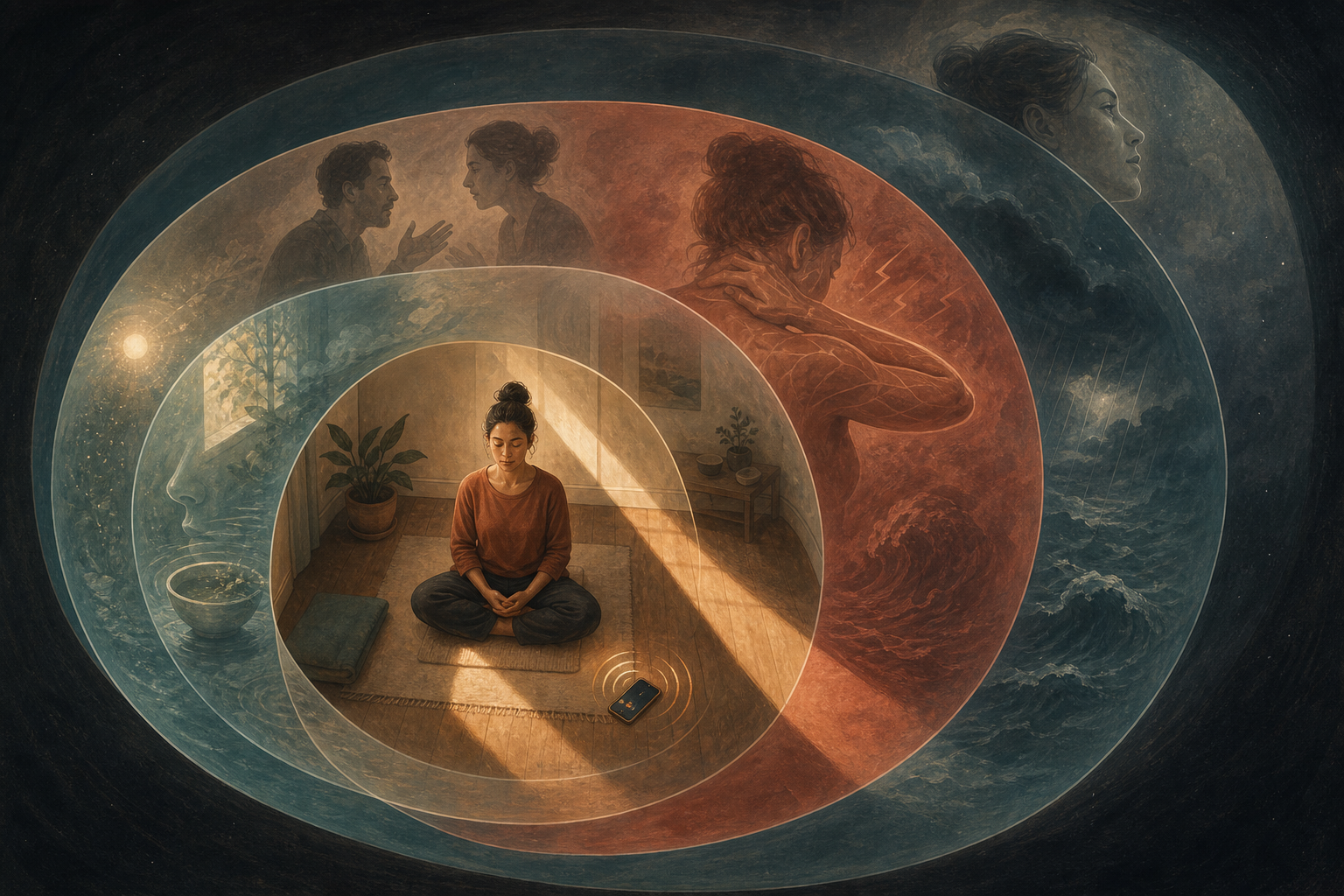
A distracted meditation is often more instructive than a quiet one. The problem is that practitioners collapse an entire sequence into a single verdict: the mind wandered, so the practice failed. Sankhya offers a more precise reading through the tattvas, the principles through which Prakriti unfolds into embodied experience.
The relevant map moves through buddhi, the discriminating intellect; ahamkara, the principle that appropriates experience as I and mine; manas, the mind that coordinates impressions; the indriyas, or sensory capacities; and the gross elements of embodied life. You do not need to memorize a catalogue before this becomes useful. You need to recognize the sequence operating in an ordinary moment.
Suppose a vehicle sounds its horn while you meditate. Hearing occurs. Manas turns toward the sound and organizes it as an interruption. Ahamkara adds a personal claim: my meditation has been ruined. Buddhi can then either serve that reaction by producing more complaints or discriminate clearly: a sound appeared, irritation followed, and both are now known.
Use a simple three-part label when distraction takes over:
- Sensation: identify the immediate sound, pressure, heat, tension, or movement without adding a story.
- Mental movement: notice the memory, judgment, anticipation, or emotion that followed.
- Appropriation: catch the moment ahamkara converts the event into a claim about me, mine, or what must happen next.
After labeling the sequence, return to the breath or mantra. The purpose is not to suppress sensory life. It is to prevent sensation, interpretation, and identity from fusing into one unquestioned reaction.
This map corrects another common mistake: treating the mind itself as the witness. A clear thought is still a movement in Prakriti, just as a confused thought is. Buddhi is essential because it can discriminate, but it remains part of the instrument being observed. From the Sankhya standpoint, Yoga clarifies the instrument so that the distinction between witness and instrument can become evident.
That is why mental quiet is useful without being the final goal. A calm lake reflects clearly, but calmness is still a condition that can come and go. Do not measure liberation by whether every session feels serene. Ask whether you recognize change sooner, identify with it less completely, and recover wise choice more readily.
Let the gunas determine how you enter practice

Prakriti operates through three gunas: sattva, associated with clarity and harmony; rajas, associated with activity and passion; and tamas, associated with inertia and obscuration. These are not permanent personality types. They are changing tendencies, often mixed together, that shape the condition in which you begin practice.
Before choosing a technique, notice the dominant condition of your body and attention. Then select an entry point that works with what is present:
- When rajas dominates: you may feel hurried, argumentative, restless, or compelled to keep changing posture. Begin with gentle, deliberate asana rather than forcing immediate stillness. Follow it with an unstrained, regular breathing practice. The task is to collect scattered activity into one rhythm.
- When tamas dominates: you may feel dull, avoidant, heavy, or inclined to drift into sleep. Do not make a long passive sit your first move. Begin with attentive movement, coordinate movement with breath, and sit only after alertness has increased. The task is to bring sufficient clarity to observation.
- When sattva is prominent: the body feels balanced and attention is naturally available. Use less preparation and move into meditation or mantra while that clarity is present. The task is not to admire the state but to use it for discrimination.
The gunas become especially useful when you stop turning them into moral labels. Tamas is not proof that you are spiritually deficient, and rajas is not an excuse for harmful speech. Saying that rajas was present should help you predict an impulsive response and interrupt it. It should not absolve you of responsibility for the response.
You can also use the gunas after practice. Compare the quality of attention before and after asana, pranayama, and meditation. Did restlessness become steadier? Did dullness become alertness? Did clarity turn into self-satisfaction? This makes practice responsive rather than mechanical and shows which methods actually support sattva in your present condition.
When agitation rises during the day, a short reset can interrupt the cycle before it reaches speech or action. One to three minutes of coherent breathing, box breathing, or nadi shodhana can help restore composure. If you choose coherent breathing, the practical rhythm is five to six comfortable breath cycles per minute. Keep the breath unforced. If a technique produces dizziness, panic, or persistent air hunger, stop and return to normal breathing.
Build one Yoga session in the right order
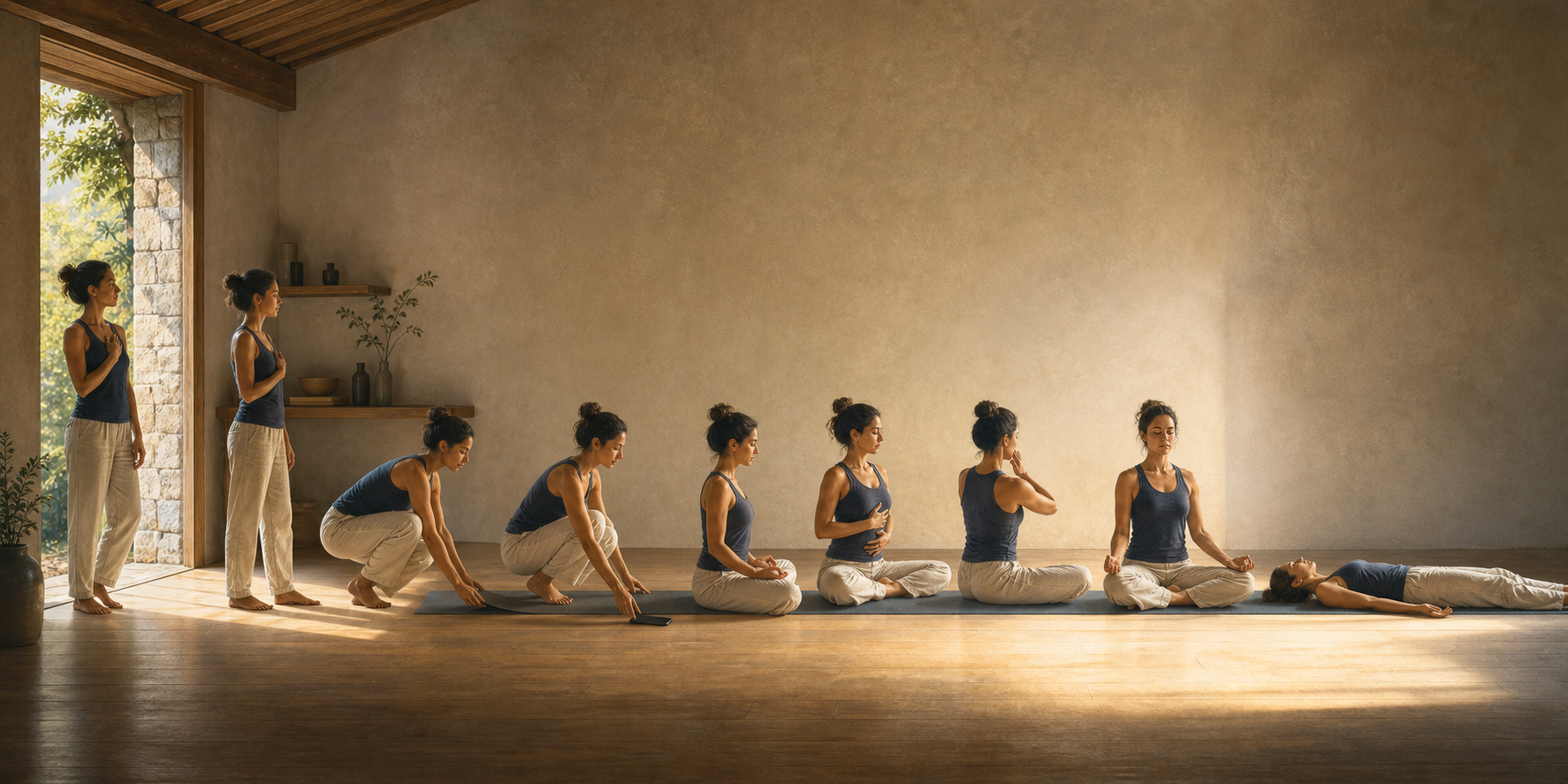
Yoga combines ethical intention, movement, breath regulation, and contemplative focus. Sankhya explains why that sequence works. Movement addresses embodied Prakriti, regulated breathing steadies arousal and attention, meditation reveals mental movements, and viveka prevents those movements from being confused with the witness.
Use this sequence as a complete daily practice:
- Set a sankalpa. Choose an intention connected to discrimination, such as noticing change without immediately calling it self. This gives the session a direction deeper than relaxation.
- Practise gentle asana for eight to ten minutes. Release obvious tension and bring attention into the body. Match the pace to the guna you observed: steady restless energy, awaken dull attention, or preserve an already balanced state.
- Regulate the breath for five minutes. Choose one method rather than switching repeatedly. Coherent breathing, box breathing, or nadi shodhana can provide a stable bridge from movement to stillness. Never strain to satisfy a count, especially during breath retention.
- Meditate or practise mantra japa for five to ten minutes. Rest attention on the chosen anchor. When sensations or thoughts appear, recognize them as movements in Prakriti. Notice any claim made by ahamkara, allow buddhi to discriminate, and return to the anchor.
- Close with an ethical direction. Identify where the clarity of the session is needed next: a conversation, decision, duty, or act of service. This prevents meditation from becoming a private refuge disconnected from conduct.
Do not judge this sequence solely by how relaxed you feel at the end. A pleasant state can disappear quickly. Look instead for a functional change: you notice irritation before speaking, recognize grasping before acting, or see a thought as a thought before organizing your day around it.
On a crowded day, preserve the logic even if the session becomes shorter. Establish the intention, regulate the body and breath briefly, observe one changing condition, and carry a specific ethical restraint into the next action. Consistency matters because abhyasa trains recognition before reactivity becomes overwhelming.
Breath, movement, and meditation may support stress regulation, but they are not substitutes for medical or psychological care. Use Yoga as a contemplative and ethical discipline alongside appropriate professional help when distress is severe, persistent, or unsafe.
Key takeaways
- Sankhya supplies the map: Purusha is the unchanging witness, while body and mind belong to changing Prakriti.
- Yoga supplies the training: ethics, asana, pranayama, meditation, and discrimination make the distinction observable in daily life.
- Use the tattvas to separate sensation, mental reaction, personal appropriation, and discriminating insight.
- Use the gunas to choose an appropriate entry into practice instead of repeating the same routine in every condition.
- Measure progress by reduced identification and wiser action, not by the production of uninterrupted calm.
Test insight at the moment of choice

The clearest test of Sankhya-informed Yoga occurs away from the mat. You may understand Purusha and Prakriti intellectually while remaining completely identified with status, resentment, fear, or possession. Ethical practice exposes that gap.
Yama and niyama connect inner steadiness with outward conduct. Three disciplines are especially useful when testing whether discrimination is becoming practical:
- Ahimsa: before acting, notice whether agitation is preparing you to injure through words, neglect, humiliation, or force. Seeing the agitation as Prakriti creates room for restraint without pretending it is absent.
- Satya: distinguish the observable event from the story ahamkara has built around it. Truthfulness begins before speech, in the refusal to disguise wounded pride as moral certainty.
- Aparigraha: notice when possession, praise, control, or a preferred outcome is being treated as necessary to your identity. The witness does not become greater when the outcome is secured or smaller when it is lost.
When a difficult message, disagreement, or disappointment triggers you, pause before replying. Name the dominant guna. Separate the physical sensation from the mental story. Notice the claim of I or mine. Use a brief, comfortable breathing practice if arousal is high. Then ask which response is consistent with ahimsa, satya, and non-grasping. This is Sankhya moving through Yoga into karma.
The same practical orientation helps explain affinities across the dharmic traditions without erasing their philosophical differences. Jain emphasis on ahimsa, Buddhist cultivation of mindfulness and metta, and Sikh commitment to seva all direct inner discipline toward conduct. They should not be treated as interchangeable metaphysical systems. Their convergence lies in the demand that insight reduce ignorance, selfishness, and harm.
Before your next practice, use this sankalpa: notice what changes without immediately calling it self. After the session, carry that distinction into the next conversation in which you feel defensive or hurried. When the witness is remembered at the point where reaction becomes choice, Sankhya has stopped being a theory and Yoga has begun doing its real work.
References
- DharmaRenaissance Blog – Sankhya Philosophy Explained: A Timeless, Rational Roadmap to Absolute Reality
- DharmaRenaissance Blog – Yoga and Peace: How Breath, Movement, and Mindfulness Transform Stress into Calm
