

You are on a packed train when someone begins preaching loudly to the carriage. You did not join a religious gathering, you cannot easily leave, and even a polite refusal may draw more attention. The immediate question is not whose faith is true. It is whether one person’s expression may commandeer everyone else’s journey.
A consent test gives you a fair answer. Private devotion belongs in public life. Unsolicited preaching crosses a civic boundary when it turns nearby passengers into an audience they did not choose and cannot readily escape. You can defend that boundary firmly without showing hostility to religion.
A shared carriage changes what respectful expression requires

Public transport is shared by people of many religions and by people who profess none. They have all paid, queued, or planned for transportation, not admission to a sermon. That difference matters because a passenger’s presence cannot reasonably be treated as consent to religious engagement.
Freedom of religion does not require believers to conceal themselves. A tilak, kara, mala, cross, head covering, scripture, or other personal expression does not demand a response from anyone nearby. Quiet prayer and silent japa can also travel with you without conscripting the carriage.
The boundary is crossed through conduct, not identity. Loud volume, amplification, repeated appeals, targeted persuasion, and refusal to stop after an objection make the message difficult to avoid. The practical problem is especially sharp when such messaging makes passengers listen in a confined place where they cannot readily opt out or move away.
This does not mean every annoying act is illegal, nor does it create an absolute right to silence. It supplies a civic standard for conduct in a constrained space: the less freedom other people have to disengage, the more restraint a speaker owes them.
Use this four-part consent test

When you are unsure whether religious expression has become an imposition, ask four concrete questions. Apply them to the situation rather than to whether you agree with the belief being expressed.
- Was attention invited? A private conversation begins because both people choose it. A carriage-wide address assumes participation without asking.
- Can a listener decline without friction? Consent is weak when saying no risks an argument, public embarrassment, repeated questioning, or unwanted scrutiny.
- Can people actually disengage? A passenger hemmed in by a crowd, luggage, a reserved seat, mobility needs, or a moving train may have no practical exit. Telling that person to move does not cure the intrusion.
- Is the practice inward or directed at strangers? Reading, praying quietly, or wearing a symbol expresses faith. Broadcasting a conversion appeal, repeatedly addressing the carriage, or singling out passengers recruits their attention.
No single factor settles every borderline case. The clearest violation appears when three conditions combine: the message is directed at strangers, those strangers cannot easily leave, and the speaker continues despite visible or stated non-consent.
Volume matters even without a microphone. A voice deliberately projected across a small carriage can dominate the space as effectively as a portable speaker. Duration matters too: a brief personal utterance and a sustained campaign for attention do not place the same demand on fellow passengers.
Practise devotion without conscripting the carriage

You do not have to make your faith invisible to respect consent. You only have to keep strangers free from compulsory participation. In practice, that means choosing forms of devotion that do not depend on capturing the carriage’s attention.
- Pray silently or keep japa quiet enough that it does not become a performance for the carriage.
- Read scripture in a book or on a device without projecting audio to other passengers.
- Use headphones for recorded discourses, kirtan, bhajans, or other devotional audio.
- Discuss faith when another person freely begins or accepts the conversation, and stop promptly when interest ends.
- Keep aisles, doors, seats, and passenger movement free from any display or activity.
- Offer an invitation once, if the setting permits it, rather than treating politeness or silence as permission to persist.
The same standard should govern everyone. If unsolicited Bible preaching in a packed train is objectionable, an amplified bhajan, pravachan, political chant, or sales pitch that commandeers the same carriage should face the same civic objection. Consistency makes the protection credible. Selective outrage turns a sound principle into a contest over which community may dominate.
For Dharmic communities, restraint is not surrender. Ahimsa, compassion, and self-command offer a disciplined response to aggressive proselytization: protect the listener’s freedom without copying the very imposition being opposed. A faith confident in its depth does not need to manufacture an audience from people trapped between stations.
Respond to disruptive preaching without creating a second disturbance
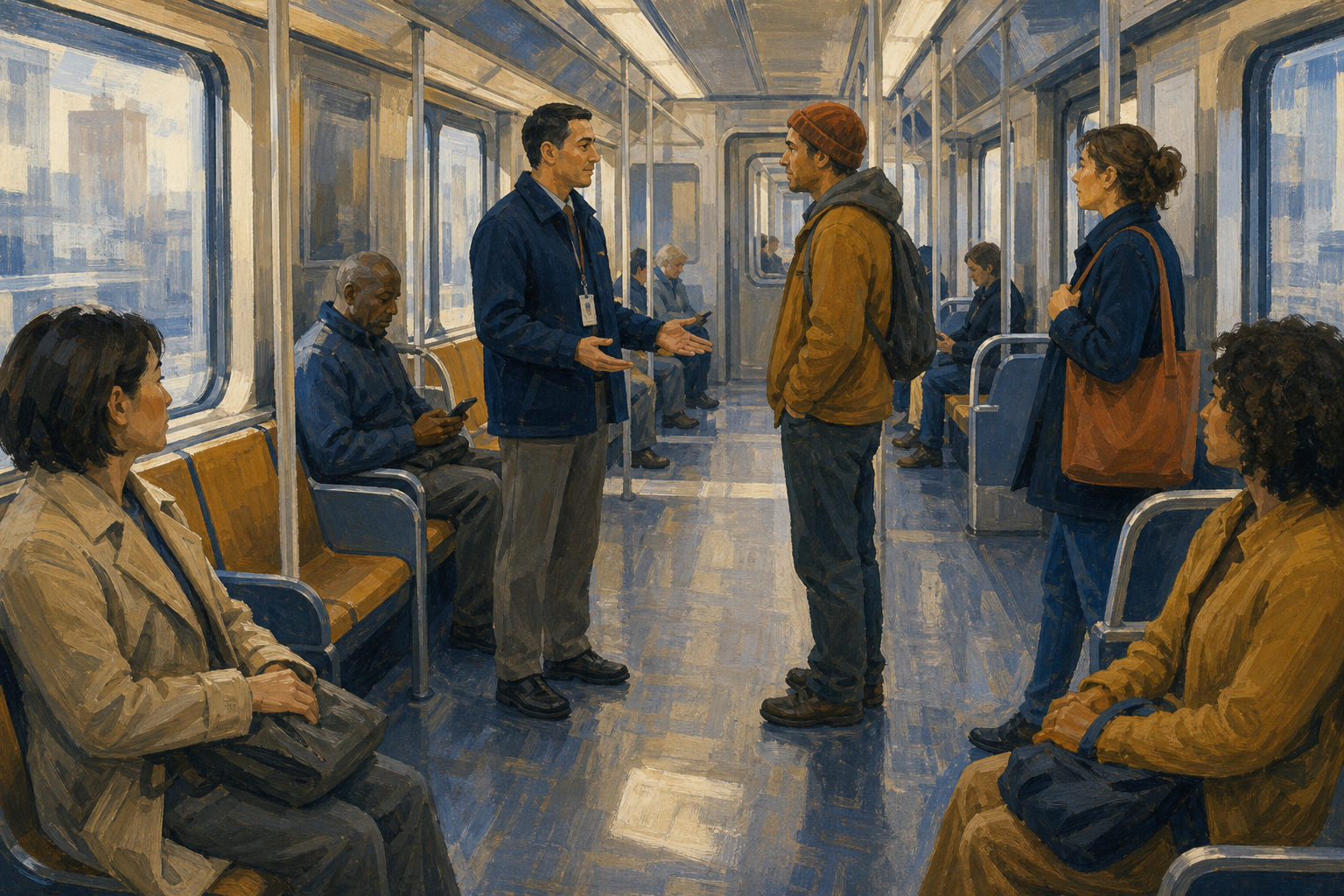
Your aim is to restore ordinary passage, not to win a theological argument. Keep the objection on conduct. Once a dispute shifts to scriptures, communities, or the truth of a religion, the practical issue of volume and consent becomes harder to resolve.
- Check the immediate risk. If the person is threatening passengers, obstructing an exit, or behaving unpredictably, do not crowd or touch them. Put distance between yourself and the danger where possible and alert transit staff.
- Make one neutral request. Say, “Please lower your voice. This is a shared carriage, and passengers have not agreed to a sermon.” A short sentence gives the speaker a clear way to comply.
- Do not debate the belief. If challenged, return to the same point: “This is about the volume and the shared space, not your religion.” Do not answer provocation with insults, rival slogans, or louder chanting.
- Avoid a crowd confrontation. If several passengers object, one calm person should speak while others give space. Surrounding someone can rapidly turn a manageable disturbance into a safety problem.
- Use the transit system’s staff. If the conduct continues, report the carriage or coach, direction of travel, station, time, and what the person is doing. Concrete details are more useful than a general complaint about a community.
- Move when safety requires it, not because the disruptor is entitled to the space. Leaving may be the prudent personal choice. It does not mean that captive passengers carry the responsibility for accommodating persistent preaching.
If another passenger responds with abuse or threats, do not join that escalation merely because you share the original objection. Religious harassment and mob intimidation do not become acceptable reactions to intrusive preaching. Ask staff to address the conduct and let the complaint remain specific.
Key takeaways for your next journey
- Being present on public transport is not consent to a religious appeal.
- Judge conduct by invitation, ease of refusal, ability to disengage, volume, and persistence.
- Protect visible and quiet devotion while opposing attempts to capture strangers’ attention.
- Apply the same rule to every religion, political message, and commercial pitch.
- When you object, name the behaviour, make one calm request, and involve staff if it continues.
- Never answer unwanted preaching with threats, collective blame, or a rival attempt to dominate the carriage.
On your next journey, carry one clear sentence with you: “Please keep personal expression personal in this shared carriage.” It protects quiet devotion, draws a boundary around consent, and gives everyone the best chance of reaching the next station without a needless conflict.
References
