
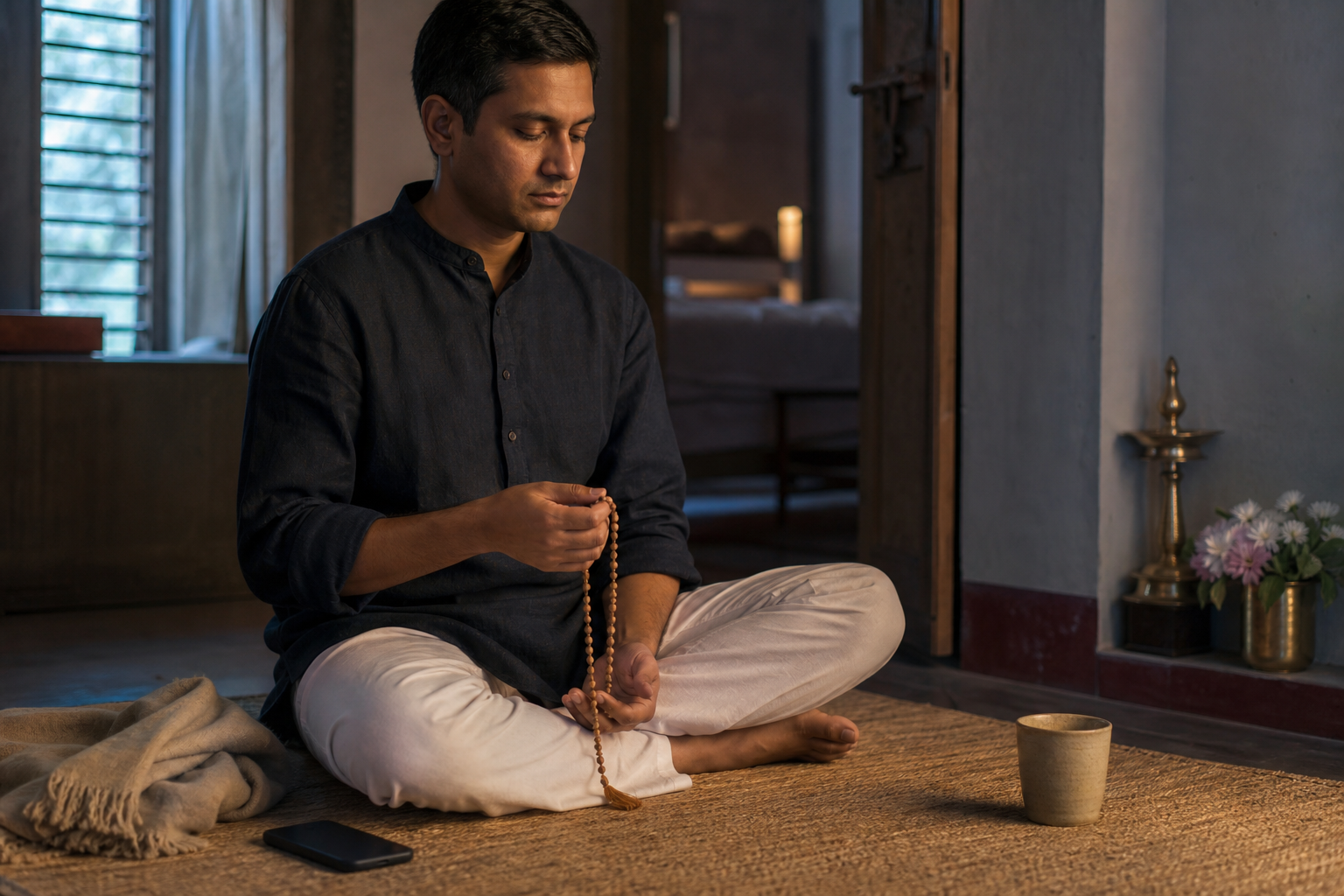
You sit with a mālā, begin the name, and discover that your mind has already gone elsewhere. After a few repetitions, the uncomfortable question appears: if the holy name is so powerful, why does your japa sometimes feel mechanical?
The answer is not to manufacture a devotional mood or force the mind into silence. You need to understand where the tradition locates the name’s potency, what your attention is supposed to do, and how chanting should reshape the part of life that begins after you put the mālā down.
Why one name can carry an entire discipline
Within Caitanya’s Bhakti tradition, the divine name is not merely a verbal symbol that reminds you of Krishna. Krishna is understood to have invested His complete potencies in each utterance of His name. Japa is therefore an encounter through sacred sound, not simply a concentration exercise with religious language added to it.
This is a theological claim, and it should be understood on its own terms. The claim is not that a sequence of syllables operates like a mechanical formula, producing the same visible result whenever anyone pronounces it. It is that the divine is genuinely accessible in the name. You do not have to manufacture that presence. Your work is to turn toward it with sincerity, attention, humility, and a willingness to be changed.
That distinction matters when japa feels dry. A distracted session does not prove that the name has become empty. It shows that your capacity to receive, hear, and remember is still being trained. The name is not made potent by your concentration; concentration helps you stop turning away from what Bhakti holds to be already present.
Hari Bhakti Vilas associates sincere chanting with the meritorious fruits traditionally sought through charity, fasting, austerity, and pilgrimage. The practical point is not that repeating a name gives you permission to avoid generosity, discipline, or sacred travel. It is that the spiritual orientation cultivated through those demanding observances can be concentrated into a practice available in ordinary life. Japa places pilgrimage on the tongue, austerity in the repeated return of attention, and offering in the surrender of time and self-importance.
You should therefore resist two opposite errors. The first is reducing japa to a wellness technique whose only purpose is to make you calm. The second is treating the name as a devotional transaction that earns merit while leaving your habits untouched. Bhakti joins remembrance to character. If chanting is deepening, it should eventually become harder to separate your prayer from your speech, decisions, duties, and treatment of other beings.
Sacred repetition also reveals a family resemblance across Dharmic paths without erasing their differences. Hindu traditions preserve nāma-smaraṇa, Sikh tradition centres simran, and Buddhist and Jain traditions include forms of mantra recitation. Their doctrines, sacred formulas, and understandings of liberation are not interchangeable. What they share is the disciplined act of returning attention to the sacred. That kinship should produce respect, not a claim that every path is saying exactly the same thing.
Set up a japa rule that can survive an ordinary day
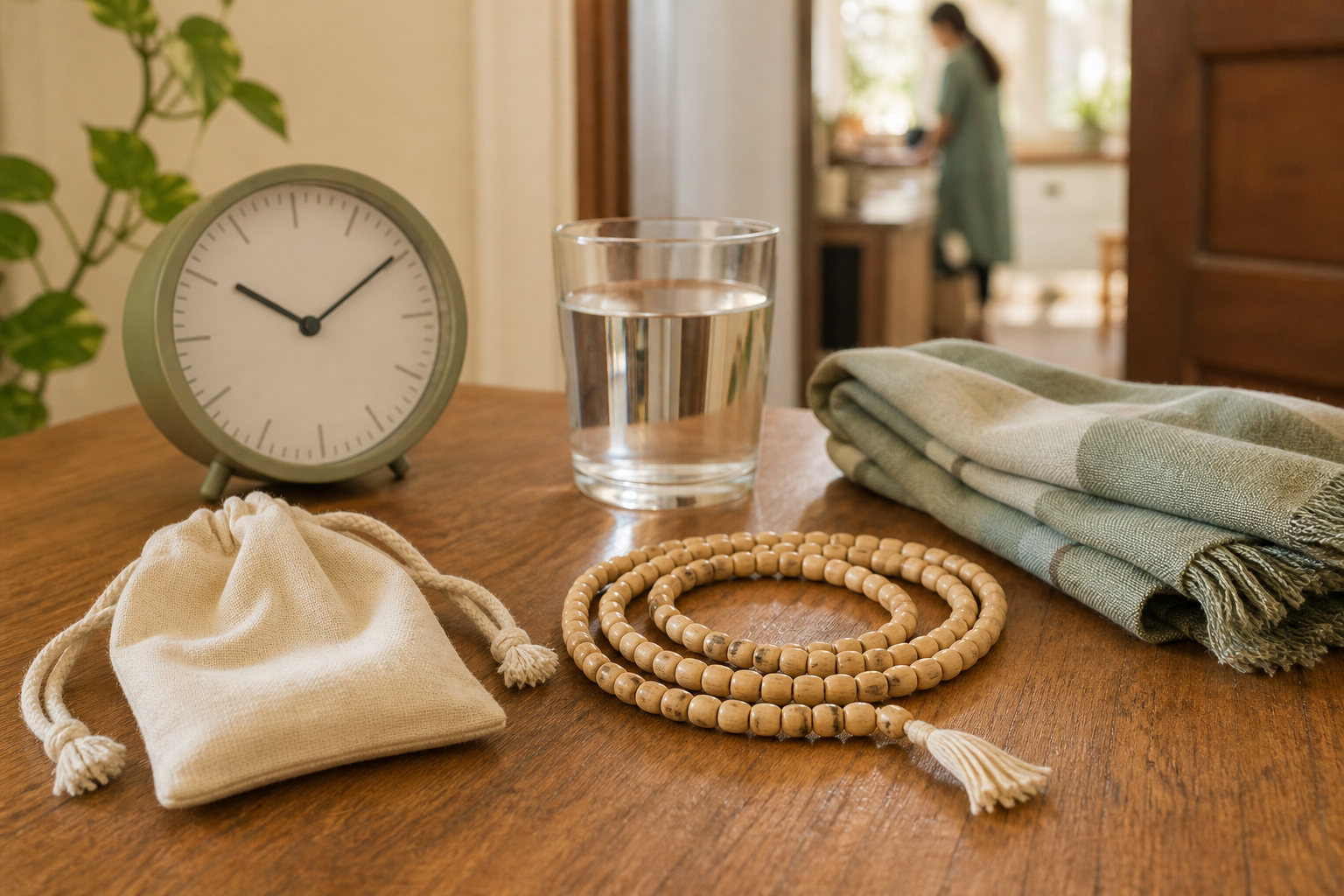
A sustainable practice needs fewer decisions. If you renegotiate the mantra, time, place, duration, and method whenever you sit down, much of your energy is spent arranging japa rather than doing it. Establish a simple rule before the next session.
- Use a stable sacred name or mantra. If you have received a mantra and instructions from a guru or lineage, let those instructions govern the practice. Do not keep changing formulas merely because novelty briefly makes attention easier.
- Attach japa to a dependable cue. It might follow your morning ablutions, precede your first meal, or begin at another transition that already occurs every day. A cue is more reliable than waiting to feel devotional.
- Choose a minimum you can keep. Define it as a complete circuit of your mālā or a fixed period of time. The minimum should remain possible on a crowded or emotionally difficult day; longer sessions can grow from it when circumstances allow.
- Prepare the body without turning preparation into a ceremony of delay. Sit or stand in a stable, alert position. Let the breath remain natural, and keep the mālā ready before you begin.
- Select the mode that supports attention. Soft, audible chanting gives the mind a sound to follow. Silent repetition suits inward absorption when attention is already steady. Congregational kirtan can renew shared devotion, but it serves a different setting from personal japa.
- Give the session an ethical destination. Before rising, identify one duty, conversation, or act of service into which you will carry the remembrance you have cultivated.
The best minimum is not the one that looks impressive on an ideal day. It is the one that protects your relationship with the name when enthusiasm is absent. Consistency tends to deepen japa more reliably than occasional intensity because every return weakens the habit of treating remembrance as optional.
If you miss the appointed session, resume at the next real opportunity. Do not turn one lapse into a verdict on your spiritual fitness, and do not create a punishing compensatory session that makes tomorrow’s practice harder. The correction for inconsistency is a clean return.
Listen while you chant: the central work of japa

The basic unit of attentive japa is not an impressive count. It is one name that you form and actually hear. Counting can protect a commitment, but it cannot listen on your behalf.
- Form the name clearly enough that it does not dissolve into hurried sound.
- Listen to the complete utterance as it is spoken or inwardly repeated.
- Let the sacred meaning or presence associated with the name remain lightly before you. Do not strain to construct a detailed mental image unless your tradition specifically instructs you to do so.
- Notice when attention has wandered. This recognition is not a failed repetition; it is the moment in which practice becomes possible again.
- Return to the next name without argument, self-accusation, or an attempt to recover every repetition you missed.
This cycle may occur repeatedly in one sitting. Each return is an act of abhyāsa, disciplined practice. The aim is not to prevent every thought from appearing. It is to stop granting every thought the authority to carry you away indefinitely.
A mālā helps because the hand supplies a quiet physical anchor. Complete the mantra, move to the next bead, and let touch bring you back when the mind becomes vague. The beads are not a scoreboard. If your hand races ahead of your hearing, slow the movement until sound and touch belong to the same repetition.
Breath can also support one-pointedness, but it should remain gentle. Allow the mantra to settle into a comfortable rhythm rather than holding, forcing, or shortening the breath to fit a preferred pattern. If synchronising breath and mantra creates strain, release the synchronisation and return to hearing the name.
| Form | When it is especially useful | What to notice |
|---|---|---|
| Silent repetition | When the surroundings require quiet or inward attention is already stable | Because there is no audible anchor, mental repetition can blur into unrelated thought without being noticed |
| Soft, audible japa | When the mind is scattered and needs a clear sound to follow | Keep the voice gentle and the breath unforced; volume is not the measure of sincerity |
| Collective kirtan | When shared singing can renew devotion and strengthen community | Participation and remembrance matter more than musical display or comparison |
When repetition becomes mechanical, the first correction is usually not more force. Move from speed to hearing. Let the next name become distinct. Mechanical japa is often sustained by trying to finish the session while mentally living somewhere else.
Do not demand a particular emotion as proof that the session worked. Affection, gratitude, grief, peace, and longing may arise, but trying to reproduce yesterday’s feeling makes the feeling your object of worship. The immediate discipline is simpler: say the name, hear it, remember whom it addresses, and return when you wander.
Judge the potency of japa by what follows the mālā
Unusual sensations, inner images, and temporary calm are unreliable measures of spiritual maturity. The more demanding test begins when someone inconveniences you, your work becomes tedious, or an old reaction asks to be repeated.
Practitioners commonly connect chanting with greater attentional clarity, emotional balance, compassionate intention, gratitude, and willingness to act with integrity. Mantra-based meditation has also been associated with improved focus, reduced stress, and broader well-being. Those contemplative effects can be valuable, but they neither prove nor exhaust the Bhakti understanding of the holy name. A calmer nervous system is not the same thing as devotion, and devotion cannot be reduced to a stress-management outcome.
Review your practice through observable questions rather than dramatic expectations:
- When attention leaves a necessary task, are you becoming more able to return without feeding the distraction?
- When irritation appears, is there a growing interval in which you can choose your response instead of immediately obeying it?
- Does the name arise outside the formal session, especially during waiting, uncertainty, or routine work?
- Is your speech becoming less careless, cruel, or self-serving?
- Are you more willing to perform a needed service when no recognition is likely?
- Does remembrance make you more honest about a harmful habit rather than giving you a spiritual excuse to ignore it?
Use these questions as examination, not as a new source of vanity. Improvement will not be perfectly linear. A difficult day may expose reactions that were already present rather than proving that practice has reversed. The important thing is whether japa helps you notice those reactions sooner, refuse to justify them, and return to dharmic conduct.
If you feel peaceful during japa but remain habitually harsh afterward, do not conclude that the name has failed. Treat the gap as instruction. Bring one relationship, duty, or recurring reaction consciously into your closing intention, and watch for the moment when remembrance can interrupt the old response.
Japa may support steadiness during stress, but it should not be used to avoid medical or mental-health care when such care is needed. Sacred practice and appropriate professional help answer different responsibilities; accepting help need not diminish devotion.
Key takeaways for dry, rushed, or proud japa
Most obstacles do not require a more elaborate technique. They require a precise correction at the point where attention, consistency, or intention has slipped.
- If japa feels dry, stop demanding an emotion and give full attention to the next audible or inwardly heard name.
- If it feels rushed, slow down only enough to hear the complete utterance. Do not turn slowness itself into a performance.
- If the mind is scattered, combine soft chanting with the tactile rhythm of the mālā instead of relying on silent repetition alone.
- If breath coordination creates tension, abandon the coordination and let breathing return to its natural rhythm.
- If practice is inconsistent, reduce the daily minimum until it is genuinely keepable, then rebuild from continuity rather than guilt.
- If novelty has faded, do not immediately shop for a different mantra. Relearn how to listen to the one you have undertaken.
- If chanting produces pride about duration, count, purity, or spiritual rank, carry the next session into an unadvertised act of service.
- If collective chanting inspires you but solitary japa remains weak, use kirtan as encouragement while preserving a personal rule of remembrance.
The holy name’s accessibility removes the need to wait for ideal external conditions. Its sacredness removes the possibility of treating the result as a personal achievement. Together, those two truths make japa both merciful and demanding: you can begin where you are, but you cannot honestly keep the practice sealed away from how you live.
Before your next session, decide three things: the cue that will begin it, the minimum you will keep, and whether silent or soft repetition will best support attention. When the last repetition ends, carry the name into one concrete act of truthful speech, restrained reaction, gratitude, or service. That is how remembrance starts becoming a way of life.

References
