
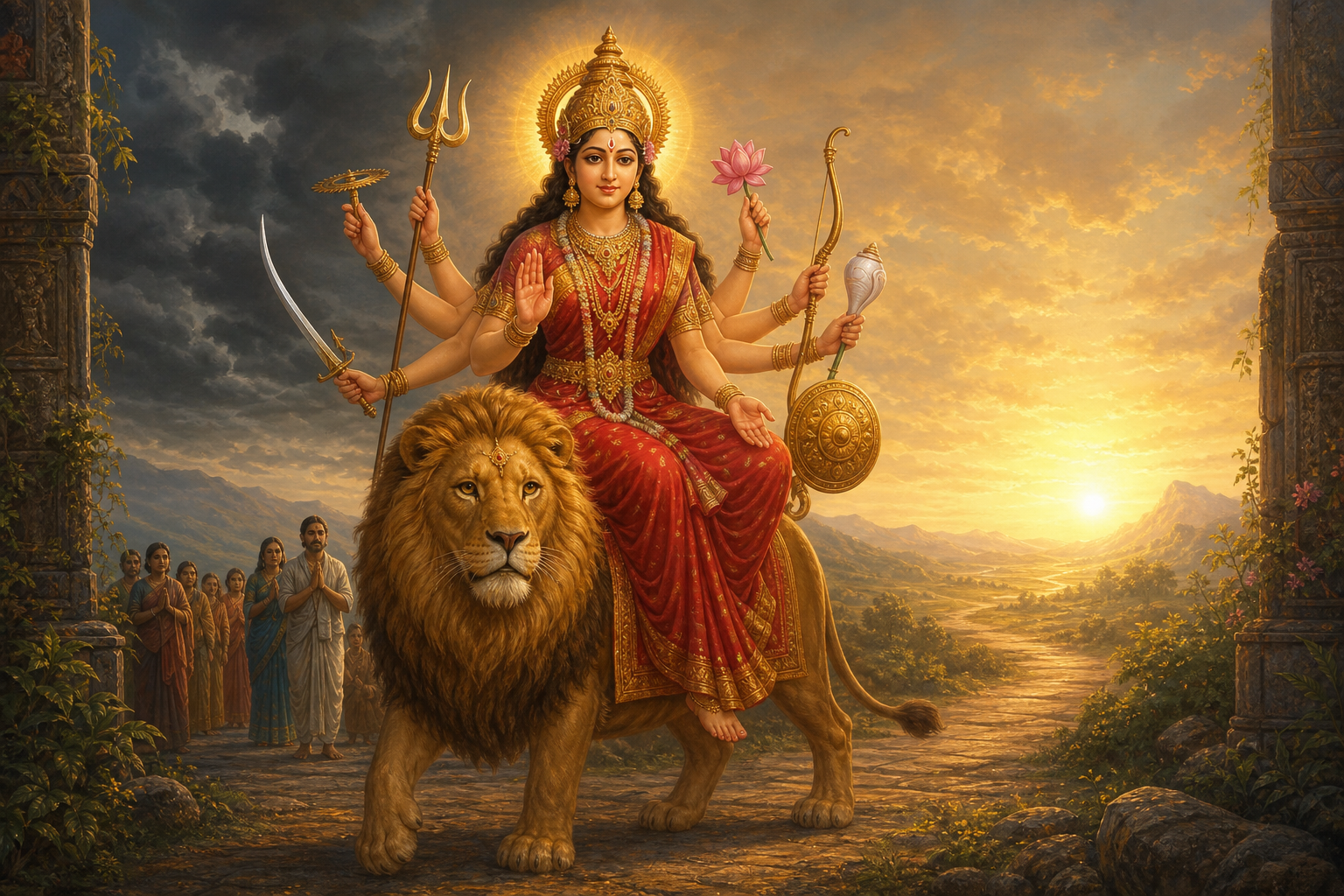
If you know that a wrong must be resisted but worry that resistance will make you harsh, Durga offers a demanding middle way. You can be firm without letting anger lead, and compassionate without abandoning the person, principle, or community in your care.
You do not need a battlefield to face this choice. It appears when you must set a boundary, challenge dishonesty, protect someone vulnerable, or confront your own fear. The practical question is not whether you have power. It is which ethic will govern the power you already have.
Power becomes dharmic when it protects
Durga’s name is linked to durgam: that which is difficult to reach, overcome, or conquer. This meaning does more than describe the Goddess as invincible. It asks you to become difficult for adharma to cross. Your courage should form a protective threshold around what is worthy of care.
The victories associated with Mahishasura and Durgamasura are therefore not celebrations of conquest for its own sake. Their moral centre is the restoration of balance when adharma threatens collective well-being. Strength becomes righteous through its purpose: protection, justice, and the common good.
That gives you a usable test before any forceful response:
- Protection: What concrete person, principle, relationship, or community would be harmed if you did nothing?
- Necessity: Is action required, or are pride and irritation making the situation feel larger than it is?
- Proportion: What is the least harmful response that can realistically interrupt the harm?
- Accountability: What limit will you place on yourself, and how will you review the consequences afterward?
- Restoration: Will your action make a just relationship possible, or is humiliation becoming the hidden goal?
If your only aim is to defeat, silence, or punish another person, the impulse has not yet passed Durga’s ethical test. A dharmic response may still be uncompromising, but it must remain answerable to something higher than personal victory.
This distinction changes ordinary decisions. In a family dispute, protective strength may mean stating a boundary without cataloguing every past offence. At work, it may mean documenting misconduct accurately instead of spreading suspicion. In public debate, it may mean correcting a falsehood with evidence while refusing to dehumanise the person repeating it. Firmness is not measured by volume. It is measured by whether the response can protect what matters without becoming another form of disorder.
Durga is not permission to turn every disagreement into a battle with Mahishasura. If you cannot describe the harm without insulting your opponent, cannot identify whom your action protects, or cannot name a limit on your own conduct, pause. The first adharma requiring restraint may be the one gathering inside your response.
Liberation begins before the outer victory
Durga’s liberating power is not confined to overcoming an external obstacle. Moksha is approached here as freedom from fear, ignorance, and inner fragmentation. Each of those conditions can quietly surrender your agency before anyone else takes it from you.
Fear makes a possible consequence feel inevitable. Ignorance fills gaps in knowledge with convenient assumptions. Fragmentation appears when your values, speech, and conduct pull in different directions. You may speak about truth while avoiding a necessary conversation, praise compassion while enabling repeated harm, or defend dharma in public while neglecting self-mastery in private.
Before a difficult decision, separate what is happening inside you:
- Fact: What do you actually know from direct evidence?
- Story: What are you inferring about another person’s motives or about what will happen next?
- Fear: Which consequence are you most eager to avoid?
- Duty: Which value would you betray through silence or impulsive action?
- Next step: What is the smallest truthful act that would move the situation toward protection and clarity?
This check does not make fear disappear. It removes fear from the position of commander. That is practical abhaya: fear can report danger, but it does not receive the final vote.
Inner freedom also means releasing your demand to control every reaction. You are responsible for speaking truthfully, choosing proportionate means, and repairing avoidable harm. You are not responsible for making everyone approve of a necessary boundary. When approval becomes the condition for ethical action, dependence has merely taken a polite form.
Durga’s iconography teaches complete, proportionate action
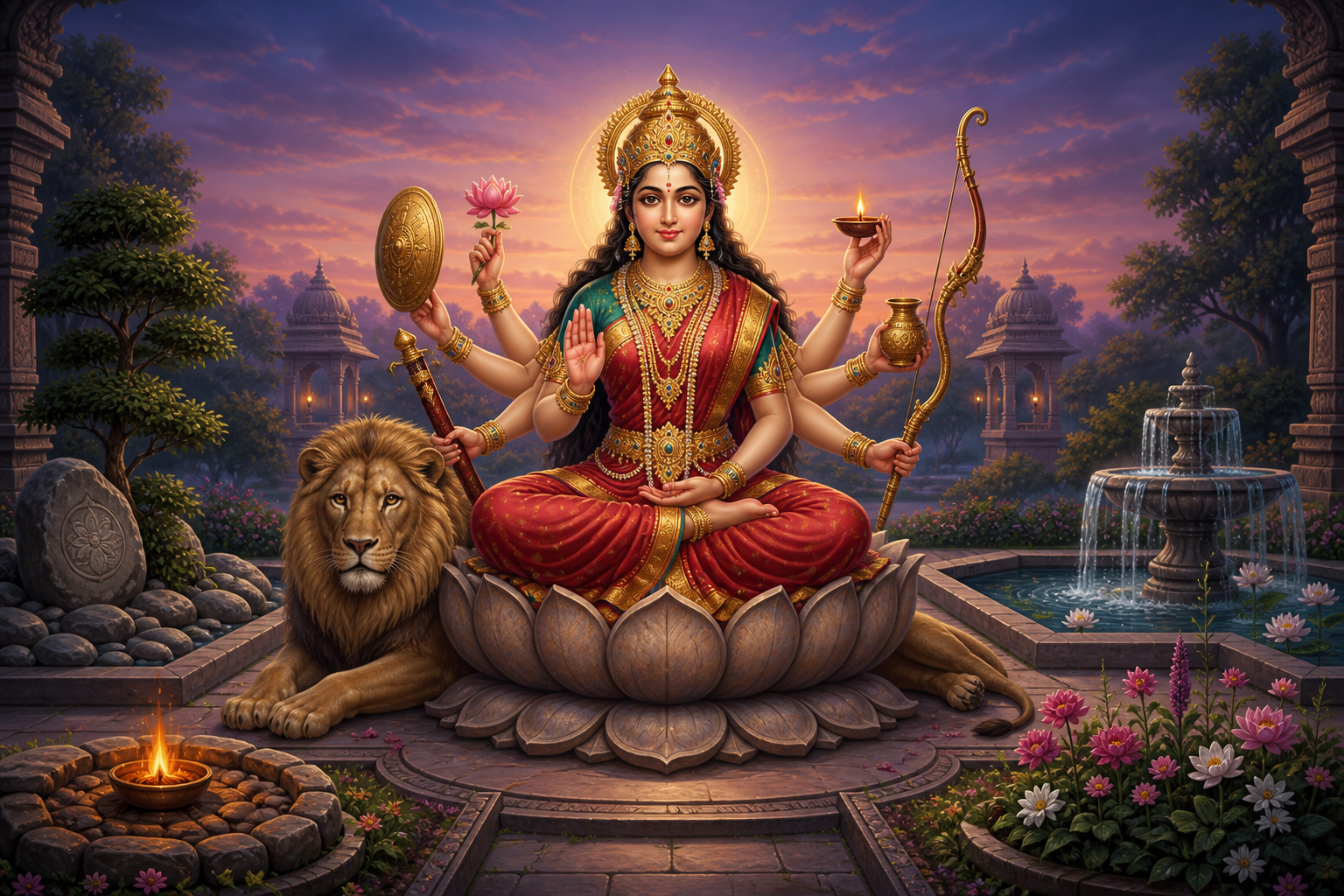
Durga’s many arms and symbolic implements need not be read as a glorification of force. They express the range of capacities required to meet different forms of difficulty. A complex threat cannot be answered by courage alone. It may also require clarity, restraint, patience, compassion, and the ability to persist after the first surge of conviction has passed.
Three qualities organise this ethic: kṣatra, protective strength; dayā, compassion; and viveka, discernment. None is sufficient by itself.
- Viveka identifies the real problem. It distinguishes injury from discomfort, evidence from suspicion, and a harmful pattern from a merely difficult personality.
- Dayā preserves dignity. It prevents a justified intervention from becoming an excuse for cruelty, collective blame, or needless exposure.
- Kṣatra holds the boundary. It keeps compassion from collapsing into appeasement when continued inaction would leave others unprotected.
- Restraint limits the means. It asks you to stop when protection has been achieved rather than extending the conflict for emotional satisfaction.
- Steadfastness completes the duty. It carries an ethical decision through inconvenience, criticism, and the temptation to return to comfortable silence.
Discernment without courage recognises harm and leaves it untouched. Courage without compassion creates unnecessary casualties. Compassion without discernment can enable the very conduct it hopes to soften. Steadfastness without self-review hardens into ego. Durga’s integrated form refuses these partial virtues.
Her plurality of implements also corrects a common mistake: reaching for the strongest available tool instead of the right one. Depending on the situation, protection may require a candid conversation, a written record, mediation, refusal, practical support, community intervention, or lawful authority. The least harmful response must still be capable of protecting. An ineffective gesture is not made ethical simply because it feels gentle, and an effective response is not made dharmic merely because it wins.
A Durga practice for the decision in front of you
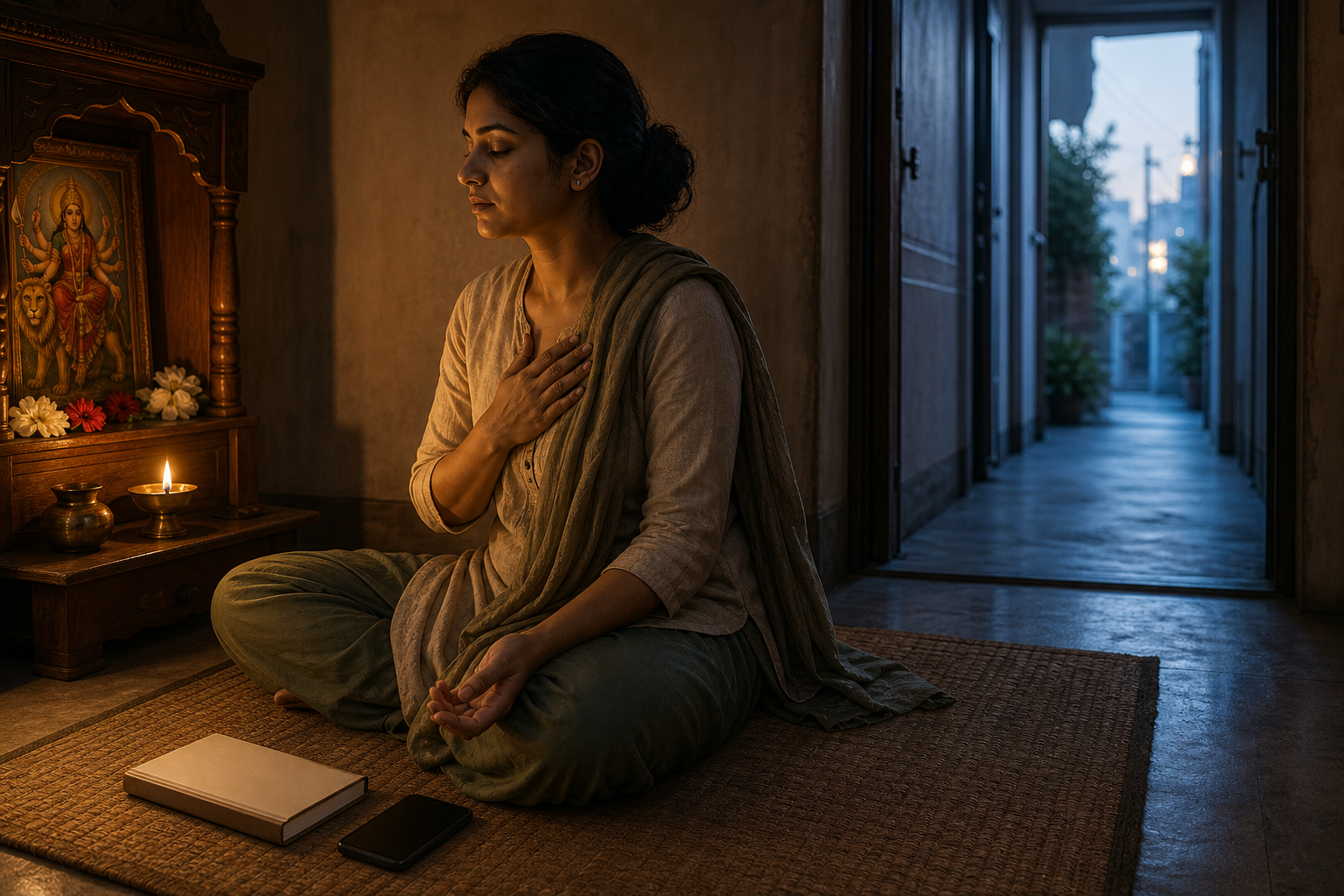
Recitation from the Durga Saptashati, contemplative puja, and mindful participation in Durga Puja or Dussehra can function as disciplines of attention and ethical resolve. Their liberating value becomes visible when devotion changes what you notice, tolerate, and do.
You can connect worship to one real decision through the following reflection. It is not a replacement for the ritual discipline of your family or sampradaya. It is a way to carry Durga’s symbolism from the sacred space into conduct.
- Name the durgam. Describe the difficult crossing in one honest sentence. Frame it as a duty rather than an enemy: you may need to tell the truth without humiliating someone, protect a person without feeding panic, or leave an unhealthy arrangement without seeking revenge.
- Name what must be protected. Be precise. It may be physical safety, trust, truthful public understanding, a child’s dignity, the integrity of an institution, or your own capacity to act without coercion.
- Separate the person from the harmful pattern. Oppose deception, intimidation, exploitation, or fear without declaring a human being irredeemably demonic. This prevents mythic language from becoming a licence for hatred.
- Choose the response and its limit. Decide what you will do, what you will not do, and what condition will tell you that the protective purpose has been met. A boundary without a limit can become punishment; a limit without enforcement becomes a wish.
- Review the action after the heat has passed. Ask whether it reduced harm, remained truthful, preserved as much dignity as the situation allowed, and created any duty of repair. If ego exceeded dharma, correct the excess without abandoning the necessary boundary.
This same discipline can shape communal celebration. Durga Puja is a gathering through which people often renew belonging, courage, and responsibility. A household or community can make that renewal concrete by identifying one neglected duty, assigning responsibility, and following through after the festivities. The duty might involve repairing a relationship, supporting someone facing hardship, or ending a tolerated pattern that contradicts the values expressed in worship.
Recitation without examination can remain a passing mood. Ethical action without inward examination can become self-righteous. Holding devotion and self-scrutiny together is what allows Shakti to liberate rather than merely excite.
Shared Dharmic ground does not erase difference
Durga belongs distinctly to Hindu sacred life, yet her ethical pattern can illuminate a wider Dharmic conversation. The union of prajñā and karuṇā in Buddhism, the Jain commitments to ahiṃsā and self-mastery, and the Sikh ideal of nirbhau, nirvair all echo the union of fearlessness, compassion, and disciplined power.
These are resonances, not equations. The traditions need not share identical theology, ritual, or accounts of liberation to recognise an ethical kinship. Difference is not an obstacle to civilisational solidarity. It is a reason to locate cooperation in conduct rather than force every tradition into the same vocabulary.
When Dharmic communities act together, the useful questions are concrete: Does this response reduce fear without cultivating hatred? Does it protect life and dignity without making harm casual? Does it unite compassion with discernment? Does it demand self-mastery from the protector as well as restraint from the aggressor? Shared answers can support common action even where metaphysical answers remain distinct.
Key takeaways
- Power is dharmic when its purpose is protection, its means are proportionate, and its use remains accountable.
- Durga’s liberation begins inwardly when fear, assumption, and divided motives stop governing your choices.
- Her many arms represent the need for several capacities at once: discernment, compassion, protective strength, restraint, and steadfastness.
- Devotion becomes an ethical discipline when it changes a specific decision, boundary, duty, or act of repair.
- Dharmic traditions can cooperate through shared virtues without pretending that their teachings and identities are interchangeable.
The next time you face a difficult crossing, do not begin by asking how to defeat the person in front of you. Name what must be protected, choose the least harmful action that can genuinely protect it, and set a limit on your own power. That is a small but serious way to let Durga’s Shakti enter your conduct.


References
