
You may have heard that Vedic cosmology anticipated the Big Bang, or that modern science has finally confirmed what the sages already knew. You may also have heard the opposite: that scripture and cosmology are so different that comparing them is pointless. Neither response is careful enough.
You do not have to choose between forced agreement and automatic conflict. There is a genuine parallel between the Bhagavatam’s idea of pradhana and the boundary represented by a Big Bang singularity. But the parallel becomes useful only when you can say exactly where it holds, where it ends, and what it cannot prove.
Begin with the exact claim, not the grand slogan
The sentence “the Vedas discovered the Big Bang” bundles several different claims together. Before accepting or rejecting it, separate the concepts that the slogan has compressed.
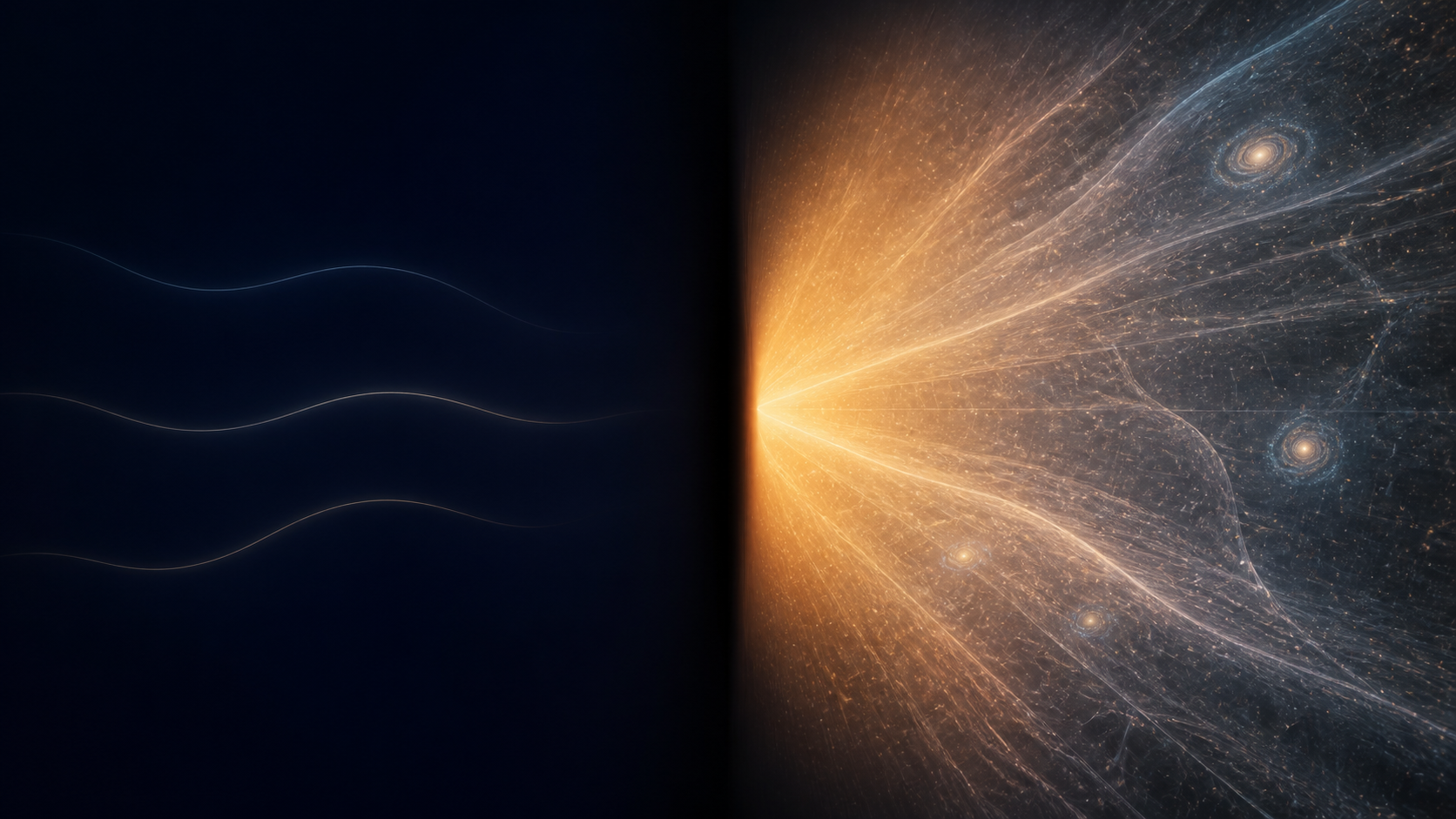
The Big Bang model describes the observable universe in an extremely hot and dense early condition. When classical general relativity is extrapolated backward, the mathematics approaches what is commonly called a singularity. That word does not necessarily identify a literal point that scientists have observed. It marks a boundary at which the classical model no longer gives a reliable account of space-time, matter, and energy in their familiar forms.
The Srimad Bhagavatam discussion associated with 3.26.10 and its purport places pradhana before differentiated material manifestation. Matter and space do not yet appear in the forms available to ordinary perception, but material potential is present in an unmanifest condition.
That last point matters. Pradhana is not simply “nothing.” It can be called void-like because differentiated forms are absent, but it is not sheer non-being. It contains material potential. If someone says that both accounts teach creation out of absolute nothingness, ask them to define what they mean by “nothing.” The comparison usually changes as soon as that word is examined.
The same discipline applies to “singularity.” A popular illustration may depict an infinitesimal dot, but the picture should not be mistaken for the scientific claim. The safer formulation is that classical extrapolation reaches a limit. It does not establish that physicists have identified a tiny object called the singularity from which everything emerged.
The real parallel is a shared boundary of familiar categories

The comparison becomes clearer when each framework is allowed to speak in its own register. The relevant resemblance is structural: both place a difficult boundary before the familiar differentiation of the material world. Their meanings, methods, and purposes remain different.
| Point of comparison | Bhagavatam framework | Big Bang framework | Responsible conclusion |
|---|---|---|---|
| Condition under discussion | Pradhana, an unmanifest condition containing material potential | An extremely hot and dense early condition approached through cosmological models | Both direct attention beyond the material world as we ordinarily experience it |
| Differentiation | Familiar matter and space are not yet differentiated | At the classical singularity, ordinary distinctions among space-time, matter, and energy cannot be described reliably | Everyday categories cannot simply be projected backward without qualification |
| Method | Metaphysical and theological description within a scriptural account of manifestation | Empirical and mathematical modelling of the observable universe | Similar language does not make the two methods interchangeable |
| Status of the boundary | A real metaphysical condition within the Bhagavatam’s cosmology | A limit reached by classical extrapolation, not necessarily a literal physical point | Pradhana and singularity should be compared heuristically, not equated |
| Question being answered | What precedes differentiated material manifestation within a theological order? | How far can the observable universe be described by extrapolating a physical model backward? | The frameworks overlap at a boundary question but do not provide the same kind of answer |
The strongest point of resonance is therefore not “both describe the same event.” It is that both confront a condition in which our usual distinctions cease to work. Form, space, matter, energy, and physical law cannot be discussed as casually as they can within the manifested universe.
That resemblance can support philosophical reflection. It cannot by itself establish identity. Two concepts may occupy similar positions in two systems while referring to different realities. A map legend and a legal definition can both mark a boundary; that does not make geography and law the same discipline. In the same way, a metaphysical account of primordial material potential is not converted into a physical theory merely because a physical theory also encounters an initial boundary.
This distinction protects both sides. It prevents scripture from being reduced to an imprecise scientific forecast, and it prevents a physical model from being recruited as proof of a theological conclusion it was not designed to test.
Use a five-step test for claims about Vedic science

When you encounter a video, debate, or social-media claim connecting Vedic cosmology with modern physics, you can evaluate it without being an astrophysicist or a Sanskrit scholar. Apply these five checks in order.
- Replace the slogan with a precise sentence. Turn “the Vedas knew the Big Bang” into something testable, such as: “The Bhagavatam’s account of pradhana has a structural resemblance to the limit represented by a Big Bang singularity.” Precision may make a claim less dramatic, but it also makes the claim defensible.
- Name the textual location and interpretive layer. “The Vedas” is too broad when the immediate basis is the discussion of pradhana connected with Srimad Bhagavatam 3.26.10 and its purport. A claim about one passage or exposition should not silently become a claim about every Vedic text, school, or commentator.
- Identify the level of comparison. Ask whether the speaker is pointing to a shared metaphor, a similar logical structure, an identical physical mechanism, or a historical prediction. The available comparison supports a structural resonance. It does not establish that both systems use the same concepts, equations, evidence, or method.
- Check the meaning of the scientific term. If “singularity” is being treated as the name of an observed primordial object, the argument has already moved beyond what the term can safely bear. Here it represents the failure of a classical extrapolation to remain reliable. It should not be casually substituted for God, pradhana, or a scriptural first cause.
- Limit the conclusion to what the resemblance supports. A meaningful analogy can open a question and sharpen reflection. It cannot prove every detail of either cosmology. If the conclusion is much larger than the comparison that produced it, reduce the conclusion.
You can also audit a claim by changing one word at a time. “Both describe a boundary beyond familiar differentiation” is defensible. “Both describe the same state” requires evidence of identity that the resemblance does not supply. “Physics proves the Bhagavatam” is larger still and changes a comparison into a claim of scientific validation.
Watch especially for the phrase “the same truth in different language.” Sometimes it expresses a generous instinct, but it can conceal the central question: are the differences merely verbal, or do the two frameworks make different claims about what exists and how we can know it? Until that question is answered, “the same truth” is a hope, not a conclusion.
The opposite dismissal is also too quick. Different methods do not make comparison meaningless. A scientific model and a metaphysical cosmology can illuminate the limits of ordinary categories without becoming substitutes for one another. The proper question is not whether comparison is permitted, but what kind of comparison the evidence permits.
Keep dharmic unity without flattening dharmic differences

A dharmic conversation about origins can include Hindu, Buddhist, Jain, and Sikh voices. It should not begin by declaring that all four possess one cosmology. Shared humility before ultimate origins is a basis for dialogue, not permission to erase doctrinal distinctions.
This is particularly important when the phrase “Vedic cosmology” is used. The specific concept under examination here belongs to a Bhagavatam framework. Buddhism, Jainism, and Sikhism should be approached through their own terms and teachings, rather than having pradhana assigned to them as though it were a universal dharmic doctrine.
If you are leading a discussion group, teaching a class, or speaking with someone from another tradition, use three questions:
- What question is this tradition trying to answer? It may be describing material manifestation, the limits of conceptual thought, divine order, or the reach of empirical explanation. Do not assume these are identical projects.
- Which terms belong to the tradition itself? Begin with its own vocabulary before importing pradhana, singularity, or any other external category.
- What remains different after the resemblance is acknowledged? Naming the remainder is not hostile. It is what turns polite agreement into serious dialogue.
This approach offers a stronger kind of unity. Participants do not need to pretend that their traditions say the same thing. They can share wonder, intellectual humility, and respect for the limits of human knowledge while remaining honest about metaphysical differences.
It also prevents modern science from becoming a test that dharmic teachings must pass before they can be taken seriously. A scriptural account may ask about purpose, causation, consciousness, or the order of manifestation. A physical model asks what can be inferred from empirical phenomena and mathematical relations. Each deserves to be judged according to the question it actually addresses.
Key takeaways for your next cosmology discussion
- Pradhana is unmanifest material potential, not a simple synonym for absolute nothingness.
- A Big Bang singularity is best treated here as a limit of classical extrapolation, not as an observed primordial dot.
- The genuine parallel lies in a boundary where familiar distinctions no longer apply straightforwardly.
- The Bhagavatam offers a metaphysical and theological account; Big Bang cosmology uses empirical and mathematical modelling.
- A structural resemblance can guide reflection, but it cannot prove that the two frameworks describe an identical reality.
- A precise comparison should name the text, define the scientific term, identify the level of resemblance, and keep its conclusion proportionate.
The next time you meet the claim that Vedic cosmology “already knew” the Big Bang, rewrite it as one exact sentence. Define pradhana. Define singularity. State whether you mean resemblance or identity. If the claim survives that discipline, it is worth exploring. If it depends on keeping the terms blurry, let it go.
Dharma does not need an overstated scientific endorsement, and science does not lose its authority when it reaches the edge of its present models. You can honour both by asking each to say exactly what it can support—and no more.
References
