
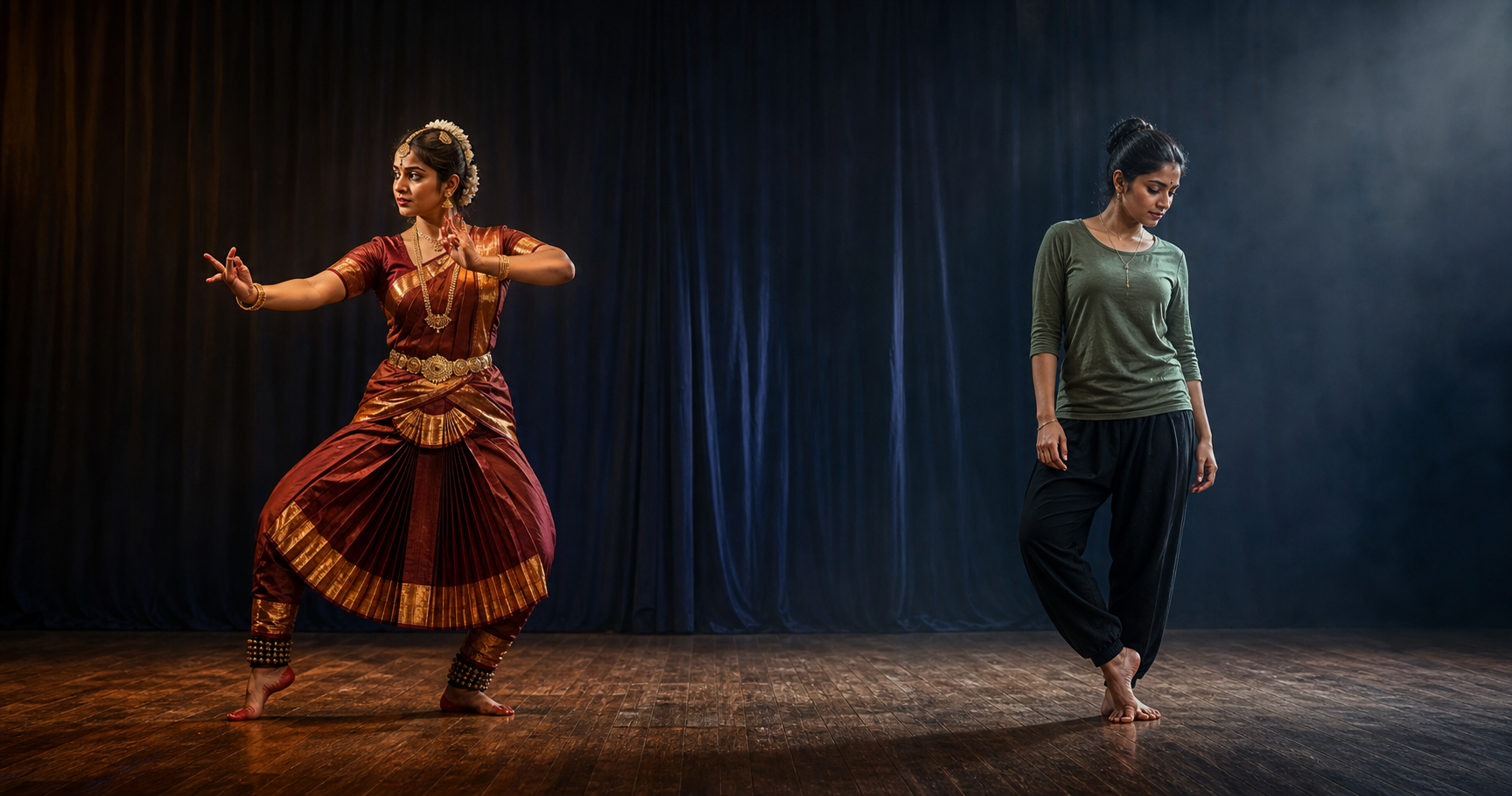
When a classical dance-drama scene feels “too formal” or “too ordinary,” the difficulty may lie in the standard you are using to read it. A codified glance and an everyday hesitation do different work. Judging both by ordinary realism makes the formal gesture look excessive; judging both by technical precision makes the human pause look insignificant.
The distinction between Natyadharma and Lokadharma gives you a better question: which stage language is carrying the meaning at this moment? Once you can answer that, you can watch more attentively, give more precise feedback, and make rehearsal choices that move coherently from bhava, the feeling embodied in performance, toward rasa, the aesthetic experience available to the audience.
Two modes of truth, not a contest between truth and artifice
In this vocabulary, dharma identifies a normative code, while abhinaya means enactment or dramatic expression. Natyadharma is the codified, stylized mode. It relies on a refined stage grammar: established gestures, directed eye movements, patterned gait, formal speech or song, and designed visual presentation. Lokadharma draws its signs from recognizable life: conversational rhythms, familiar social behavior, plausible reactions, and the way people ordinarily occupy space.
Neither term measures sincerity. Stylization need not be emotionally false, and naturalism is not automatically truthful. A meticulously shaped gesture can communicate an inner condition with great clarity. An apparently casual reaction can remain empty if it has not grown from close observation and a coherent dramatic intention.
The two modes are also not rungs on a ladder from ancient to modern. They are complementary ways of making an action intelligible. Natyadharma can lift an event toward archetype and symbol. Lokadharma can give that event recognizable human weight. The useful distinction is therefore not “traditional or realistic?” but “where does the audience’s recognition come from?”
| What to examine | Natyadharma | Lokadharma |
|---|---|---|
| Basis of recognition | A shared, learned grammar of performance | Behavior recognizable from ordinary life |
| Typical signs | Refined mudras, directed eyes, codified gait, formal musical-poetic structure | Colloquial phrasing, familiar timing, spontaneous-seeming rhythm, plausible social cues |
| Primary contribution | Concentration, symbolic force, and archetypal clarity | Immediacy, narrative grounding, and human accessibility |
| Question for the viewer | What convention must I recognize to understand this action? | What observed behavior makes this action believable? |
| Question for the performer | Is the formal sign precise enough to carry meaning? | Is the lifelike detail selected and purposeful, or merely casual? |
A scene can move between these modes without announcing the change. A character may enter through formal gait, establish identity through a codified gesture, and then respond to another character with a pause drawn from everyday behavior. Do not rush to label an entire work as one mode or the other. Look for the source of meaning in each dramatic moment.
Read both modes through the four channels of abhinaya
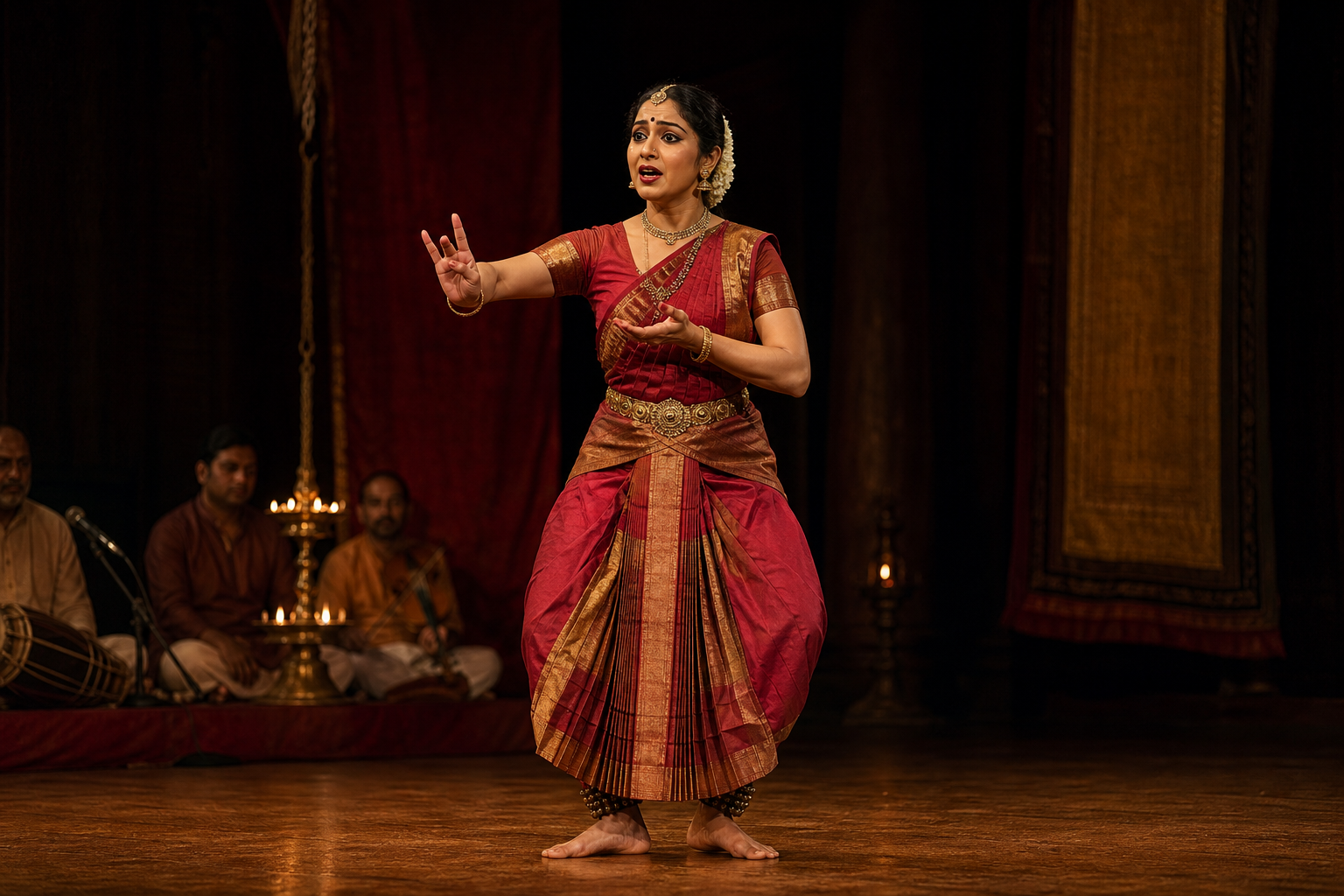
The most reliable way to examine a scene is through the four classic channels of abhinaya: angika, vachika, aharya, and sattvika. These are not four additional acting styles. They are the places where a performance organizes meaning, and Natyadharma or Lokadharma can shape each one differently.
- Angika, body and gesture: Watch the hands, eyes, face, posture, and gait. Natyadharma appears through refined mudras, deliberate drishti, and patterned gati. Lokadharma appears through behavior such as an ordinary shift of weight, a familiar recoil, or the changing distance between two people. Ask whether the body is speaking through an inherited convention, observed life, or a deliberate combination.
- Vachika, speech and song: Listen to the shape of the utterance, not only its literal meaning. Canonical musical or poetic structure can place a passage within Natyadharma. Colloquial cadence, conversational interruption, and familiar speech rhythm can bring Lokadharma forward. A formal text may still be delivered with an intimate human inflection, so text and delivery should be considered separately.
- Aharya, costume and design: Notice how visual choices tell you what kind of world you have entered. Formal costume and designed presentation can raise a character beyond the merely individual. A more familiar environment can make relationships and circumstances immediately legible. Aharya is not background decoration; it conditions how you read everything the body and voice do.
- Sattvika, inner affect: Do not judge this channel by the size of the visible expression. Ask whether the gesture, voice, timing, and design seem governed by a coherent inner condition. A large codified movement can possess inward restraint, while a small naturalistic reaction can feel manufactured. Sattvika credibility depends on integration, not volume.
Do not force one label across all four channels. Angika may be highly codified while vachika uses a more conversational rhythm. Aharya may establish an archetypal world while a quiet sattvika orientation keeps the character humanly recognizable. This layered arrangement is often where the relationship between Natyadharma and Lokadharma becomes most expressive.
If you are studying a performance, make four brief notes marked Ang, Vac, Aha, and Sat. Record the dominant mode in each channel and the sign that led you to that judgment. If you are rehearsing, use the same four-part check before accepting a vague direction such as “make it more real” or “make it more classical.” The check forces the useful follow-up: which channel needs to change, and what exactly should it communicate?
A practical method for interpreting a scene
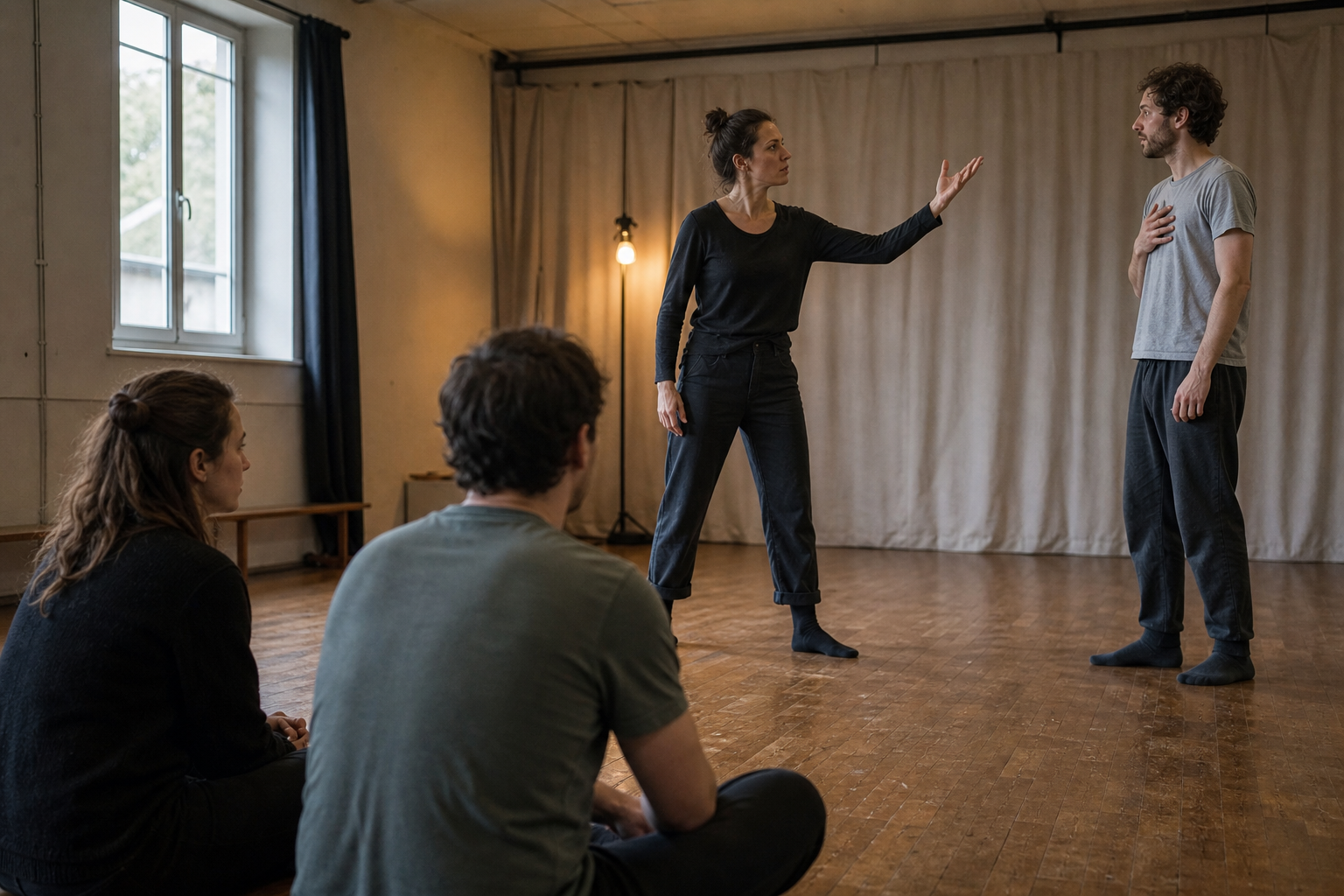
Start with dramatic function, not admiration or dislike. If your first response is “beautiful,” “exaggerated,” or “realistic,” you have described your reaction without yet explaining the scene. Work through the following sequence instead.
- State the action plainly. Complete a sentence such as “the character requests forgiveness,” “the character conceals anger,” or “the character recognizes a divine presence.” This gives you a stable narrative fact against which to test every expressive choice.
- Locate the codified signs. Identify the mudra, eye direction, gait, recurring bodily pattern, formal vocal structure, or visual convention that carries information. Name what the sign accomplishes. Do not treat every movement that differs from daily behavior as meaningless ornament.
- Locate the life-observed signs. Watch for conversational timing, hesitation, changes in social distance, interruption, or a reaction that resembles ordinary behavior. Then ask what that detail clarifies. A lifelike pause matters only if it reveals a decision, relationship, resistance, or change of feeling.
- Identify the bhava with direction and object. “Anger” is too broad for close reading. Ask who is angry, toward whom, because of what, and whether that anger is advancing, restrained, concealed, or transformed. The answer helps you see why a formal gesture or naturalistic detail was chosen.
- Ask which rasa the arrangement makes available. The movement from bhava to rasa can illuminate aesthetic states such as śṛṅgāra, love; karuṇa, compassion; raudra, fury; or adbhuta, wonder. Do not merely match an emotion word to a facial expression. Consider how body, voice, design, and inner orientation prepare the audience’s whole experience.
- Test the contribution of each mode. Mentally remove the codified element: does the scene lose symbolic concentration or narrative clarity? Then remove the lifelike element: does the character become remote or emotionally illegible? What disappears tells you what each mode is doing.
You should now be able to describe the scene as a relationship rather than a label: “The formal gait establishes the character’s archetypal stature; the familiar pause before the reply reveals hesitation; together they direct the scene from concealed bhava toward karuṇa.” That is far more useful than calling the same passage either overacted or realistic.
This method also improves criticism. Replace “the expression was too much” with a precise observation: Was the mudra unclear? Did the drishti contradict the character’s intention? Did colloquial timing interrupt the formal musical structure? Did the naturalistic reaction clarify a relationship, or did it weaken an established convention? Specific language gives the performer, teacher, and rasika something they can actually examine.
Rehearse the relationship without flattening the tradition
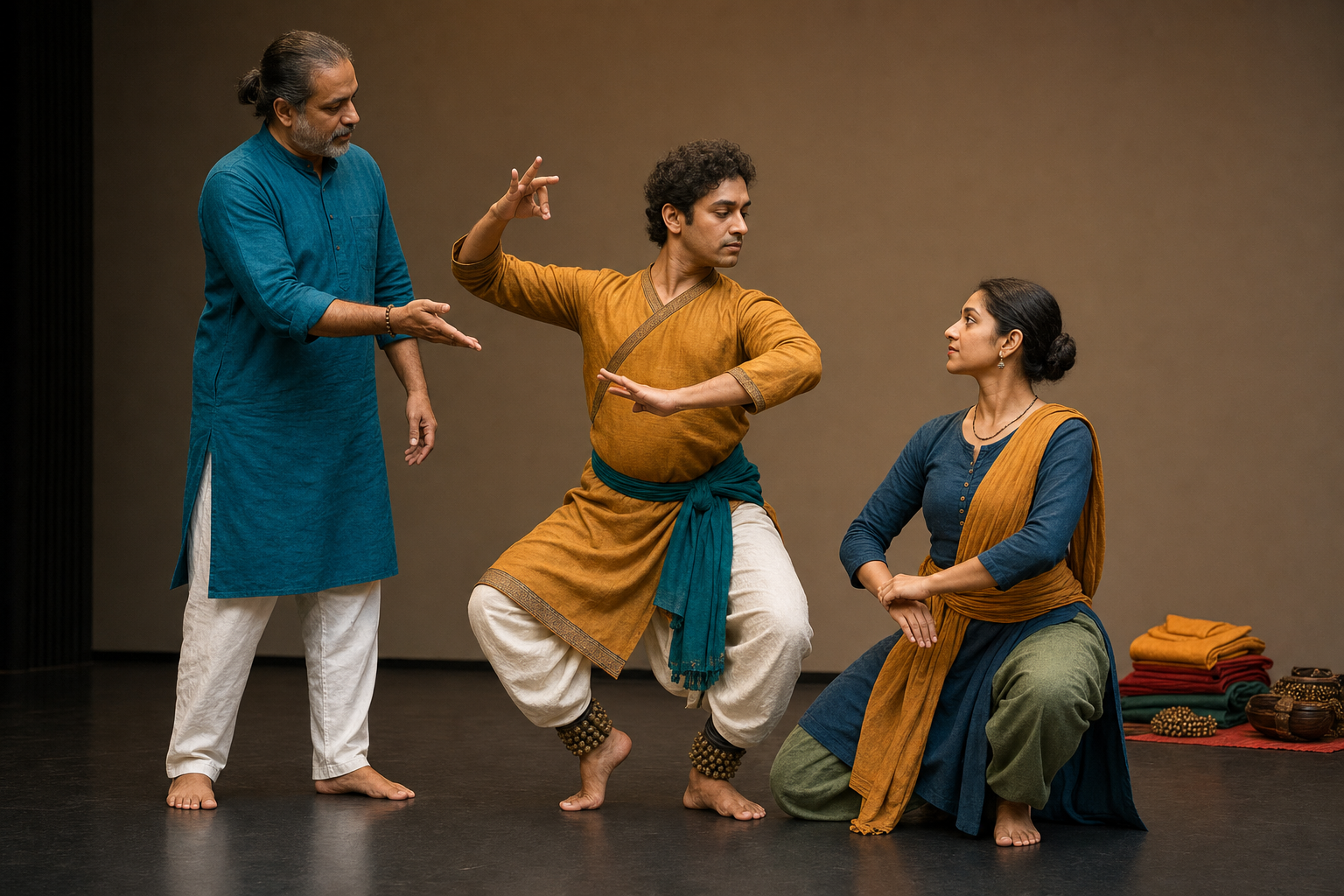
Natyadharma and Lokadharma interweave across Bharatanatyam, Kathakali, Kuchipudi, Odissi, Yakshagana, and allied forms, but that does not make their vocabularies interchangeable. Each lineage gives particular weight to gesture, gaze, gait, music, speech, costume, and dramatic pacing. Use the distinction to understand a form more closely, not to reduce different traditions to a single formula.
In rehearsal, the practical task is to decide what must remain fixed, what may be interpreted, and what kind of recognition the audience needs at each point.
- Fix the lineage anchors. Mark the required gesture, drishti, gati, text, musical structure, and aharya convention. Do not discard a formal sign merely because an everyday substitute seems easier to understand.
- State the dramatic change. Decide what the audience must recognize by the end of the passage: a new intention, a reversed relationship, a concealed feeling, a revelation, or a shift in status.
- Choose the dominant mode for that dramatic unit. If symbolic concentration is essential, let Natyadharma lead. If immediate human plausibility is needed to clarify the relationship, let Lokadharma lead. Dominance does not require exclusivity.
- Add a bridge from the secondary mode. A codified passage may gain accessibility from a carefully placed pause or familiar social response. A naturalistic exchange may gain concentration from a decisive formal gesture. Add only the detail that performs a clear function.
- Check all four channels together. A naturalistic vocal rhythm may fail if the body remains unintentionally rigid. A precise gesture may lose force if costume, gaze, or inner orientation directs attention elsewhere. Repair the contradiction at its actual channel.
- Ask a viewer two concrete questions. First, “What changed in the scene?” Then, “What aesthetic quality remained with you?” If the action is unclear, revisit the signs. If the action is clear but the intended rasa does not emerge, revisit the coordination of bhava and the four channels.
Failure patterns worth catching early
- Equating stylization with exaggeration: Increasing the size of a movement does not strengthen its grammar. Precision of sign, gaze, timing, and relation matters more than sheer scale.
- Equating naturalism with casualness: Lokadharma still requires selection and discipline. An unshaped habitual movement is not valuable simply because people perform it in ordinary life.
- Using realism to apologize for tradition: A lifelike detail should open access to the dramatic action, not erase the inherited vocabulary that gives the form its identity.
- Forcing every channel into the same mode: Contrast can be purposeful. A codified body and conversational voice may reveal a tension that uniform treatment would remove.
- Naming a rasa without creating its conditions: An intended aesthetic experience cannot be supplied by a program note. It must emerge through the organization of bhava, gesture, voice, design, and inner affect.
This discipline is why abhinaya can be approached as sadhana rather than display alone. Precision, restraint, observation, and sincerity make the performer responsible for how meaning travels. The aim is not to make the stage resemble daily life at every point, nor to make every action ceremonially elevated. It is to create a trustworthy passage from human or archetypal feeling into shared aesthetic experience.
Key takeaways
- Natyadharma communicates through codified stylization; Lokadharma communicates through behavior recognized from everyday life.
- The modes are complementary. A scene may use both, and different channels of abhinaya may use them at the same moment.
- Read a scene through angika, vachika, aharya, and sattvika instead of judging the entire performance by a single standard of realism.
- Connect every expressive choice to a dramatic action, a directed bhava, and the rasa the arrangement makes available.
- In rehearsal, preserve lineage anchors, choose a dominant mode for each dramatic unit, and add a secondary detail only when it clarifies meaning.
- Replace vague criticism with a channel-specific observation: identify the gesture, gaze, voice, design, timing, or inner orientation that needs attention.
At your next performance, follow one short scene closely. Note what you understand because you recognize an inherited stage code, then what you understand because you recognize ordinary human behavior. Finally, name the movement from bhava toward rasa. That small exercise will tell you more than trying to classify the whole work at once.
If you are performing, reverse the process: decide what the audience must grasp, stabilize the inner direction, and assign the work across the four channels. Keep asking one narrow question about every addition: does it sharpen the meaning, or merely make the scene busier? Retain the stylization that concentrates truth and the naturalistic detail that opens access to it.
References
