
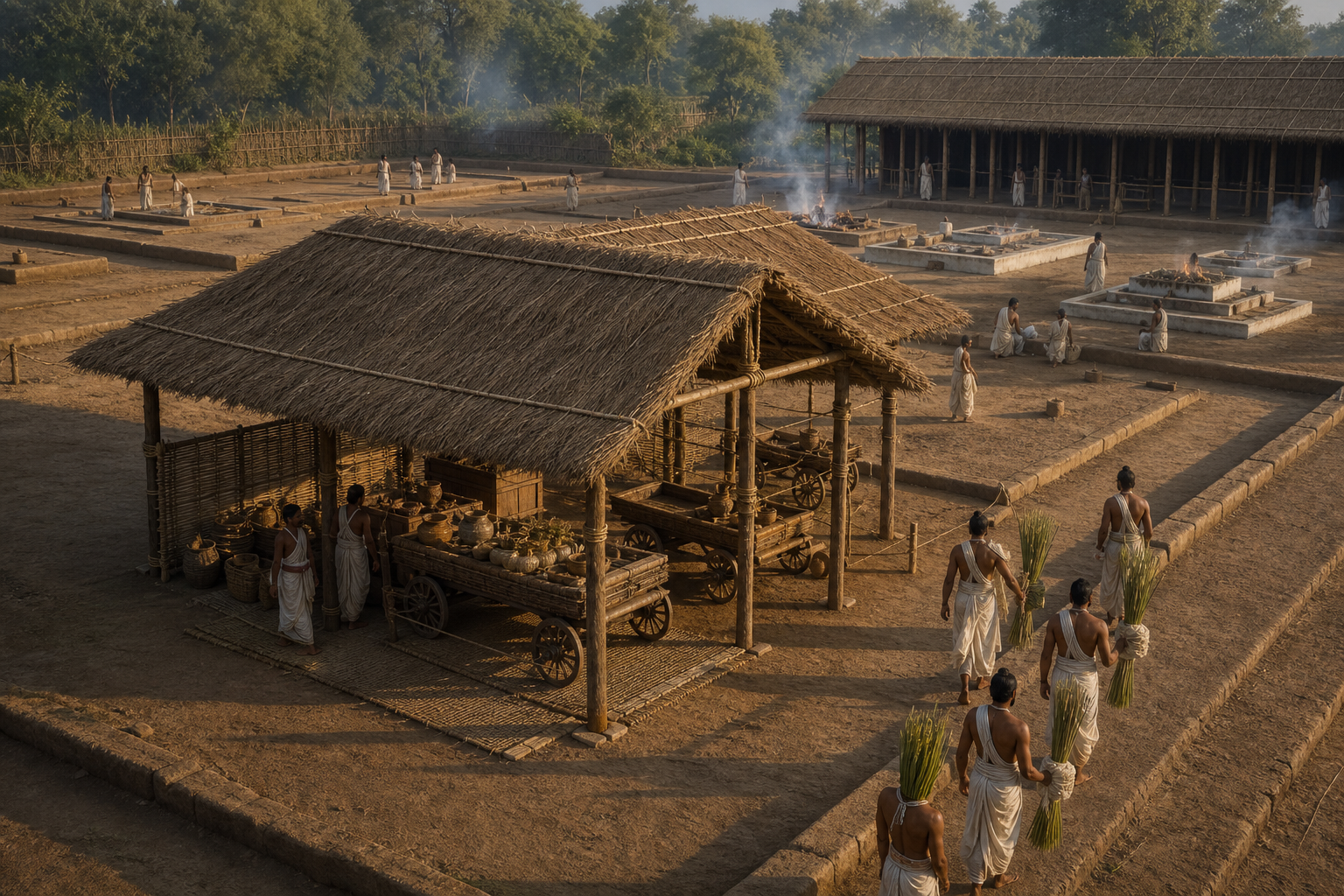
You are looking at a Somayaga ground plan. The Mahavedi and the fires draw your eye, while the Sadas suggests visible priestly activity. Beside them, the Havirdhana can look like a modest support shed. If you dismiss it as storage, however, the ritual landscape stops making sense.
Follow the soma instead. The Havirdhana then appears as a controlled threshold between acquisition and offering: a place where sacred material is received, protected, arranged, and made ready for transformation. That route gives you the clearest way to understand both its architecture and its symbolism.
A working enclosure, not a decorative building
The name joins havis, an oblation, with dhāna, a repository. The literal sense is useful, but repository must not be confused with an ordinary storeroom. The Havirdhana is a purpose-built enclosure that receives, protects, and sanctifies the soma creeper and associated offerings.
Those three functions are inseparable. Reception requires a recognized place of arrival. Protection requires a clear boundary and guarded handling. Sanctification requires the material, implements, priestly actions, and mantras to meet in the correct order. The building serves the rite because it makes that order physically possible.
This is why modesty should not be mistaken for informality. A Havirdhana may be a simple shed, yet its dimensions, materials, limits, and internal arrangement demand care. Its importance lies less in visual grandeur than in precision. The enclosure does not need to dominate the sacrificial ground; it needs to make every relevant distinction unmistakable.
When you examine a representation or reconstruction, therefore, begin with three practical questions. Can you identify the boundary? Can you identify the threshold through which soma enters? Can you distinguish the protected holding and preparation area from the route leading toward pressing and offering? If those relationships are unclear, an attractive reconstruction may still fail to explain the ritual.
Do not infer a universal blueprint from one diagram. Exact orientations can vary across Śrauta lineages, and a symbolic overview is not sufficient authority for construction. Anyone attempting a working reconstruction should use the appropriate lineage-specific manual and the direction of qualified ritual practitioners.
Read its placement as a network of ritual relationships
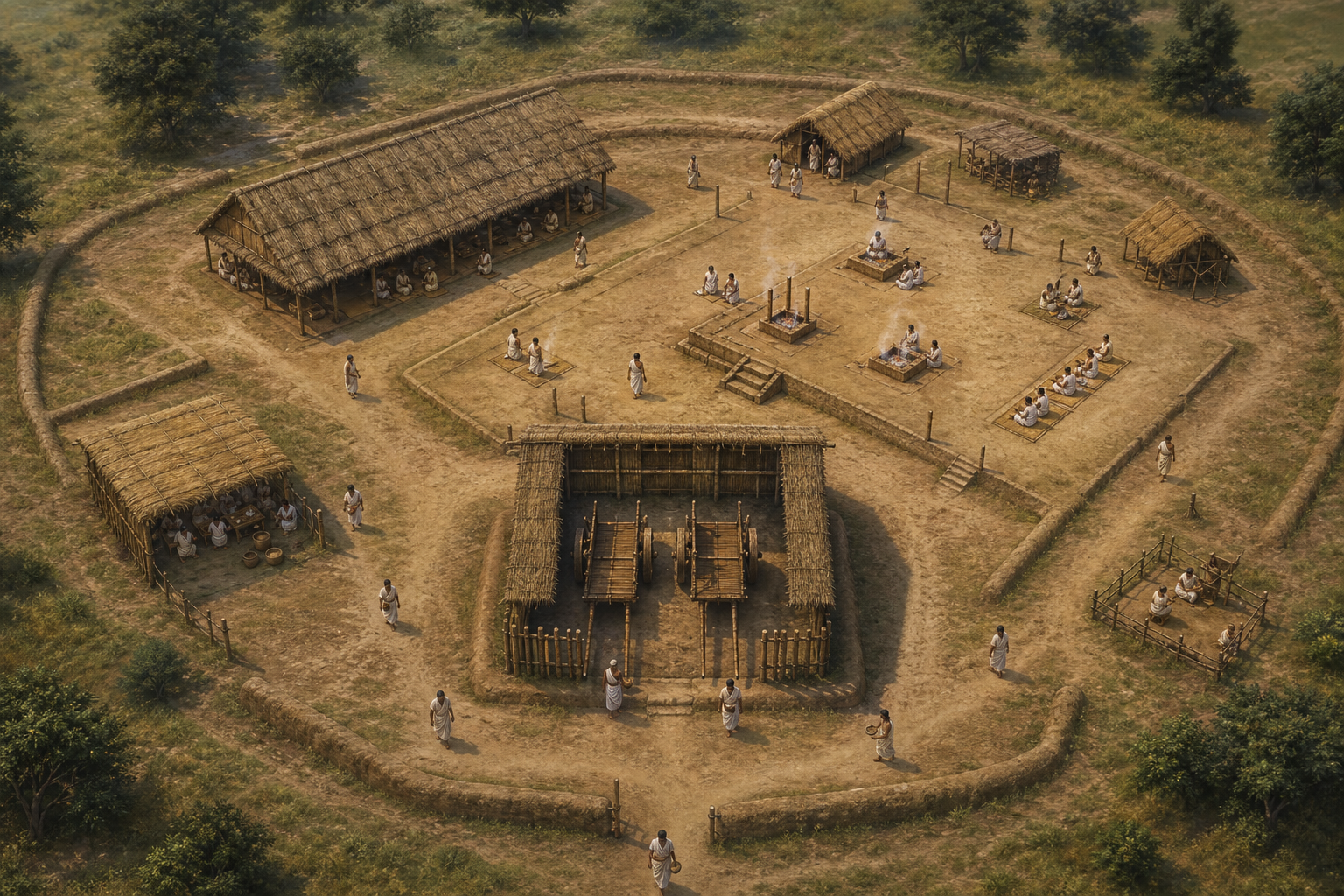
The Havirdhana belongs to a larger sacrificial campus. It is typically placed adjacent to the Sadas and coordinated with the Mahavedi and the three fires. None of these spaces can be interpreted adequately as an isolated building. Their arrangement supports the movement of offerings, implements, priests, and recitation through the rite.
Start with the Sadas. Its proximity helps you see that the Havirdhana is connected to the active priestly order of the sacrifice, not set apart as a remote warehouse. Next, trace the Havirdhana’s relationship to the Mahavedi and the fires. Then mark the likely arrival and onward pathways of the soma. You are looking for a spatial sequence, not merely a compass bearing.
This distinction matters because orientation may differ among lineages while relational logic remains essential. A diagram cannot be declared correct merely because one building faces an expected direction. Nor should it be declared wrong solely because it differs from another lineage’s plan. Ask instead whether the arrangement preserves intelligible boundaries, guarded movement, and coordination with the other ritual spaces.
A useful reading order is outside to inside, and then inside to onward action. Locate where soma approaches the enclosure. Find the threshold at which its status changes. Identify where it is placed and protected. Finally, trace how the rite proceeds toward pressing, straining, and offering. This method turns a static plan into a map of ritual time.
The soma’s journey turns architecture into liturgy
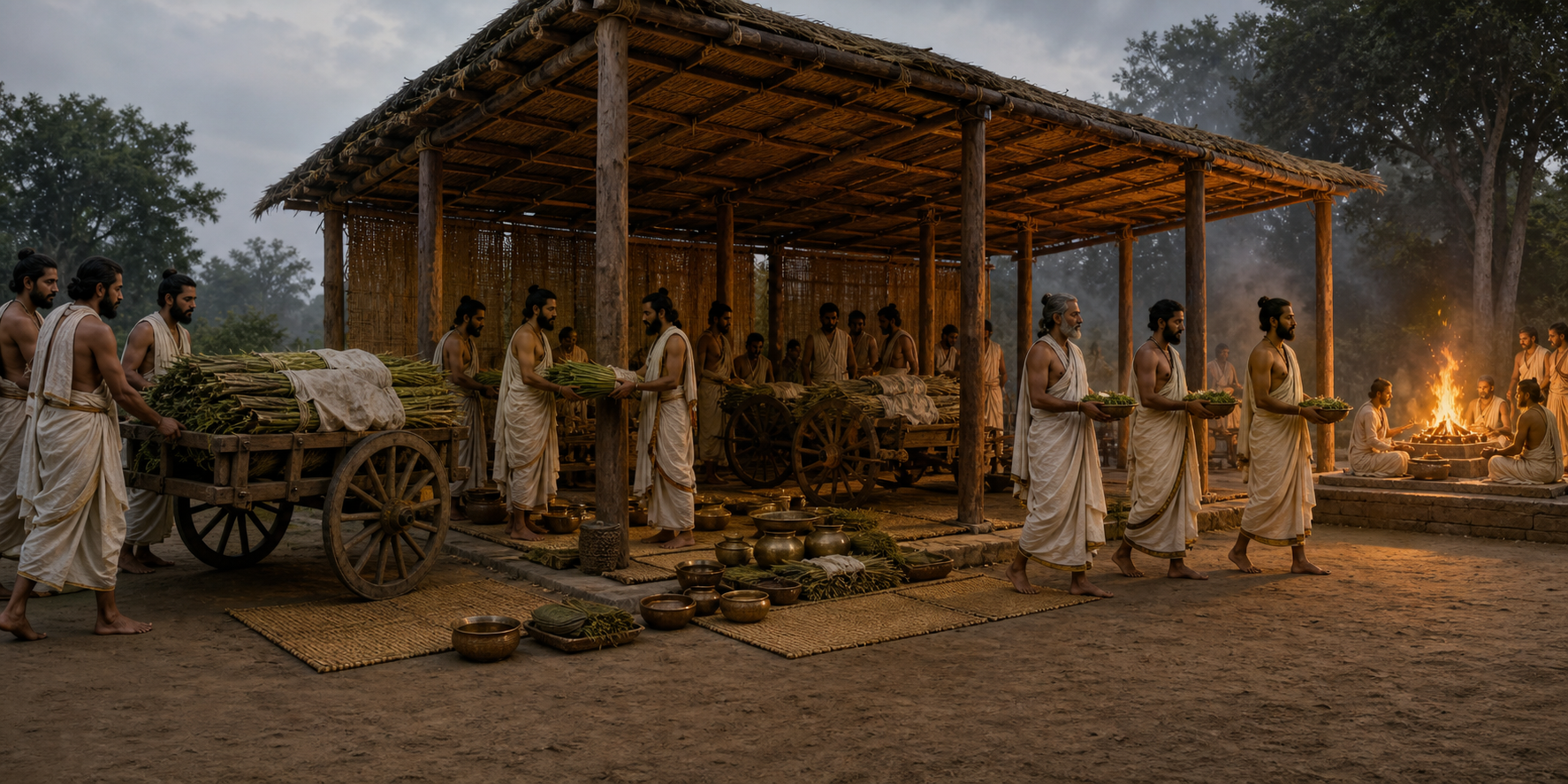
The Havirdhana becomes easiest to understand when you reconstruct the sequence of actions it supports:
- The soma is obtained through the ritually appropriate process.
- It is transported carefully and guarded against contamination.
- Its entry into the Havirdhana forms a deliberate threshold moment governed by mantra and disciplined movement.
- The soma is placed within the consecrated enclosure, while vessels and the implements needed for pressing, straining, storage, and oblation are assembled in measured order.
- The prepared soma proceeds toward pressing and offering as part of the larger sacrificial sequence.
Architecture regulates every transition in that sequence. A boundary distinguishes ordinary approach from consecrated handling. The threshold gives entry a definite moment. Internal order prevents vessels, implements, and offerings from becoming an undifferentiated collection. The onward route ensures that protection does not become stagnation: what is contained here is being prepared for release as offering.
Priestly roles make the spatial sequence fully intelligible. The Adhvaryu oversees the practical progression of measured actions. The Hotṛ’s recitations give voiced form to the ritual order. The Brahman sustains the alignment of intention and rite. Supporting priests complete the coordinated work. The enclosure is therefore not a silent container around the sacrifice; it is an instrument that allows chant, action, and intention to converge without confusion.
The stillness associated with the soma’s entry should not be read as inactivity. It is concentrated attention. The creeper is neither being handled casually nor rushed toward the visible offering. The pause protects the integrity of the sequence. When watching a reenactment or studying an image, identify the stage of the soma’s journey before trying to name every object. Function will usually clarify the object more reliably than appearance alone.
Its symbolism grows directly from its practical design

The Havirdhana occupies a liminal position. It is not an unrestricted public area, but neither is it a permanently hidden inner sanctum. It is a transitional enclosure in which something gathered from the world is prepared to become an offering. Its symbolism is therefore architectural before it is abstract: boundary, threshold, containment, order, and onward movement create the meaning.
Purity is protected through form and conduct
Purity here is not a decorative label attached to the soma. It depends on how the creeper is transported, where it is placed, how the vessels are sanctified, which pathways are guarded, and whether the established protocols are maintained. The enclosure gives those disciplines a visible structure. Its boundary says that purity of an end cannot be separated from purity of means.
Precision is coordination, not mere measurement
Dimensions and placement matter, but precision extends beyond geometry. The relevant action must happen at the proper stage, with the proper implement and the corresponding mantra. Priests must know how their tasks relate to one another. A perfectly measured shed would still miss the point if its internal order or ritual traffic produced confusion.
Unity of purpose gives every distinction a direction
The enclosure separates spaces, materials, roles, and moments, but separation is not the final purpose. Every distinction directs the soma toward offering. Matter, mantra, disciplined action, and intention meet in one ritual movement. Havirdhana thus embodies purity of means, precision of sequence, and unity of purpose without reducing any one of them to an isolated ideal.
This also explains the symbolism of restraint. The soma’s potency is not expressed through immediate use. It is first contained, protected, and prepared. Restraint precedes ritual realization, while order makes transformation possible. You can apply that insight to the study of Vedic practice without turning the Havirdhana into a loose metaphor: first understand what the enclosure does, and only then ask what its disciplined containment teaches.
A broader Dharmic reading can notice resonances without pretending that distinct traditions perform the same rite. Respectful handling of the soma reflects humility, gratitude, and care toward sacred material. That ethical posture can be placed in conversation with Jain ahiṁsā, Buddhist attention to intention, and Sikh reverence for disciplined service. The responsible comparison concerns shared habits of care and self-command, not an assertion that their doctrines or ritual forms are interchangeable.
Key takeaways for reading a Havirdhana
- Havirdhana is a purpose-built enclosure for receiving, protecting, and sanctifying soma and associated offerings, not an ordinary storeroom.
- Its architecture should be read relationally: begin with the Sadas, Mahavedi, fires, guarded pathways, and the soma’s route.
- Orientation may vary across Śrauta lineages, so one plan should not be treated as a universal construction template.
- The soma’s movement from acquisition toward pressing and offering turns spatial arrangement into ritual sequence.
- Its central symbolic themes are purity of means, precision of sequence, and unity of purpose.
- Its boundary represents disciplined transition: containment prepares sacred material for transformation rather than removing it permanently from action.
When you next encounter a Somayaga plan, mark three things before interpreting any symbolism: the soma’s entrance, its protected place of preparation, and its onward route. Then add the priestly actions and recitations attached to that movement. This simple exercise prevents both common errors: reducing the Havirdhana to a shed and detaching its symbolism from the exact ritual work that gives it meaning.
References
