
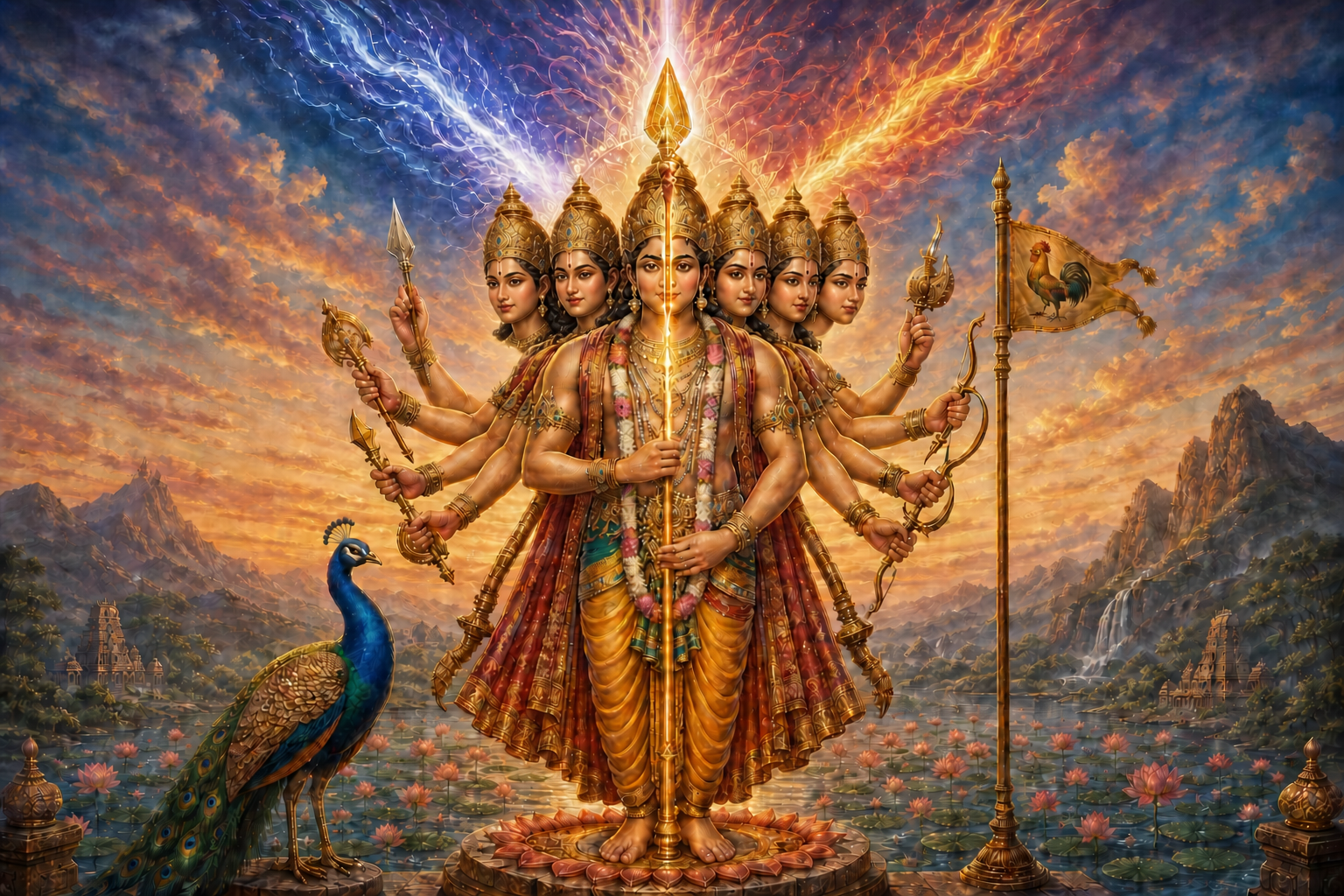
You may have encountered two explanations of Murugan that seem to pull in different directions. One calls him the embodiment of Iccha Shakti, the power of divine will. Another presents him through the Vel, sacred knowledge, disciplined warfare and decisive action. If will is only one of the three Shaktis, where do Jnana and Kriya belong?
They belong inside the same movement. Murugan’s birth begins with consciousness seeing clearly, passes through a will aligned with dharma, and reaches fulfilment in knowledgeable action. Once you follow that sequence, the familiar details of the birth narrative stop looking like disconnected marvels. They become a practical map for turning desire into purpose without letting ego, confusion or restless activity take command.
Follow the birth as a movement from insight to form
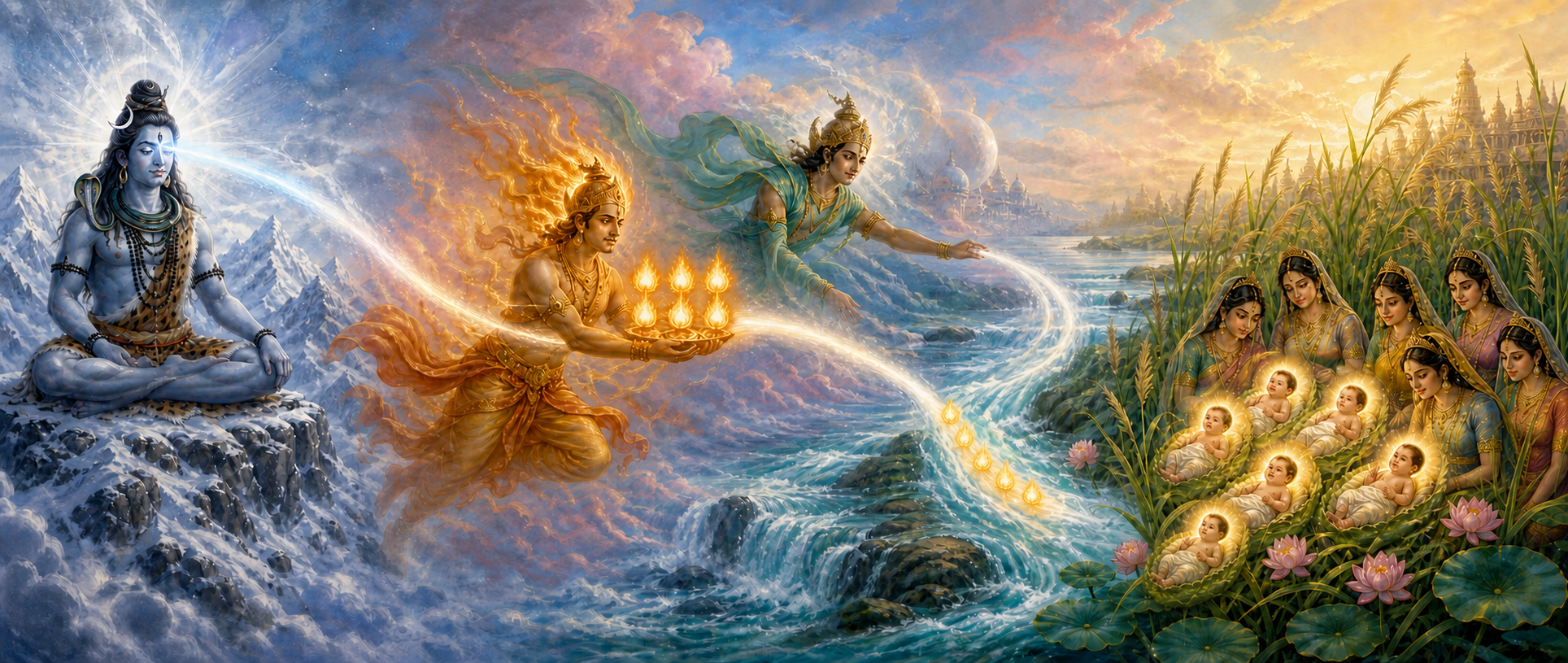
In the familiar Puranic telling, Murugan does not arise from an ordinary impulse. Sparks issue from Shiva’s third eye, are borne by Agni and Vayu toward waters sanctified by Ganga, and become six radiant infants nurtured by the Krittikas at Saravana. Parvati then unites the six as Shanmukha, the six-faced Lord.
The sequence matters. Each stage prevents us from confusing Iccha Shakti with the ordinary urge to acquire, dominate or prove ourselves.
- The third eye places insight before intention. Shiva’s third eye signifies vision that penetrates appearances and dualities. Murugan’s originating will is therefore not blind appetite; it is will awakened by consciousness.
- Agni and Vayu carry the sparks. Fire conveys transforming force, while movement carries that force beyond its point of origin. Sacred intention must become living energy if it is to enter the world.
- Ganga’s waters and the care of the Krittikas receive that energy. Power is not complete merely because it is intense. It must be held, nourished and given a form capable of serving its purpose.
- Parvati unites the six infants without abolishing their sixfold awareness. Integration is not dull uniformity. It is the gathering of many capacities around one dharmic center.
This reading also corrects a common mistake: searching for one exclusive code in which every image has only one permissible meaning. The six faces are commonly related to mastery of the six inner enemies – kama, krodha, lobha, moha, mada and matsarya – but they can also signify awareness capable of looking in every direction without becoming fragmented. The readings are complementary. One concerns mastery of the inner field; the other concerns completeness of perception.
When you contemplate Shanmukha, the useful question is therefore not simply, What do the six faces stand for? Ask what in you remains divided. A worthy intention may coexist with anger, vanity, attachment or rivalry. Naming that division is the beginning of unifying it.
The three Shaktis form one dharmic movement
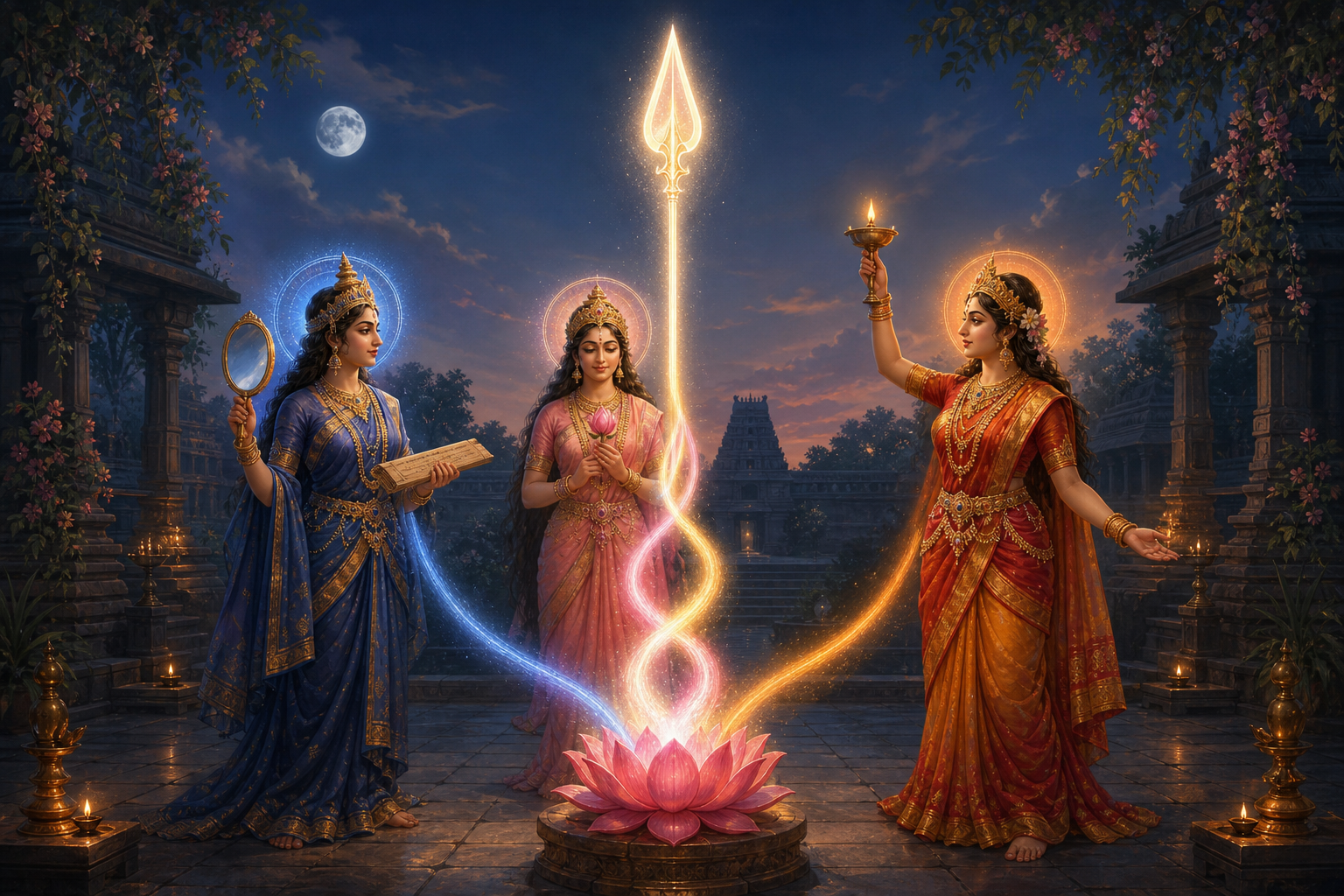
Iccha, Jnana and Kriya are not three competing divine substances. They are interdependent modes of Shakti: the power to intend, the power to know and the power to act. We separate them in thought because the distinction helps us diagnose where a decision has gone wrong. In a whole life, each continually corrects and completes the others.
| Shakti | Dharmic function | What distortion looks like | Question to ask |
|---|---|---|---|
| Iccha Shakti | Clarifies the end toward which your energy should move | Personal craving, wounded pride or the need to control disguises itself as purpose | Would this still be worth doing if it brought me no praise or advantage? |
| Jnana Shakti | Discerns truth, duty, consequence and the right means | Assumption is mistaken for knowledge, or analysis becomes an excuse never to act | What do I know, what am I merely assuming, and what does dharma require here? |
| Kriya Shakti | Gives intention an effective and disciplined form | Busyness, aggression or ritual performance proceeds without a worthy aim | What concrete act would serve the purpose without betraying it? |
Iccha without Jnana is easily captured by impulse. Jnana without Kriya can remain sterile understanding. Kriya without clarified Iccha and Jnana becomes activity for its own sake, and activity can do harm even when it feels forceful or efficient. A decision becomes dharmic only as the three begin to agree.
The order is not mechanical. Action may reveal that your knowledge was incomplete. Better knowledge may purify your intention. A purified intention may require a different action. The three Shaktis work more like a living circuit than a row of sealed compartments. That is why reconsidering a course of action is not necessarily weakness. It may be Jnana correcting Kriya so that Iccha can remain faithful to dharma.
Murugan’s Vel, six faces and guardianship complete the circuit
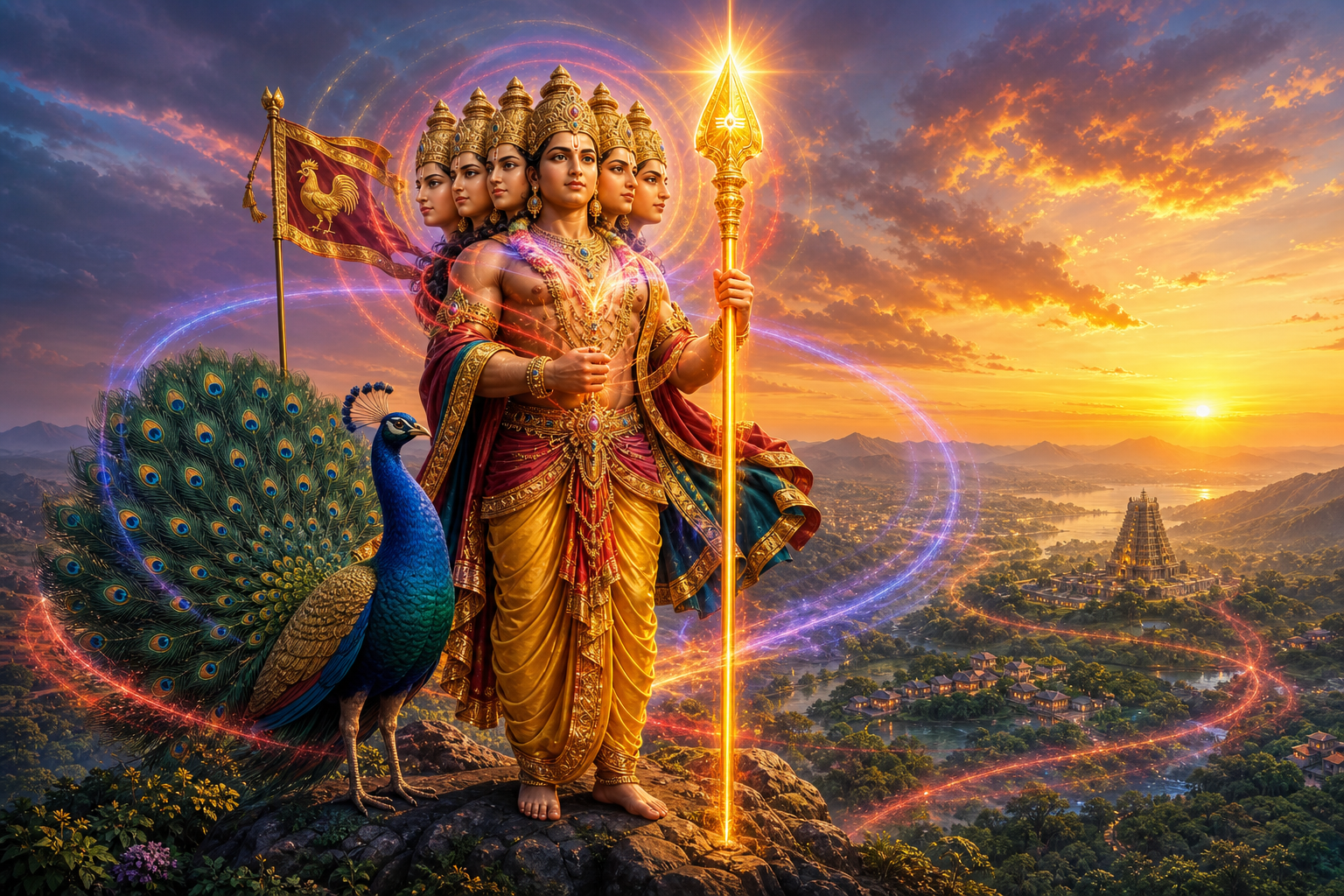
Murugan can be especially associated with Iccha Shakti without being confined to it. His birth reveals the arising of sacred will, while his attributes show what that will becomes when knowledge and action complete it.
- His emergence from Shiva’s third eye presents Iccha as luminous intention born from insight.
- The Vel represents Jnana that penetrates confusion and separates truth from the ignorance surrounding it.
- His protective and warrior form represents Kriya: knowledge and intention carried into courageous action on behalf of dharma.
- His six faces represent awareness gathered rather than scattered, capable of meeting the inner and outer field without losing its center.
- As Subrahmanya, he expresses the guru principle, through which power becomes instruction rather than mere force.
The Vel deserves particular care in interpretation. If you read it only as a weapon, you miss its sharpest demand. It must first pierce ignorance, including the ignorance that allows self-interest to masquerade as righteousness. Murugan’s warrior character does not offer sacred cover for uncontrolled anger. It asks whether your action protects dharma, arises from clear perception and remains governed by discipline.
The same standard applies to the conquest of the arishadvargas. Mastery does not mean pretending that desire, anger, greed, delusion, pride and envy are absent. It means seeing which one is trying to occupy the command position. Before you call a struggle righteous, identify what in you benefits from escalating it. That single act of scrutiny brings the third-eye symbolism into daily conduct.
Murugan’s wider Dharmic resonance should also be handled with precision. Skanda-Kumara appears as a protective figure in Buddhist traditions across parts of East and Southeast Asia. Jain emphasis on tapas and self-restraint, and the Sikh ideal of nishkam seva, resonate with the ethical pattern of intention purified by insight and expressed through principled action. These resonances do not erase the distinct teachings of the traditions. They give you a responsible basis for discussing shared values – discipline, guardianship, restraint and service – without claiming that every tradition is saying the same thing.
Put the three Shaktis into one real decision

The symbolism becomes useful when you apply it before a consequential action, not after the result has already pleased or embarrassed you. Use this sequence when you face a family conflict, a community duty, a difficult refusal or a desire to undertake a spiritual vow.
- Name the purpose. Complete the sentence: I want to act because something worthy must be protected, restored or served. If the sentence only names what you want to obtain, go deeper.
- Test Iccha. Ask whether the intention survives the removal of applause, victory and personal advantage. Notice any desire to humiliate, display superiority or avoid an inconvenient duty.
- Apply Jnana. Separate what you know from what you infer and what you fear. Identify who may be affected, what obligation is actually yours, and whether your chosen means contradicts the end you claim to serve.
- Choose Kriya. Select a complete, proportionate act. It might be a truthful correction, an apology, a firm boundary, a request for counsel, an act of seva or the disciplined choice not to react.
- Review the circuit. After acting, ask whether the result exposed a flaw in your knowledge or intention. Correcting the next step is part of integrated action, not an admission that the original purpose lacked value.
This process prevents a devotional teaching from collapsing into a technique for getting whatever you want. Iccha Shakti is not a promise that intense wanting will make the universe comply. It is the purification of wanting until your will can serve what is true. Jnana then tests the means, and Kriya accepts the discipline required to carry the purpose into life.
You can bring the same structure into worship. Begin by naming one intention that needs purification rather than presenting a long catalogue of desired outcomes. Recite Om Saravanabhava with attention gathered around that intention. Contemplate the Vel as the clarity needed to cut one specific confusion. Then let the worship end in an act: restraint where impulse has ruled, truth where evasion has ruled, or service where self-concern has ruled.
If kavadi is part of your devotional life, treat the vow as tapas rather than spectacle. Its inner work is the concentration of scattered urges into disciplined offering. Karthigai and Thaipusam likewise place personal resolve within community worship, humility and shared purpose. The external form matters, but its test is what happens to your will: whether it becomes steadier, clearer and less self-centered.
Key takeaways
- Murugan’s birth from Shiva’s third eye presents Iccha Shakti as will awakened by insight, not ordinary craving.
- Iccha chooses a worthy end, Jnana discerns truth and right means, and Kriya carries both into disciplined action.
- The passage through fire, movement, water and maternal care shows that sacred power must be transmitted, received, nourished and integrated.
- Shanmukha’s six faces can direct attention toward mastery of the six inner enemies and toward awareness that remains whole in every direction.
- The Vel tests the seeker before it confronts the world: ignorance, pride and confused motive must be pierced within.
- Devotion becomes practical when mantra, contemplation, tapas or festival worship produces a specific act of restraint, truth or service.
The next time a strong desire presents itself as a calling, don’t measure it by intensity alone. Bring it before Murugan’s threefold test: Is the will dharmic, is the understanding clear, and is the action worthy of both? Then take the step that lets all three Shaktis move together.
References
