
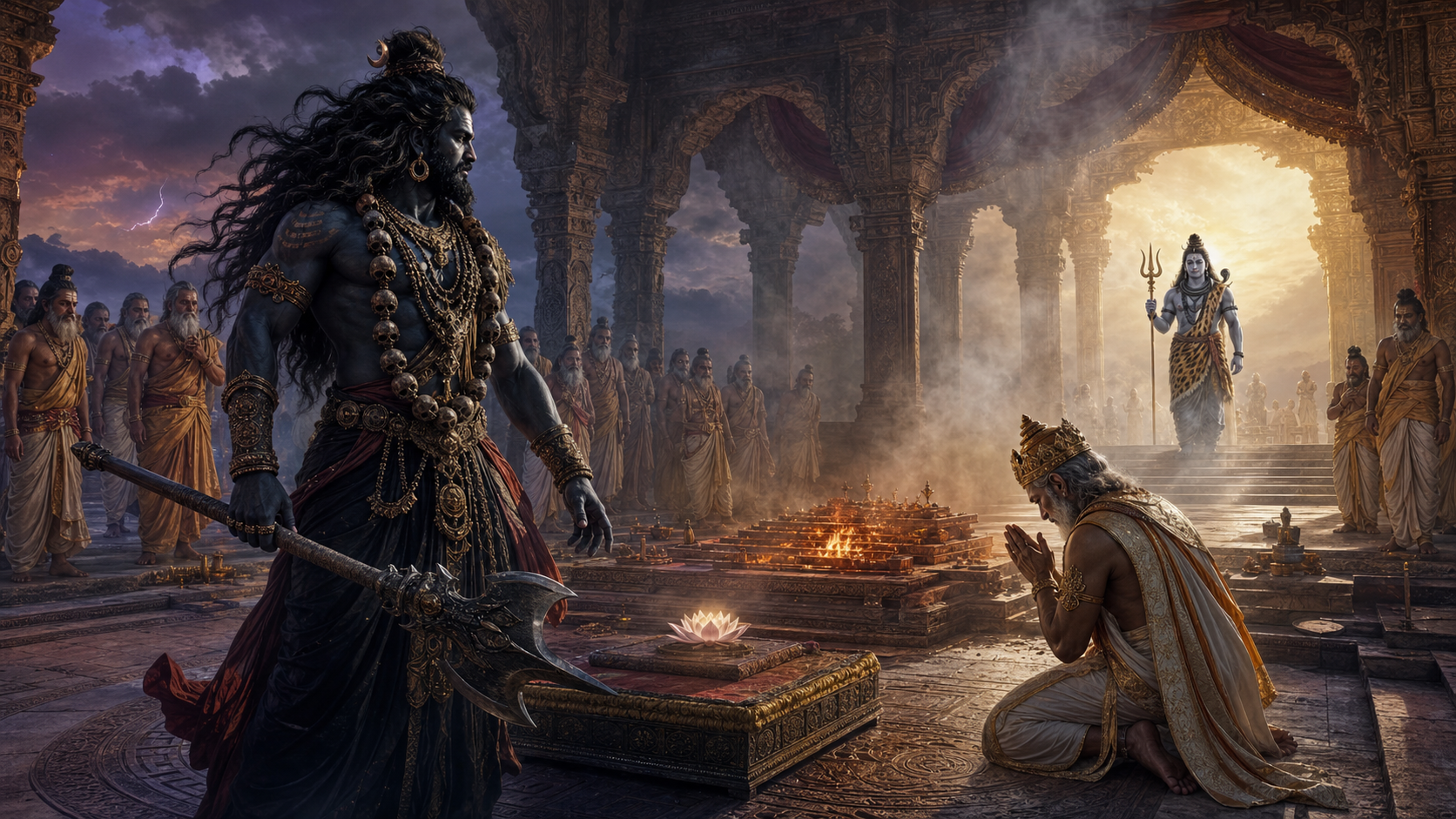
You may remember the Daksha Yagya mainly for its fiercest images: Sati relinquishing her body, Veerabhadra destroying the sacrifice, and Daksha receiving a goat’s head. If you stop there, the katha can look like a chain of insult and retaliation. Read as a complete sequence, however, it asks a more useful question: what should dharmic strength do after pride has corrupted a sacred relationship?
The answer is neither passive tolerance nor permanent vengeance. You protect dignity, interrupt adharma, hold the offender accountable, and preserve a route to restoration. That sequence can guide you through disputes in families, temples, community organizations, and relations among different sampradayas.
The yagya fails before Veerabhadra destroys it
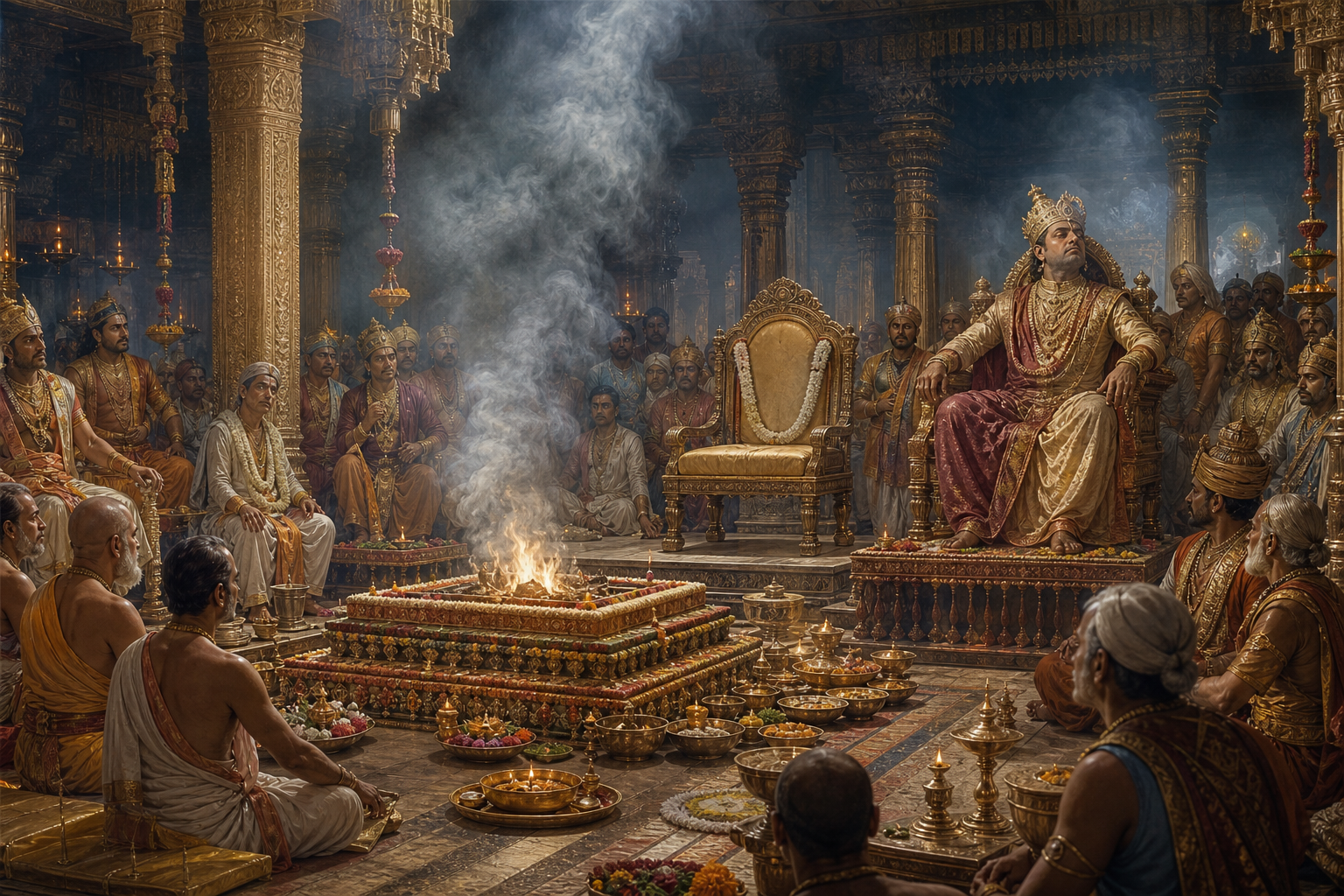
The physical destruction of the yagya is not the beginning of the crisis. The sacrifice has already been damaged by the intention behind it. Daksha arranges a magnificent rite, surrounds it with recognized religious authority, and deliberately excludes Shiva. Grandeur makes the exclusion more conspicuous; it does not make it righteous.
Keep the whole causal order in view:
- Daksha uses a sacred gathering to express a personal and spiritual rejection of Shiva.
- Sati learns of the gathering and wants to return to her paternal home. Shiva, aware of Daksha’s hostility, counsels restraint, but she attends out of filial attachment.
- Daksha publicly disparages Shiva. Sati experiences this not as a minor breach of etiquette but as an assault on her chosen devotion, her marriage, and the sanctity of the rite. She relinquishes her body through yogic resolve.
- Shiva’s grief becomes a corrective force. From a lock of his matted hair arises Veerabhadra, while several retellings also recall Bhadrakali. Veerabhadra halts the proceedings, breaks the instruments of the sacrifice, humbles the assembly, and beheads Daksha.
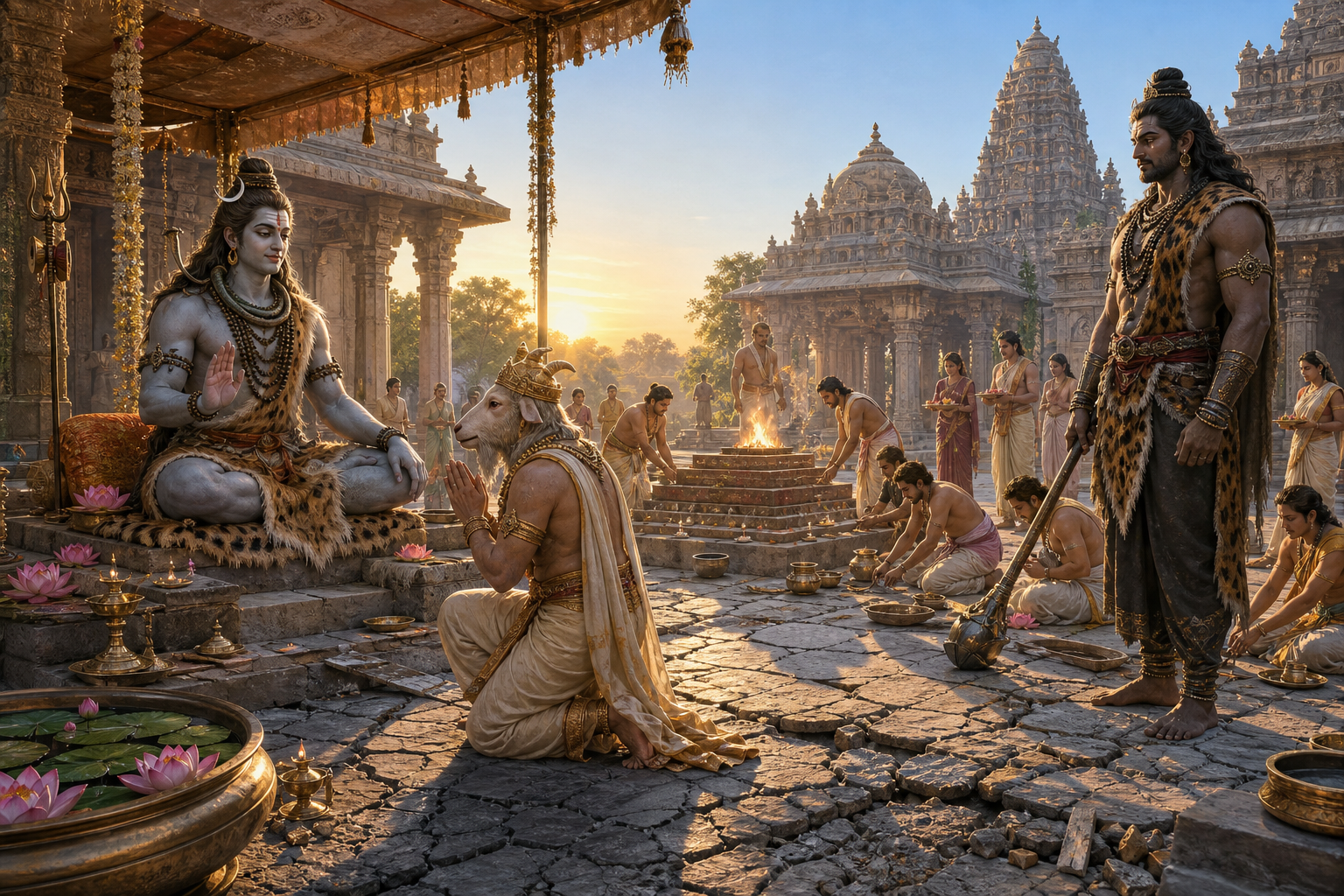
- Shiva does not leave the world at the point of punishment. Daksha is restored with the head of a goat, and the yagya is completed with due reverence.
Each isolated scene can produce a distorted lesson. Daksha’s ceremony, viewed without its contempt, appears respectable. Sati’s death, separated from the cosmic and yogic setting of the katha, can be dangerously romanticized. Veerabhadra’s fury, cut off from Shiva’s eventual compassion, can be mistaken for a licence to retaliate. Restoration, detached from Daksha’s punishment and transformation, can be reduced to cheap forgiveness. The ethical meaning appears only when the scenes remain connected.
Daksha’s error is greater than a missing invitation
Daksha’s first visible act is exclusion, but ahankara is the deeper mechanism. He treats his position as permission to decide which manifestation of the divine deserves honour. He then uses a yagya, which should orient participants toward sacred order, to publicize that judgement.
This distinction matters whenever you assess a religious dispute. Not every limited guest list is an act of adharma, and not every disagreement is persecution. Look for the combination present at Daksha’s gathering: a person or path is singled out, the exclusion carries deliberate contempt, and the prestige of the institution is used to make that contempt appear legitimate.
Before organizing a temple program, inter-sampradaya gathering, family puja, or community commemoration, ask three concrete questions:
- What is the rule for participation? A neutral limitation can be explained and applied consistently. A rule invented for one disliked person is exclusion disguised as procedure.
- What speech will the gathering permit? Theological disagreement can be direct, but a sacred platform should not become a stage for humiliating another person’s deity, guru, lineage, or spouse.
- Who can stop a breach? Decide in advance who may pause the program, remove a speaker from the microphone, or call the parties aside. Without that responsibility, everyone may wait for someone else while the injury grows.
The katha also offers a disciplined way to speak about unity among Dharmic traditions. Hindu reverence for diverse forms of the divine, Buddhist attention to non-ego, Jain emphasis on restraint, and Sikh commitment to seva and truthful living can meet around humility and responsible conduct. This resonance does not erase doctrinal differences. It establishes a floor beneath them: difference in worship does not authorize contempt.
Unity therefore cannot mean pressuring the injured person to remain silent so that the ceremony looks harmonious. That merely protects the appearance of order. Real unity requires a structure in which disagreement can occur without degradation and in which status does not place anyone beyond correction.
Sati’s dignity is not an instruction to imitate her death

Here, Sati is Daksha’s daughter and Shiva’s consort. Her relinquishing of the body belongs to a Puranic narrative of yogic and cosmic consequence. It must not be turned into a social command, a defence of self-harm, or a model for how a person should respond to humiliation in ordinary life.
The humanly recognizable part of her situation comes earlier. She wants to visit her paternal home even though her husband knows she will not be received with goodwill. That tension prevents a simplistic reading in which either attending or staying away is always the dharmic choice. Affection for your family of birth is real, but it does not guarantee that a particular gathering is safe or respectful. A warning based on known hostility is not necessarily an attempt to control you.
If you are deciding whether to enter a gathering where your spouse, practice, or convictions may be mocked, replace vague hope with a boundary plan:
- Confirm whether you are genuinely welcome rather than assuming kinship makes an invitation unnecessary.
- Tell the person accompanying you what conduct will end the visit. A boundary stated beforehand is easier to follow than one invented amid public pressure.
- Keep control of your exit. If hostility is likely, do not depend on the hostile party for transport, lodging, or permission to leave.
- Do not debate the merits of your path while abuse is continuing. Stop the exchange, leave the setting, and discuss doctrine only after ordinary respect has been restored.
- Seek immediate support from a trusted person if humiliation or conflict is provoking thoughts of harming yourself. Self-destruction is not a dharmic boundary.
Sati’s refusal to accept public dishonour should sharpen your sense of dignity, not narrow your available choices to endurance or catastrophe. In present life, dignity is usually protected through a life-affirming act: leaving, refusing participation, documenting misconduct, seeking allies, or making future contact conditional on changed behaviour.
The katha should also never be used to demand that a married person automatically sever relations with a birth family, or to insist that someone attend a hostile event to prove courage. The relevant question is not, “Which side have you chosen?” It is, “What boundary allows relationship without cooperation in humiliation?”
Veerabhadra represents force governed by purpose
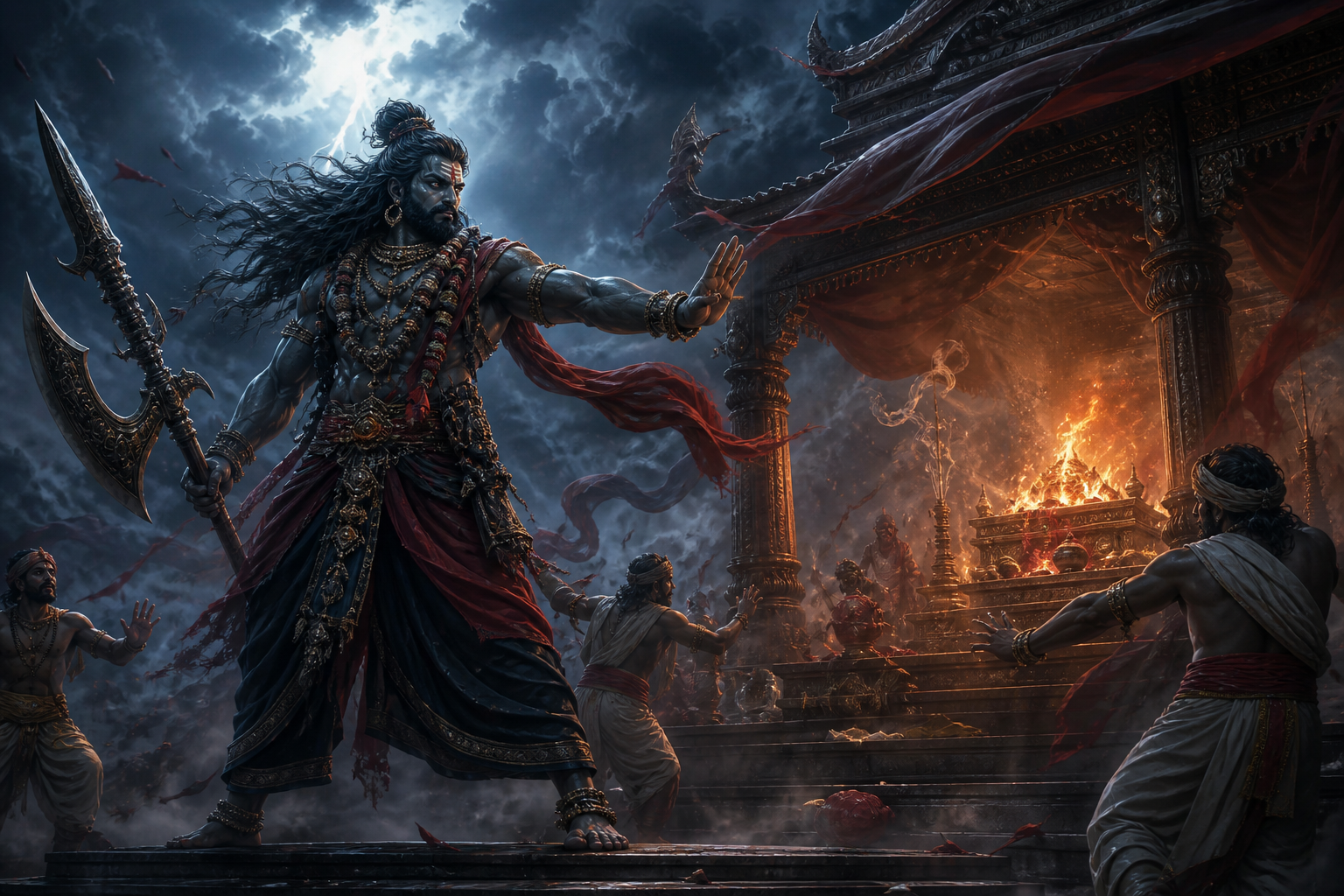
Veerabhadra is terrifying because the violation is serious. He does not appear to soothe the assembly or preserve its respectable appearance. He interrupts a rite that has become an instrument of pride. This is kshatra in service of dharma: strength directed toward protection and correction rather than personal expansion.
Yet Veerabhadra’s fury is not the final authority in the katha. Shiva is. The fierce intervention must therefore be interpreted together with Shiva’s restoration of Daksha. Raudra without karuna would end in vengeance; karuna without accountability would leave the original arrogance intact. The story holds the two together.
Before calling anger righteous, test it against four limits:
- It answers a real breach, not merely wounded prestige. Daksha’s conduct profanes a sacred relationship in public. Your irritation at being contradicted is not automatically equivalent.
- It protects something beyond the angry person’s ego. Dharmic strength serves dignity, truth, community, or sacred order. Rage that chiefly displays dominance has begun to resemble Daksha.
- It stops when the violation has been stopped. Corrective action has an intelligible purpose and a boundary. It does not search for additional targets after the immediate harm is contained.
- It leaves room for accountable return. The offender need not be trusted instantly, but a specific change should make renewed participation possible.
In a contemporary dispute, Veerabhadra is not a warrant for physical retaliation. The corresponding intervention may be to suspend a ceremony, remove a person from a leadership role, stop amplification of an insult, preserve a record of what occurred, or ask credible elders to conduct a transparent review. Use the least coercive response that can actually stop the breach. A merely symbolic objection is inadequate when harm continues, but excessive punishment can reproduce the arrogance it claims to oppose.
Daksha’s goat’s head makes the logic of restoration visible. He returns, but not as though nothing happened. His identity now bears the sign of correction; the transformed head symbolizes the taming of ego. The completion of the yagya matters for the same reason. The purpose of intervention is not to destroy sacred community forever. It is to make sacred action truthful again.
A practical dharmic protocol for conflict and repair
When a conflict combines family loyalty, religious identity, and public status, people often argue about motives while the immediate injury continues. Use the sequence of the katha to separate five decisions:
- Name the breach in one sentence. Identify the words, exclusion, or decision at issue. Avoid broad claims about another person’s entire character, community, or lineage.
- Stop the continuing injury. Pause the event, end the conversation, remove the affected person from danger, or suspend the disputed decision. Do this before attempting a grand reconciliation.
- Assign proportionate accountability. Ask who decided, who participated, and who had authority to intervene. Do not spread blame to every relative, devotee, or member of an institution.
- Define repair in observable terms. An apology may be part of it, but altered conduct matters more. A useful agreement states what must stop, what must be corrected, and what will happen if the conduct recurs.
- Return to the legitimate purpose. Once adequate correction is in place, resume the family relationship, ceremony, or community work if it can proceed without renewing the original humiliation.
How this looks in ordinary situations
At a family gathering, suppose a host begins mocking a guest’s spouse or spiritual practice. The immediate task is not to win a theological debate. State that the speech is unacceptable, end the interaction if it continues, and leave together. Later contact can depend on a clear commitment that the insult will not be repeated. This protects the relationship from further damage without pretending that kinship excuses contempt.
In a temple or community organization, suppose an established procedure is selectively invoked to exclude one group. Pause the decision and put the participation criteria in writing. Compare how the same rule has been applied to others. Correct the process before continuing the program. This addresses the institutional form of the problem rather than reducing it to a clash of personalities.
In an inter-sampradaya disagreement, criticize the teaching or claim precisely, using the standards of the tradition being discussed. Do not turn a sacred gathering into a referendum on whether another community deserves dignity. Plurality does not prohibit judgement; it disciplines the manner and scope of judgement.
Key takeaways
- The Daksha Yagya becomes ethically disordered through deliberate contempt before Veerabhadra causes any physical destruction.
- Sati’s Puranic relinquishing of the body is not a behavioural prescription; in present life, protect dignity through boundaries, safe departure, support, and accountable action.
- Veerabhadra embodies force that interrupts adharma, but Shiva determines the final direction of that force.
- Daksha’s restoration shows that compassion does not erase consequences. Reconciliation follows correction and visible change.
- Dharmic unity does not require silence about disagreement. It requires that disagreement never become a licence for humiliation.
Before your next difficult family or community gathering, agree on one boundary and one route back: what conduct will stop the proceedings, who will name it, and what repair would permit renewed participation. That preparation turns anger from an impulse into a responsibility and gives reconciliation something firmer than good intentions to stand on.
References
- HinduPad – Sati and Daksha Yagya: A Timeless Puranic Lesson on Dharma, Dignity, and Unity
- HinduPad – Veerabhadra Katha: Story of Veerabhadra Swamy
