
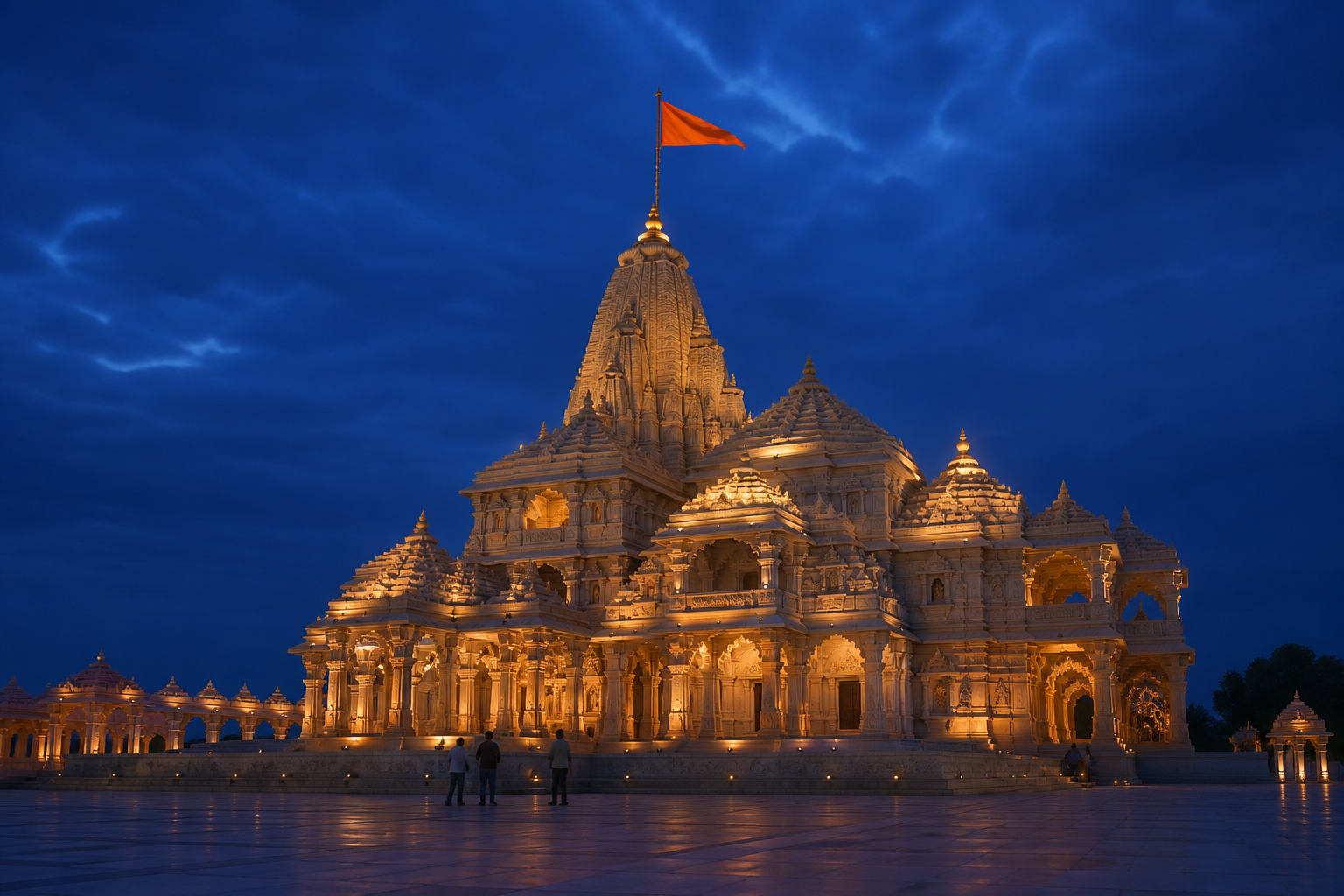
If you have seen the illuminated Ram Mandir and wondered whether the flag above it is a finishing ornament, begin again with the flag. The Dharma Dhwaja is the key to the scene. It tells you how to read the temple, the ceremony, and even the modern light projected across the stone.
The useful question is not simply, “What happened at Ayodhya?” It is, “What does placing dharma at the highest visible point ask of those who stand beneath it?” That question turns a memorable image into a standard for personal conduct and public life.
The flag is a declaration, not a decorative flourish
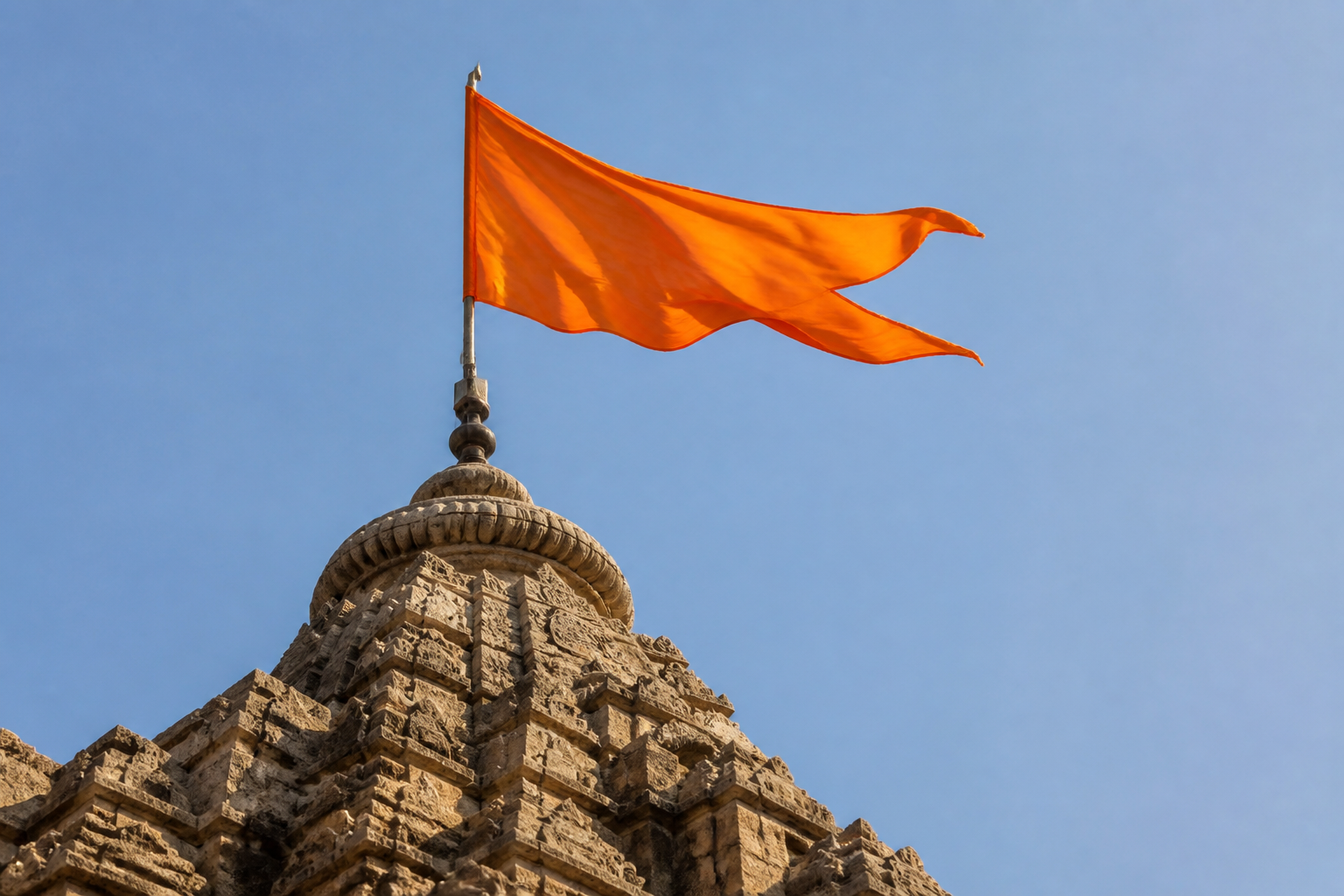
A dhwaja is a flag or banner, but its function in a sacred setting reaches beyond identification. Raised high enough to be seen from a distance, it announces that the place below is oriented toward something greater than private preference. In the case of a Dharma Dhwaja, that governing principle is dharma.
Dharma cannot be reduced to a slogan or translated neatly as religion. Its meanings vary across Dharmic traditions, but the word consistently directs attention toward the order, duties, disciplines, and forms of conduct that sustain life. The flag therefore points not only to identity but also to obligation.
At the Ram Mandir, its elevated position makes a hierarchy of meaning visible. The temple is the sacred centre. The flag stands above it as an emblem of auspiciousness, moral order, and communal welfare. The public gathering, the architecture, the cameras, and the illumination all remain below that claim.
This distinction matters because a symbol of dharma can easily be misread as a symbol of possession alone. Cultural confidence is part of the moment, but confidence without duty is incomplete. The Dharma Dhwaja does not merely invite you to say, “This is ours.” It asks what kind of conduct should follow from belonging to the civilisation it represents.
When you look at an image of the temple, notice the order of attention. Find the flag first. Then look at the temple beneath it. That simple act corrects the most common visual mistake: allowing the brightness of the presentation to eclipse the meaning of the ceremony.
Separate the sacred act from its public presentation
The recording shared by Yogi Adityanath shows the temple illuminated after the Dharma Dhwaja was raised. Coordinated light defines the facade and shikhara, giving viewers a heightened sense of the building’s scale and symmetry.
There are four layers in that sequence, and keeping them separate prevents confusion:
- The ritual act: the Dharma Dhwaja is hoisted.
- The sacred setting: the flag takes its place above the Ram Mandir.
- The public presentation: light draws attention to the temple’s architectural form and the ceremonial culmination.
- The wider circulation: a digital recording allows people far from Ayodhya to encounter the occasion.
The laser display is not itself the ritual. It is a medium through which the completed ritual is presented to a large public. That distinction lets you avoid two equally shallow reactions. One treats every modern visual technique as an intrusion into sacred space. The other treats the spectacle as the entire event and forgets what made the occasion sacred.
A better test is practical: does the technology direct attention toward the temple and its meaning, or does it reduce the temple to a background for entertainment? Here, the illumination followed the contours of the facade and shikhara while the hoisted flag remained the ceremonial culmination. The presentation therefore returned the eye to the sacred structure rather than detaching the spectacle from it.
You can apply the same test whenever technology enters a religious setting. Ask what occupies the centre, what receives the longest attention, and what viewers are likely to remember after the display ends. Technology serves tradition when it clarifies the sacred focus. It competes with tradition when novelty becomes the only point.
Shared Dharmic resonance does not erase distinct traditions

The Dharma Dhwaja speaks immediately within a Hindu temple dedicated to Shri Rama. That context should be named plainly. There is no need to weaken its specifically Hindu meaning in order to recognise a wider Dharmic resonance.
Hinduism, Buddhism, Jainism, and Sikhism are not interchangeable paths. They differ in doctrine, sacred history, authority, discipline, and religious practice. Yet their civilisational vocabularies repeatedly turn attention toward principled conduct, restraint of destructive impulses, responsibility beyond the isolated ego, and the welfare of living communities. The Dharma Dhwaja can evoke that shared ethical horizon without implying that every tradition teaches the same theology.
The most accurate way to discuss the flag is to move from the particular to the wider meaning:
- Begin with the actual setting: it is the Dharma Dhwaja above Ayodhya’s Ram Mandir.
- Explain its immediate significance: auspiciousness, moral order, and welfare under the sign of dharma.
- Then identify the wider resonance: several Dharmic traditions understand spiritual life as carrying ethical consequences for the individual and the community.
- Do not claim doctrinal sameness where none has been established.
This approach is both confident and precise. It allows Hindus to describe the event in its proper setting while inviting Buddhists, Jains, Sikhs, and others to recognise an ethical aspiration without being absorbed into a vague, artificial uniformity.
It also protects the symbol from an opposite distortion. A call to shared welfare does not make the Dharma Dhwaja culturally empty. Its wider relevance arises from a rooted tradition; it does not require the removal of that root.
Key takeaways
- The Dharma Dhwaja is the interpretive centre of the Ayodhya scene, not an ornament added after the temple was completed.
- Its significance joins auspiciousness with moral order and communal welfare; identity and obligation belong together.
- The hoisting is the sacred act. The laser display is the public medium that directs attention toward the temple and the completed ceremony.
- The flag can carry meaning across the Dharmic family without making Hinduism, Buddhism, Jainism, and Sikhism identical.
- The strongest response is not admiration alone. It is a decision to make conduct worthy of the symbol.
Turn the image into a standard of conduct
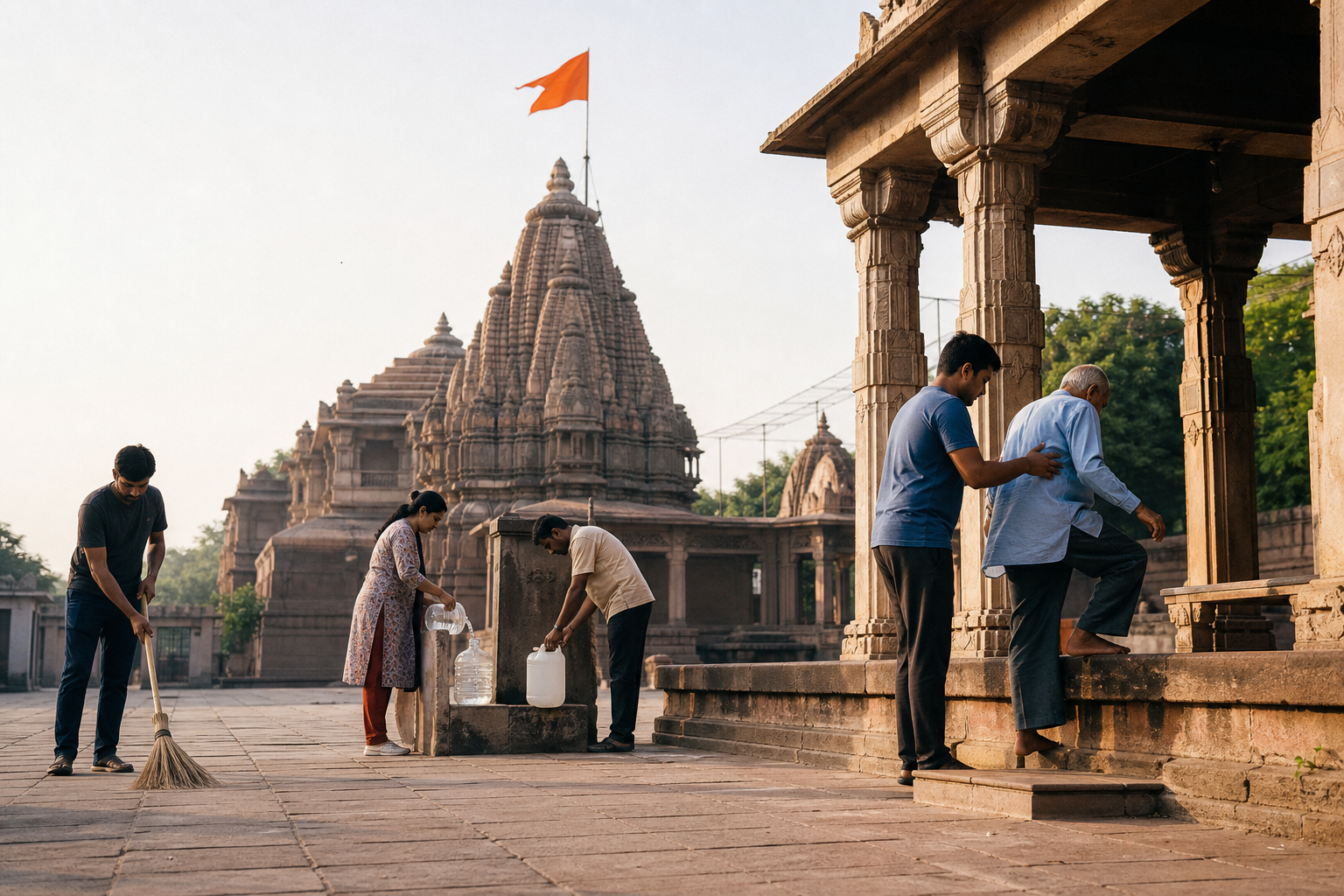
A sacred flag can be photographed, circulated, praised, and then forgotten. To prevent that, connect what you see to what you will do. The flag’s height represents a priority: dharma must govern the impulses, loyalties, and powers gathered below it.
Before sharing the video or an image from the ceremony, describe the sequence accurately. Say that the Dharma Dhwaja was raised above the Ram Mandir and that the illumination marked the occasion. This preserves the ritual meaning instead of presenting the temple as an unexplained visual attraction.
Then use language that carries substance. “A magnificent display” tells the reader what the scene looked like. “A sign of moral order and communal welfare” tells the reader what the flag asks people to uphold. Both observations can belong in the same description, but the second is what keeps beauty connected to dharma.
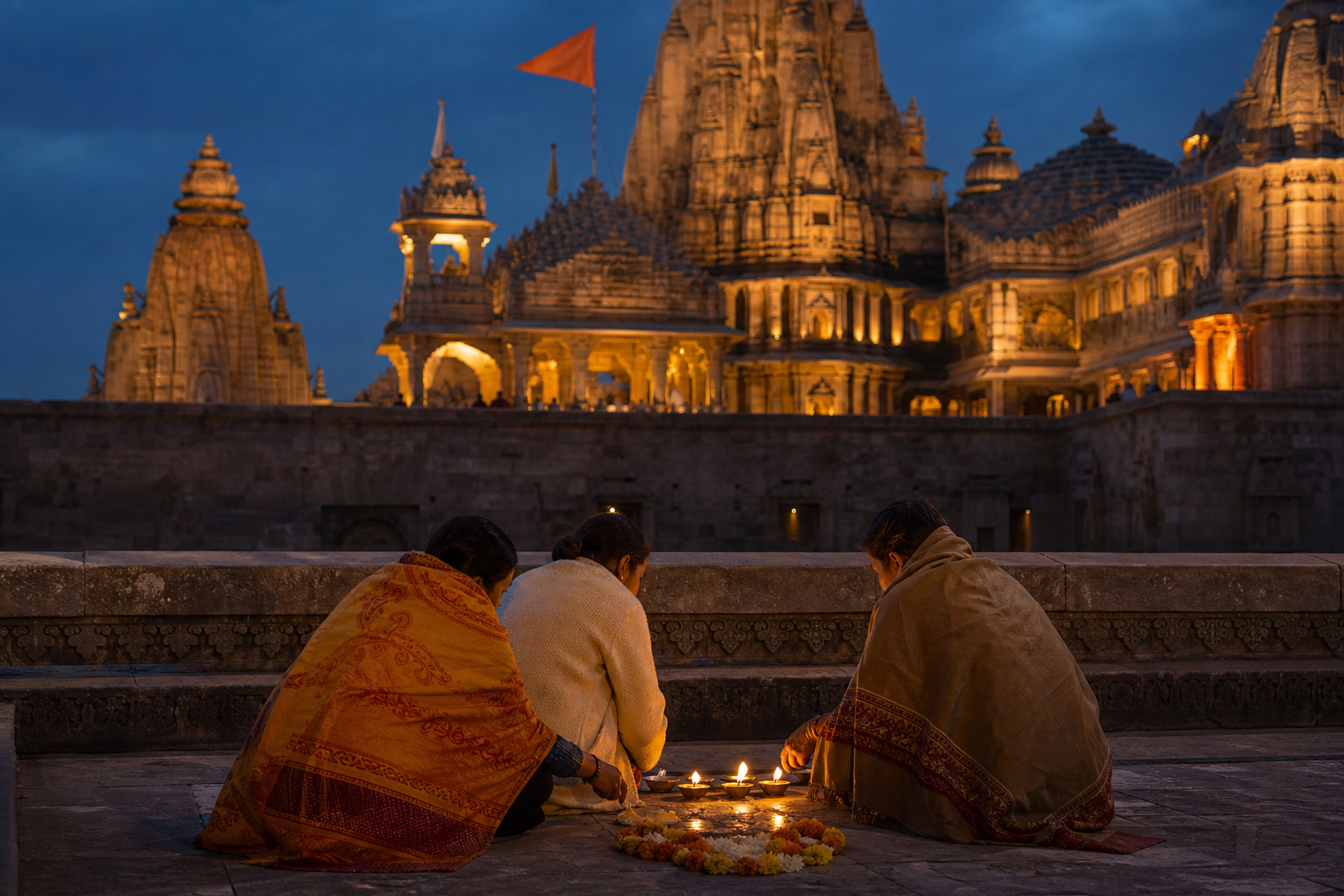
If you visit Ayodhya, approach the temple as a living sacred place rather than a backdrop for content. If you encounter it online, resist reducing the occasion to a political taunt or a passing aesthetic trend. In either setting, cultural confidence becomes durable when it is expressed through responsible attention, respect for the shrine, and concern for the welfare represented by the flag.
The next time the illuminated Ram Mandir appears on your screen, do not stop at “beautiful.” Point to the Dharma Dhwaja, explain why it stands above everything else, and ask what should stand above everything else in your own choices. That is how a public symbol becomes a living measure of dharma.
References
