
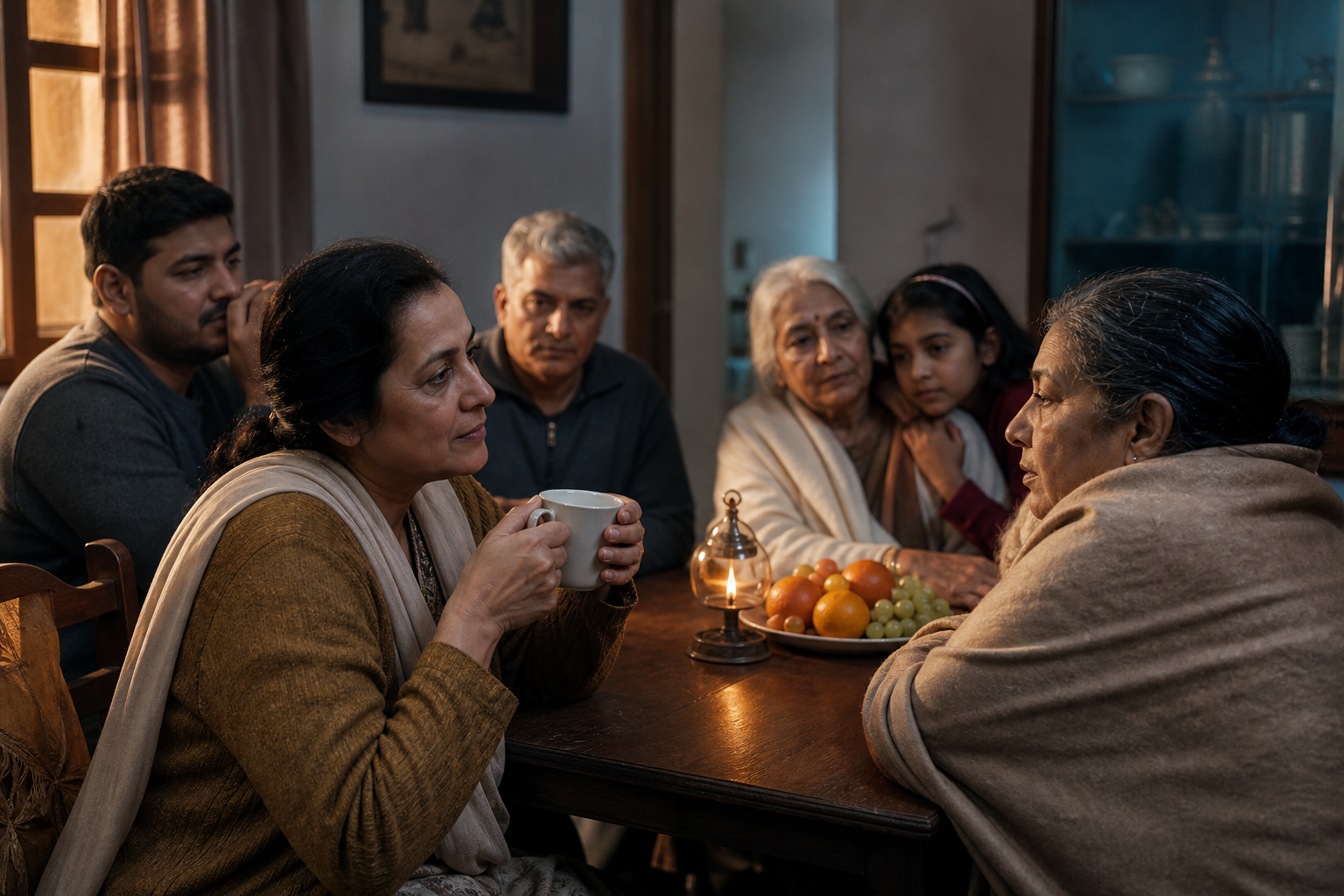
You can have a reason to be thankful and a reason to be hurt. Sometimes both are sitting at the same table. A family gathering can carry affection and conflict; a sacred occasion can awaken joy and painful history; solitude can hold peace and loneliness at once.
You do not resolve that tension by forcing yourself to feel positive. You meet it by seeing clearly, receiving whatever is genuinely life-giving, and choosing a response that causes less harm. This is where gratitude becomes more than good manners: it joins compassionate awareness to dharma.
Gratitude starts with what is true, not what is perfect
If you wait for life to become orderly before giving thanks, your circumstances remain in charge of your attention. A Dharmic approach treats gratitude as a discipline that can begin before circumstances feel settled. You acknowledge a real gift without pretending that everything surrounding it is good.
Receiving a gift does not acquit everything around it. You can be grateful for a meal without denying tension among the people sharing it. You can value your community while naming an injustice within it. You can appreciate the life you have received while grieving what has been lost.
When gratitude feels false, use two clauses rather than one. Name what is difficult, and then name what is still given:
- This relationship is strained, and this meal still came through many hands.
- I am grieving, and this breath is supporting me now.
- I do not know what comes next, and I am not facing this moment entirely without help.
- This history contains suffering, and I can still honor the land, ancestors, and communities that sustain life.
Choose a blessing you can honestly verify. It may be the movement of breath, eyesight if you have it, the ability to love, shelter, memory, companionship, or freedom to worship according to conscience. Do not borrow an impressive spiritual answer that you do not believe. Quiet gratitude for one actual gift is steadier than a long list recited against your own experience.
Then ask the question that keeps gratitude from becoming passive: What does this gift ask of me? Gratitude for shelter may call you toward hospitality. Gratitude for community may call you toward service. Gratitude for religious freedom may deepen your respect for another person’s sincere path. The practice is incomplete until receiving begins to shape conduct.
Detachment should make you more responsive, not less human
When feeling becomes exhausting, numbness can look like peace. Constant scrolling, overwork, and distraction can also imitate detachment because they reduce immediate discomfort. But reducing contact with an emotion is not the same as becoming free of its control.
The crucial distinction is between suppression and steadiness. Vairagya is not the destruction of feeling; it is freedom from being driven blindly by attachment and aversion. Samata, or equanimity, is not indifference; it is the balance that lets you remain present enough to respond wisely. The Dharmic aspiration is compassionate awareness rather than stone-like invulnerability.
You can test the difference by looking at what follows your practice. Are you more able to hear another person’s pain, examine your own desire, and carry out a necessary duty? Or are you less willing to feel, listen, or act? If a spiritual exercise repeatedly makes you unavailable to suffering, call the result avoidance rather than transcendence.
Compassionate awareness has a simple movement. First, allow the experience to be visible. Next, observe it without treating every impulse as an instruction. Then choose an action that reflects discernment and non-harm. Anger may be present without being allowed to choose your words. Grief may remain while you accept help. Desire may arise without becoming a command that must be obeyed.
The Bhagavad Gita’s image of sthitaprajna, steady wisdom amid change, is useful here. Steadiness matters because life continues to make claims on you. The point is not to become unreachable; it is to become less easily pushed away from dharma.
Four traditions give the practice distinct ethical tests
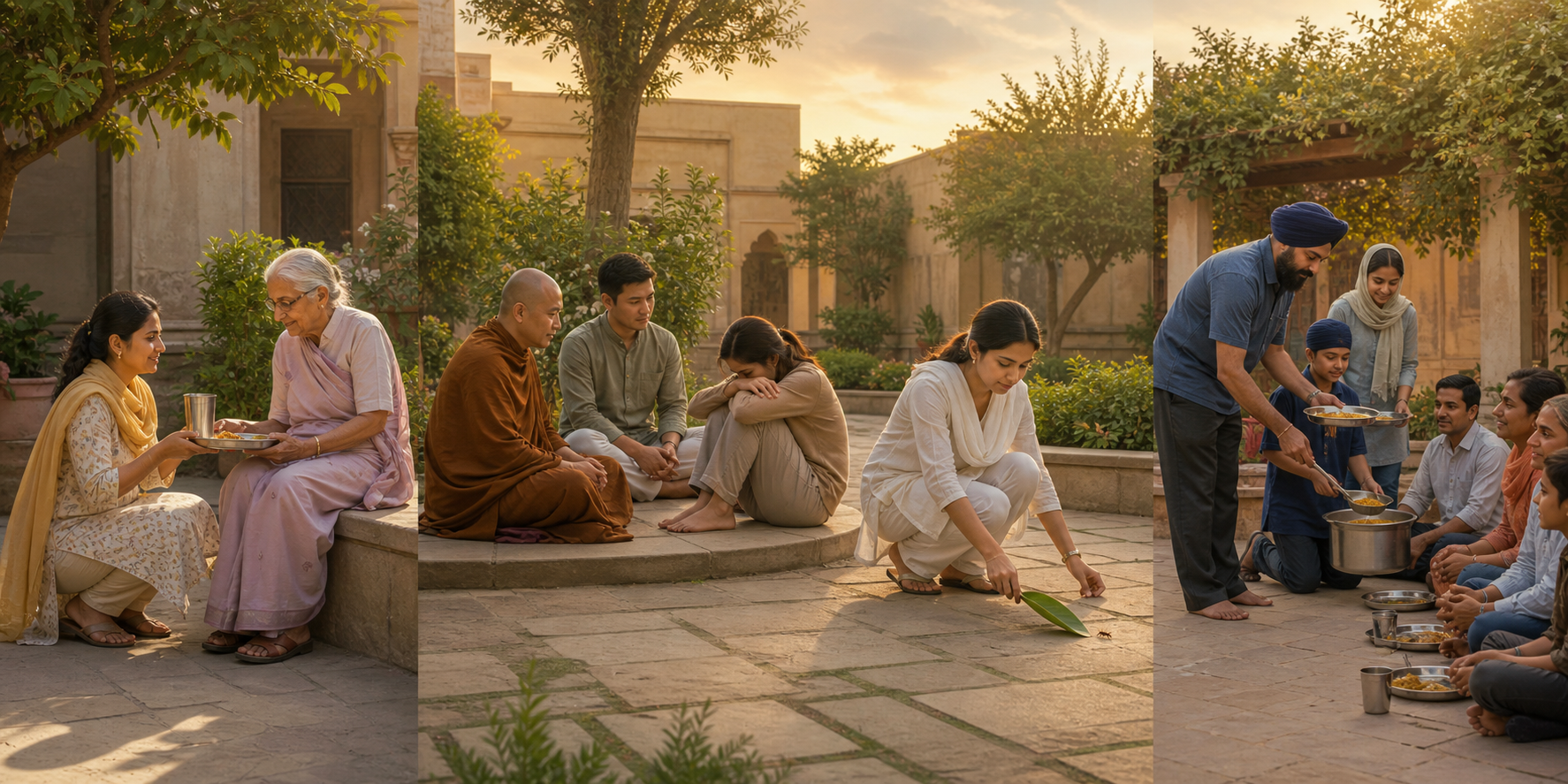
Hinduism, Buddhism, Jainism, and Sikhism should not be collapsed into a single system. Their teachings, disciplines, and theological commitments remain distinct. Yet each can expose the same practical mistake: confusing the absence of feeling with spiritual freedom. Each also gives you a way to test whether awareness and gratitude are becoming ethical action.
Hindu paths: remembrance, discernment, and dharma
Bhakti turns attention toward devotional remembrance. Viveka distinguishes what is merely compelling from what is worthy. Vairagya loosens the hold of craving and aversion, while the ideal of sthitaprajna keeps wisdom steady amid change. These are not instructions to stop caring. They prepare you to act without surrendering judgment to the emotion of the hour.
Use this test: after naming a blessing, identify the duty connected to it. If you are grateful for knowledge, teach or guide responsibly. If you are grateful for family, give care without pretending that every family behavior is acceptable. If you are grateful for a spiritual inheritance, practise it rather than merely displaying its symbols.
Buddhist paths: mindfulness, loving-kindness, and compassion
Mindfulness keeps experience visible. Maitri, loving-kindness, and karuna, compassion, prevent observation from becoming cold. Equanimity steadies the mind so that another being’s suffering can be encountered without immediate flight, denial, or retaliation.
Use this test when pain appears: can you notice the feeling without debating whether it should exist, and can you choose a response that does not add more suffering? The aim is neither indulgence nor emotional erasure. It is sufficient clarity to see what is happening and sufficient compassion to care about what happens next.
Jain paths: non-harm, non-grasping, and self-mastery
Ahimsa gives awareness an uncompromising ethical edge. Aparigraha, non-grasping, asks whether accumulation and appetite are ruling the mind. Self-mastery interrupts the habit of treating every preference as a necessity. Gratitude for what is already present can therefore loosen the demand for more.
Use this test at a meal or celebration: do your words of thanks and your choices point in the same ethical direction? Notice the land, labor, living beings, and relationships involved. Where possible, make an ahimsa-informed choice that reduces harm. Gratitude becomes credible when it changes consumption, not merely the blessing spoken before it.
Sikh paths: remembrance expressed through seva
Seva makes gratitude public. Courageous engagement keeps spiritual steadiness from becoming withdrawal. Appreciation for community is expressed by carrying some of its burden, especially when service is inconvenient and recognition is unlikely.
Use this test: if you are thankful for belonging, what work will you take up for someone else? Prepare food, share a necessary task, contact the isolated person, or help repair a strained relationship where repair is safe and welcome. Service gives gratitude hands.
The vocabularies differ, but a useful ethical movement runs through them: attention becomes steadiness; steadiness weakens grasping; reduced grasping creates room for non-harm, compassion, and service. This is inner freedom expressed through responsible action, not escape from the world.
A repeatable practice for ordinary and difficult moments

You do not need to wait for a festival, retreat, or emotional breakthrough. Use the following sequence when you wake, before a meal, before answering a difficult message, or whenever distraction has begun to replace awareness.
- Stop. Let a natural breath finish before you reach for a screen, an argument, or another task. The pause is not an attempt to become serene. It simply interrupts automatic reaction.
- Name the fact. State what is present without spiritual correction: anger is here, I feel lonely, I am holding tightly to this outcome, or I do not know what to do yet.
- Receive one actual gift. Notice the breath, a place to sit, a person who has helped, the capacity to remember, or another support that is true now. Let it be small.
- Widen the frame. Remember the relationships behind the moment: ancestors, land, teachers, family, labor, community, and other living beings. This keeps gratitude from becoming a private mood detached from interdependence.
- Choose the dharmic response. Select one bounded action: speak without insult, delay a reactive reply, make a less harmful choice, offer practical help, acknowledge a wrong, or perform an act of seva.
- Continue without demanding a reward. Do not check whether the practice has made you feel sufficiently peaceful. Its immediate measure is whether your next action is more honest, less harmful, and more responsible.
Attach the sequence to thresholds that already exist in your day:
- On waking: before entering the news or social feed, name a few quiet blessings that are actually present.
- Before eating: keep a moment of silence for the land, ancestors, hands, and beings involved in the meal. Let that awareness inform an ahimsa-aligned choice where possible.
- During conflict: let the feeling be real, but do not let it write the next sentence automatically. Finish a breath, name the impulse, and choose the least harmful truthful response available.
- When alone: light a lamp or candle if that supports your practice, sit with the breath for a few minutes, and then make one small movement toward connection or service.
These anchors matter because mood is unreliable. A practice tied only to moments of inspiration disappears precisely when reactivity is strongest. A practice tied to waking, eating, conflict, and solitude meets you where the habit is needed.
When gratitude meets grief, injustice, or harm

Grief does not owe gratitude a smile. Do not rush to turn a loss into a lesson or pressure yourself to find a hidden blessing in the event that caused pain. Let gratitude rest on something adjacent and true: the person who remains present, the memory that still carries love, the breath that makes the next moment possible, or the freedom to mourn honestly.
The same discipline applies to collective and historical suffering. Gratitude is not closure, and it does not erase colonization, violence, exclusion, or unresolved responsibility. A sacred observance can hold joy and painful history in the same moral field. Honoring ancestors and land should deepen truthfulness, repair, and reconciliation rather than replace them.
At a personal level, gratitude is not an instruction to remain silent about coercion, violence, or repeated harm. Appreciation for one part of a relationship does not cancel the need for a boundary around another part. If a situation is unsafe, prioritize concrete help and appropriate professional or emergency support rather than using spiritual discipline to endure danger.
Ethical discomfort can also be instructive. If a celebration praises abundance while ignoring avoidable suffering, do not discard gratitude; let gratitude correct the celebration. Change the meal where possible. Include the lonely person. Recognize labor that usually remains invisible. Replace a performative blessing with a quieter observance and a tangible act of care.
Key takeaways
- Name the wound and the gift. Neither has to cancel the other.
- Treat detachment as freedom from domination by emotion, not freedom from feeling.
- Respect the distinct language of each Dharmic tradition while noticing the shared movement toward clarity, non-harm, compassion, and service.
- Convert every sincere expression of thanks into one visible ethical response.
- Judge the practice by the quality of your next action, not by whether your mood changes immediately.
At your next ordinary threshold – waking, eating, opening a difficult message, or entering a tense room – pause before habit takes over. Name what hurts, name what is given, and choose one act that reduces harm or serves another being. That is how gratitude becomes dharma in motion.
References
- Hindu Human Rights Blog – Gratitude Before the Feast: A Dharmic, Hindu-Informed Path to a Sacred Thanksgiving
- Dandavats – Beyond Stone-Like Detachment: Embracing Compassionate Awareness Across Dharmic Paths
