

Your phone brings back a face, a journey, or a family season you had not expected to revisit. For a moment, gratitude and loss may arrive together. The useful question is not whether nostalgia is good or bad. It is whether you can receive the memory without letting it pull you away from the life in front of you.
A memory reel can become a small practice of emotional steadiness. The practice requires no elaborate routine: give one memory your full attention, notice what it reveals, translate that recognition into a present action, and then close the app.
The benefit comes from the pause, not the algorithm

Daily pressure distorts scale. A difficult morning can feel like the truth about your entire family, career, or character. A short sequence of photographs restores a longer view. A child’s growing confidence, years of recurring family outings, or the changing faces around a festival table may reveal a pattern of care that was almost invisible while you were living it.
That longer view does not erase hardship. It corrects the tendency to treat whatever is urgent now as if it were the whole story. Positive reminiscence can support mood, ease stress, and strengthen feelings of connection and continuity. Photographs are especially effective prompts because they can restore visual detail and emotion quickly.
Surprise and brevity matter. Searching through old photographs when you already feel low can become an open-ended hunt for a vanished time. An automatically surfaced reel works differently: it interrupts the day, presents a bounded selection, and ends. You can receive the perspective without making nostalgia your next destination.
The algorithm itself is not wise, and a notification is not an instruction. Its useful function is simply to place a forgotten moment before you. Your attention determines whether that moment becomes gratitude, rumination, avoidance, or a return to dharma.
Key takeaways: the one-reel remembrance practice
Use this sequence when a memory appears and you have enough privacy to accept whatever feeling follows. If you are driving, handling a demanding task, or already emotionally overwhelmed, leave it unopened until you are settled.
- Stop competing input. Pause the conversation, work, or scrolling. If you cannot give the reel undivided attention, save it for later.
- Watch it once. Do not immediately open the full album or search for more. The boundary protects a brief recollection from becoming an extended retreat into the past.
- Name the feeling honestly. It may be joy, affection, grief, regret, relief, or several of these at once. You do not need to turn every memory into happiness.
- Name the value underneath it. Look for care, seva, companionship, courage, play, perseverance, or family continuity. Ask what the images reveal about how people showed up for one another.
- Choose one present-tense response. Send a message of thanks, call an elder, record a detail younger relatives may not know, arrange time with someone you have neglected, or carry greater patience into your next duty.
- Return deliberately. Close the app, take one unhurried breath, and resume the day. The memory has done its work when it improves your presence rather than replacing it.
If gratitude does not arise, do not manufacture it. Honest sadness is more useful than compulsory positivity. The discipline lies in seeing clearly and responding wisely, not in forcing yourself to feel pleasant.
Dharmic remembrance is more than pleasant nostalgia

Dharmic traditions give remembrance a deeper purpose than emotional self-soothing. Smarana in Hindu traditions, anussati in Buddhism, pratikraman in Jainism, and simran in Sikhism each involve forms of recollection or reflective return. They are not synonyms, and none can be reduced to watching photographs. Each belongs to a distinct spiritual discipline and lineage.
Digital reminiscence can still borrow one modest principle from them: remembrance should reorient you. It should bring attention back to what is truthful, worthy of gratitude, in need of repair, or deserving of renewed commitment. A gallery is not a sacred text, and an automated montage is not spiritual practice by itself. The quality of attention and the action that follows make the difference.
Three questions keep the exercise grounded:
- What deserves gratitude? Identify the person, opportunity, protection, sacrifice, or ordinary act of care that the image makes visible.
- What does this memory ask of you now? It may call for renewed contact, an apology, preservation of a family tradition, or more attentive participation in the life you still have.
- What must be released? You may need to let a finished season remain finished instead of trying to recreate it or judging the present for being different.
This prevents a common spiritual mistake: confusing attachment to a former moment with reverence for what the moment taught. You can honour a childhood home, a departed relationship, or an earlier version of yourself without demanding its return.
Know when reminiscence has turned into rumination

Nourishing reminiscence widens your view. It lets affection and impermanence coexist, and it eventually releases you back into the present. Rumination narrows your attention around loss, comparison, blame, or counterfactual questions: Why did it end? Why was I happier then? Why did I not know what I had?
After one reel, check the effect rather than assuming it helped:
- Can you close the app without searching for another image?
- Do you feel more connected to your present relationships, or more resentful that life has changed?
- Has the memory suggested a constructive action, or only another round of comparison?
- Can you return to your next duty with reasonable steadiness?
If the answer repeatedly points toward agitation, stop using surprise memories as a wellness practice. Mute the notifications, decline to open them, or review photographs only at a time and place you choose. Not every image deserves automatic access to your attention.
Some archives include bereavement, estrangement, abuse, illness, or another painful period. A cheerful soundtrack does not make such material safe or welcome. Skip the reel when necessary, and do not treat avoidance of a harmful prompt as spiritual failure.
A phone feature is not a therapist. If old images repeatedly cause intense distress, panic, intrusive recollection, or disruption to sleep, work, or relationships, seek support from a licensed mental-health professional. Digital reminiscence may complement appropriate care; it should never be used as a substitute for it.
Build an archive that supports presence
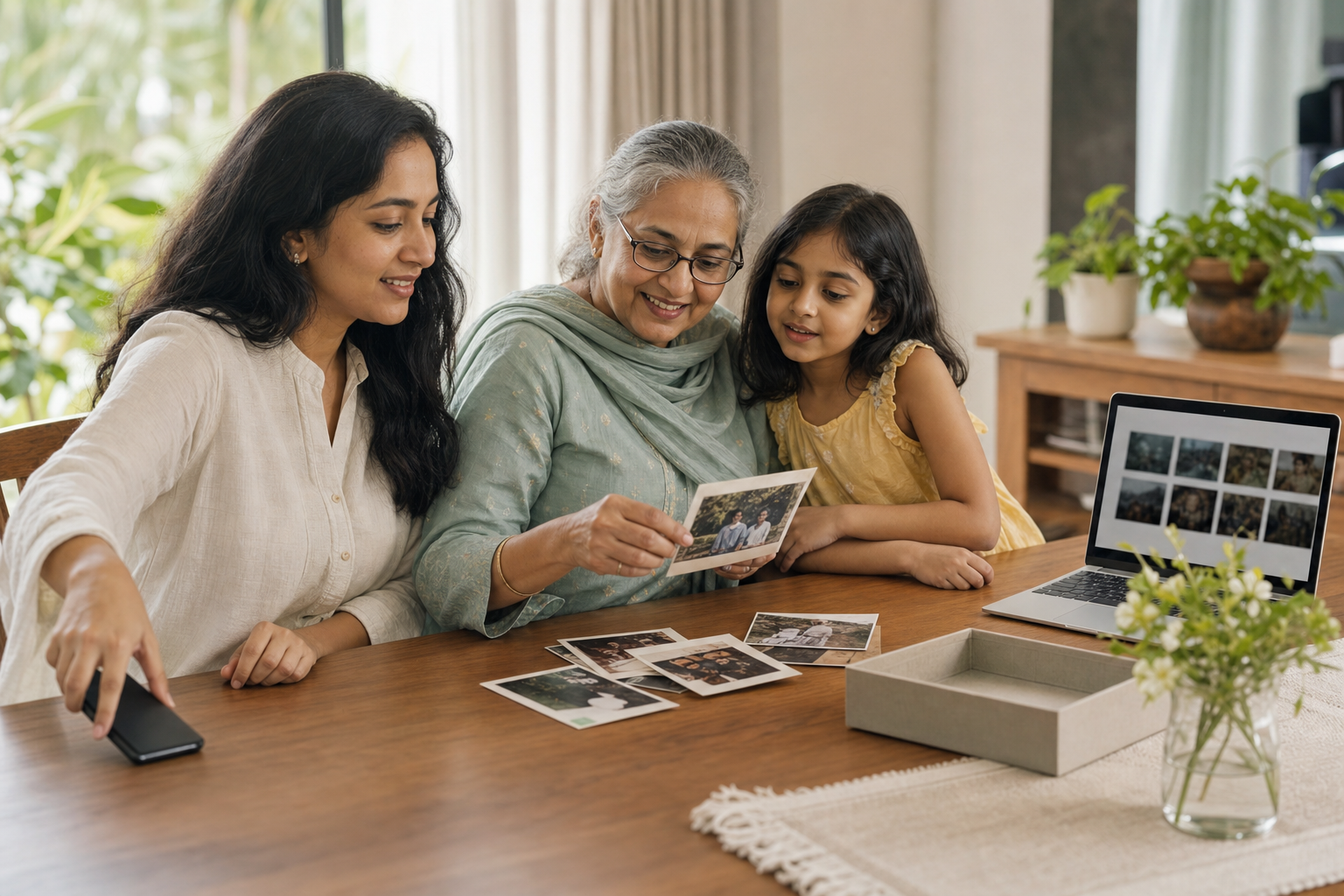
Your camera roll is selective. It records what someone decided to photograph, not the complete truth about a life. Treat it as a collection of witnesses, not a verdict that the past was perfect or that the present is deficient.
You can make future reminiscence more truthful and useful with a few deliberate choices:
- Photograph ordinary care. Include shared meals, preparations for worship, visits with elders, children’s small achievements, and the work behind family traditions. These moments often reveal continuity better than staged celebrations do.
- Preserve context. Add a name, occasion, location, or short account of why the moment mattered. An image may survive long after younger relatives have lost the story around it.
- Include the usual photographer. Ask someone else to take a photograph occasionally so that the person preserving family life is not absent from its visual record.
- Keep private memories private. A photograph can strengthen family remembrance without becoming social-media content. Respect the dignity and consent of everyone shown.
- Protect irreplaceable images. Do not leave the only copy on one phone. Keep an independent backup before replacing a device, removing files, or reorganising an archive.
- Put the phone away again. Take the photograph, then return your attention to the meal, pilgrimage, conversation, or celebration. A future memory is not worth weakening the present experience that creates it.
Begin with the next memory notification. Watch one reel, name one value, take one present-tense action, and close the phone. The purpose is not to live backward. It is to return to today with clearer gratitude and a more faithful sense of the life you are still building.
References
