
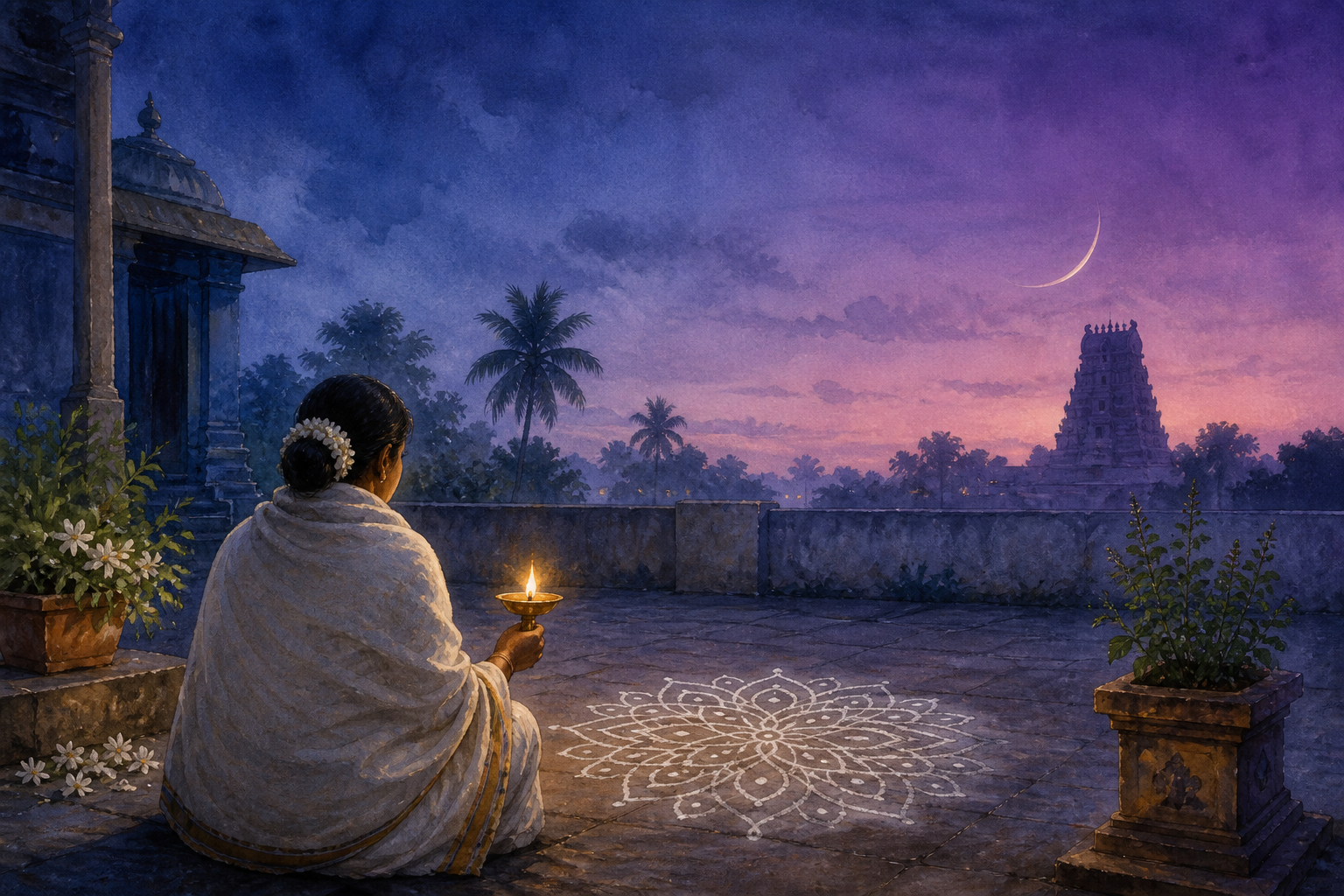
If you want to observe Margazhi but keep losing the thread between early-morning Tiruppavai, Amavasya, and the first crescent, the problem is probably not your devotion. You are asking one calendar to do two different jobs.
Let Margazhi provide the month-long rhythm of prayer and disciplined living. Let the lunar cycle identify observances such as Chandra Darshan, the first sighting of the waxing crescent after Amavasya. Once you separate those functions, you can build a practice that is traditional, manageable, and attentive to both dawn and dusk.
Use the two calendars without confusing them
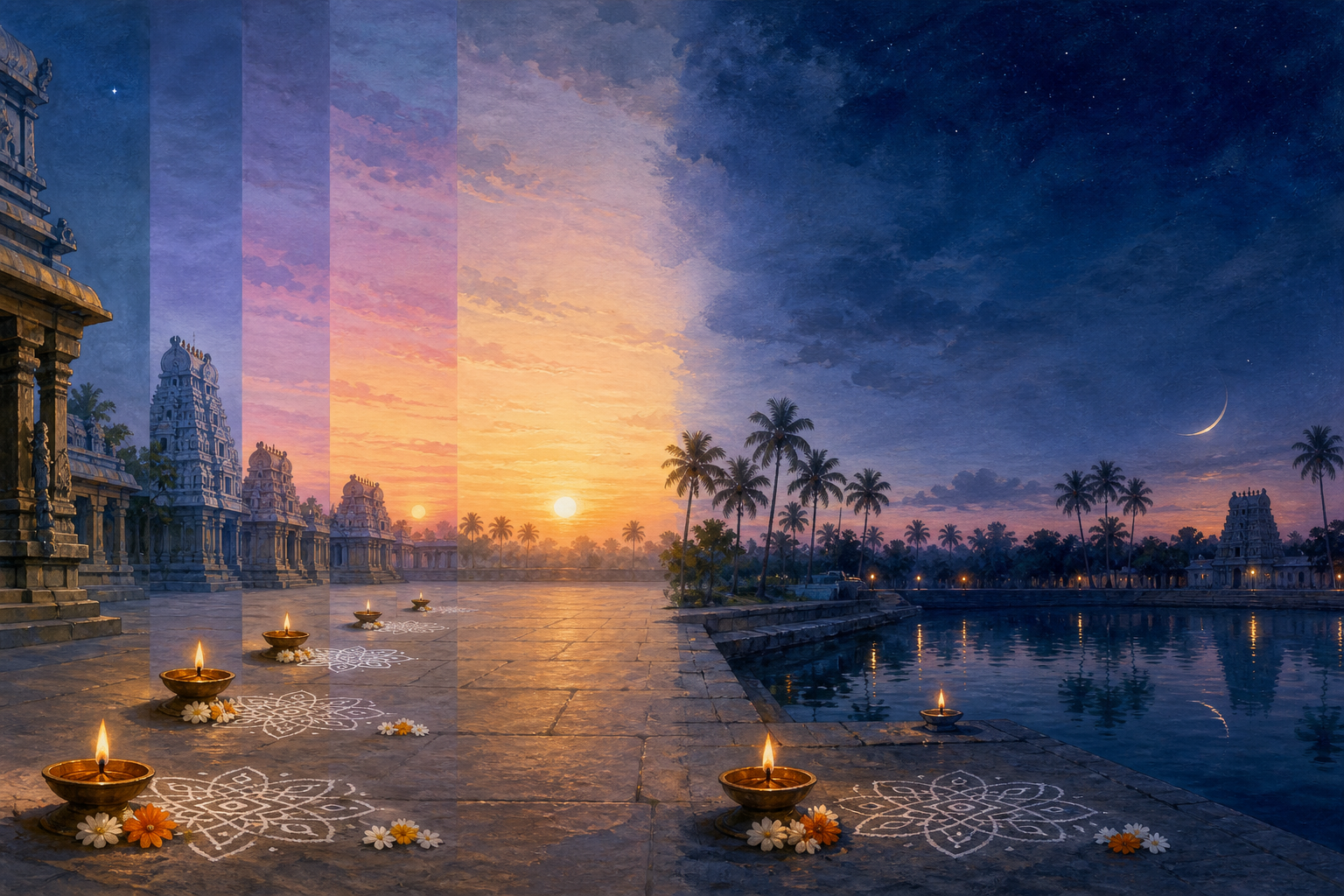
Margazhi tells you where you are in the Tamil seasonal calendar. A tithi tells you where you are in the waxing or waning lunar sequence. The two systems meet in lived worship, but they do not measure the same thing. That distinction matters when you are deciding what to chant every morning and when to step outside for a particular lunar observance.
Do not use the familiar expression Margazhi-Margashirsha as a mechanical date-conversion rule. It can help Hindi-speaking devotees approach Andal’s Margazhi devotion and the thirty verses of Tiruppavai, but regional calendars do not always place identical month names over identical dates.
The diversity becomes clear in a concrete example. On 21 December 2025, the period was identified as Poush or Pushya in North India, Andhra Pradesh, and Karnataka; Margazhi in the Tamil calendar; Dhanu in the Malayalam calendar; Poush in the Bengali Panjika; and Posh in the Nepali calendar. The shared celestial event did not require every region to use the same name.
Before planning your observance, consult a Panchang calculated for your location and write down three things: the regional month, the relevant tithi, and the sunset-to-moonset viewing window. Use your family’s or sampradaya’s calendar convention consistently. Switching between regional labels midway through the month creates apparent contradictions that are usually differences of calendrical method, not failures of tradition.
This gives you a simple rule: the month determines your continuing discipline, while the tithi and local sky determine a time-specific lunar act. You do not need to choose between Margazhi bhakti and lunar observance. You need to give each its proper place.
Build one practice around dawn, the day, and dusk
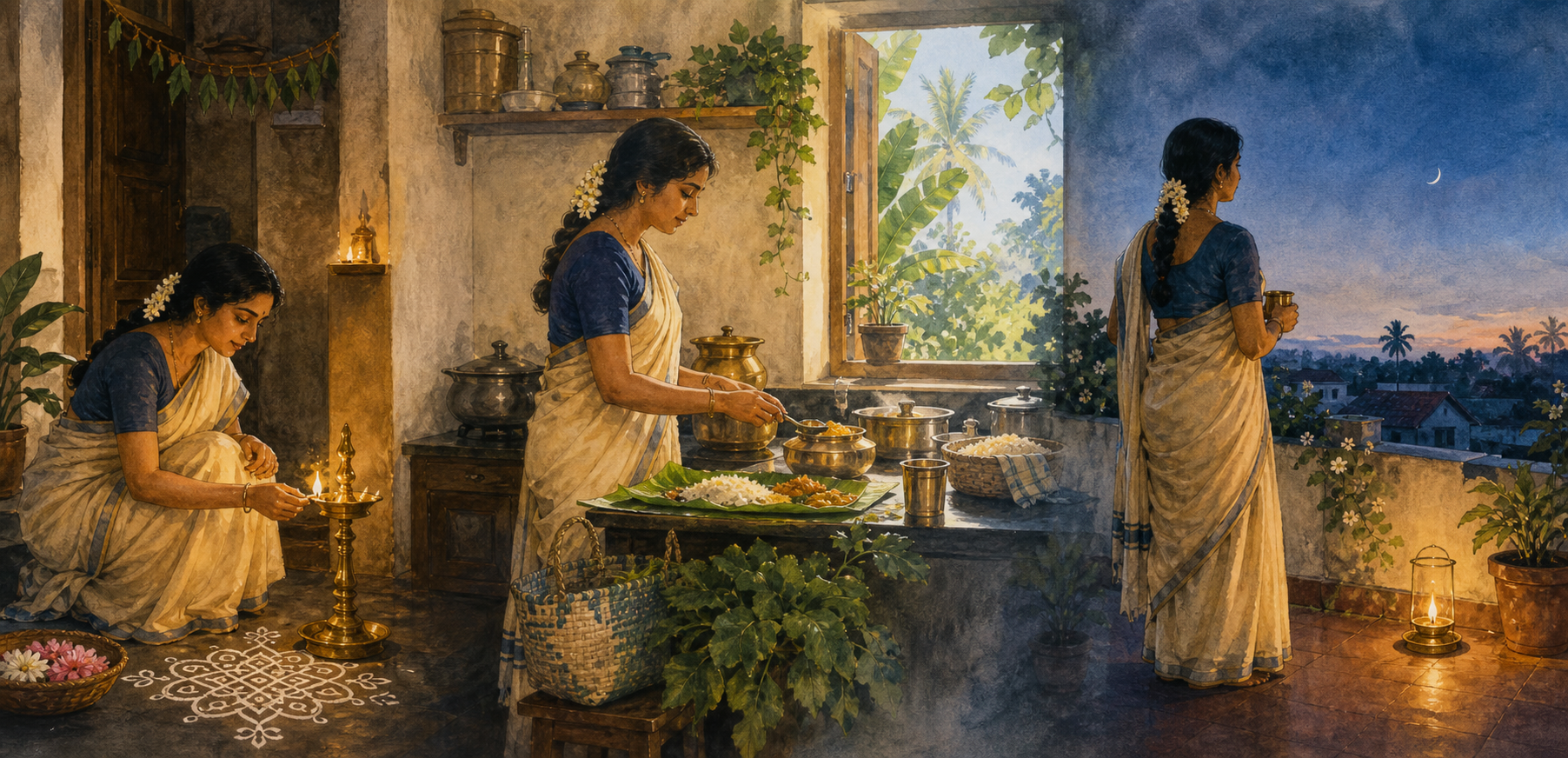
A workable vrata should tell you what to do at a particular time. It should also be modest enough to repeat when enthusiasm settles into routine. Use the following structure as a household framework, adapting offerings and mantras to your lineage.
- Prepare before sleeping. Set out the Tiruppavai text, a translation you understand, and anything required for your morning lamp or puja. If Tamil pronunciation is new to you, queue a traditional recitation in advance instead of searching for one while half awake.
- Begin before sunrise when your circumstances permit. Bathe or wash according to your household practice, light the lamp safely, and settle before handling messages or daily work. Early rising, bathing, prayer, and collective singing belong to the living Margazhi discipline associated with Tiruppavai.
- Chant one verse slowly. Listen once if necessary, recite without rushing, and then read its meaning. Thirty verses make a one-verse-per-day rhythm natural. If you also attend a full congregational recitation, keep the daily verse as your point of contemplation rather than treating the group chant as a substitute for attention.
- Carry one instruction into the day. Choose a concrete expression of the verse: restrained speech, an act of service, help for someone in the household, honest work, or a deliberate surrender of resentment. This prevents recitation from becoming a sound-only accomplishment.
- Prepare separately for Chandra Darshan. Check the local Panchang before dusk. Choose a place with a clear western horizon because the slender crescent is sought low in the west shortly after sunset. Urban lighting, buildings, and clouds can interfere with visibility, so decide where you will stand before the viewing window begins.
- Keep the evening act simple. When the crescent is visible, offer a brief prayer to Chandra and, where customary, water as arghya. Some households also use white grains or curd. Ask for steadiness, health, and collective wellbeing without turning the observance into a list of demands.
- Close by reconnecting the evening to the vrata. Recall the morning verse and name the action you attempted during the day. The moon marks renewal after darkness; your review makes that renewal practical rather than merely symbolic.
A light fast is part of some Chandra Darshan observances and may be broken after sighting the moon. It is not a reason to compete in austerity. If fasting is unsafe for you or conflicts with medical advice, omit it and keep a suitable restraint instead. The devotional work can be carried by prayer, simplicity, truthful conduct, and seva.
Let Andal’s thirty verses change what you do
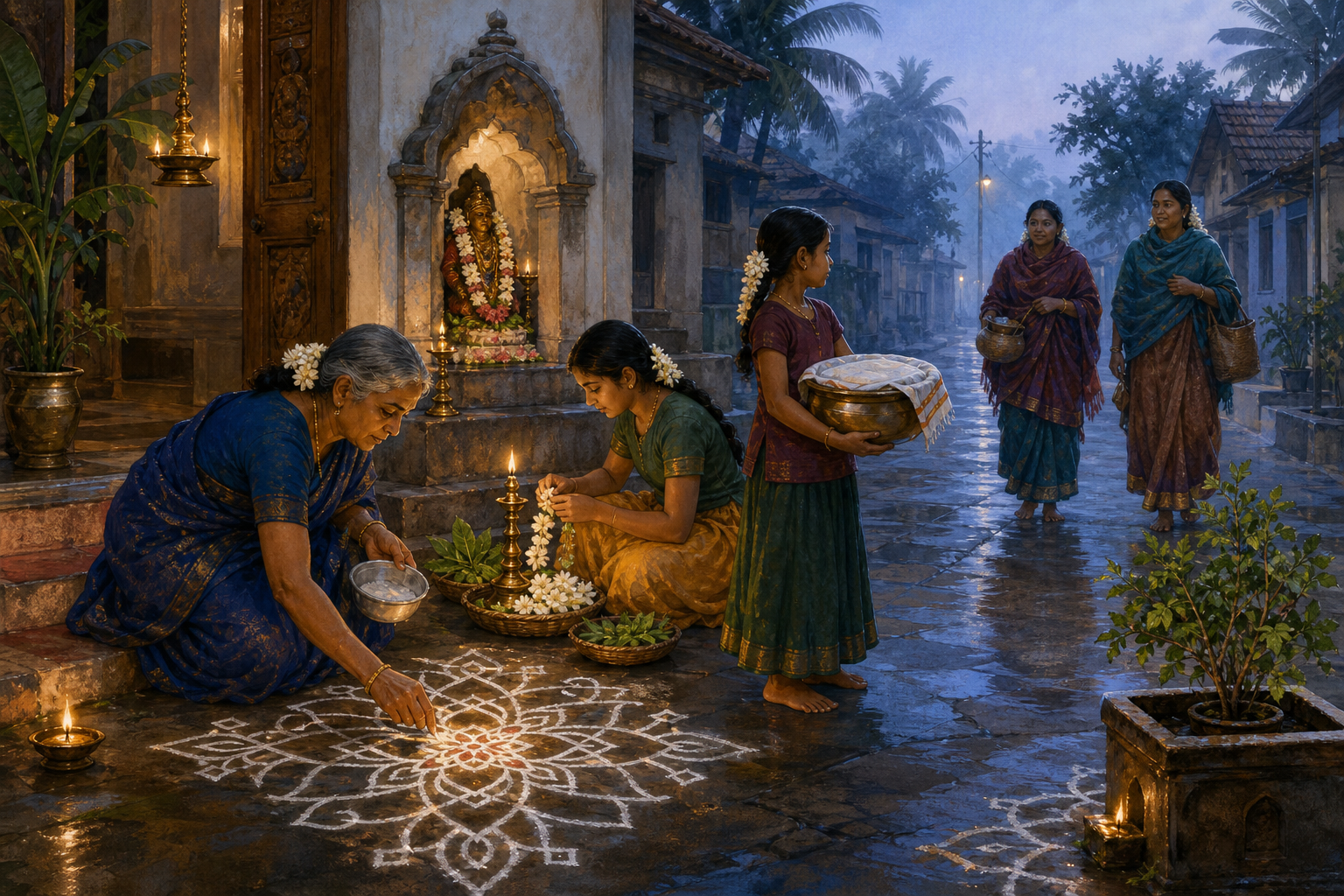
Tiruppavai is not simply a collection to finish. Its movement from awakening calls to communal vows, moral exhortation, and deeper theological reflection gives you a way to examine how devotion matures. The recurring concerns of clarity, service, grace, and surrender ask more of you than accurate pronunciation.
After each verse, use four questions. You do not have to answer all four in writing, but do not end the practice until one answer has become specific.
- Who or what must be awakened? It may be your own attention, a neglected household duty, or the courage to invite another person into prayer.
- What is the collective obligation? Tiruppavai’s voice repeatedly reaches beyond isolated spirituality. Decide who should benefit from today’s discipline besides you.
- Which quality must govern the day? Choose one: clarity, truthful speech, restraint, compassion, reliability, or service. Name the situation in which you expect that quality to be tested.
- What must be surrendered? Prapatti is not an excuse for passivity. Surrender the need to control the result while still performing the duty in front of you.
Suppose a verse’s awakening imagery catches your attention. Your response could be to wake ten minutes earlier the next day and invite another family member without pressuring them. If the communal vow stands out, prepare food for someone, assist at a temple, or quietly complete an unpleasant shared task. If grace is central, stop measuring the practice by whether you felt spiritually elevated that morning.
For readers using Hindi or another translation, keep three layers together: listen to the Tamil, chant as carefully as you can, and read the meaning in the language in which you think. Slow repetition and reflective pauses protect the contemplative character of the hymn. Perfect fluency is not a prerequisite, but indifference to meaning should not be mistaken for fidelity.
Make at least part of the vrata communal. A weekly family recitation, a temple gathering, or a short call with fellow devotees is enough to restore the shared dimension. Keep the daily practice small, but do not make it entirely private; Andal’s devotional world calls people awake together.
Keep the observance when conditions are imperfect
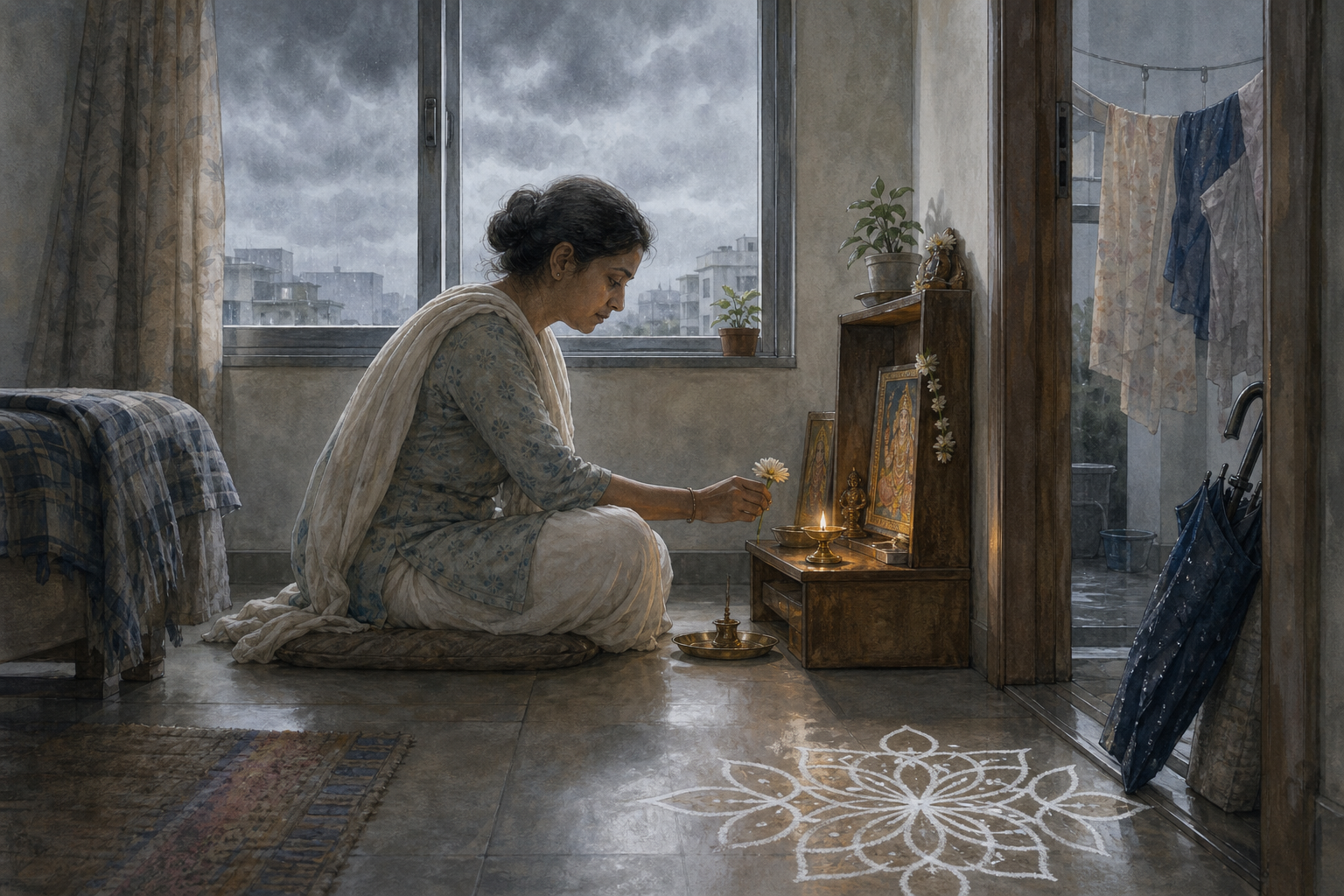
Real observance takes place amid work schedules, winter weather, apartment buildings, uneven pronunciation, and households with more than one regional inheritance. A sound practice needs rules for those conditions before they arise.
- If the crescent is hidden: distinguish the lunar event from your success in seeing it. Check the Panchang’s local moonset and viewing window, make a sincere attempt from a clear western horizon, and follow your family or sampradaya on what to do when clouds or urban obstruction prevent sighting. Do not invent a universal rule from one unsuccessful evening.
- If pre-sunrise prayer is impossible: choose the earliest fixed time you can keep without neglecting care, safety, or necessary work. Preserve the sequence of washing, settling, chanting, reflection, and action. Consistency is more useful than repeatedly abandoning an ideal schedule.
- If pronunciation is the barrier: work with one verse at a time. Listen to a traditional rendering, repeat a phrase, check the transliteration, and then read the meaning. Speed hides errors and leaves no room for contemplation.
- If your household follows different calendars: agree in advance which local Panchang will govern the timing. Family members can retain their regional month names while sharing the actual observance.
- If you belong to another Dharmic tradition: recognise kinship without erasing distinction. Buddhist Uposatha, Jain tithi-based fasting, and Bikrami references in Sikh commemoration show a wider Dharmic attentiveness to cyclical time. Tiruppavai nevertheless remains a specifically Sri Vaishnava offering oriented to Vishnu, especially Krishna.
- If the vrata is becoming performative: reduce the outward complexity and restore the daily ethical act. A shorter recitation followed by actual seva is closer to the discipline’s purpose than an elaborate routine that produces irritation or pride.
The important distinction is between adaptation and carelessness. Adaptation protects the core when circumstances change. Carelessness discards the core while preserving an attractive surface. Keep remembrance, discipline, meaning, service, and surrender; adjust the clock time, language aid, gathering size, or optional offering when necessary.
Key takeaways
- Use Margazhi as the month-long devotional frame and the lunar cycle to time Chandra Darshan and other tithi-based observances.
- Do not convert regional month names from memory. Consult a location-specific Panchang for the month, tithi, sunset, and moonset window.
- At dawn, chant one Tiruppavai verse, understand its meaning, and choose one ethical or devotional action for the day.
- At Chandra Darshan, look low in the western sky shortly after sunset and keep offerings consistent with your household tradition.
- Treat fasting as optional discipline, not a test of devotion, and never override medical advice.
- When weather, language, or scheduling interferes, preserve the core of remembrance, seva, and surrender rather than abandoning the vrata.
Tonight, choose the text and translation you will actually use, identify tomorrow’s verse, and check your local Panchang. At the next dawn, begin with that single verse. At the next first crescent, step outside knowing exactly why the morning and evening belong to the same life of devotion without being the same observance.
References
- DharmaRenaissance Blog — Tiruppavai in Hindi: Meaning, Practice, and Andal’s Divine Bhakti for Margazhi
- DharmaRenaissance Blog — Chandra Darshan on 21 December 2025: Month Names Across India, Auspicious Rituals, Harmony
