
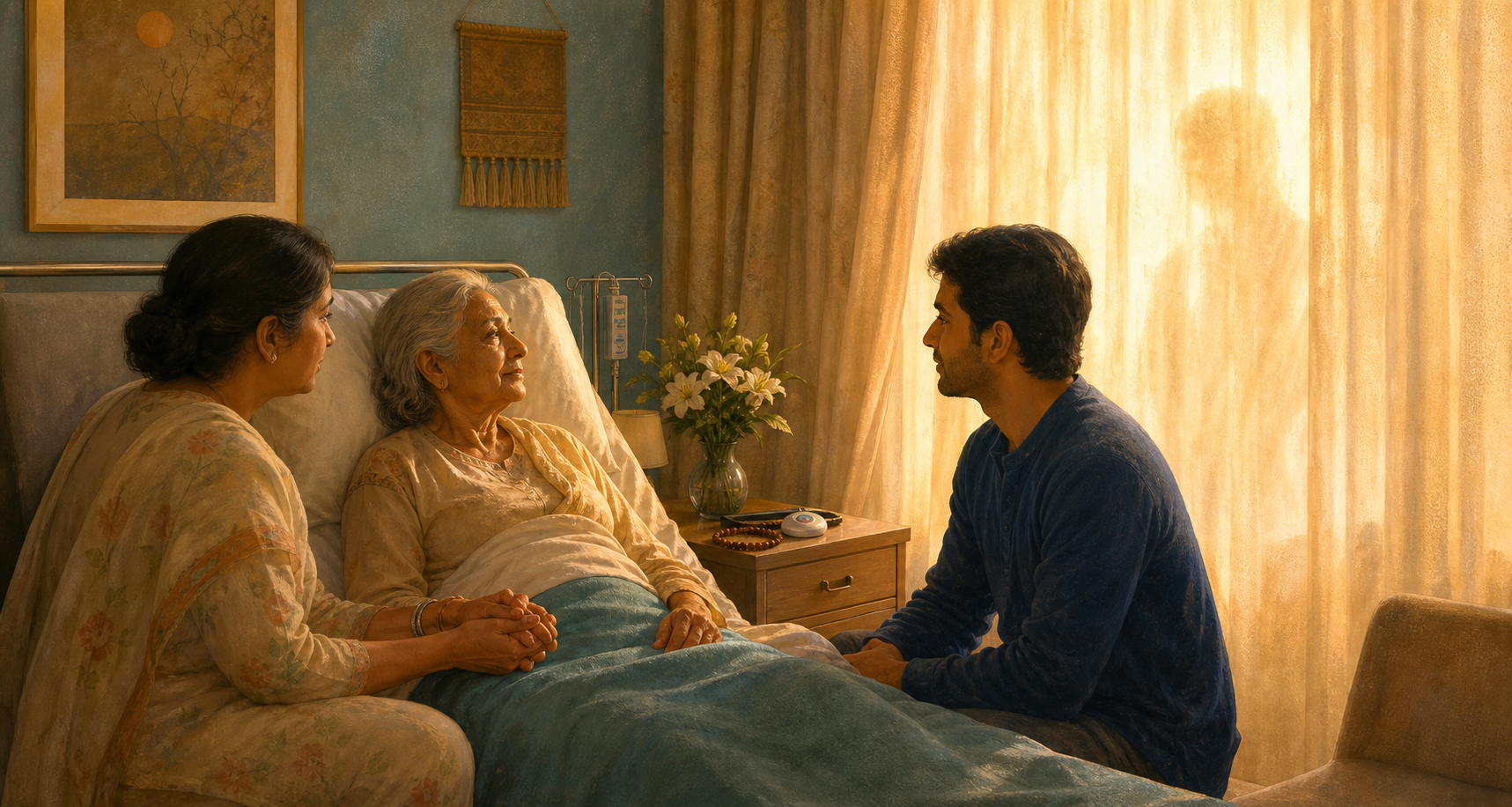
Someone you love begins speaking to a deceased parent, a guru, or a divine presence that nobody else can see. Two questions arrive at once: Is this a sacred encounter, or is something medically wrong? What should you do without frightening, dismissing, or misleading the person?
You do not have to settle the metaphysics at the bedside. Your immediate responsibility is to protect the person’s comfort and safety while treating the experience with dignity. A mature Dharmic response can hold spiritual possibility and medical prudence together.
Hold medical care and spiritual reverence together
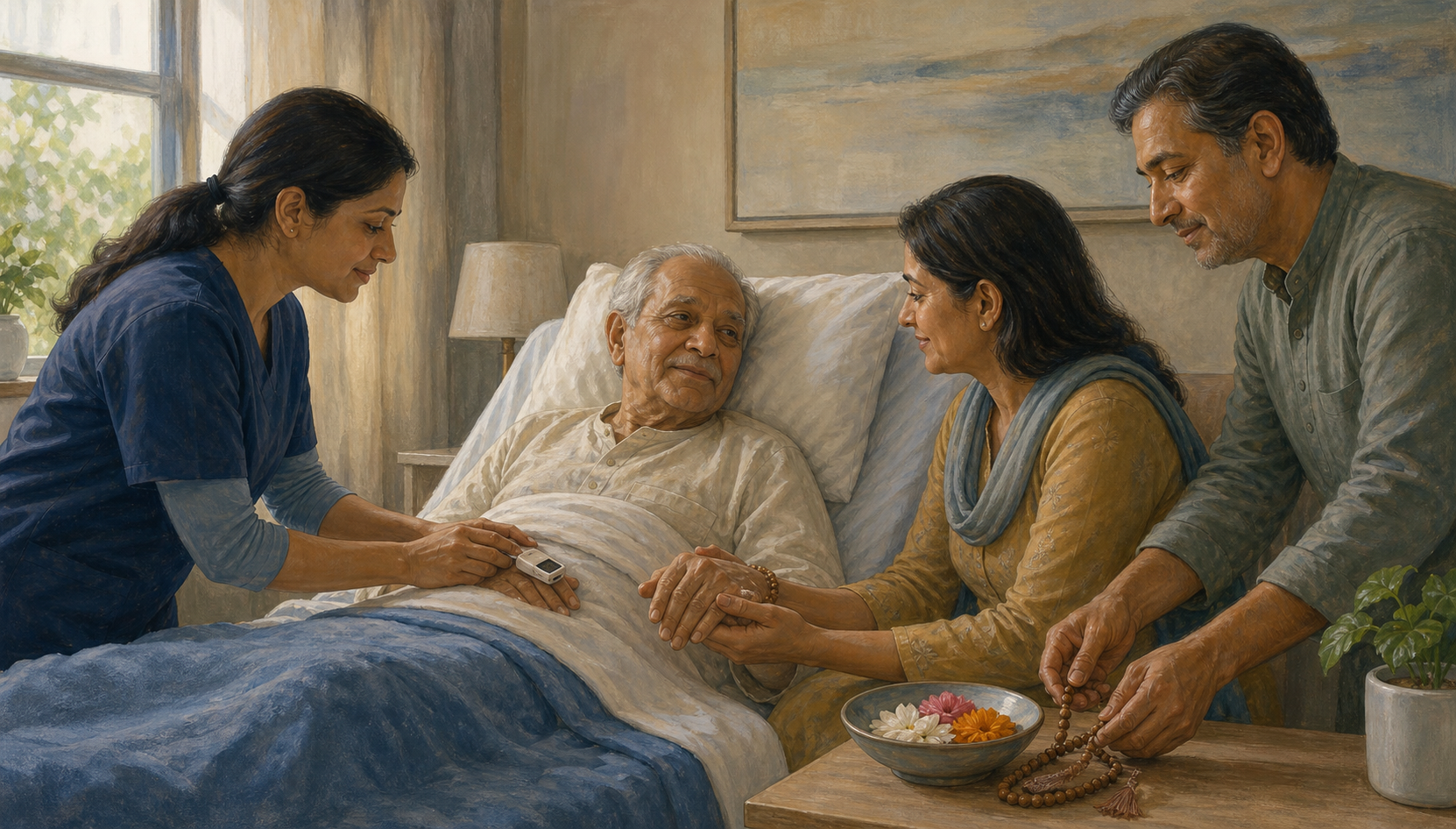
A hallucination is a perception without an observable external stimulus. Near the end of life, altered perceptions can accompany fever, low oxygen, infection, medication effects, or other physiological changes. Delirium may also produce confusion, fragmented speech, fear, agitation, or rapidly changing awareness.
Dharmic traditions leave room for another possibility. Consciousness, or caitanya, is not treated merely as a chemical side effect, and the approach of death may involve a subtle reordering of prāṇa, memory, attention, and the inner faculties. An encounter with a departed relative, guru, deva, or Ishta Devata can therefore be received as potentially meaningful without being declared proven.
These possibilities are not mutually exclusive. A person can be physiologically vulnerable while having an experience that carries spiritual meaning. Finding a medical contributor does not tell you that the experience was meaningless; finding the experience peaceful does not rule out a treatable cause.
Contact the hospice nurse or treating clinician promptly if there is new severe agitation, sudden confusion, apparent terror, fever, breathing difficulty, inability to recognize familiar people, or an abrupt change after medication. Follow the person’s established care plan, and do not stop or alter medication because the experience seems spiritual. Relieving avoidable distress can help the person return to the prayer, silence, or awareness they value.
Read the experience through five practical clues

No checklist can prove that a vision came from another realm. These clues help you notice the character of the experience and decide what kind of support is needed. Treat them as signs for discernment, not as a spiritual diagnostic test.
- Notice the emotional effect. Does the person become settled, reconciled, and less afraid, or increasingly frightened and agitated? A peaceful effect is compatible with a meaningful visitation, while distress raises the urgency of checking for a medical cause. Neither response proves the origin.
- Listen for coherence. A sustained encounter with an identifiable relative, guru, or divine form differs from rapidly shifting images, disconnected statements, or obvious disorientation. Ask one gentle question and listen. Do not turn the bedside into an interrogation.
- Consider the person’s lifelong spiritual world. An experience involving the person’s Ishta Devata, guru, ancestors, or established practice may express deeply formed saṁskāras. An image that matters to you but was never important to the dying person should not be imposed as the explanation.
- Check ordinary orientation and clinical context. Some comforting end-of-life encounters occur in people who remain lucid and oriented. By contrast, a simultaneous change in breathing, temperature, medication, recognition, or alertness gives the clinical team information it needs.
- Look at what remains after the moment. Does the experience leave enduring peace, moral clarity, forgiveness, or readiness? Occasionally, families report details that are later corroborated, but unusual information should be recorded accurately rather than embellished. Do not coach the person or make extraordinary claims on their behalf.
Calm is not proof of visitation, and agitation is not proof that nothing spiritual is happening. A frightening image may arise within a person’s spiritual language, while a hallucination may be benign. The most reliable question is not, Can we label this with certainty? It is, What response protects this person from distress while honoring what the experience means to them?
Let the person’s own Dharmic path shape the response
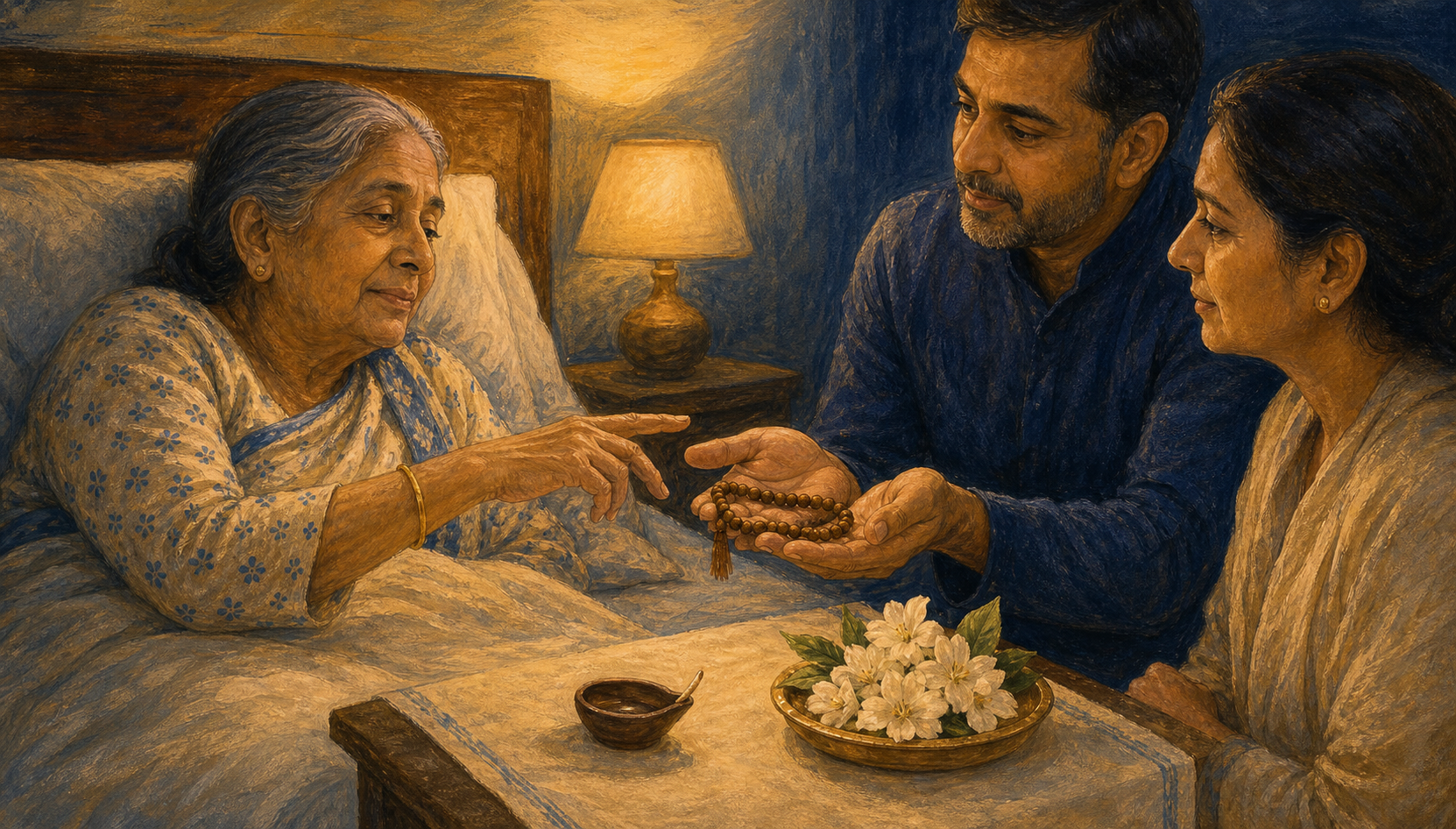
Hinduism, Buddhism, Jainism, and Sikhism share a concern for clarity, compassion, and freedom from unnecessary fear at death. They do not offer one interchangeable account of consciousness or the after-death journey. The bedside practice should come from the dying person’s path, not from a relative’s need to make every tradition say the same thing.
For a Hindu: support remembrance without creating pressure
Bhagavad-Gita 8.5–6 gives special significance to remembrance, or smaraṇa, at the final moment. This is best understood within a life of devotion, action, and accumulated saṁskāras. It should not be turned into a threat that one stray thought, frightened reaction, or sedated interval will mechanically decide the person’s destiny.
If the person has an established Ishta Devata or mantra, keep that relationship central. Recite a familiar passage from the Bhagavad-Gita, repeat the chosen Divine Name, chant a known stotra, or place a familiar sacred image where it can be seen without effort. If the person speaks of receiving darśana, you can acknowledge the peace or significance of the moment without claiming certainty about what others cannot perceive.
For a Buddhist: protect awareness and loving-kindness
A Buddhist response may emphasize mindful dying, gentle awareness of the breath, metta, or recollection of the Buddha’s qualities. Teachings about transitional states vary among Buddhist traditions, so use the practice the person actually follows. A quiet familiar recitation can be more supportive than introducing a new doctrine during the final hours.
If a deceased relative or spiritual figure appears, ask whether the encounter feels peaceful. Then help the person return to compassion, non-grasping, or their chosen object of recollection. Do not demand a display of perfect mindfulness from someone in pain or physical decline.
For a Jain: make ahiṁsā present in speech and atmosphere
At the Jain bedside, ahiṁsā includes the way relatives speak, touch, argue, and manage their own fear. Pratikraman may support reflection, forgiveness, and release from regret; samayik may support equanimity and inward steadiness. Adapt the practice to the person’s strength. A weak or exhausted person should not be made to perform for the emotional satisfaction of observers.
Where the person wants silence, protect it. Where reconciliation is desired, keep words simple and free of accusation. Non-attachment at death does not require emotional coldness from the family; it requires love that does not clutch, command, or burden.
For a Sikh: accompany the person through Hukam and Naam
A Sikh response can center on trust in Hukam and remembrance through Naam Simran. Repetition of Waheguru or familiar shabad kirtan may steady attention and affirm the Divine presence. Keep the volume comfortable and follow the person’s preference rather than treating devotional sound as an obligation.
If the person describes a sacred presence, respond in language consistent with their Sikh life. There is no need to translate the encounter into Hindu categories of Ishta Devata or pitṛs. Dharmic solidarity is strongest when it respects real differences about the self, liberation, and the passage through death.
Follow a calm bedside sequence when a vision occurs

When the room is emotional, a short sequence prevents relatives from arguing over interpretation while the dying person is still speaking. One calm family member should take the lead.
- Check whether the person feels safe. Ask: Does this feel peaceful or frightening? Then ask: Would you like to tell me whom you see? If speaking is tiring, accept a gesture or brief answer.
- Notice accompanying physical or cognitive changes. Observe whether there is new distress, breathing difficulty, fever, marked confusion, or a recent medication change. Share observations with the care team in plain language: what happened, when it began, and what changed.
- Reflect the person’s meaning without declaring a verdict. You can say, You seem comforted by seeing your mother, or I am here with you. This validates the person’s emotional reality without insisting that everyone in the room accept a supernatural conclusion.
- Offer one chosen spiritual anchor. Ask whether the person wants a mantra, Naam Simran, metta, pratikraman, scripture, a sacred image, or silence. Use what is already familiar. The final hours are rarely the right time to teach a complicated new practice.
- Reduce unnecessary stimulation. Lower competing noise, soften harsh light, limit overlapping conversations, and keep familiar sacred objects within an easy line of sight. Do not surround the bed with several people chanting different prayers.
- Protect consent and dignity. The person’s wishes govern the room. Do not force ritual, touch, recitation, confession, or theological discussion. If the person asks for quiet, quiet itself can be the form of reverence.
Four responses that usually make the moment harder
- Flat dismissal: Telling the person that nobody is there may create isolation or shame without resolving the experience.
- Unqualified certainty: Announcing that the vision definitely proves a particular afterlife claim can burden the person and divide the family.
- Fear-based spiritual instruction: Warnings about karma, rebirth, or a supposedly incorrect final thought can intensify distress precisely when steadiness is needed.
- Rapid questioning: Demanding names, details, predictions, or proof turns a vulnerable moment into a performance. Let the person lead.
Prepare a one-page bedside note before the final hours
If death is expected, ask the person about spiritual preferences while conversation is still easy. Record the preferred Divine Name or mantra, scripture or recitation, sacred image, person authorized to lead prayer, desired level of sound, and circumstances in which silence is preferred. Add the hospice or clinical contact and keep the note where relatives can find it.
This small preparation prevents a common conflict: family members acting from love but pulling the room in different directions. It also keeps the dying person’s own dharma at the center when they can no longer explain their wishes repeatedly.
Key takeaways
- A deathbed vision can be spiritually meaningful and still warrant clinical attention; the two responses do not cancel each other.
- Calm, coherence, personal spiritual fit, continuing orientation, and enduring reconciliation can help you understand the experience, but none proves its source.
- New agitation, confusion, breathing difficulty, fever, apparent terror, or a change following medication should be reported promptly to the hospice nurse or treating clinician.
- Use the dying person’s established Hindu, Buddhist, Jain, or Sikh practice. Do not impose a relative’s preferred theology or flatten distinct traditions into one ritual.
- At the bedside, ask whether the experience is peaceful, address possible distress, offer one familiar spiritual anchor, and protect the person’s consent.
If this is happening now, begin with one gentle question: Does what you are seeing feel peaceful or frightening? Report any new clinical change, then offer the prayer, recitation, or silence the person has actually chosen. You do not need to solve the mystery of consciousness in order to accompany someone through death with clarity and reverence.
References
