
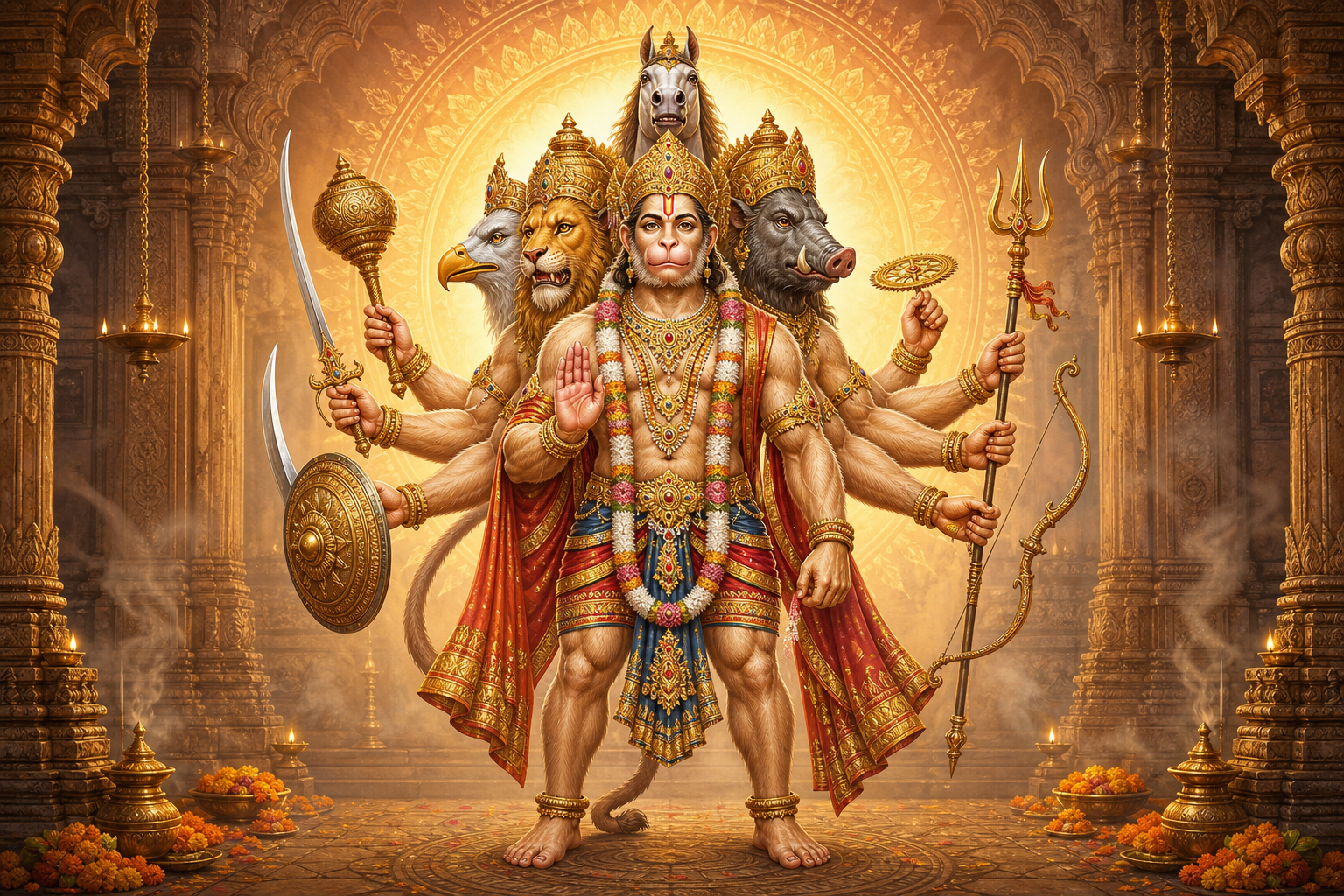
You may know Hanuman as the embodiment of devotion and courageous service, yet still pause before a Panchmukhi murti. Which face is which? Why do the directions matter? Are you meant to seek protection, knowledge, courage, prosperity, or all of them?
Begin with the arrangement itself. The five faces are not five disconnected promises. They form one discipline of complete attention: serve with resolve, defend dharma, detect danger, keep your footing, and seek clarity. Once you read the image this way, Panchmukhi Hanuman becomes more than an impressive icon. It becomes a practical map for sadhana and ethical action.
How to read the five faces and their directions
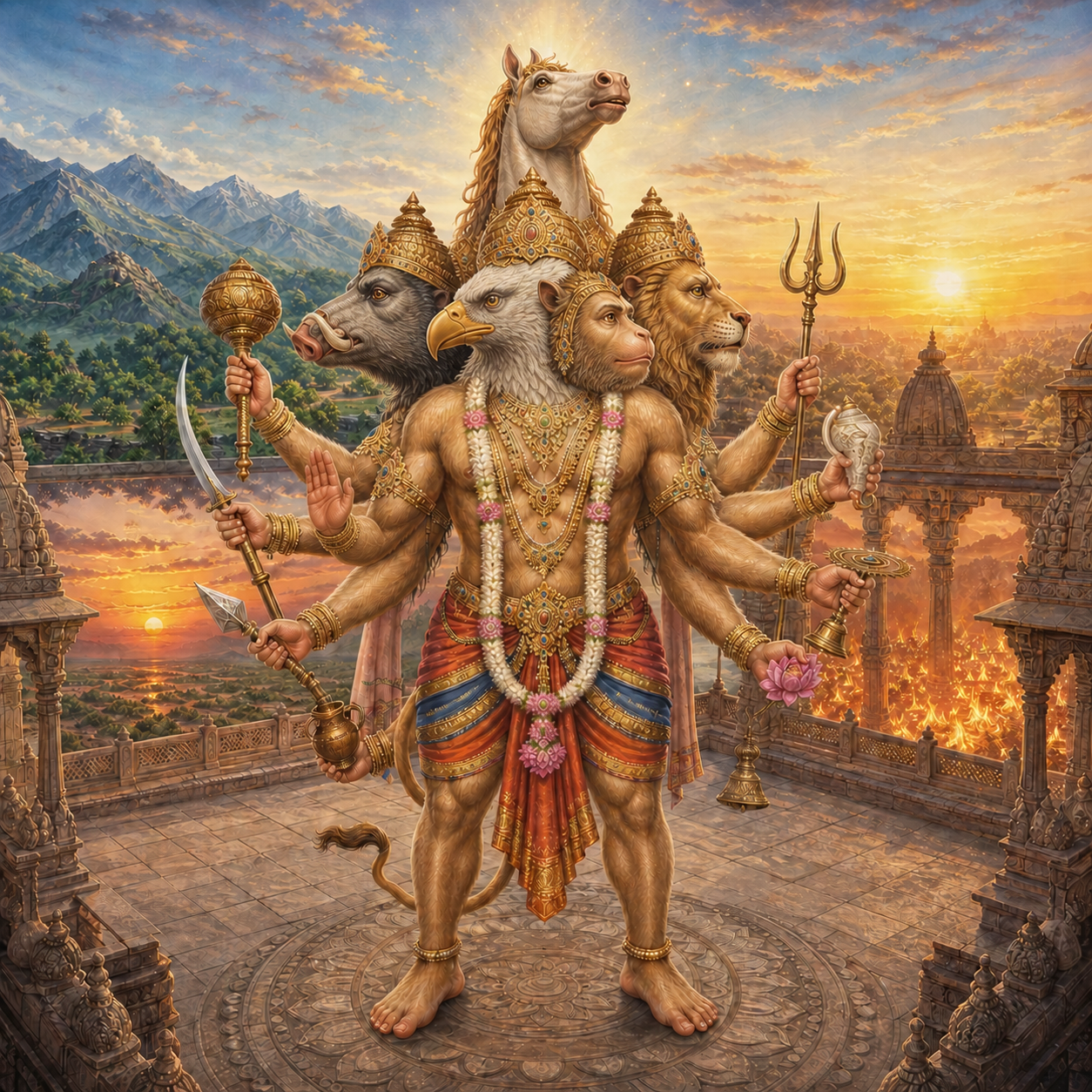
Panchmukhi means five-faced. In the widely followed directional understanding, Hanuman faces east, Narasimha faces south, Garuda faces west, Varaha faces north, and Hayagriva faces upward. Each brings a distinct capacity into one integrated vision of protection and spiritual discipline.
| Face and direction | Spiritual emphasis | How you can apply it |
|---|---|---|
| Hanuman, east | Bhakti, prana, inner resolve, humility, and disciplined service | When your commitment weakens, return to the duty you already know and choose a concrete act of seva. |
| Narasimha, south | Fearless protection and uncompromising defense of dharma | Name what genuinely needs protection. Establish a clear boundary without turning courage into cruelty. |
| Garuda, west | Speed, vigilance, freedom from harmful influences, and removal of obstacles | Scan for the urgent obstruction you have overlooked. Act promptly, especially when preparing for a journey or responding to a changing situation. |
| Varaha, north | Stability, grounding, upliftment, resilience, and well-being | Restore your foundation before reaching for a dramatic solution. Attend to responsibilities, resources, routines, and the next sustainable step. |
| Hayagriva, upward | Clarity, sacred learning, contemplation, and luminous knowledge | Identify what you do not yet understand. Study, ask a better question, and let knowledge discipline your response. |
The fifth direction is upward rather than another horizontal point. That matters. The image does not merely watch the surrounding field; it also directs awareness toward knowledge and higher understanding. Protection without insight can become reaction. Insight without grounded action can remain sterile. Panchmukhi Hanuman holds both together.
Do not identify a face merely by where it appears on the left or right of a photograph. A picture may be taken from an angle, reversed, cropped, or arranged for visibility. Use the named form, the murti’s established orientation, or the explanation followed by the temple or household tradition.
The faces also restrain one another’s possible excesses. Garuda’s swiftness is steadied by Varaha. Narasimha’s ferocity remains governed by Hanuman’s devotion. Hayagriva’s knowledge must enter service rather than pride. Varaha’s concern with stability must not become attachment or inertia. The unity of the form is therefore as important as the identity of each face.
What the Ahiravana story reveals about protection
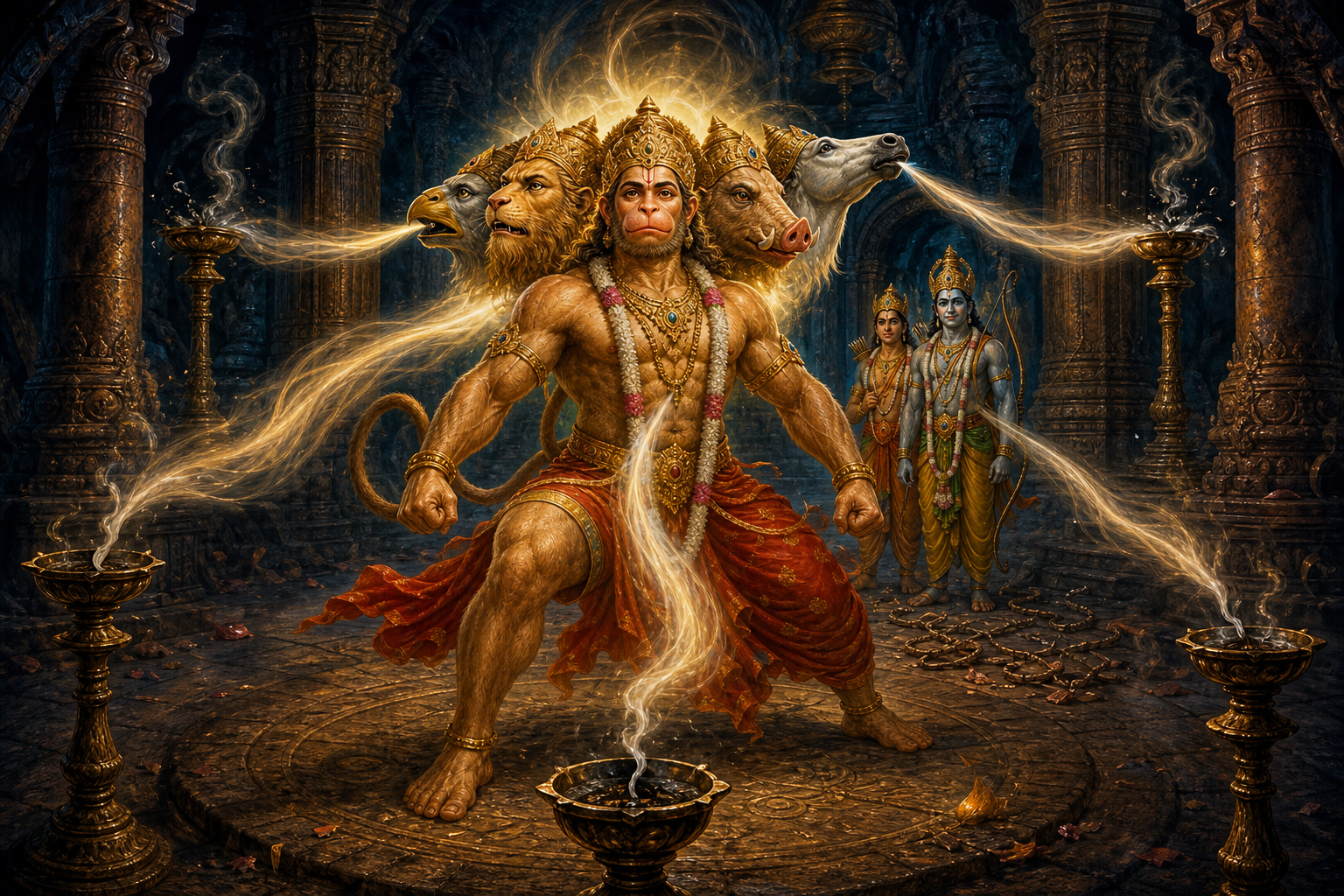
A cherished narrative associated with Ramayana traditions places the five-faced manifestation in Hanuman’s confrontation with the subterranean sorcerer Ahiravana, also called Mahiravana in some tellings. Hanuman must extinguish five lamps positioned in different directions at the same moment. He therefore assumes the five-faced form, defeats the dispersed mechanism of the adversary’s power, and completes his protective mission.
Details vary across regional tellings, so the story should not be used to impose one rigid narrative version on every community. Its spiritual architecture is nevertheless clear: a danger operating across several fronts cannot be overcome by attention fixed in only one direction.
This gives you a more demanding understanding of protection. It is not passive insulation from every difficulty. It is the ability to see the whole field and coordinate the right capacities. A problem may involve neglected duty, an absent boundary, a fast-moving obstacle, an unstable foundation, and missing knowledge at the same time. Addressing only the most visible part allows the rest to remain active.
Suppose you are preparing for an important journey. Garuda calls for vigilance and prompt removal of obstacles, but that does not replace Varaha’s practical preparation, Hayagriva’s accurate information, Narasimha’s willingness to refuse an unsafe choice, or Hanuman’s disciplined purpose. The same logic applies to study, family responsibility, community work, and periods of uncertainty. The form teaches coordinated action, not dependence on a single favoured quality.
A shrine can anchor this awareness, but worship does not release you from ordinary responsibility. If you pray for a safe journey, check what needs checking. If you seek clarity, study. If you invoke protection, establish the necessary boundary. If you ask for stability, repair the neglected foundation. Devotion becomes stronger when it produces responsible action.
Turn the symbolism of five into a complete sadhana
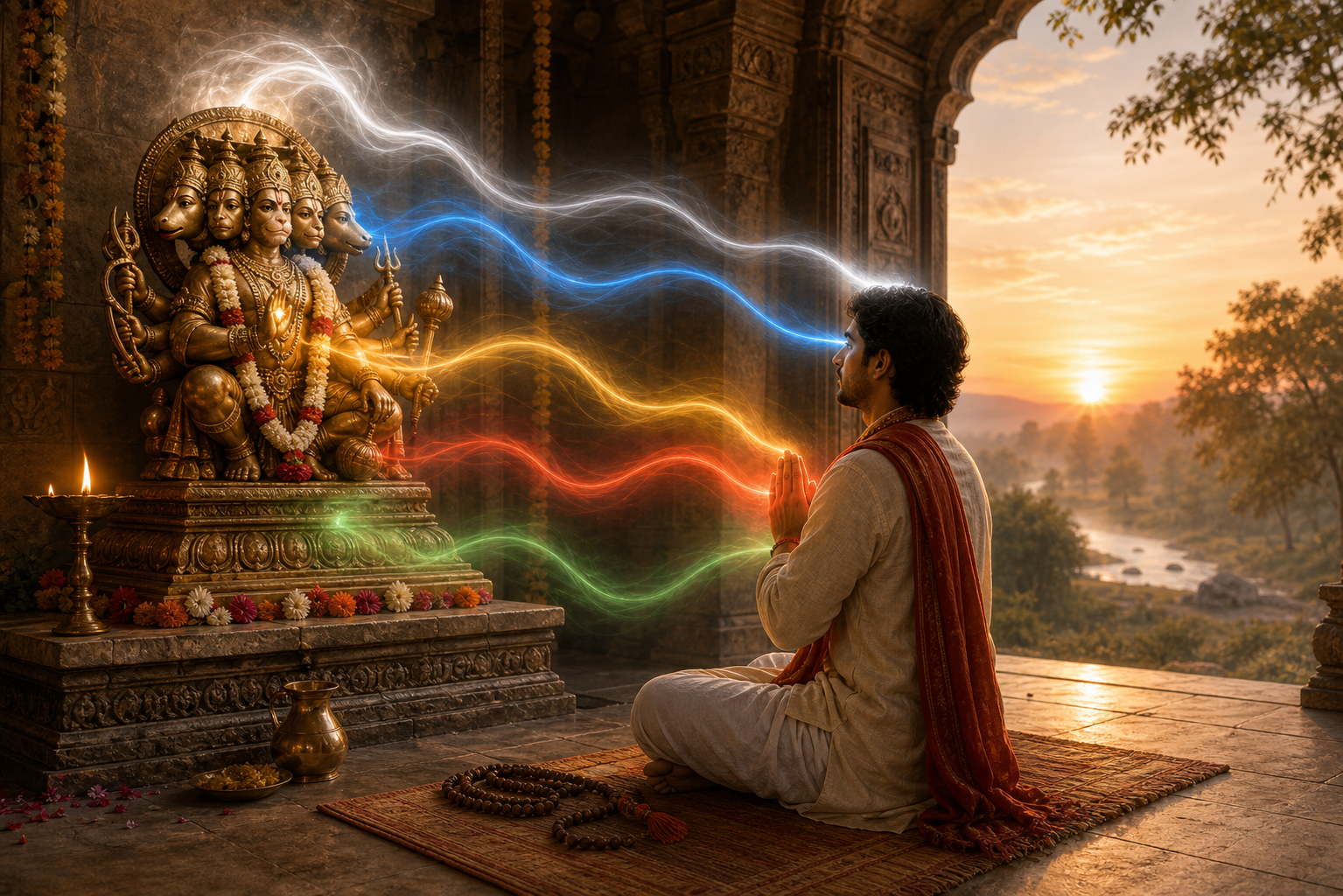
Let the image reach body, energy, senses, conduct, and intellect
The symbolism belongs to a wider Indic pattern of fiveness: the pancha-bhutas, or five elements; the pancha-pranas, or five vital energies; and the five senses. These sets should not be forced into a mechanical code in which every face must equal exactly one element, one vital current, or one sense. Their value is holistic. They remind you that spiritual protection concerns your entire way of being, not merely an external threat.
Varaha brings attention to embodiment and grounding. Hanuman turns breath, energy, and the senses toward disciplined service. Garuda sharpens vigilance. Narasimha tests whether you can stand for truth without surrendering dharma in the process. Hayagriva illuminates the intellect. Read together, the faces ask whether your body is steady, your energy directed, your perception alert, your conduct courageous, and your understanding clear.
The wider Dharmic world also contains distinct languages of fiveness, including directional and mandala symbolism in Buddhism, ethical groupings in Jain traditions, and the honoured symbolism of the Panj in Sikh memory. These are not interchangeable doctrines, and similarity does not prove a single historical origin. Their resonance is more useful when it helps you notice recurring commitments to discipline, knowledge, service, virtue, and fearless compassion without flattening the integrity of each path.
A five-pass contemplation you can use in daily life
The following sequence is a contemplative aid, not a claim that every lineage prescribes the same ritual order. If your guru, temple, or family sampradaya gives specific instructions, follow that discipline. Otherwise, you can use the directional map to examine a difficult situation without reducing worship to wish-making.
- Begin with Hanuman in the east. Ask: What is my duty here, and which part of it am I postponing? Choose the next act of service that does not depend on praise or recognition.
- Turn to Narasimha in the south. Ask: What must be defended, and where have I confused peace with avoidance? Define a boundary or truthful statement that protects dharma without feeding personal anger.
- Turn to Garuda in the west. Ask: What harmful influence, distraction, or urgent obstacle requires attention? Remove the obstruction you can actually address instead of circling it mentally.
- Turn to Varaha in the north. Ask: What would restore firm ground? Repair the practical base of the situation through steadiness, preparation, fulfilled responsibility, and sustainable effort.
- Look upward with Hayagriva. Ask: What do I still need to learn? Clarify the question, seek trustworthy instruction, and delay a careless conclusion when understanding is incomplete.
You may then recite Om Panchamukha Hanumate Namah, an invocation used for protection, courage, and guidance. Recite it according to the discipline you follow rather than inventing a count for the sake of appearing rigorous. The test comes after the recitation: can you name the dharmic action that your prayer now requires?
You do not always have to begin with the same face. Before study, Hayagriva may reveal the immediate need; before travel, Garuda may do so; during instability, Varaha may be the natural entry point. Begin where the difficulty is most obvious, but complete the full circuit. That prevents a real need from becoming an excuse to neglect the other dimensions of the situation.
Choose placement and worship without reducing the icon to vastu
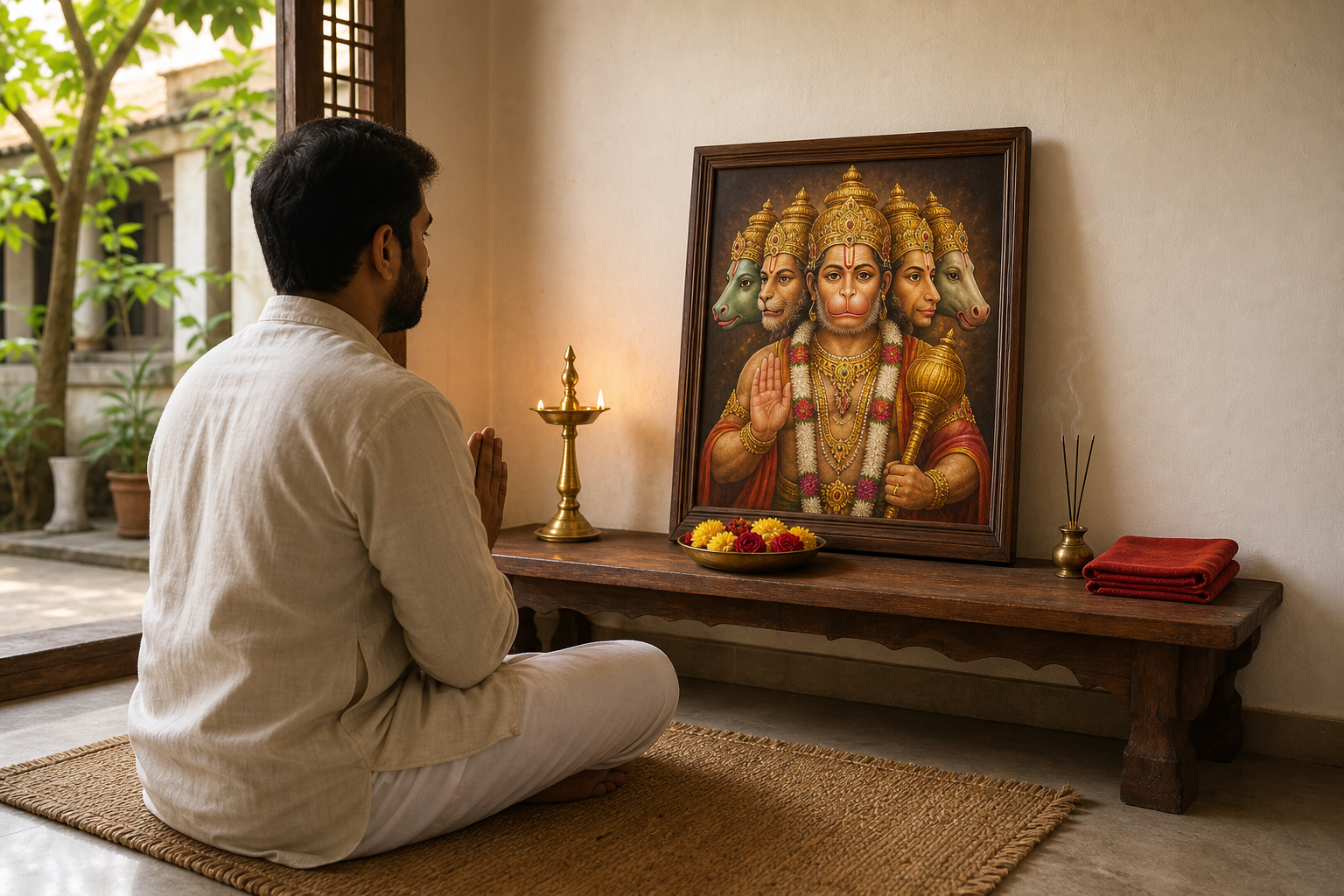
Panchmukhi Hanuman is enshrined in temples and homes as a focus for comprehensive well-being. Its directional structure naturally lends itself to sacred geography and vastu-inspired interpretation. A symbolic correspondence, however, does not by itself establish a universal architectural rule for every house, murti, region, or sampradaya.
If you are deciding where to place an image, first follow the tradition responsible for your worship space. Ask a knowledgeable priest, guru, or family elder when such guidance is available. Do not rotate a murti merely because an isolated online chart assigns a desired result to one direction. When no special instruction governs the placement, choose a clean, stable, respectful location where regular worship is practical and the image will be treated with care.
Several common misreadings disappear once you keep conduct at the centre:
- Varaha is not a guarantee of money. Prosperity without stability, responsibility, and resilience misses the face’s grounding significance.
- Garuda is not permission for impulsiveness. Spiritual swiftness includes vigilance; haste without clear perception can multiply obstacles.
- Narasimha is not a religious excuse for rage. Fearless protection serves dharma. Personal aggression merely borrows sacred language.
- Hayagriva is not a substitute for study. Invoking knowledge should make you more willing to learn, question, contemplate, and correct yourself.
- Hanuman is not a symbol of strength separated from humility. His resolve is directed through bhakti and seva rather than self-display.
The same standard applies to the mantra. Treating it as a transaction narrows the very symbolism you are invoking. Let the prayer gather your faculties, then carry that gathered attention into the work in front of you.
Key takeaways
- Hanuman faces east and represents devotion, prana, resolve, humility, and disciplined service.
- Narasimha faces south and represents fearless protection and defense of dharma.
- Garuda faces west and represents vigilance, swiftness, and release from harmful influences and obstacles.
- Varaha faces north and represents grounding, upliftment, resilience, and stable well-being.
- Hayagriva faces upward and represents clarity, sacred learning, and luminous knowledge.
- The Ahiravana narrative presents protection as omnidirectional awareness and coordinated action, not passive escape from difficulty.
- The five faces can guide a daily examination of duty, boundaries, obstacles, foundations, and understanding.
The next time you stand before Panchmukhi Hanuman, do not rush to ask which face grants the result you want. Ask which capacity the situation demands, which capacity you have neglected, and how all five can serve one dharmic response. Then leave the shrine with a specific action worthy of the prayer.
References
