
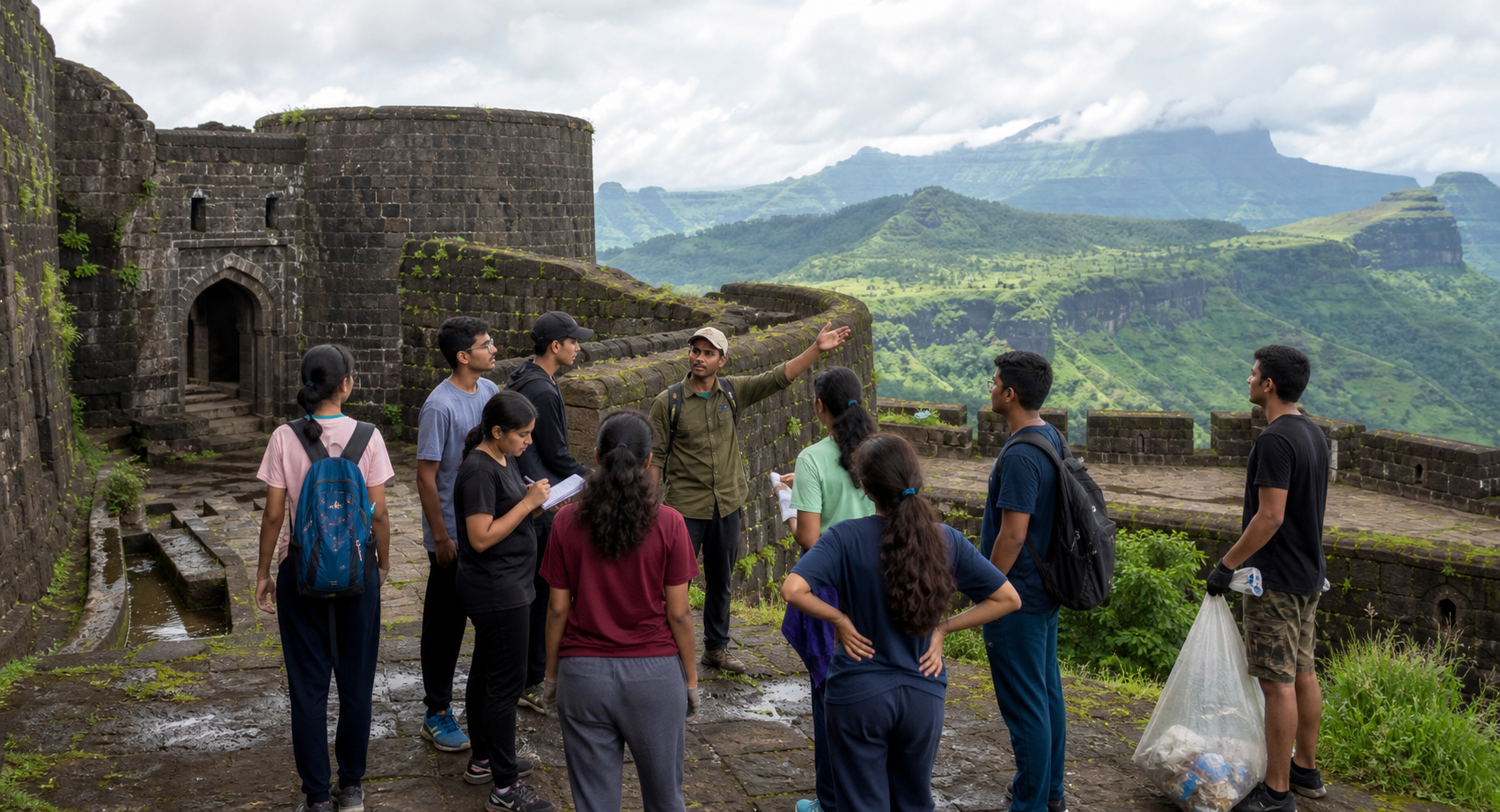
If you are planning a youth visit to a Maratha fort, the central challenge is not getting people onto the ramparts. It is helping them leave with a more careful understanding of the place, a personal stake in its protection, and a useful job they are willing to continue.
A fort can be a viewpoint, a backdrop for photographs, or a living classroom. The difference comes from programme design. Give young participants a question to investigate, evidence to examine, boundaries to respect, and an authorised act of service. That structure turns admiration for Chhatrapati Shivaji Maharaj into responsible conduct rather than a passing burst of emotion.
Key takeaways for youth organisers
- Build the visit around one historical or civic question instead of a long outdoor lecture.
- Teach participants to separate what they can observe from what they infer or have heard.
- Connect courage, self-discipline, respect, and service to conduct at the fort.
- Obtain permission before cleaning, moving, marking, repairing, or attaching anything to the site.
- Give every participant a defined role and a concrete output that someone will use.
- Agree on the next contribution before the group disperses; attendance alone is not continuity.
Design the visit around one question, not a long lecture
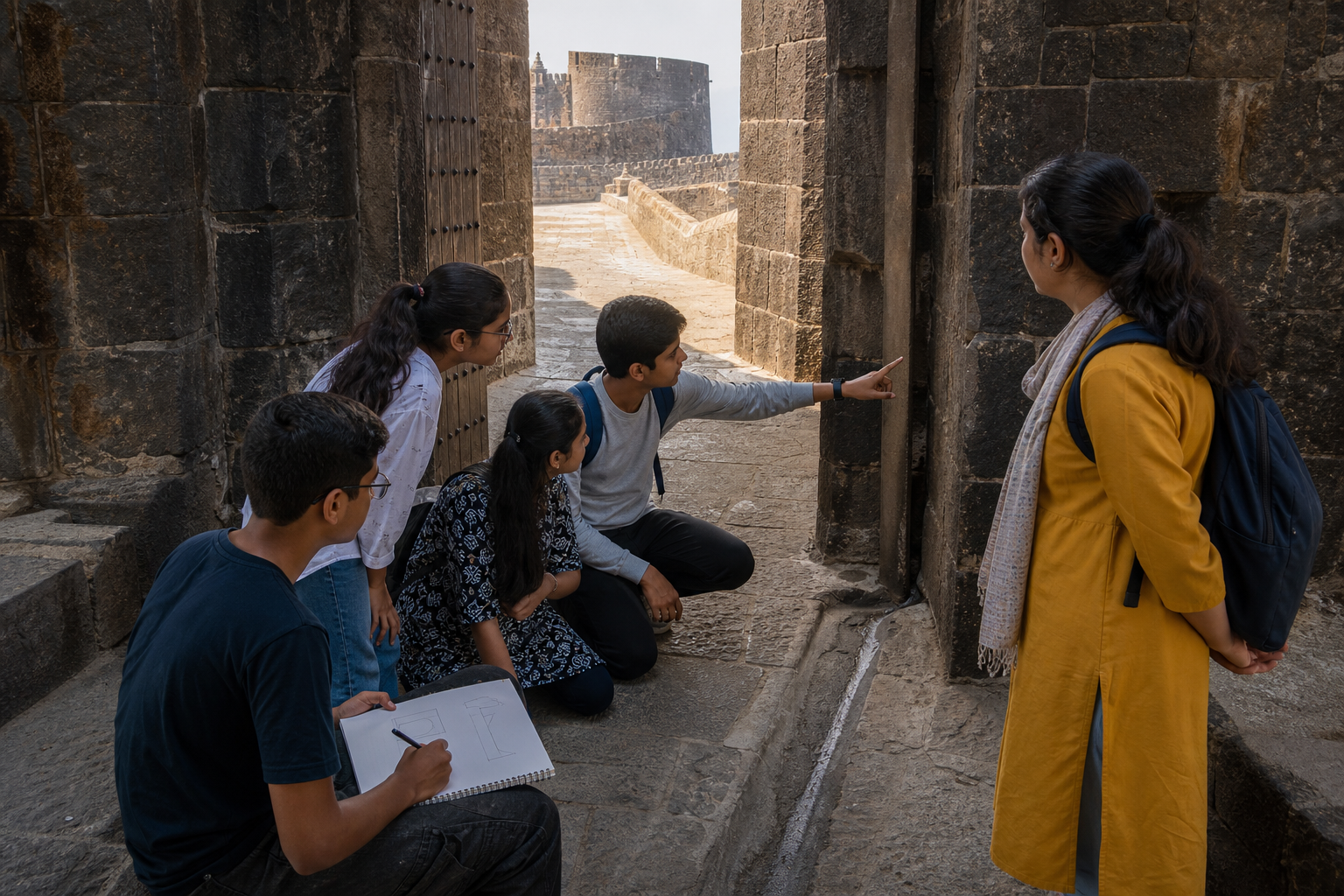
Young people do not need to be persuaded that a fort is visually impressive. They need help discovering why its location, form, memory, and condition matter. Begin with a question that can only be answered by paying attention at the site.
You might ask how the visible features of the fort shaped movement, vigilance, water use, communication, or collective security. Where a feature is absent, damaged, or uncertain, that absence can become part of the inquiry. The objective is not to make every participant an instant historian. It is to replace passive sightseeing with disciplined curiosity.
A fort-centred initiative at Ratnadurg and Govindgad brought together 80 young participants around Maratha heritage, leadership, dharmic values, and civic duty. That gathering does not establish a universal formula, but it does show that a substantial youth audience can respond to place-based learning when the place is connected to responsibility.
A workable programme can be built from five linked elements:
- Set one guiding question that participants can investigate at the fort.
- Give them an observation task, such as recording a feature, route, boundary, visitor behaviour, or preservation concern.
- Ask them to distinguish direct observation, reasonable inference, inherited memory, and a claim that still needs verification.
- Connect the inquiry to one civic value associated with Shivaji Maharaj’s legacy, such as courage, ethical governance, self-discipline, or community responsibility.
- End with an authorised service output and a named person responsible for carrying it forward.
Keep the introductory talk short enough that the fort itself remains the primary learning environment. Supply the minimum context needed to ask better questions, then let participants look, compare, sketch, map, discuss, and report. If a historical claim cannot be traced to dependable evidence, label it as a question rather than presenting it as certainty. That habit protects both heritage and credibility.
Teach participants to read the fort before interpreting it
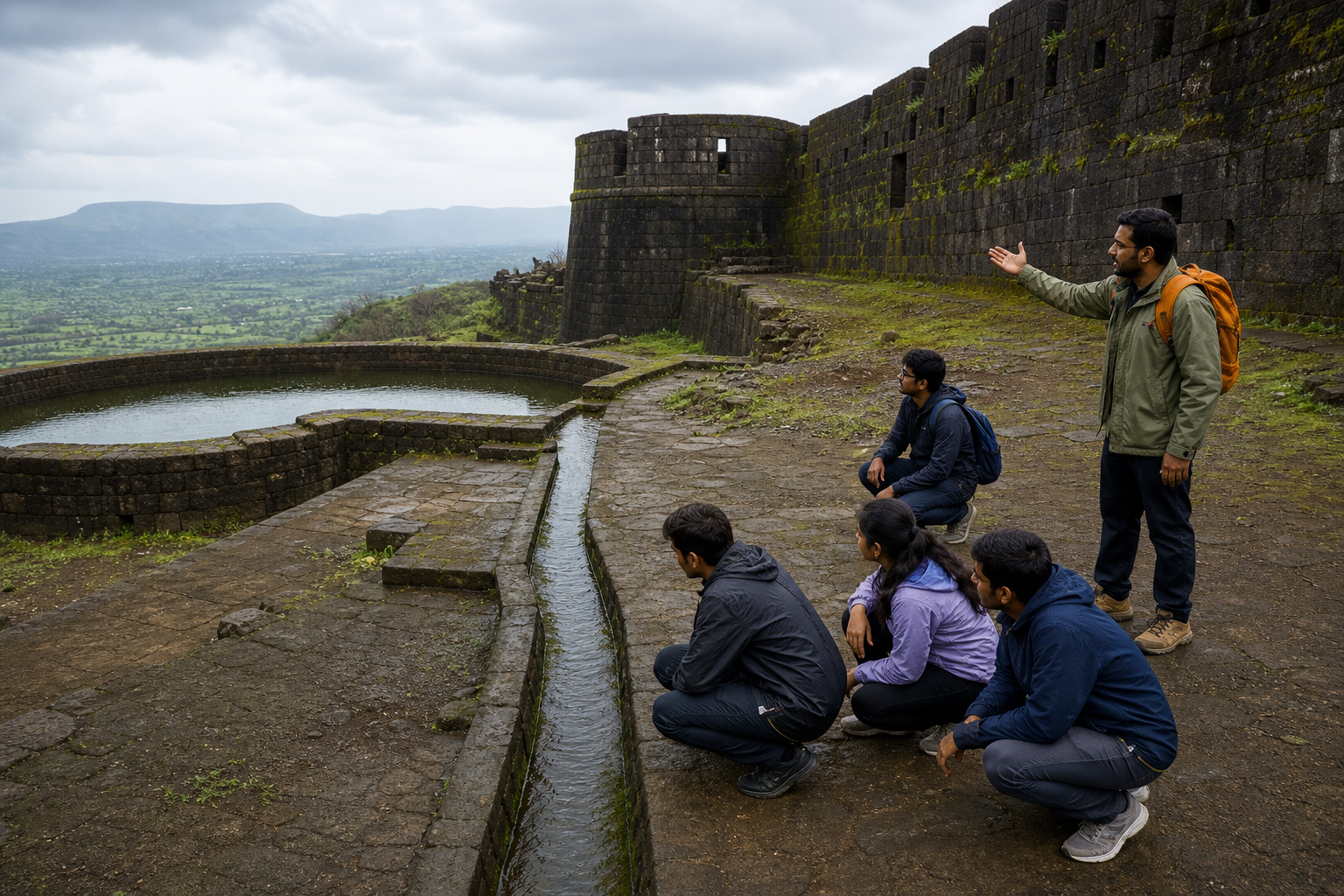
A fort is not merely a setting for a story already known. Its approaches, walls, gateways, sightlines, water features, surviving structures, later alterations, and present condition may all carry evidence. Not every feature will survive at every site, and not every visible element necessarily belongs to the same period. Careful observation must therefore come before confident interpretation.
- Observe: record what is actually visible without assigning it a purpose immediately.
- Infer: propose what the feature might have done, while marking the proposal as an interpretation.
- Test: ask what additional evidence would support or weaken that interpretation.
- Contextualise: connect the feature to the larger problems of movement, defence, administration, provisioning, worship, or community life only where the evidence permits.
- Protect: identify what visitor conduct would preserve the feature and what conduct could damage it.
This sequence corrects a common weakness in heritage outings: a confident story is often repeated before anyone has examined the place. A better facilitator welcomes uncertainty. If two groups interpret a feature differently, ask each group to identify the observation behind its conclusion. Disagreement then becomes a lesson in evidence rather than a contest in assertion.
Participants should also learn that touching is not the same as learning. Do not climb unstable masonry, scrape surfaces, carve names, apply paint, reposition stones, remove objects, or clear vegetation. Even an action performed with reverence can destroy context or accelerate damage. When the responsible authority has not approved an intervention, observation and documentation are the proper forms of service.
Move from physical evidence to dharmic public ethics
The ethical discussion should emerge from what participants did at the site. Otherwise, words such as courage and service remain decorative. Ask what each value requires when enthusiasm meets limits, when a friend behaves carelessly, or when a popular claim cannot be verified.
| Value | Conduct at the fort | Conduct after the visit |
|---|---|---|
| Courage | Calmly challenge unsafe or disrespectful behaviour without creating a confrontation. | Speak up when heritage is treated as disposable, while keeping claims factual. |
| Self-discipline | Stay within permitted areas and accept that curiosity does not create permission. | Complete the task you accepted rather than waiting for another public event. |
| Service | Do work that the site’s custodians have approved and can actually use. | Deliver the record, fact sheet, volunteer list, or awareness material to its intended recipient. |
| Respect | Listen, avoid vandalism, and distinguish evidence from interpretation or inherited memory. | Represent historical and religious differences without ridicule or careless simplification. |
| Community responsibility | Consider local residents, custodians, ordinary visitors, and future visitors. | Join a continuing local network instead of treating the fort as a one-day venue. |
A broad dharmic frame can connect Hindu, Buddhist, Jain, and Sikh participants through respect, restraint, courage, and service. It should not pretend that the traditions are doctrinally identical, and it should not detach a Maratha fort from its specific history. Shared ethical language works best as an invitation to responsible action, not as a substitute for historical precision.
Give youth a real stewardship role, not symbolic work
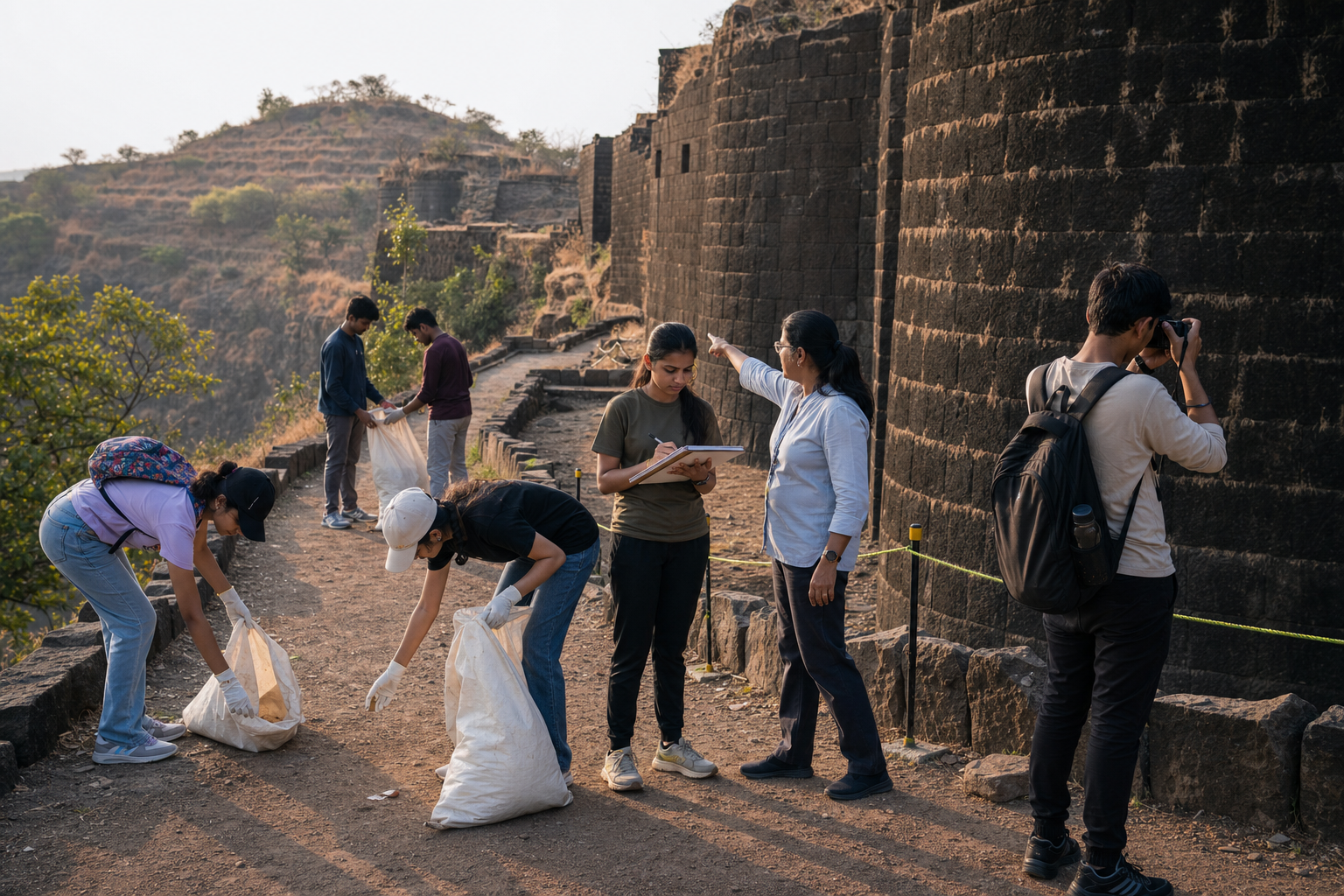
Young participants notice when an activity exists only to produce photographs. A stewardship task should answer three questions: who needs it, who has authorised it, and what happens to the result. If those questions have no answers, redesign the task before the visit.
- Contact the responsible custodian or organising authority and ask what activity is permitted, useful, and currently needed.
- Define the physical boundary of the work. State clearly what participants may observe, handle, collect, clean, publish, or report.
- Offer a small menu of approved roles so that youth exercise judgement within safe limits.
- Name the recipient of every output. A condition log, visitor-awareness draft, translated note, or volunteer register is unfinished until it reaches the person who can use it.
- Record what was accepted, what needs revision, and who owns the follow-up.
When permission for physical work is unclear, choose a no-touch task. Participants can create an observation log from public routes, record questions that require expert verification, note missing or confusing visitor information, draft a responsible-visitor message for official review, or organise opt-in interest for a later authorised activity. These jobs build attention without turning volunteers into untrained conservators.
Litter collection is not automatically harmless simply because the intention is good. The area, collection method, disposal route, and safety arrangements should be approved. Painting, reconstruction, stone movement, vegetation removal, excavation, and the attachment of signs require a much firmer boundary: do not proceed without explicit authority and appropriate expertise.
Within those boundaries, let young people lead. Useful roles include route coordinator, observation recorder, historical-claim verifier, visitor-communication drafter, accessibility observer, safety liaison, and handoff coordinator. For minors, adult supervision, appropriate consent, and responsibility for safety remain with the organisers. Youth leadership should never mean asking a young participant to enforce rules against strangers or manage a hazardous situation.
This distinction matters because stewardship is not ownership. Loving a fort does not grant permission to alter it. The mature expression of attachment is the willingness to serve within limits, seek expertise, and preserve evidence that belongs to future generations as well as the present one.
Build the return path before the group leaves
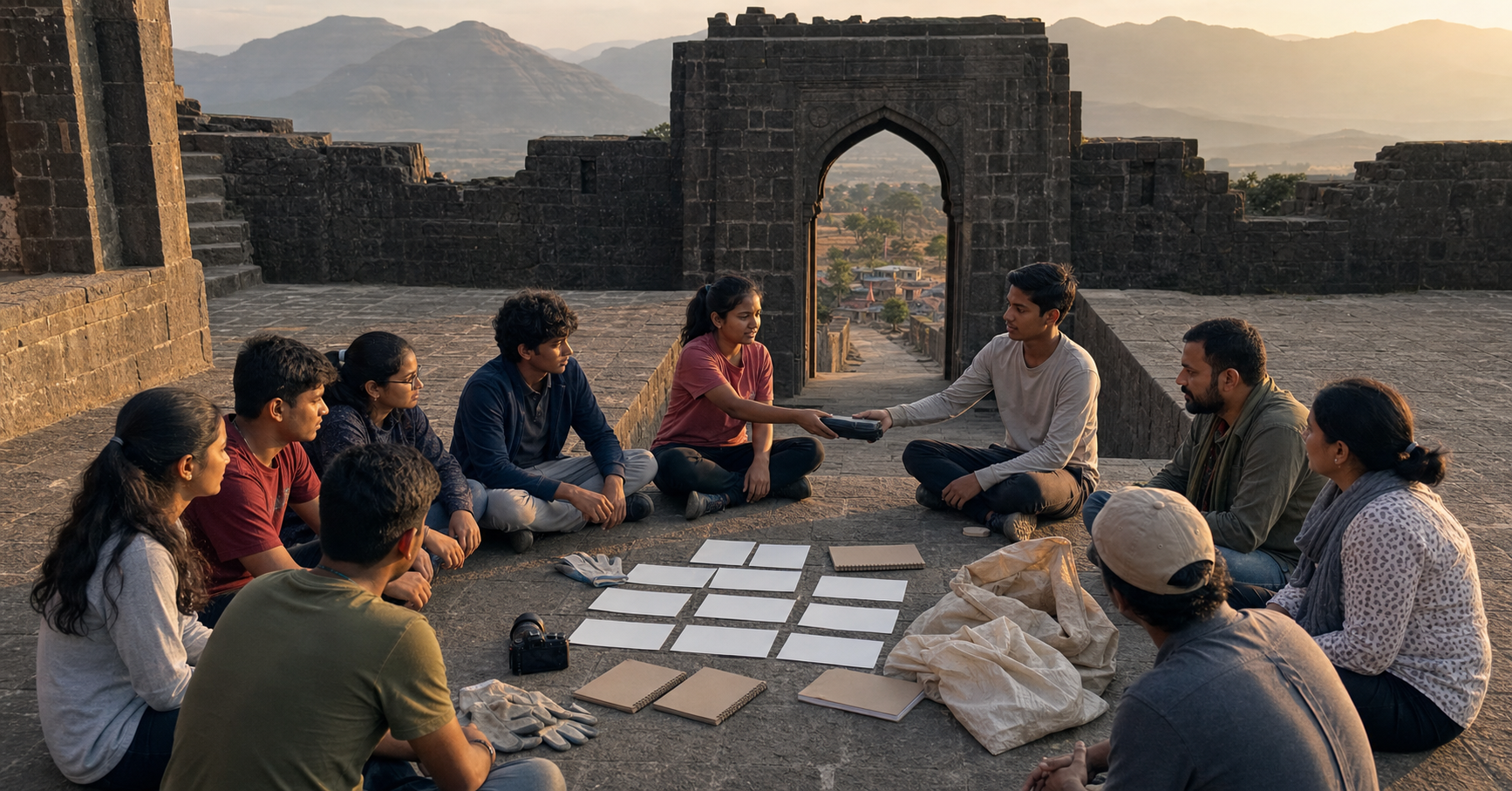
An enthusiastic day can still disappear into a camera roll. Continuity begins before participants leave the site, while the questions, relationships, and unfinished tasks are still clear. Do not end only with thanks or a group photograph.
Ask every participant to complete three statements: one thing they observed, one claim they still need to verify, and one contribution they are prepared to make. The answers reveal whether the programme produced attention, intellectual honesty, and agency rather than momentary excitement.
Then convert willingness into a visible chain of responsibility:
- Name the output that remains to be completed.
- Assign an owner and a person who will review it for historical accuracy or site appropriateness.
- Identify the custodian, community group, school, or organiser who will receive it.
- Set the next contribution while participants are present, including its task, place, and agreed timing.
- Collect contact details only on an opt-in basis, explain how they will be used, and restrict access to the people managing the activity.
Measure more than turnout. Look for evidence of understanding: can participants describe a feature without immediately turning inference into fact? Look for evidence of conduct: did they respect site boundaries even when no one was watching? Look for evidence of service: did an authorised recipient receive something useful? Look for evidence of continuity: does the next task have an owner rather than an unnamed group?
Public communication needs the same discipline. Share verified history, explain why protective boundaries matter, and credit local custodians or collaborators where appropriate. Report a preservation concern through the proper channel before turning it into a public accusation. Visibility can support stewardship, but attention without verification can burden the people already caring for the site.
If you can organise only one visit, make it complete: choose one fort, one verified question, one authorised service task, and one named follow-up. That is small enough to carry out responsibly and substantial enough to begin a durable youth relationship with Maratha heritage.
References
