

If you encountered Riksharaja while asking whether Hindu tradition has room for lives that cross ordinary gender categories, you may have found two equally unsatisfying answers. One turns the figure into proof of a complete modern theory of gender. The other treats the unusual embodiment as an irrelevant curiosity.
Neither reading does justice to the narrative. Riksharaja gives you something subtler and more useful: a sacred image in which masculine and feminine capacities can inhabit one biography, parenthood can exceed a single bodily category, and difference need not imply hierarchy. You can take those meanings seriously without pretending that an ancient or regional telling uses every concept available to us now.
Begin with the textual boundary, not a universal claim
The first discipline is simple: say where the account belongs. Riksharaja’s dual-gendered parenthood appears across certain Ramayana recensions and related Hindu traditions. It is associated especially with later Puranic and regional retellings rather than appearing uniformly in critical editions of the Valmiki Ramayana.
That qualification does not make the account less Hindu or less meaningful. A living sacred tradition can preserve a central moral world while retelling genealogies, miracles and local memories in more than one form. But textual plurality requires accurate speech. Saying, “In some Ramayana traditions, Riksharaja…” is more faithful than saying, “The Ramayana definitively teaches…”
This distinction matters especially when the story enters a modern argument. If you make every recension say the same thing, an informed listener can dismiss your larger point by exposing the textual overstatement. If you identify the tradition precisely, the real question remains available: why did a Hindu community preserve a sacred genealogy in which one parent crosses the categories normally kept apart?
Use three levels whenever you interpret the account:
- Narrative fact: what happens within a particular telling.
- Symbolic possibility: what the event allows a devotee or reader to contemplate.
- Ethical application: how that contemplation should affect your conduct toward actual people.
Keeping those levels distinct prevents both literalism and careless appropriation. The event need not function as a modern legal category before it can enlarge your moral imagination.
Riksharaja presents complementarity within one life
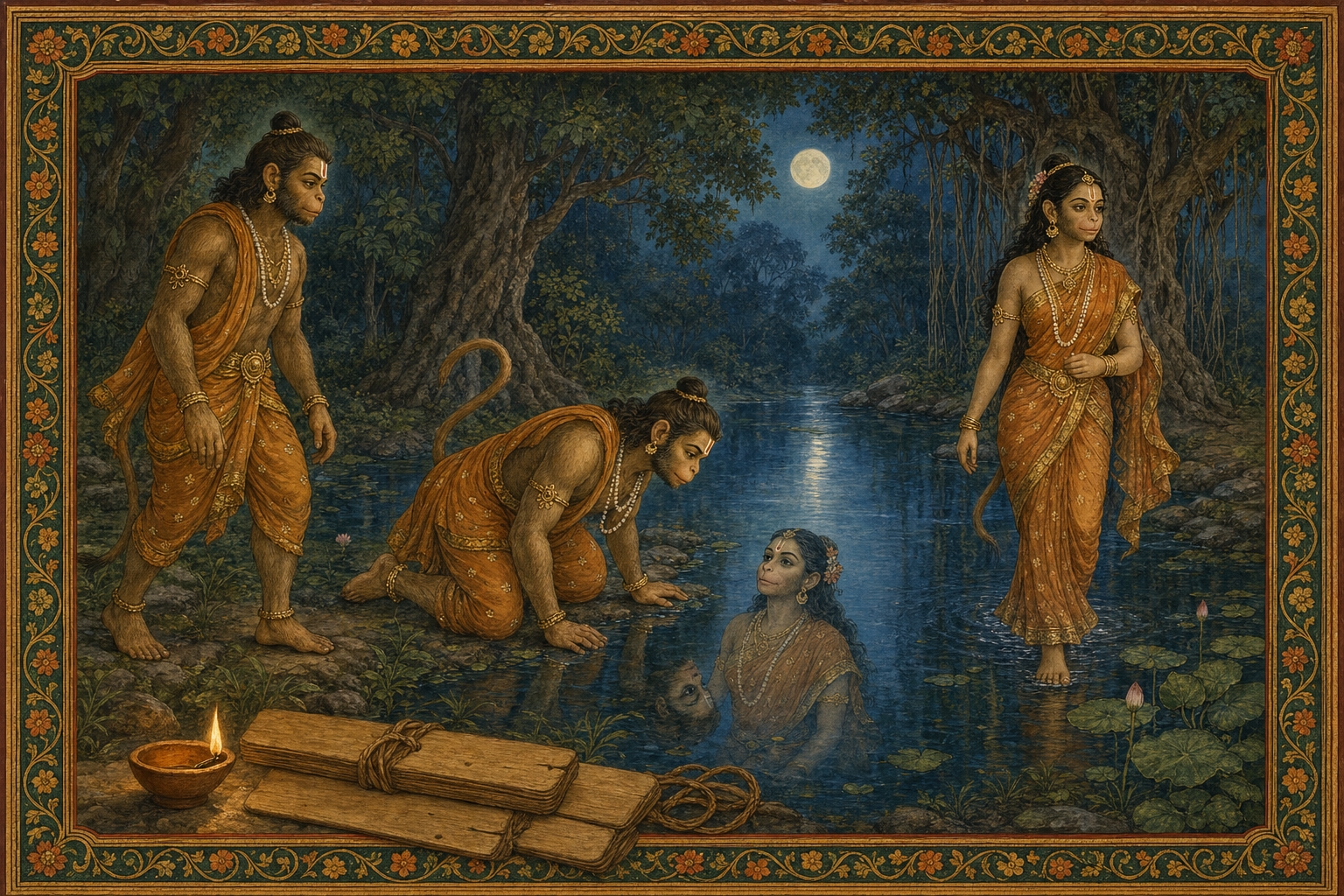
Riksharaja is born from a tear of Brahma, placing the figure’s origin within a sacred and cosmically sanctioned setting. In some tellings, an encounter with a reflective surface accompanies a change of form. The transformed Riksharaja then bears Vali and Sugriva, whose divine associations remain linked with Indra and Surya.
The sequence matters. Riksharaja is not introduced as an error outside creation that must be corrected before dharma can continue. The unusual embodiment stands inside a divinely framed genealogy and becomes the means through which two consequential vanara lives enter the world. Difference is narratively productive.
That gives gender complementarity a meaning more spacious than the familiar claim that men and women perform separate social functions. We should distinguish two uses of the term:
- Descriptive complementarity notices that qualities commonly coded as masculine or feminine can coexist, interact and contribute to a larger whole.
- Prescriptive complementarity assigns fixed duties, temperaments or social spaces to men and women.
Riksharaja offers a strong sacred image for the first idea. The same life encompasses transformation, generative embodiment, parental care and dynastic consequence. The story does not, by itself, supply a programme of fixed occupations for every man and woman. Using it to enforce such a programme would narrow the very image you are trying to interpret.
This is also why comparison with Ardhanarishvara can illuminate the account without collapsing the two figures into one. Ardhanarishvara makes the mutual presence of Shiva and Shakti visible in a single form. Riksharaja belongs to a different narrative and genealogy, yet similarly invites you to resist the assumption that masculine and feminine must always appear as isolated, competing domains.
Complementarity here is not a polite word for inequality. Nor does it mean that difference disappears. It means that distinction can exist without hostility, and unity can be real without reducing every manifestation to sameness. That is a recognisably dharmic way of handling apparent opposites: hold the tension long enough to ask what relationship, duty and balance require.
Parenthood carries more moral weight than classification
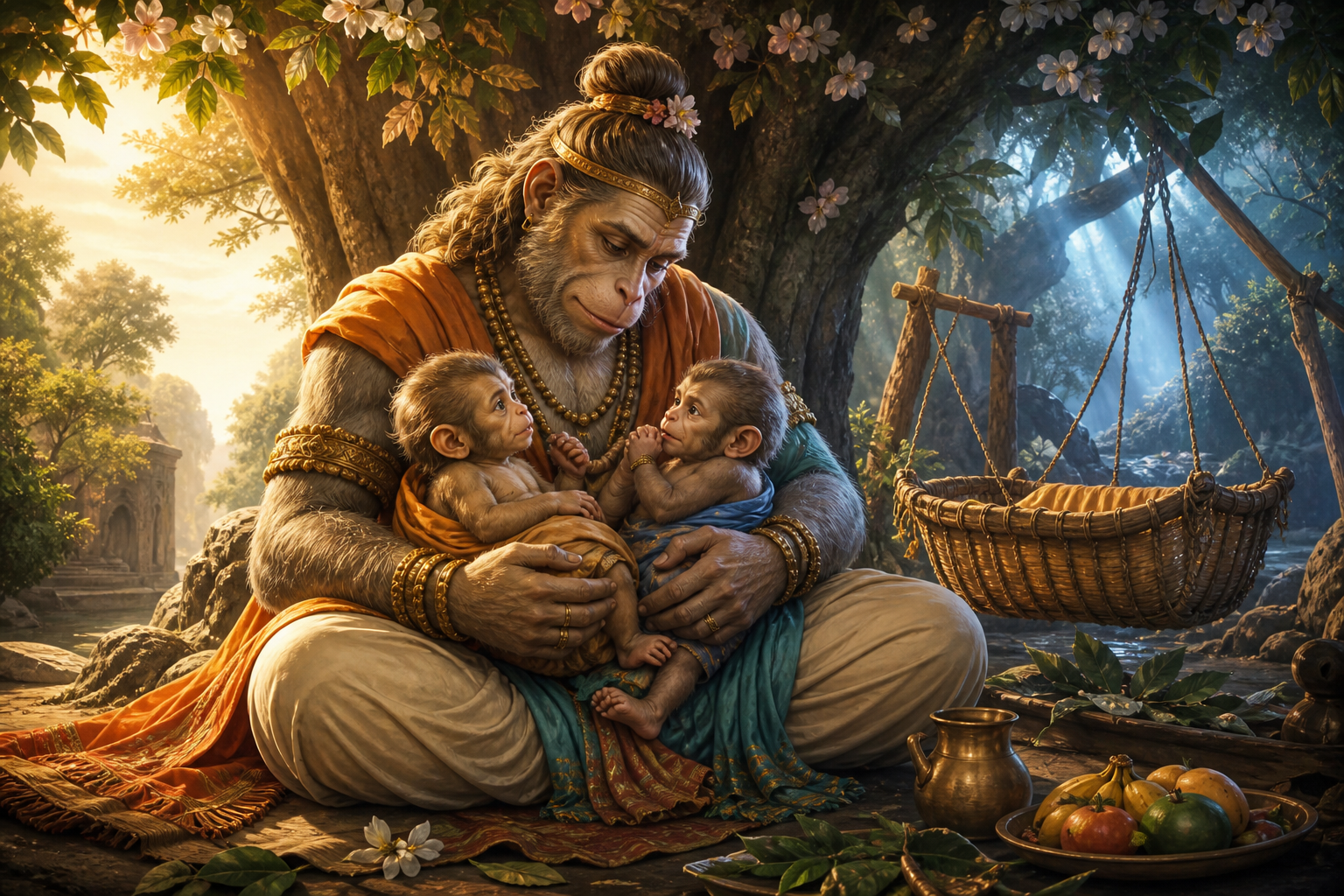
The most revealing question may not be, “Which modern label fits Riksharaja?” It may be, “What does Riksharaja do?” The figure becomes the bearer and parent of Vali and Sugriva. The genealogy therefore places nurture, continuity and responsibility ahead of the reader’s desire for a tidy classification.
That shift is practical. When a family or community encounters someone whose life does not fit its usual categories, abstract debate can become a way to avoid immediate dharma. Who has offered care? Who is owed gratitude? Who is being humiliated? Who has accepted responsibility? Which response protects dignity without denying truth? These questions do not settle every philosophical dispute, but they reveal whether the dispute is being conducted ethically.
Riksharaja’s parenthood also prevents a crude opposition between strength and nurture. Vali and Sugriva are remembered as powerful vanara figures, yet their origin depends upon a parent whose embodiment crosses an expected boundary. The genealogy does not require generative care to become weak so that heroic strength can appear strong. Each depends upon the other.
The brothers’ later rivalry adds a harder lesson. Shared origin does not automatically produce harmony. Kinship creates obligations, but it cannot replace justice, restraint or truthful judgment. If you use Riksharaja only to celebrate unity, you miss the warning contained in the family line: people born from one source can still fracture their common inheritance.
This applies beyond a household. Hindu, Buddhist, Jain and Sikh traditions remain distinct; invoking a shared dharmic civilisation should not erase those distinctions. The more responsible point is ethical. Compassion, duty, restraint and service give communities ways to live with difference without treating every difference as a threat. Civilisational kinship becomes meaningful when it changes conduct, not when it is used merely as a slogan.
Do not force an ancient figure into a modern culture war

Ancient sacred narratives and modern gender vocabularies answer overlapping but non-identical questions. It is therefore too strong to claim that Riksharaja maps exactly onto a contemporary identity. It is equally too strong to insist that the account has no relevance to gender because its language is ancient. Both moves decide the meaning before listening to the story.
A more defensible approach is to describe first and classify second. You can say that Riksharaja crosses male and female embodiment, becomes a parent through the transformed form, and occupies a legitimate place in a sacred genealogy. Those claims give you solid ground. Any further identification should be presented as an interpretation, not smuggled in as an uncontested textual fact.
Four habits will keep your use of the story honest:
- Name the textual scope. Say “some Ramayana traditions” or identify a regional or Puranic context when you know it. Do not make one variant stand for every recension.
- Preserve the narrative before extracting a message. Keep Brahma’s tear, the transformation, the parenthood and the links to Vali and Sugriva together. Removing the sacred genealogy leaves only a modern talking point.
- Mark inference as inference. Phrases such as “this can be read as” or “this resonates with” are signs of precision when a symbolic interpretation is involved.
- Test the interpretation by its ethical fruit. If your reading produces contempt, denial of dignity or a licence to caricature others, it has lost contact with the narrative’s themes of kinship and care.
This method protects the tradition from two distortions at once. It refuses the claim that Hindu sacred literature is incapable of imagining gender complexity. It also refuses to conscript every complex figure into a present-day ideology with no remainder. A capacious tradition does not need inflated claims to demonstrate its depth.
Key takeaways for a careful reading
- Riksharaja’s dual-gendered parenthood belongs to certain Ramayana-related, Puranic and regional traditions, not uniformly to every textual recension.
- The unusual embodiment occurs within a sacred genealogy rather than outside the moral universe of dharma.
- The account supports descriptive gender complementarity: masculine and feminine capacities can coexist within one life and contribute to a shared purpose.
- It does not, on its own, prove an exact modern identity or prescribe fixed social roles for all men and women.
- Parenthood directs attention toward care, responsibility and kinship, giving you an ethical test for any interpretation.
- The most faithful public language describes the variant accurately, distinguishes fact from symbolism and refuses to turn Riksharaja into a weapon against living people.
The next time Riksharaja appears in a discussion, begin with one precise sentence about the textual setting. Then ask what the figure’s parenthood requires you to notice about dignity, dependence and duty. That small discipline will take you further than either denial or overclaiming.
References
