

You watch a beautifully staged ritual, enjoy a magician’s performance, or encounter a sharply edited political clip. All three arrange perception. Only some betray the person watching. If you are wondering whether Indrajala makes every illusion suspect, or gives clever manipulation a dharmic excuse, the useful answer is neither.
The decisive question is not simply whether an appearance was shaped. You need to ask what the shaping is trying to do, what the audience reasonably expects, which truth is being concealed, and who bears the consequences. That distinction lets you appreciate wonder and sacred art without becoming careless about propaganda, coercion, or fraud.
Indrajala names a skill before it gives a moral verdict
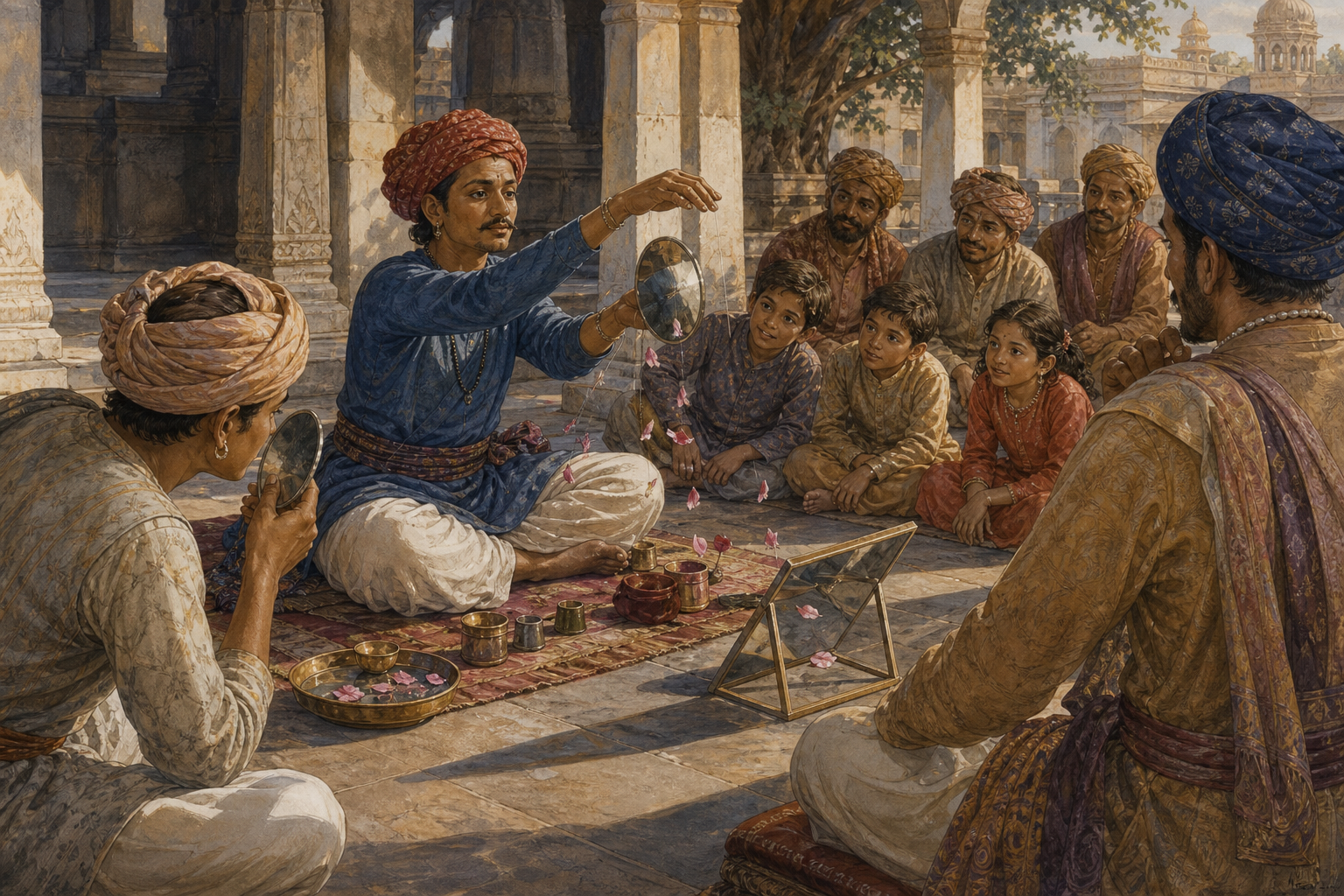
Indrajala joins Indra, understood here as dexterity or the king of the gods, with jala, a web or net. Its Sanskrit range includes conjuring, sleight, and the broader image of a net that entangles perception. It was also counted among the 64 traditional arts, or kalas. That placement matters: the tradition could treat the skill of directing attention as a disciplined art without treating every use of that skill as righteous.
Classical uses place Indrajala where performance, ritual, narrative strategy, and trained control of perception meet. The operative power is not necessarily brute force. It is the ability to arrange what another person notices, overlooks, anticipates, or fears.
That ability is morally unfinished. Technique does not bring its own ethical permission. Before judging a particular use, separate three things that are often blurred together:
- Illusion presents an appearance whose production differs from what the senses seem to report. A spectator may understand that this is the point.
- Deception tries to secure a false belief from someone who is relying on the appearance as evidence.
- Metaphor or dramatic representation presents something that is not literal so that a relationship, mood, value, or insight can become perceptible.
An actor portraying a divine or heroic figure is not ordinarily claiming to be that figure. A magician does not usually promise that the apparent impossibility is a scientific demonstration. Their audiences enter a recognisable frame. A manipulated civic message is different when it borrows the authority of evidence while hiding the editing that created its conclusion.
Begin, then, with the audience’s reasonable expectation. Do they know that perception is being playfully or artistically arranged? Or are they being induced to treat an arrangement as an unaltered record? The visible technique may be similar, but the ethical relationship is not.
Use five questions to test whether an illusion serves dharma

A dharmic appraisal of Indrajala turns on intention, consequence, self-mastery, ahimsa, and social harmony. Those principles become useful when converted into questions you can apply before performing, publishing, forwarding, or endorsing something.
- What is the real intention? Look beyond the declared purpose. Is the arrangement meant to create wonder, deepen attention, protect someone, communicate a difficult truth, win obedience, provoke fear, or secure an advantage the audience would not knowingly grant?
- Does the audience understand the frame? A person who knowingly enters a performance accepts artifice within that setting. Someone assessing a factual claim expects material evidence not to have been fabricated or rearranged beyond recognition.
- Which concealed fact would change the decision? Not every omission is deception. Every telling is selective. The warning sign is an omitted fact that would substantially alter what the audience believes, supports, condemns, or undertakes.
- Who receives the benefit, and who carries the harm? An ahimsa-oriented judgment cannot stop at the creator’s motive. Notice humiliation, panic, hostility, exploitation, and damage to communal trust, especially when those costs are shifted onto people who never accepted the performance.
- What habit is this technique cultivating? Repeated manipulation trains the manipulator as well as the audience. Ask whether the act strengthens restraint and discernment or makes domination, vanity, and convenient falsehood easier the next time.
Intention alone cannot settle the matter. A communicator may sincerely believe that frightening people is necessary for a good cause. Consequence alone is also insufficient, because a lucky result does not purify a reckless method. The stronger judgment considers motive, means, audience, foreseeable effects, and the disposition being formed through repetition.
A useful disclosure test follows from these questions: if the method became known afterward, would the audience feel merely surprised, or would they realise that their judgment had been captured under false pretences? Surprise belongs to many legitimate arts. Meaningful betrayal is evidence that the performance crossed into deception.
Indrajala also appears near discussions of strategy, including psychological tactics distinguished from physical confrontation. That does not create a general exemption for deceptive conduct. A tactic considered within conflict cannot simply be imported into worship, scholarship, journalism, commerce, or ordinary community disagreement. Context may change the moral problem; it does not abolish moral scrutiny.
Maya and Indra’s Net deepen responsibility rather than erase it

The language of illusion is sometimes misused to end an ethical discussion: everything is maya, so nothing finally matters. That move confuses suspicion about appearances with permission to mistreat the beings who encounter them. Even when perception is partial or conditioned, your choices still shape fear, trust, attachment, conflict, and suffering.
For ethical purposes, maya should make you less naive about appearances, not less responsible for consequences. It invites you to examine how an impression arose. It does not require you to pretend that the injury caused through a false impression is irrelevant.
The image popularly called Indra’s Net presents a radically interconnected web in which each facet reflects the others. Read ethically, the image frustrates the fantasy of an isolated act. A falsehood does not remain between one speaker and one listener. It alters the listener’s later choices, the trust available to a community, and the credibility of truthful speech that follows.
Hindu, Buddhist, Jain, and Sikh paths should not be flattened into one metaphysical system. Their texts, doctrines, and disciplines are not interchangeable. Yet web and net imagery can support a shared dharmic concern with perception, clarity, compassion, and responsibility. Unity here comes from asking a serious ethical question together, not from pretending that every tradition supplies the same answer in the same vocabulary.
This gives you three direct replies to common evasions:
- If someone says, Everything is illusion, so the harm is unreal, ask who is experiencing the consequences and why their suffering should be discounted.
- If someone says, The message inspires devotion, so the method is justified, ask whether devotion is being invited or manufactured by concealing a material truth.
- If someone says, The goal is dharmic, so any means may serve it, return to ahimsa, self-mastery, and the effect on communal trust. A righteous label does not automatically purify a coercive method.
This standard must apply to messages that flatter your own commitments as firmly as it applies to hostile messages. Pro-Dharma communication loses moral force when it relies on evidence its audience would reject if the editing, omission, or staging were visible. Loyalty should sharpen discernment, not suspend it.
Turn Indrajala into a daily discipline of attention

Indrajala becomes practical when you stop treating yourself as a passive spectator. The question is not only whether a message is true or false. You also need to notice how framing, order, repetition, and spectacle are steering you toward a conclusion before you have examined the claim.
When you consume a persuasive message
Before sharing an emotionally charged image, clip, speech, or religious claim, make one deliberate pass through the following sequence:
- Describe the record without its supplied interpretation. State only what you can actually see, hear, or read. Do not repeat the caption as though it were part of the evidence.
- Name the devices shaping attention. Look for cropping, sequence, dramatic presentation, selective emphasis, repetition, and emotionally loaded wording.
- Separate observation from inference. Write the literal claim in one sentence, then identify what has merely been implied about motive, identity, cause, or consequence.
- Ask what relevant context is absent. Concentrate on information that could reverse or materially qualify the conclusion, not on the impossible demand for total context.
- Identify the action being solicited. Is the message trying to make you reflect, donate, condemn, fear, vote, ostracise, or forward immediately? Urgency can be part of the perceptual arrangement.
- Choose your response deliberately. Share when the factual core survives inspection. Add a qualification when the evidence supports only a narrower claim. Decline to circulate it when the emotional force is stronger than the verifiable content.
This is discernment, not cynicism. The lesson of crafted perception is not that nothing can be trusted. It is that confidence should correspond to what has actually been established. If you cannot verify the wider claim, you can still say what the material shows and where your certainty ends.
When you create a performance or persuasive message
Ritual and theatre can use arranged perception to inspire devotion, wonder, or catharsis. Ethical practice does not require stripping sacred and artistic expression of beauty. It requires preserving the difference between meaningful representation and counterfeit evidence.
- Signal the frame. Let people know when they are encountering drama, symbolism, reconstruction, satire, or imaginative representation rather than an unaltered record.
- Do not manufacture proof. A symbolic scene may illuminate a teaching, but it should not be passed off as documentation of an event.
- Preserve the audience’s ability to step back. Avoid devices designed to prevent reflection, punish reasonable questions, or make immediate conformity the only socially safe response.
- Use the least coercive effective means. If explanation can secure understanding, fear is unnecessary. If transparent staging can produce wonder, false factual claims add moral cost without adding legitimate value.
- Keep a route for correction. If the presentation creates a materially false impression, clarify it openly rather than defending the impression because it served the intended result.
- Review the afterlife of the message. Consider how a clip, image, quotation, or performance will function after it leaves its original setting. Context understood in a temple or theatre may disappear when an extract circulates alone.
The same discipline applies to teachers, artists, activists, spiritual institutions, political communicators, and ordinary social-media users. Your medium may differ, but the ethical burden begins wherever another person’s attention becomes an instrument in your hands.
Key takeaways
- Indrajala is a disciplined capacity to arrange perception; its status as an art does not make every use ethical.
- Illusion is not automatically deception. The audience’s reasonable expectation and the concealment of decision-changing facts mark the crucial difference.
- A dharmic test considers intention, informed participation, material truth, harm, and the habits being cultivated.
- Maya is not an excuse to dismiss suffering, while the image of Indra’s Net makes the wider effects of manipulation harder to ignore.
- When consuming media, separate the observable record from its framing. When creating media or performance, preserve agency and never disguise artifice as evidence.
The next time a message captures your attention, pause before accepting either its appearance or your first reaction. Identify the frame, locate the concealed assumption, and decide whether the technique leaves you freer to understand or easier to control. Then choose what you will believe, share, create, or refuse. That small act of attention is where the ethics of Indrajala becomes lived dharma.
References
