
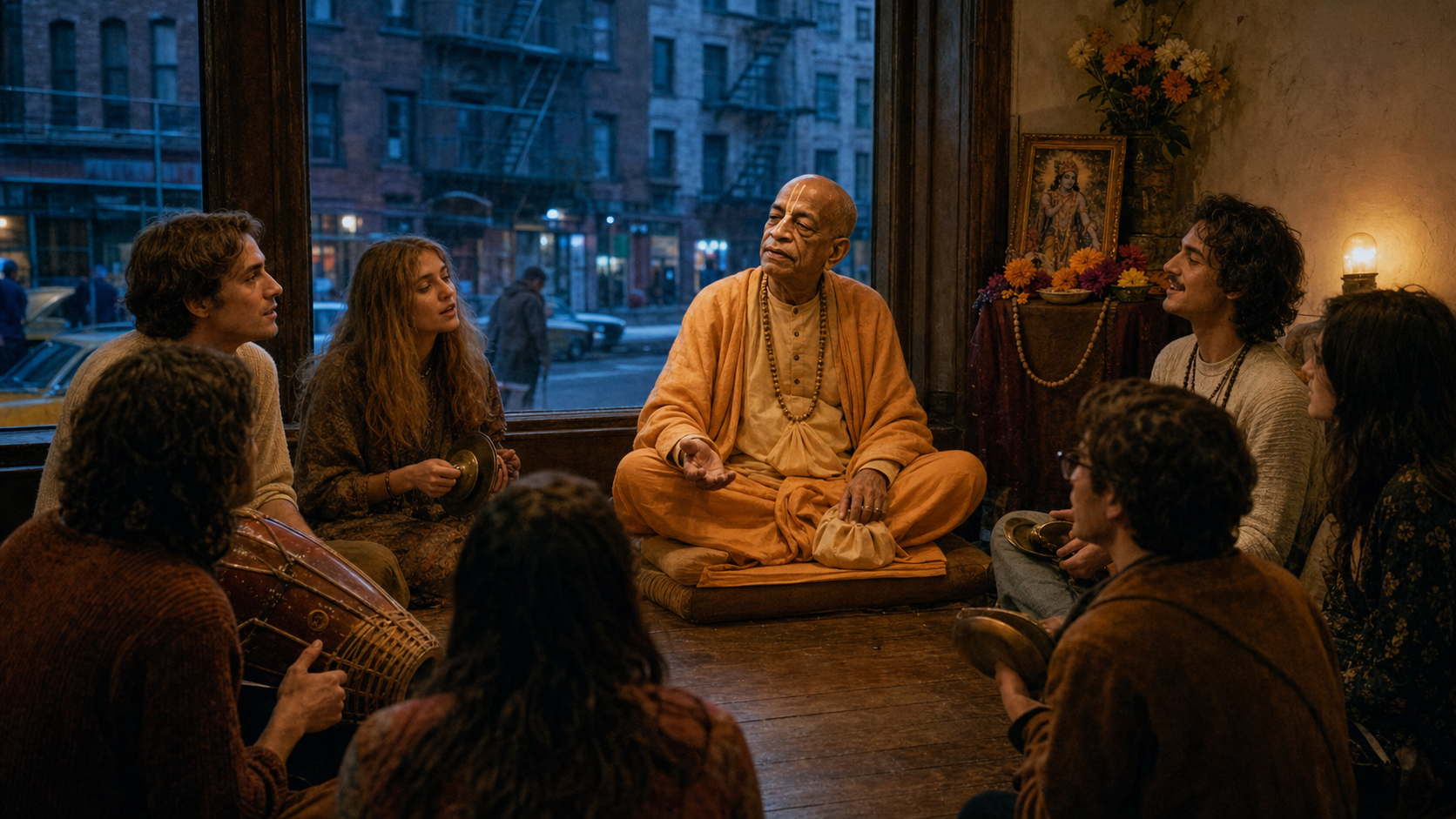
If your picture of Prabhupada’s New York begins and ends with saffron robes and public chanting, you are seeing the visible result, not the engine that produced it. The more useful question is why a traditional Krishna-bhakti discipline could take root among people who had little inherited connection to it.
The answer matters if you want to understand the Hare Krishna movement, introduce someone to bhakti without diluting it, or establish a steadier practice of your own. Prabhupada combined an open doorway with a demanding destination: chant, study, serve, and let devotion reshape how you live.
Key takeaways
- Prabhupada met a restless culture with a practice people could begin before they fully understood its philosophy.
- Chanting made bhakti immediately participatory; the Bhagavad-gita and Srimad-Bhagavatam gave that participation intellectual and theological depth.
- Service carried devotion beyond private experience into conduct, responsibility, and community.
- The method was culturally adaptable without making Krishna-bhakti vague or interchangeable with every other spiritual path.
- You can apply the same pattern by joining remembrance, reflective study, and one concrete act of service in a repeatable rhythm.
Why New York was ready for a practice, not another slogan

In the mid-1960s, A.C. Bhaktivedanta Swami Prabhupada arrived in New York by steamship from Calcutta. He entered a cultural setting populated by bohemians, beatniks, hippies, and other seekers. Music, art, communal experiments, altered states, and dissatisfaction with consumer life had loosened old assumptions. They had not necessarily supplied a durable replacement.
That distinction explains much of what followed. Cultural rebellion can clear space, but an empty space does not tell you what is true, how to discipline attention, or how to treat another person. Prabhupada offered a positive practice rather than merely agreeing that modern life was disordered. The invitation was direct: chant the Hare Krishna maha-mantra, hear Krishna’s teachings, ask questions, and begin serving.
The public doorway did not require an entrance examination. A newcomer could participate in sacred sound before mastering Gaudiya Vaishnava vocabulary. That accessibility was not the same as theological vagueness. The chanting pointed to Krishna, and the accompanying teaching supplied a definite account of devotion, the self, moral discipline, and the purpose of life.
This gives you a practical test for any spiritual movement that presents itself as accessible. Ask whether a newcomer can begin without pretending to understand everything. Then ask whether the path provides enough substance to move that person beyond novelty. Easy entry without depth becomes entertainment; depth without an entry point remains inaccessible. Prabhupada joined the two.
The method joined sacred sound, serious study, and service
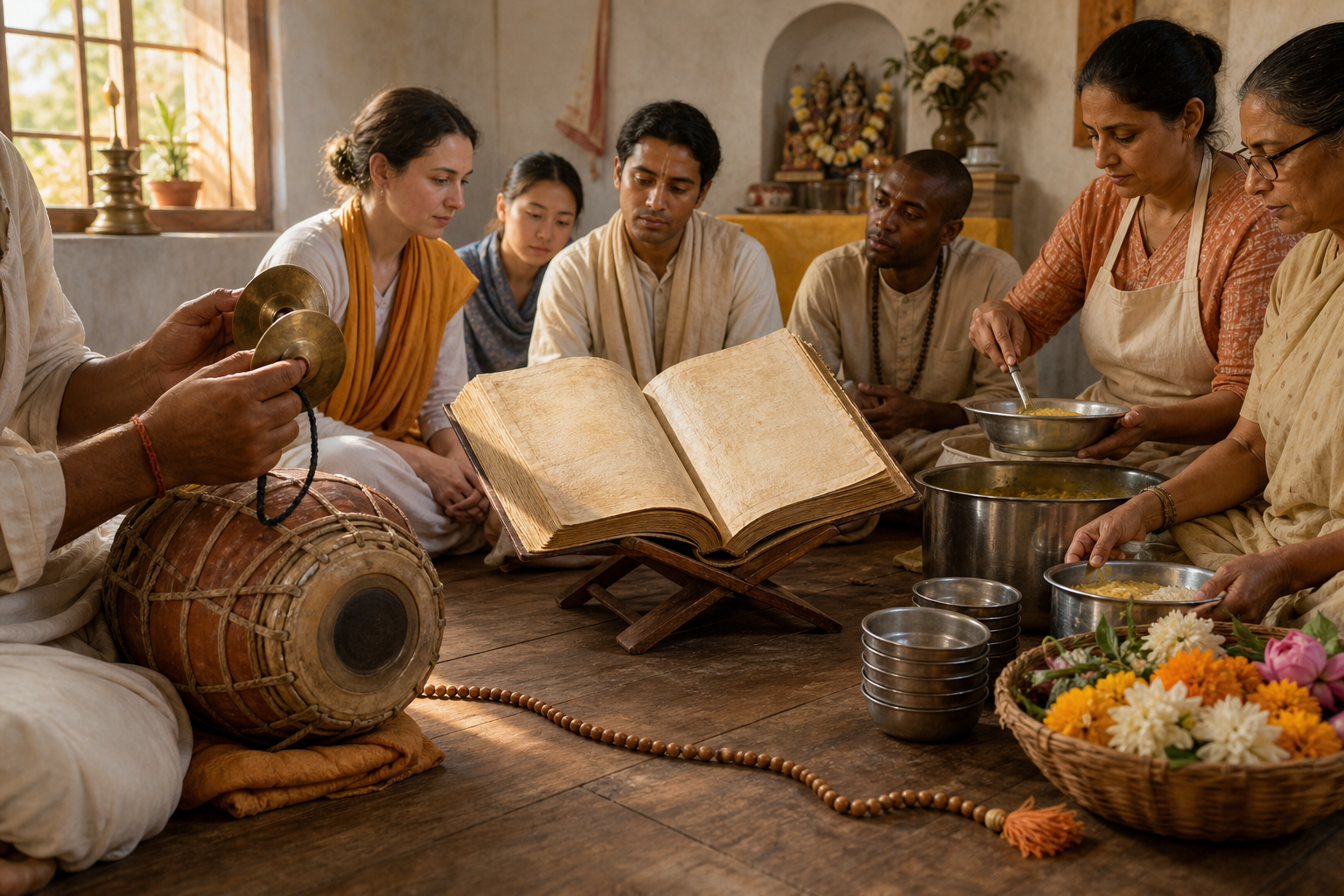
Chanting gave restless attention somewhere to return
Kirtan made the first step concrete. Instead of asking a distracted person to adopt an abstract spiritual identity, it asked that person to listen and respond. The voice, rhythm, repetition, and presence of other participants gathered attention around the divine name. When the mind wandered, the sound provided a clear place to return.
This is why chanting should not be reduced to the background music of a spiritual gathering. Its purpose is remembrance. If you chant, listen to the mantra rather than treating completion, volume, or emotional intensity as the goal. A quiet session in which you repeatedly bring attention back to the sacred name can be more disciplined than an exciting session that leaves your conduct untouched.
Scripture prevented mood from becoming the whole message
Prabhupada paired kirtan with readings from the Bhagavad-gita and Srimad-Bhagavatam. That pairing matters. Sacred sound may open the heart, but study helps the practitioner interpret the experience. It asks what devotion is directed toward, what Krishna teaches, and what obligations follow from spiritual recognition.
Without study, a person can mistake a pleasant state for realization. Without practice, study can become an accumulation of religious language. Read a short passage after chanting and identify its central claim in your own words. If you cannot state what the passage asks you to understand or do, read it again instead of rushing onward.
Service tested whether devotion had entered daily life
Bhakti did not end when the singing stopped. Compassion, responsibility, and community building gave devotion an outward form. Service turns the question from “What did I feel?” to “What am I now prepared to give, repair, or carry?” That change protects spiritual practice from becoming another form of self-absorption.
You can use the same test. After chanting and reading, choose one bounded act that another person can actually receive: keep a neglected promise, help with a community duty, prepare something needed by others, or correct a careless action. The act need not be dramatic. Its value lies in joining remembrance to responsibility.
A gentle revolution still demands real change

The gentleness of Prabhupada’s New York mission lay in its means: invitation, patient conversation, shared chanting, teaching, and service. It did not depend on coercion. The revolutionary element lay in what those means were intended to transform: attention, desire, habit, identity, and the purpose for which people formed a community.
This distinction is important because “gentle” can be misread as undemanding. Bhakti may begin with a mantra anyone can hear, but it does not end with appreciation of the music. It asks for discipline when enthusiasm fades, truthfulness when deception is convenient, nonviolence in conduct, and service when private preference points elsewhere.
The founding of ISKCON gave this pattern an enduring institutional form. A gathering could now become a community, and a community could preserve teaching and practice beyond the charisma of a single evening. Institutional durability also creates responsibility: a spiritual organization should be judged not merely by its visibility, but by whether its practices cultivate ethical conduct, informed devotion, accountable leadership, and care among its members.
Use those criteria when you assess a temple, kirtan group, or spiritual teacher. Look for room to ask sincere questions, a clear relationship between teaching and scripture, expectations that apply to leaders as well as newcomers, and service that benefits people beyond the platform. Intensity can attract a crowd. Reliability is what allows a community to carry dharma.
Dharmic kinship does not require theological sameness
Prabhupada’s use of sacred sound can be understood within a wider dharmic landscape. Hindu traditions employ mantra and nama-japa; Buddhist communities cultivate disciplined remembrance through mindfulness and, in some traditions, mantra; Jain practice includes japa; Sikh dharma gives a central place to simran. These practices share an insistence that attention must be trained rather than left at the mercy of impulse.
The resemblance should encourage conversation, not careless equivalence. Krishna-centered bhakti in Gaudiya Vaishnavism has its own object of devotion, scriptures, theology, and lineage. Buddhist, Jain, and Sikh practices arise from their own accounts of liberation, reality, authority, and disciplined life. Saying that each tradition values remembrance does not mean that every tradition means the same thing by God, self, liberation, or grace.
You can discuss dharmic unity more honestly by following a simple order. Name the practice as its own tradition understands it. Identify a genuinely shared discipline, such as remembrance, nonviolence, truthfulness, restraint, or service. Then acknowledge the doctrinal difference instead of hiding it. The result is solidarity without erasure.
That balance also clarifies Prabhupada’s cultural achievement. He did not need New Yorkers to become culturally Bengali before they could chant, yet he did not detach chanting from Krishna to make it easier to market. Adaptation occurred at the point of access. The center of the practice remained recognizable.
Build your own rhythm of chanting, study, and service

You do not need to recreate the Lower East Side to learn from it. You need a rhythm simple enough to repeat and complete enough to influence life beyond the practice period. Use this sequence:
- Choose a stable cue and place. Attach the practice to a part of the day that already occurs reliably. Put away notifications and remove the small frictions that make postponement easy.
- Chant with attention to the heard sound. Use the Hare Krishna maha-mantra aloud or softly. When attention wanders, return to listening. Do not force an emotion or treat distraction as failure; the deliberate return is part of the discipline.
- Read a short passage. Turn to the Bhagavad-gita or Srimad-Bhagavatam and ask what it says about Krishna, the self, duty, devotion, or conduct. State the central point plainly before moving on.
- Convert reflection into service. Choose a specific responsibility that can be completed, not a broad intention to become more compassionate. Let another person or your community receive a real benefit.
- Practise with others when possible. Kirtan, sacred dialogue, and shared service keep bhakti from shrinking into a private wellness technique. Choose company that welcomes serious questions and connects enthusiasm to ethical accountability.
- Examine the fruits over time. Do not judge the path by whether every session produces calm. Look for steadier attention, gratitude, truthful conduct, nonviolence, dependable service, and a clearer orientation toward Krishna.
Some practitioners describe even brief kirtan as calming or anxiety-softening, but chanting should not be presented as a replacement for needed mental-health care. Its spiritual purpose is remembrance and devotion. Any emotional benefit belongs within that larger discipline, not as a guaranteed therapeutic result.
Begin where Prabhupada began: make devotion participatory, make its meaning intelligible, and make its consequences visible in service. The next time you chant, pair the sacred sound with a passage you will think about and a duty you will actually perform. That is how bhakti moves from an inspiring moment into a way of life.
References
