
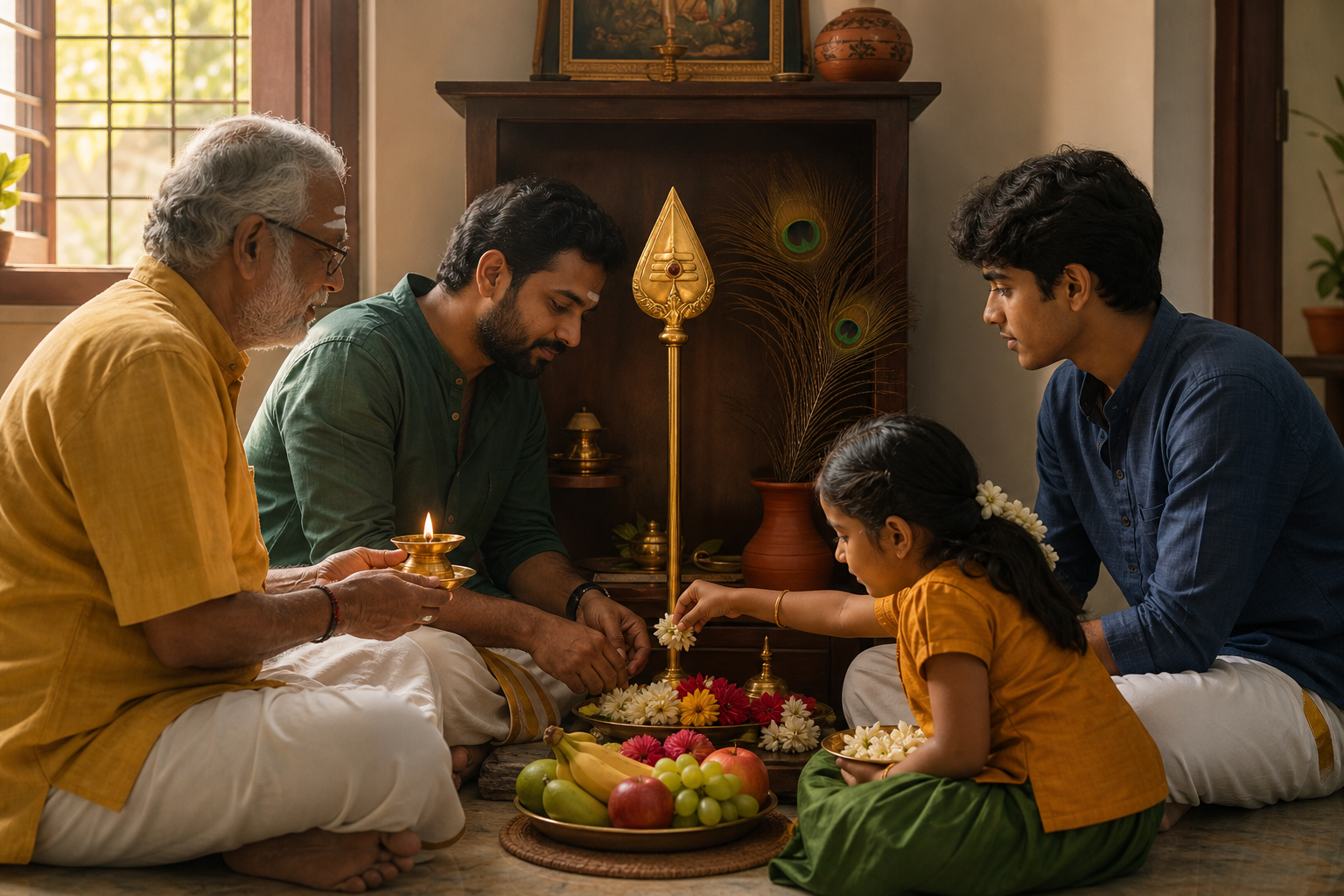
If Murugan matters in your home but Tamil is no longer the language your family reaches for first, the choice can feel harsh: simplify the tradition until it loses its texture, or insist on fluency and watch younger people disengage. You do not have to make that choice.
Treat the inheritance as a practice, not a test. A hymn heard and understood, a shrine approached with a thoughtful question, a festival joined to service, and a story received from an elder can all carry Tamil forward. The goal is not to manufacture nostalgia. It is to let language, devotion, place, and conduct reinforce one another in ordinary life.
See the whole inheritance: language, place, and devotion

Murugan is not simply a deity who happens to be popular among Tamil Hindus. His Tamil presence joins sacred language to landscape, poetry, pilgrimage, music, vows, and community memory. If you teach only the divine name, the cultural setting disappears. If you teach only cultural pride, devotion becomes an emblem rather than a relationship.
Classical Tamil literature gives you a better starting point. In Sangam literature, the kurinji mountain landscape is associated with Murugan. Mountain country is therefore more than scenery: ecology, aesthetic imagination, ethical ideals, and divine presence meet in a recognizably Tamil form. The Tirumurukāṟṟuppaṭai connects Murugan with sacred geography, showing how poetry can guide the devotee through places as well as ideas.
This relationship gives you a practical way to teach identity. Do not begin with the broad question, “What does Murugan represent?” Begin with things a learner can notice: What landscape appears in the verse? Which Tamil name is being spoken? Which shrine is remembered? What quality does the prayer ask you to cultivate? These questions turn heritage from a slogan into a field of attention.
The six sacred abodes offer a natural map for that learning: Palani, Tiruchendur, Swamimalai, Pazhamudircholai, Thiruthani, and Thiruparankundram. Make a family or classroom heritage map with those names. For each shrine, leave space for the correct pronunciation, a hymn or remembered narrative, a festival or ritual connection, and a family memory. Do not rush to fill every space from an unsourced internet summary. Let temple instruction, careful reading, pilgrimage, and conversations with knowledgeable elders supply the entries over time.
Murugan’s Tamil character also does not require you to deny his wider place in Sanatana Dharma. Kartikeya and Skanda are familiar names in Sanskritic traditions, and Tamil traditions have interacted with materials such as the Skanda Purana. Teach the names together, but do not use one to erase the texture of another. A learner can understand that Murugan belongs to a wider pan-Indic sacred world while also recognizing that Tamil poetry, geography, and worship have developed a distinctive intimacy with him.
Build Tamil through sound, meaning, and disciplined return
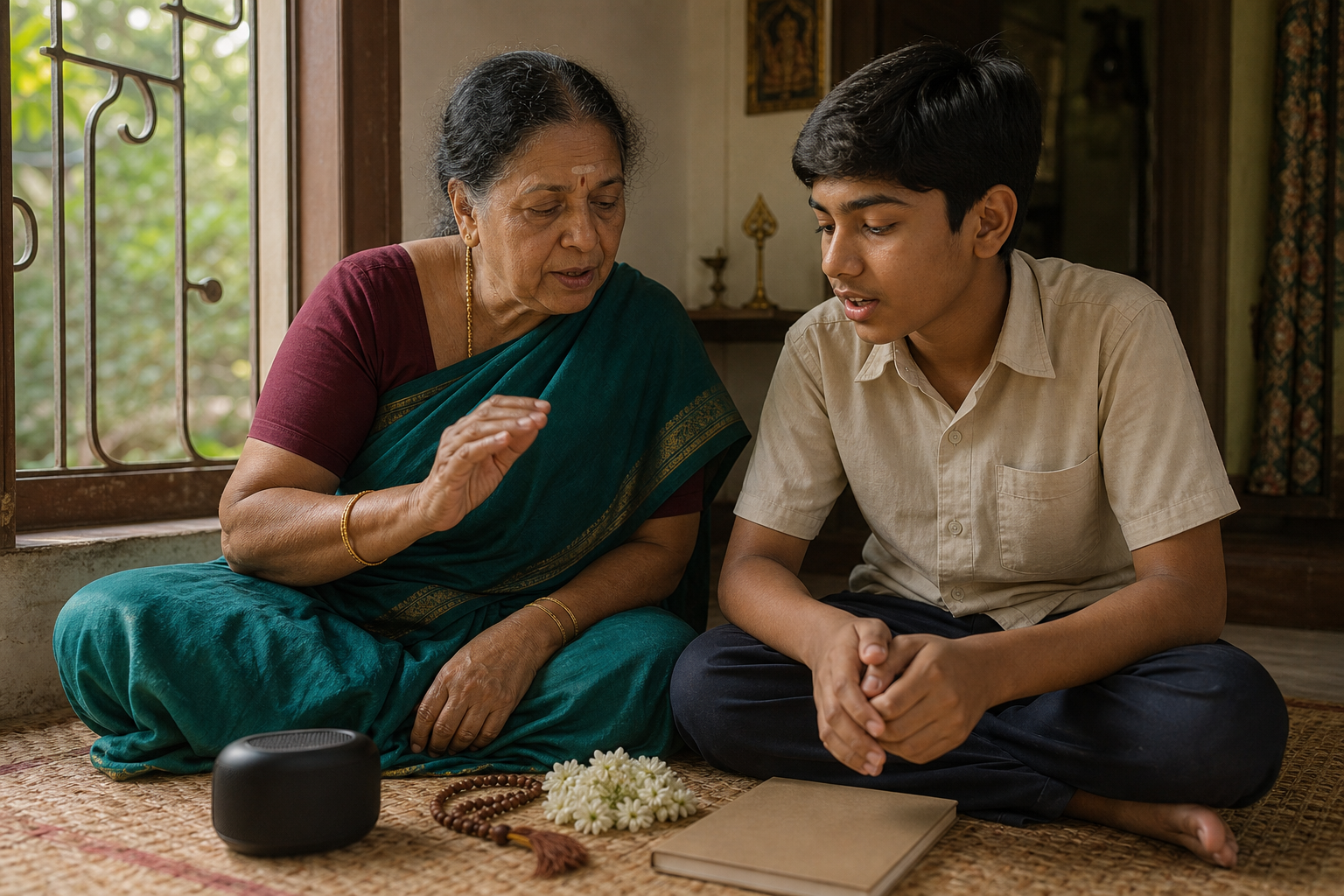
Many heritage-language efforts begin with vocabulary lists or a demand to speak fluently. Murugan devotion offers another entrance: meaningful sound. The complex prosody of Arunagirinathar’s Tiruppugazh is not decorative packaging around a religious message. Rhythm, pronunciation, image, and meaning work together. Recitation can therefore become both language learning and sadhana.
That does not mean asking a beginner to imitate a recording without comprehension. Sound without meaning can become borrowed performance; meaning without attention to sound loses much of what Tamil devotional poetry is doing. Keep the two together with a simple learning sequence:
- Choose a short passage from Tiruppugazh or Tirumurukāṟṟuppaṭai with a dependable Tamil text and guidance from a competent teacher, temple singer, or knowledgeable practitioner.
- Listen for phrase boundaries and repeated sounds before trying to recite at full pace.
- Speak the passage slowly enough to preserve pronunciation. Speed is not evidence of understanding.
- Write the Tamil script alongside transliteration if the learner still needs it. Treat transliteration as a bridge into the script, not as a reason to abandon the script.
- Add a plain-language meaning. Then identify the image, place, virtue, or devotional movement carried by the words.
- Return to the same passage during worship or family observance. Repetition in a meaningful setting is what turns a lesson into memory.
A useful learning sheet should answer practical questions rather than merely reproduce lyrics. What is the Tamil text? How is it pronounced? What does it mean in direct language? Which image or quality deserves attention? Where does your family or community use it? If nobody can yet answer the last question, ask at the temple instead of inventing a context.
Do not turn pronunciation into a purity test. Correct gently, explain why a sound matters, and let the learner try again. Humiliation makes the language feel like a guarded border. Patient precision presents it as an inheritance worth entering. At the same time, encouragement should not become indifference: playing Tamil hymns in the background is not the same as learning to hear, pronounce, and understand them.
This method also works when adults in the household have partial Tamil. The parent does not need to pretend to be the final authority. Learning the passage with the child, checking pronunciation with someone qualified, and recording the meaning in clear language models a valuable Dharmic discipline: receive carefully, practise humbly, and transmit honestly.
Turn temples and festivals into cultural apprenticeship
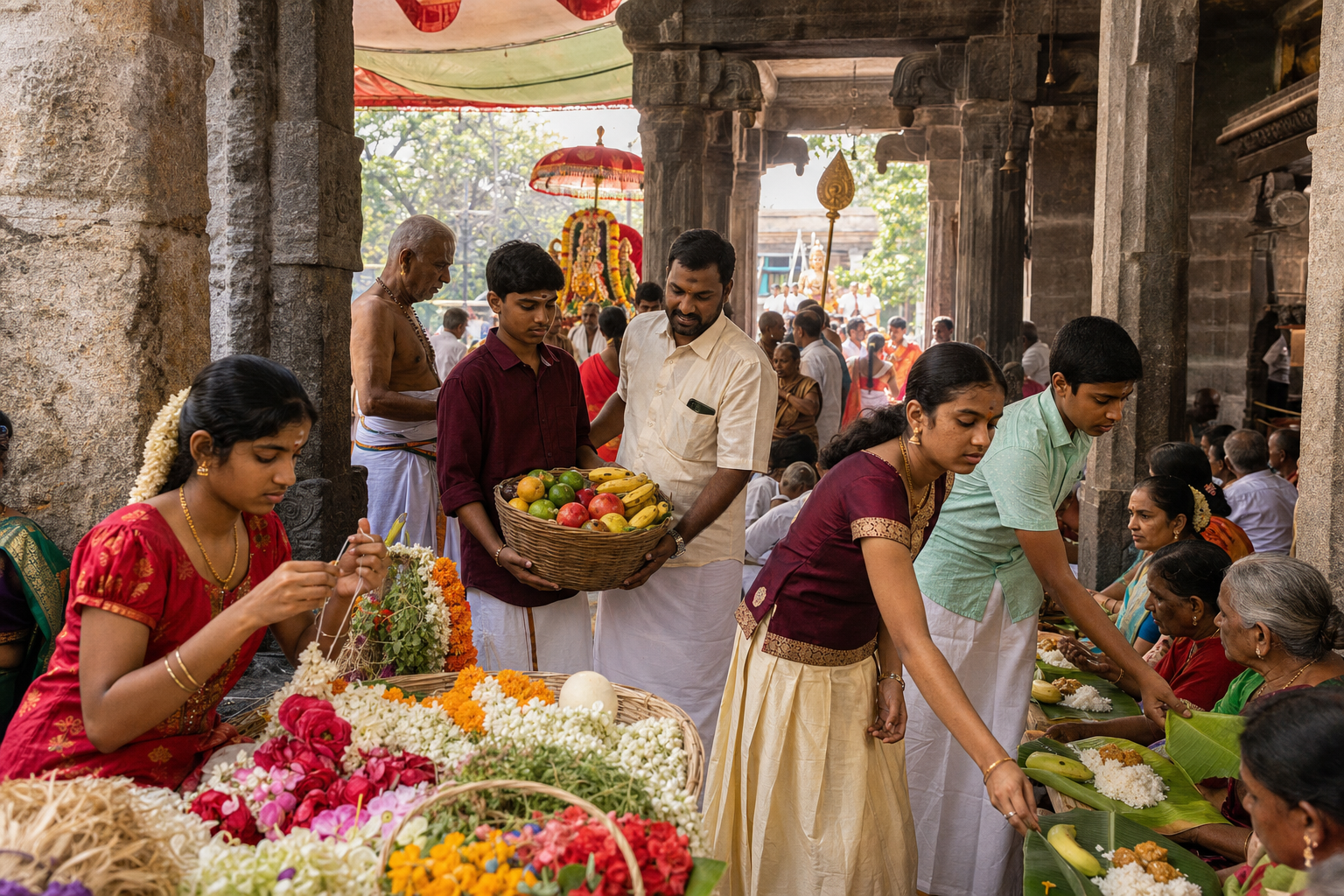
A Murugan temple is not only a destination for darshan. Its inscriptions, ritual calendar, oral histories, architecture, and music can preserve forms of knowledge that a household cannot sustain by itself. Pilgrimage becomes more formative when you arrive as a learner rather than as a collector of photographs.
Before visiting a shrine, learn to say its Tamil name and prepare a question connected to its worship, history, music, or local memory. At the temple, listen to how the deity and place are named. Notice whether inscriptions, songs, festival notices, or architectural features carry Tamil into public sacred life. Ask a temple guide, priest, singer, or informed community member which practices are particular to that shrine. Afterward, add what you learned to your heritage map and connect it to a hymn, story, or family conversation.
This approach matters even when pilgrimage to the six sacred abodes is not possible. A local Murugan temple in the Tamil diaspora can still hold processions, kirtan, Tamil hymns, service activity, and oral memory. The question is not whether it reproduces every feature of a temple in Tamil Nadu. Ask whether it gives people a disciplined way to hear the language, participate in worship, learn from elders, and serve together.
Festivals such as Skanda Sashti and Karthigai Deepam carry the same educational potential. Do not let the calendar entry be the entire lesson. Before participating, find out which vow, narrative, hymn, or ethical quality organizes the observance in your community. During it, give younger members something to listen for or do. After it, ask what the practice demanded of the participant, not merely whether the event was enjoyable.
Kavadi attam and Mayil Attam should receive the same care. Their inherited associations with penance, grace, and the peacock as Murugan’s vahana cannot be preserved by costume and movement alone. If you present these arts, connect the performance to its devotional meaning, Tamil vocabulary, and community setting. Learn from practitioners who understand the form. Vows or acts of penance should follow competent family or temple guidance; they should not be copied for spectacle.
A good festival programme lets you identify three living layers: Tamil is heard and explained, devotion leads to disciplined participation, and the gathering creates an avenue for seva. When one layer is missing, you know what to strengthen. Add a short explanation before a hymn, a conversation with an elder after a procession, or a service responsibility connected to the observance. Small structural choices can prevent a festival from becoming a stage show that spectators consume and forget.
Give the next generation a role, not another lecture
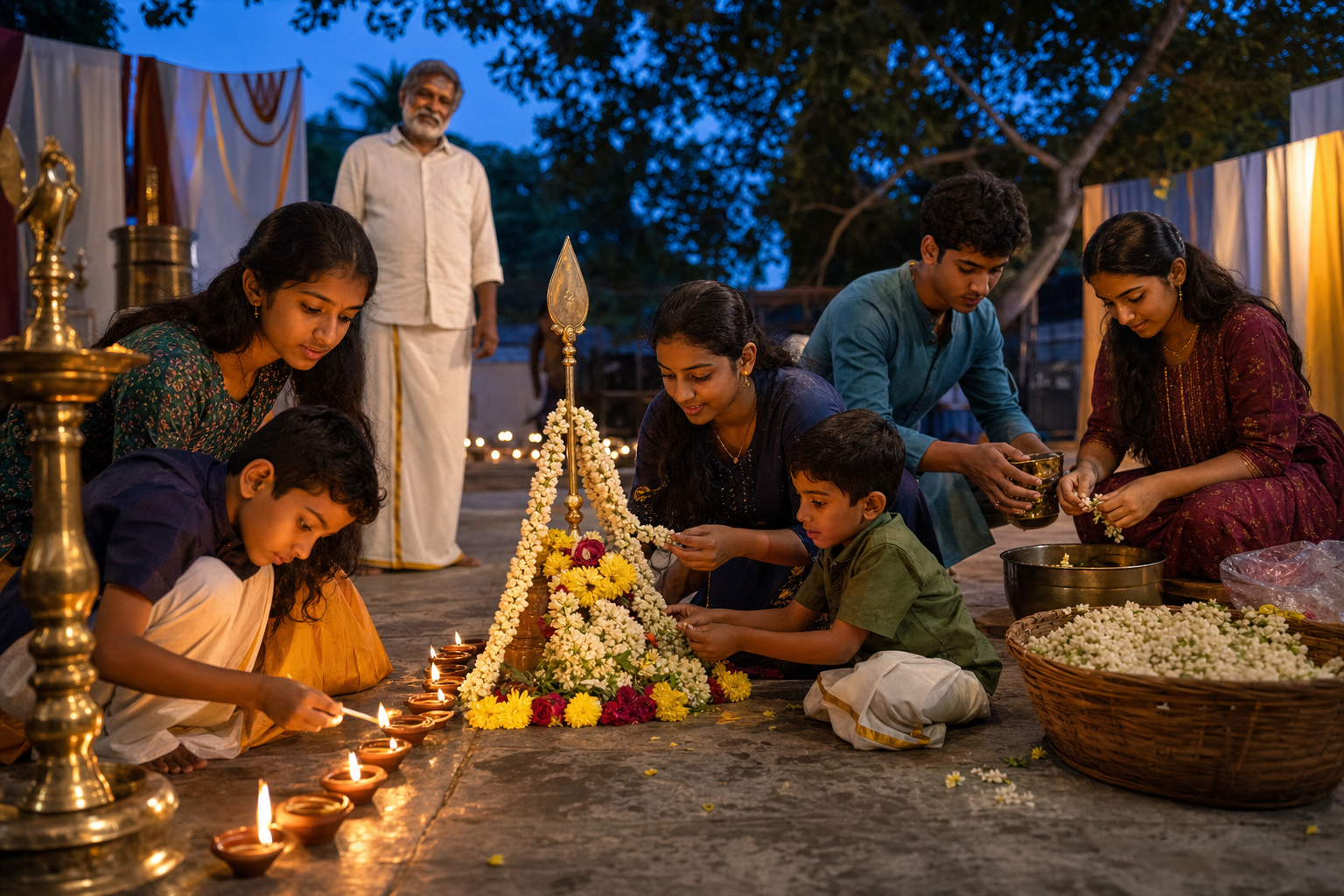
Young people seldom inherit a living tradition by being told that it is important. They inherit it by becoming responsible for something inside it. Choose roles by readiness, interest, and skill rather than assuming that every learner must enter through the same door.
- A beginning learner can practise a Murugan name, recognize it in Tamil script, and connect it with a shrine or devotional image.
- A developing reader can prepare a page containing Tamil text, transliteration, and a plain meaning for family use.
- A confident singer can learn a short Tiruppugazh passage from a qualified guide and help others follow its phrasing.
- A curious researcher can document a temple inscription, ritual calendar, or oral history while clearly recording where the information came from.
- An artist can study Kavadi attam or Mayil Attam in its devotional context rather than borrowing the appearance of the form.
- An organizer can link a Murugan observance with seva, making benevolence part of the event rather than an optional addition.
Real responsibility changes the family conversation. Instead of asking, “Why do you not care about our culture?” you can ask, “Which part would you like to learn well enough to help carry?” The answer might be music, language, temple history, visual art, pilgrimage planning, or community service. Each route can lead back to the same sacred bond if it remains connected to Tamil meaning and Murugan devotion.
Keep standards, but make them visible and attainable. A cultural presentation should use Tamil as more than decoration. A recitation should include meaning. A story should distinguish family memory from verified temple history. A dance should acknowledge its devotional setting. A service project should be carried out, not merely announced. These are concrete signs of integrity; vague appeals to authenticity are not.
Murugan’s associated virtues also give you a way to connect identity with conduct. Knowledge should produce greater clarity, courage should remain guided by dharma, and strength should make room for benevolence. This keeps heritage from shrinking into ancestry alone. The test is not simply whether a learner can name Murugan, but whether the practice shapes speech, responsibility, humility, and service.
In a wider Dharmic setting, you can discuss resonances with Hindu, Buddhist, Jain, and Sikh commitments to disciplined speech, compassion, inner courage, ahimsa, or seva without pretending that all traditions have identical theology. Shared ethical language can support mutual respect. Distinct histories and doctrines should still be named accurately. Unity becomes more credible when it does not require flattening difference.
Key takeaways
- Teach Murugan through the relationship among Tamil language, sacred place, poetry, worship, and conduct, not through isolated facts.
- Use Tiruppugazh or Tirumurukāṟṟuppaṭai as a practice of sound and meaning. Accurate recitation and clear understanding should grow together.
- Approach Palani, Tiruchendur, Swamimalai, Pazhamudircholai, Thiruthani, and Thiruparankundram as sources of learning, not items on a travel checklist.
- At festivals and performances, connect the visible form to its vow, song, devotional meaning, and opportunity for seva.
- Give each learner a genuine responsibility suited to their readiness, then help them carry it with accuracy and humility.
- Use pan-Indic names and connections to widen understanding without erasing Murugan’s distinctive Tamil literary and cultural life.
Start at the next real point of practice. Choose a short hymn passage, learn how to pronounce and explain it, connect it with a shrine or observance, and give someone in your household responsibility for carrying it forward. Living heritage survives through this kind of attentive return: language spoken with purpose, devotion expressed through conduct, and memory entrusted to another person.
References
