
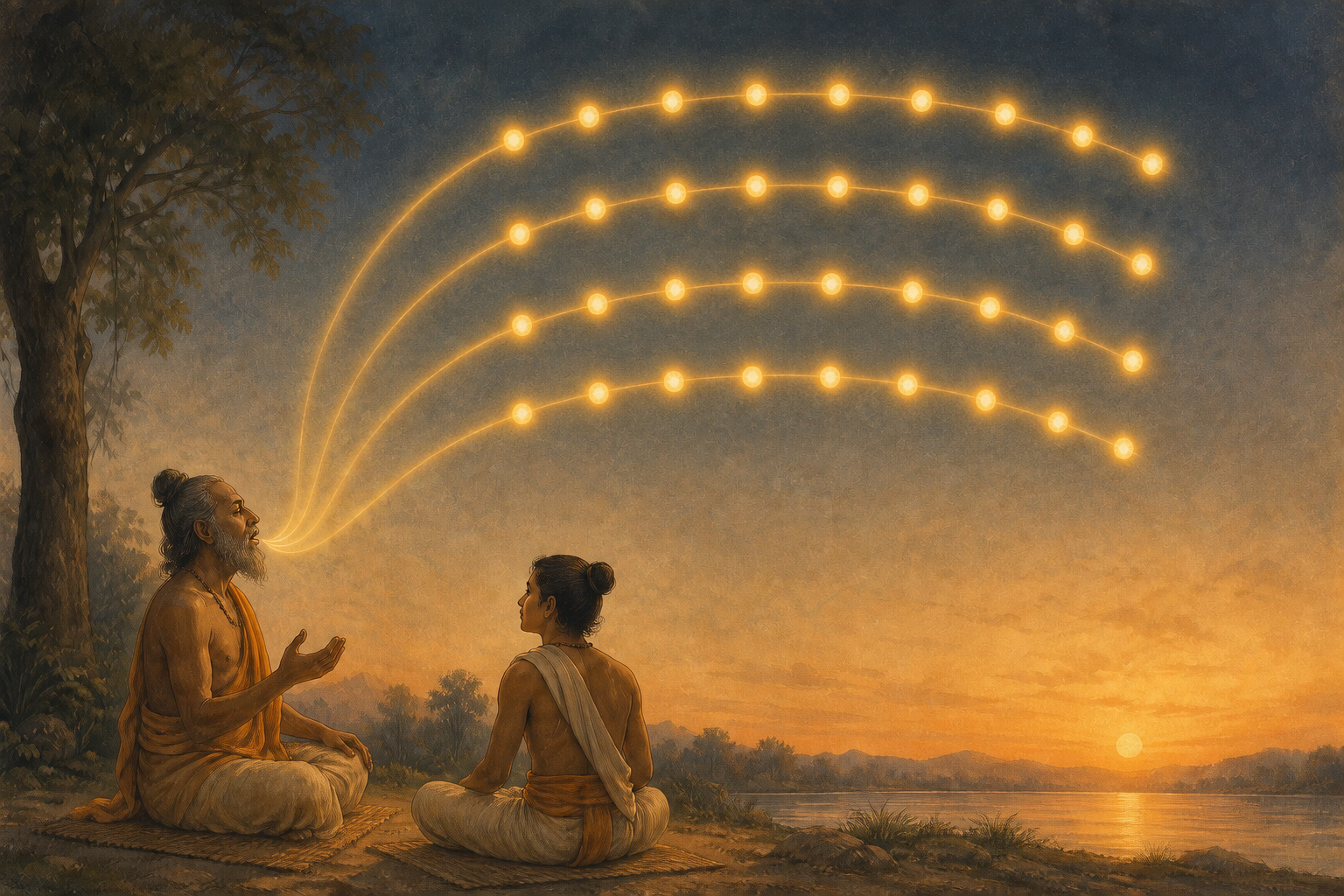
You have a Vedic stanza identified as Brhati, but the label alone does not tell you what to listen for. Printed line breaks can mislead you, transliteration can distract you, and a correct total can still conceal a badly divided stanza.
The dependable approach is to work from recited syllables, one pada at a time. Once the count is secure, you can hear how Brhati gives sacred speech room to expand without acquiring the longer sweep of the larger Vedic meters.
The count that anchors Brhati
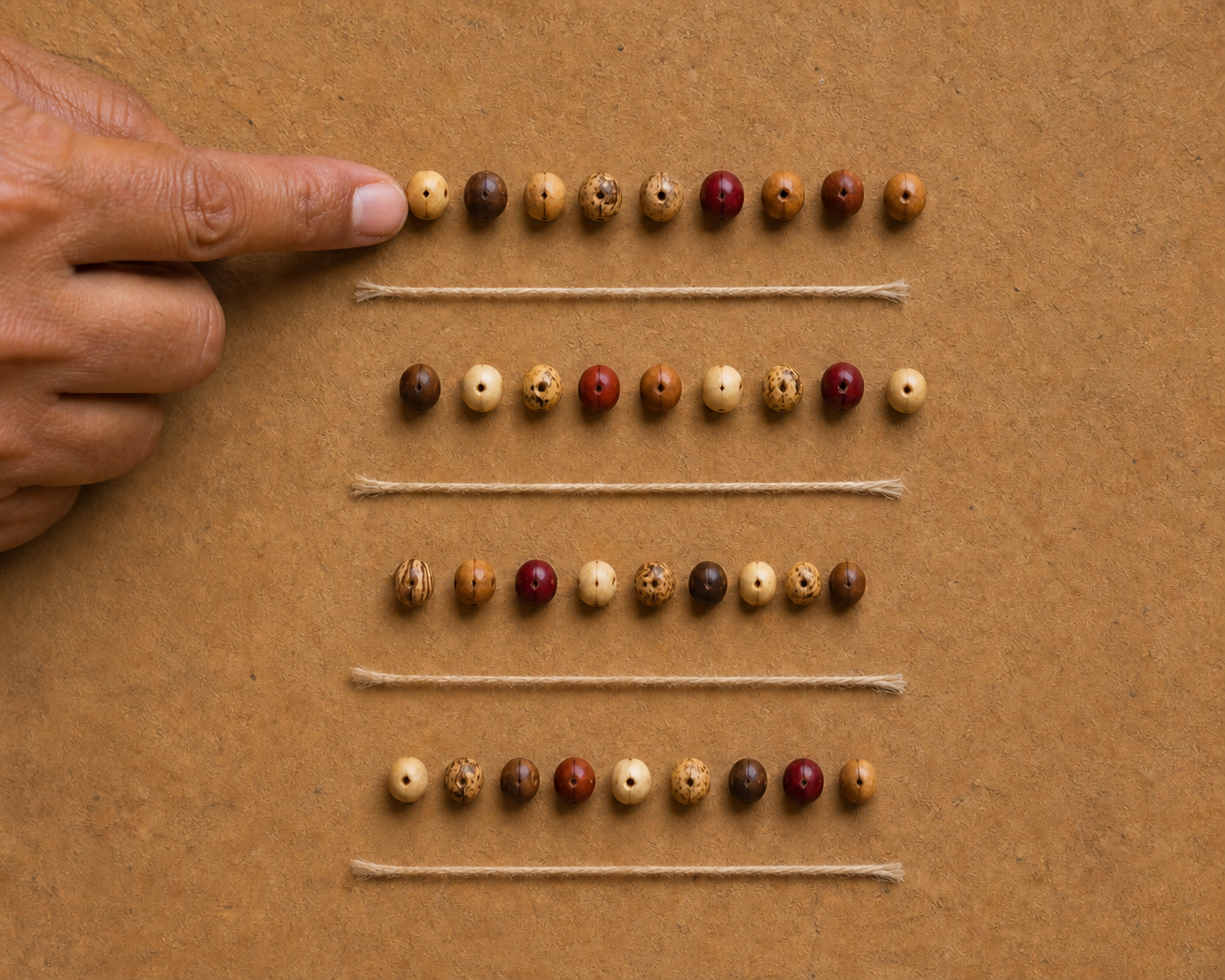
For practical recognition, Brhati consists of 36 syllables arranged as four padas of nine syllables each:
9 + 9 + 9 + 9 = 36
A pada is a metrical quarter. It is not necessarily identical to a line on a webpage or in a modern printed edition. A publisher may wrap one pada across two visual lines, or place more than one pada on the same line. Preserve the received pada divisions before you begin counting.
Count syllables, not words, letters, or consonants. As a first pass, mark each pronounced vowel nucleus. A diphthong forms one nucleus, while a consonant cluster, anusvara, or visarga does not create an additional syllable by itself. The sounded form matters because Sanskrit spelling and sandhi can make a passage look more crowded or more compact than it is when recited.
The name Brhati, more precisely written Bṛhatī, is connected with bṛhat, meaning great or vast. That is a useful mnemonic for its character: it is broader than the familiar 32-syllable Anustubh, but it remains more contained than Tristubh or Jagati. The name can help your ear remember the effect, but the syllable count establishes the identification.
Do not confuse syllable count with the separate question of laghu and guru, the light and heavy quantities examined in Sanskrit prosody. Begin with the architecture of the stanza. Only after you have confirmed the four padas should you study quantity, accent, and finer rhythmic behavior. Trying to solve every layer at once is a common way to lose the basic metrical shape.
A reliable way to scan a Brhati stanza
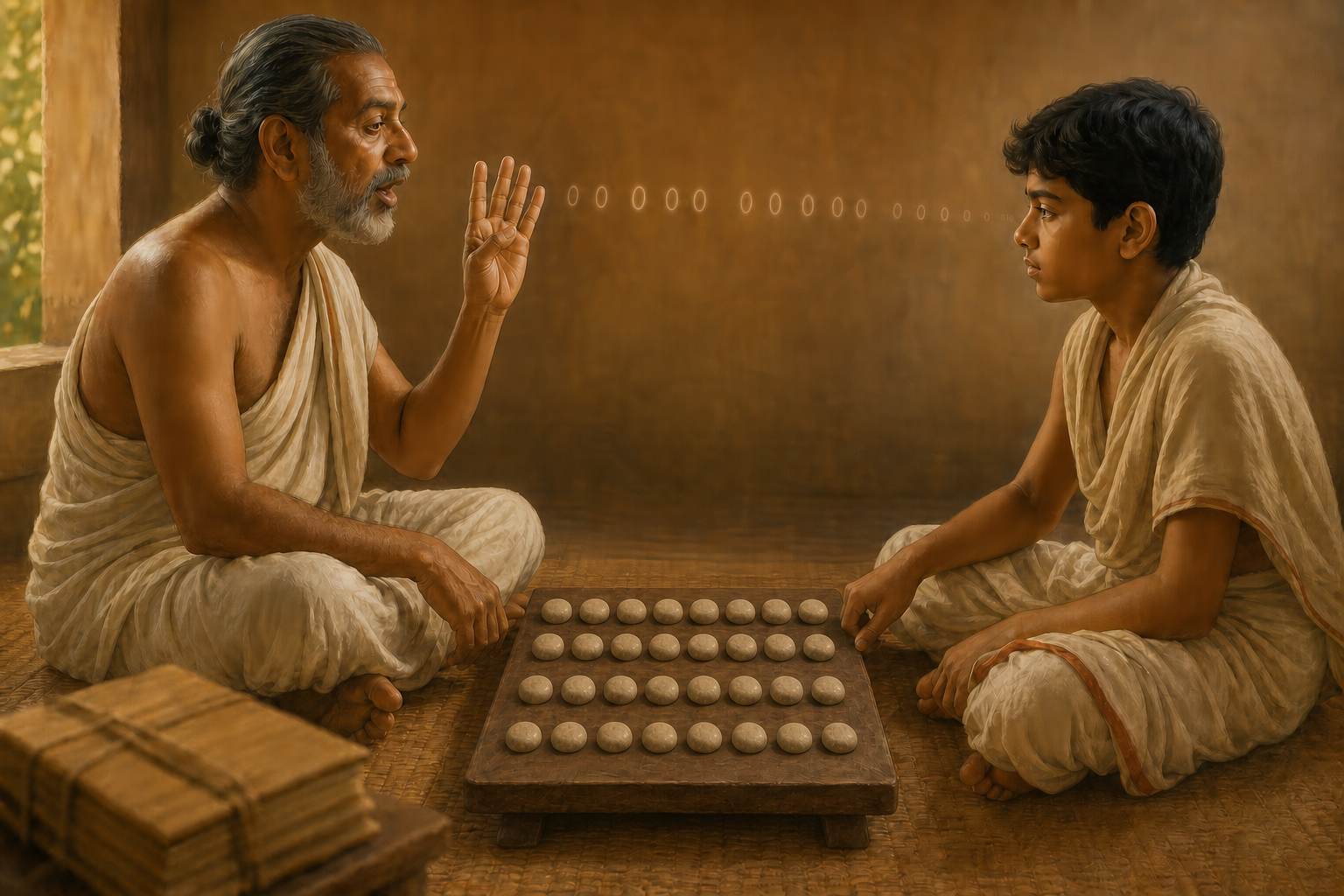
- Locate the pada boundaries. Use the divisions supplied by a reliable edition or recitational tradition. Do not infer them from screen width or punctuation alone.
- Read each pada aloud without counting. This gives you its natural words, joins, and cadence before numbers begin to dominate your attention.
- Mark the sounded vowel nuclei. Work from pronunciation rather than the visual length of the written word. Treat this as a first-pass scan, especially where sandhi or Vedic pronunciation creates uncertainty.
- Number the syllables within each pada. Start again from one at every quarter and look for nine. Counting the full stanza in one uninterrupted sequence can hide a misplaced boundary.
- Confirm the whole structure. Four successful nine-syllable padas should produce the 36-syllable stanza. The quarter-by-quarter result is more informative than the total alone.
- Recite again without the numbers. Notice where words conclude, where the syntax continues across a boundary, and where the additional syllabic space gives the utterance a forward lift.
If a pada falls short or runs long, do not immediately stretch a vowel, swallow a sound, or move the boundary to make the arithmetic work. Check the printed division, the effects of sandhi, the textual reading, and the received pronunciation. If the difficulty remains, take the passage to a qualified teacher. Meter is a diagnostic aid; it is not permission to rewrite the recitation.
A useful practice sheet has one pada per line, enough room beneath every word to mark its syllables, and a separate place for meaning. Keeping sound and translation visible together prevents scanning from becoming empty arithmetic.
How Brhati differs from nearby Vedic meters
Brhati becomes easier to recognize when you place it in the numerical ladder of the principal meters. The relevant totals are 24, 32, 36, 40, 44, and 48 syllables.
| Meter | Total syllables | Practical listening cue |
|---|---|---|
| Gayatri | 24 | Compact and quickly resolved |
| Anustubh | 32 | Shorter than Brhati and closely associated with the later classical sloka |
| Brhati | 36 | Measured breadth without the longer sweep of the larger meters |
| Pankti | 40 | More extended than Brhati |
| Tristubh | 44 | More spacious and a major working meter of the Rigveda |
| Jagati | 48 | The most expansive of this comparison |
This comparison is most useful as an elimination tool. If a stanza feels more ample than Anustubh yet does not sustain the reach of Tristubh, Brhati becomes a reasonable possibility. You must still count. Cadence suggests the answer; metrical structure verifies it.
The contrast with Anustubh deserves special attention. Familiarity with classical Sanskrit verse can train your ear to expect the 32-syllable sloka. A Brhati stanza gives you additional room, and that difference can feel like a subtle continuation beyond the point where the shorter cadence would normally settle. Do not compress that space merely because the Anustubh rhythm feels more familiar.
What the meter contributes to recitation and meaning

Brhati occurs in the Rigveda and other Vedic Samhitas, including hymnic settings of praise and invocation. Its nine-syllable quarter can maintain momentum while leaving enough space for a phrase to develop. That does not mean every Brhati stanza has one theme or emotional color. Meter shapes the vehicle of expression; it does not mechanically determine the meaning.
To see what the form is doing, read the meaning of a pada before reciting it. Then mark where its important word or grammatical turn falls within the nine-syllable movement. You may notice that the quarter carries a thought slightly farther than a compact cadence would, or that a word receives emphasis because of its position near a boundary. This is where scanning begins to serve interpretation.
Vedic tradition also places chandas within a larger understanding of order, measure, and ṛta. The relationship is more disciplined than decorative symbolism: sacred speech is given a repeatable form, and that form supports faithful memory and performance. Brhati’s breadth matters because it remains measured. Vastness is not looseness.
The form remains part of teaching in Veda pāṭhaśālās and śrauta and gṛhya recitational settings. Recordings and digital archives can help you hear the cadence repeatedly, but they do not settle every question of accent or pronunciation. Use them to train recognition; use a received teaching tradition when exact recitation is the goal.
Brhati is specifically Vedic, while the discipline of chandas belongs to a wider Indic intellectual inheritance. Works such as Pingala’s Chandaḥśāstra helped systematize the study of meter, and disciplined attention to sound and form became part of Hindu, Buddhist, and Jain literary cultures. Keep the distinction clear: a shared prosodic heritage does not make every meter function identically in every Dharmic tradition.
Key takeaways
- Use four padas of nine syllables, totaling 36, as the practical recognition pattern for Brhati.
- Count pronounced syllables rather than words, letters, or the visual length of a printed line.
- Verify every pada separately; a correct total cannot repair incorrect quarter divisions.
- Use cadence to form a hypothesis and syllable count to confirm it.
- Study meaning, word boundaries, quantity, and accent only after the basic metrical architecture is secure.
- Do not change a received recitation merely to force your first count to fit.
The next time you meet a stanza marked Brhati, make a pencil scan of its four padas and then put the pencil down. Recite it once more without counting. The immediate task is accurate identification; the longer aim is to let the measured breadth become something you can hear.
References
