
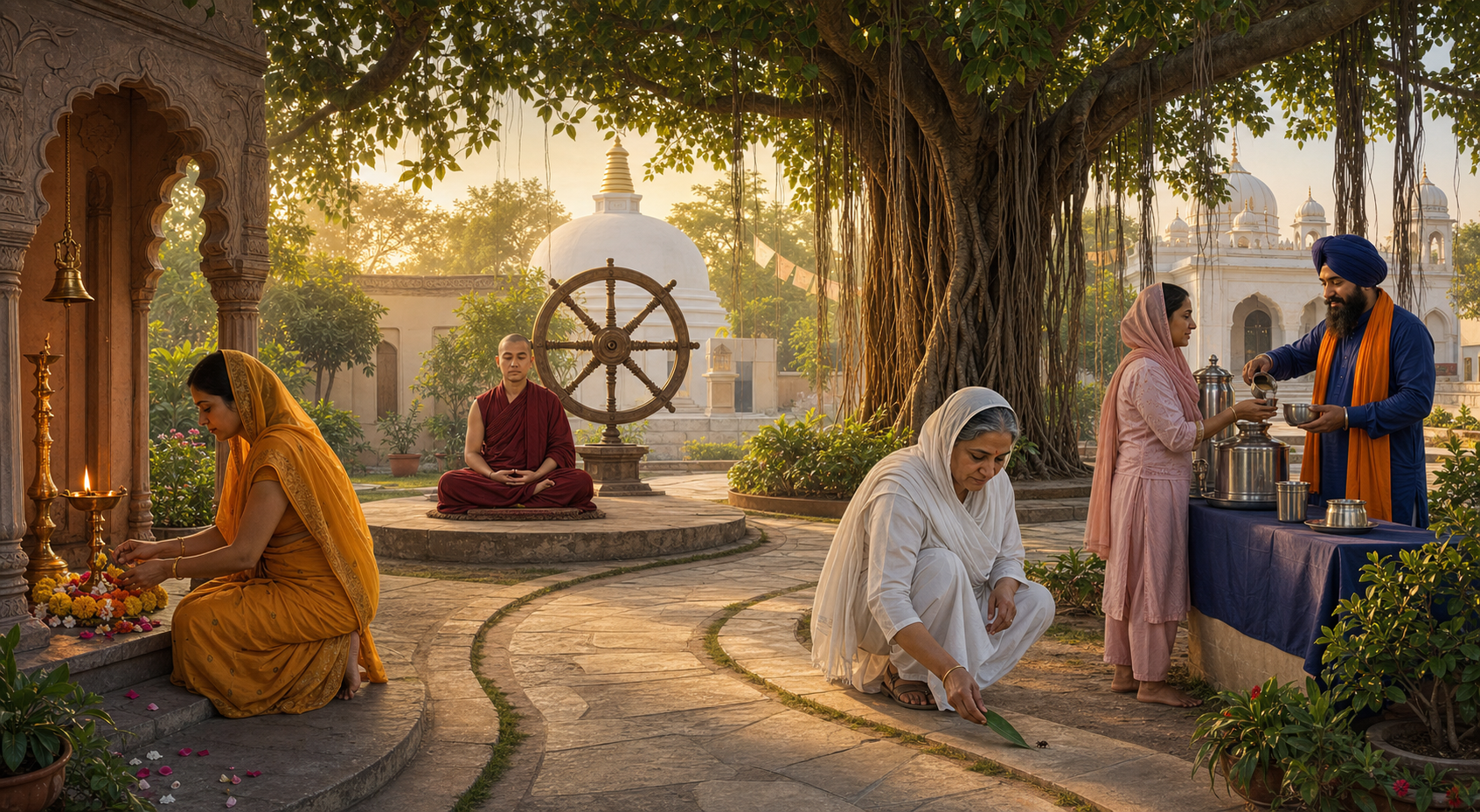
You may be trying to explain why one Hindu family can honor different forms of the Divine, why a Hindu can learn from Buddhist practice or Jain philosophy, or why Sikh seva belongs in a wider dharmic conversation. Two familiar answers create more confusion than clarity. Saying “they are all the same” erases real differences. Saying “only one can be true” assumes that truth requires uniformity.
Dharmic pluralism offers a more demanding alternative. You can hold a definite conviction, follow a disciplined path, and still recognize that another person may approach spiritual freedom through a different form, method, or philosophical language. The point is not to blend everything together. It is to understand difference without turning difference into hostility.
Pluralism protects difference without surrendering truth

Pluralism is often mistaken for the claim that every belief is equally correct. That is relativism, not pluralism. A pluralist can examine a teaching, reject an interpretation, defend a tradition, and maintain clear boundaries. What pluralism refuses is the further claim that disagreement automatically licenses contempt, coercion, or the suppression of every other path.
Hindu traditions already provide a practical model. The principle of Ishta allows a seeker to approach the Divine through a form that genuinely engages that seeker’s temperament. This does not require every Hindu to adopt the same deity, imagery, philosophy, or devotional mood. Nor does it reduce a chosen form to an arbitrary preference. Choice becomes spiritually meaningful when it supports sustained sadhana.
The wider dharmic family should be approached through family resemblance, not forced identity. Hindu paths speak of moksha and offer different yogas. Buddhism cultivates insight and liberation through tested practice. Jainism speaks of kevala jnana while Anekantavada disciplines the tendency to treat a partial viewpoint as the whole. Sikhism centers remembrance of Naam, life in harmony with hukam, seva, and the refining power of sangat. These vocabularies may illuminate one another, but they are not disposable labels for an identical doctrine.
You can detect a weak account of pluralism by looking for three errors:
- Reduction says that every tradition secretly teaches the same metaphysics. It creates agreement by ignoring what practitioners actually believe.
- Premature ranking judges another path before learning its purpose, discipline, and understanding of liberation.
- Relativism treats sincerity as the only standard, even when a belief encourages ego, irresponsibility, or coercion.
A stronger test is simple: can you describe another tradition in terms its own practitioners would recognize, identify a genuine area of agreement, and state a real difference without hostility? If you can do all three, you are practicing pluralism rather than merely praising diversity.
Many paths meet different seekers, but each path still asks for discipline

Different temperaments need different doors. The Bhagavad Gita’s presentation of bhakti, jnana, karma, and dhyana makes this especially clear. One seeker is drawn through devotion, another through inquiry, another through responsible action, and another through meditative cultivation. The Upanishadic impulse toward direct inquiry adds another important point: inherited language must eventually become examined and realized understanding.
Comparable forms of adaptability appear elsewhere without making the traditions identical. Buddhist upaya, or skillful means, adapts instruction to the condition of the learner. Jain Anekantavada reminds you that reality cannot always be captured from a single standpoint. Sikh practice joins remembrance with conduct and community, preventing spirituality from becoming nothing more than private preference. These are different ways of preserving agency while directing it toward transformation.
None of this means that you should sample practices endlessly without committing to one. Upaya does not mean that any method will work. Anekantavada does not mean that contradictions no longer matter. Ishta does not mean that devotion requires no training. Freedom makes practice authentic, but discipline gives freedom a direction.
If you are choosing or reassessing a spiritual practice, use the following questions:
- What is the aim? Name it in the tradition’s own language rather than using a vague phrase such as “being spiritual.”
- What is the method? Identify the actual practice: devotion, inquiry, meditation, ethical restraint, remembrance, service, or another defined discipline.
- What does the method require? A sadhana, vow, precept, or commitment should tell you what to do when enthusiasm fades.
- What fruit should become visible in conduct? Look for greater truthfulness, restraint, clarity, compassion, responsibility, and willingness to serve.
- Who can correct your blind spots? Guidance may come through a guru-shishya relationship, sangha, samgha, sangat, or satsang, depending on the path.
This distinction also helps you recognize religious rigidity. Discipline asks you to consent to a demanding practice and accept correction within it. Rigidity tries to produce conformity through fear, social pressure, or the refusal of honest questions. The first can refine conscience. The second can replace conscience with performance.
When evaluating a community, do not ask only whether it has rules. Ask what the rules are for, whether questions can be raised without humiliation, and whether seniority is joined to accountability. A tradition can be rigorous without being coercive, just as an apparently permissive community can still be manipulative.
Read sacred symbols in layers, not as riddles with one solution

A sacred symbol is not merely a decorative image, and it is rarely a code with one correct answer. It can carry a devotional presence, a philosophical principle, a moral warning, a memory of cosmic order, and an invitation to personal practice at the same time. Pluralism in symbolism begins by allowing these layers to coexist.
The Dashavatara offers a useful example. Matsya can evoke protection amid danger; Kurma, the stability required to support a larger process; Varaha, recovery and ecological uplift; and Narasimha, justice that crosses rigid categories. Vamana can direct attention toward measure and rightful balance. Rama can be contemplated through ethical governance, Krishna through morally responsive wisdom, the Buddha through compassion and non-violence, and Kalki through the need for renewal when disorder becomes entrenched. This layered reading connects cosmic restoration, ethical formation, ecological attention, and inner development.
These interpretations do not exhaust the avataras. A devotional reading, a theological reading, and a civilizational reading may ask different questions of the same form. Pluralism lets those questions remain distinct while allowing them to enrich one another.
You can read almost any dharmic symbol through five passes:
- Describe the form before interpreting it. Notice the figure, action, posture, relationship, or sequence actually presented.
- Identify the disorder or limitation being addressed. Ask what has become unstable, excessive, forgotten, or unjust.
- Find the quality the symbol calls forth. It may be courage, restraint, protection, compassion, balance, discernment, or service.
- Move from the inward to the collective. Ask how that quality should affect family conduct, community life, governance, or care for nature.
- State the limit of your interpretation. Say what the symbol helps you notice without claiming that your reading is its only meaning.
Apply this method to Varaha, for example. The image can direct your attention toward recovery: what has been allowed to sink into neglect, and what would responsible uplift require? An inward reading may concern a neglected duty. A social reading may concern environmental stewardship or the restoration of justice. Neither interpretation cancels the devotional meaning of the avatara.
The same restraint is essential when relating the Dashavatara sequence to biological evolution. Its movement through aquatic, stabilizing, terrestrial, boundary-crossing, social, and ethical motifs can be used as a metaphorical teaching pattern. That resemblance is intellectually suggestive, but it is not evidence that ancient narratives formulated modern evolutionary biology. Say that the sequence can evoke stages of development; do not turn symbolic affinity into an anachronistic scientific claim.
Another boundary matters when traditions meet. A Hindu interpretation may place the Buddha within an avatara sequence, while Buddhism speaks through its own doctrines, practices, and understanding of liberation. You can recognize a shared emphasis on compassion without using one tradition’s symbolic framework to define another tradition on its behalf. Respect does not require reciprocal theology.
The final test of a symbolic reading is practical. If an interpretation produces only clever conversation, it has stopped too early. Ask what the symbol changes in your attention, choices, restraint, service, or treatment of others. A symbol becomes spiritually serious when contemplation enters conduct.
Use a clear protocol when dharmic traditions disagree
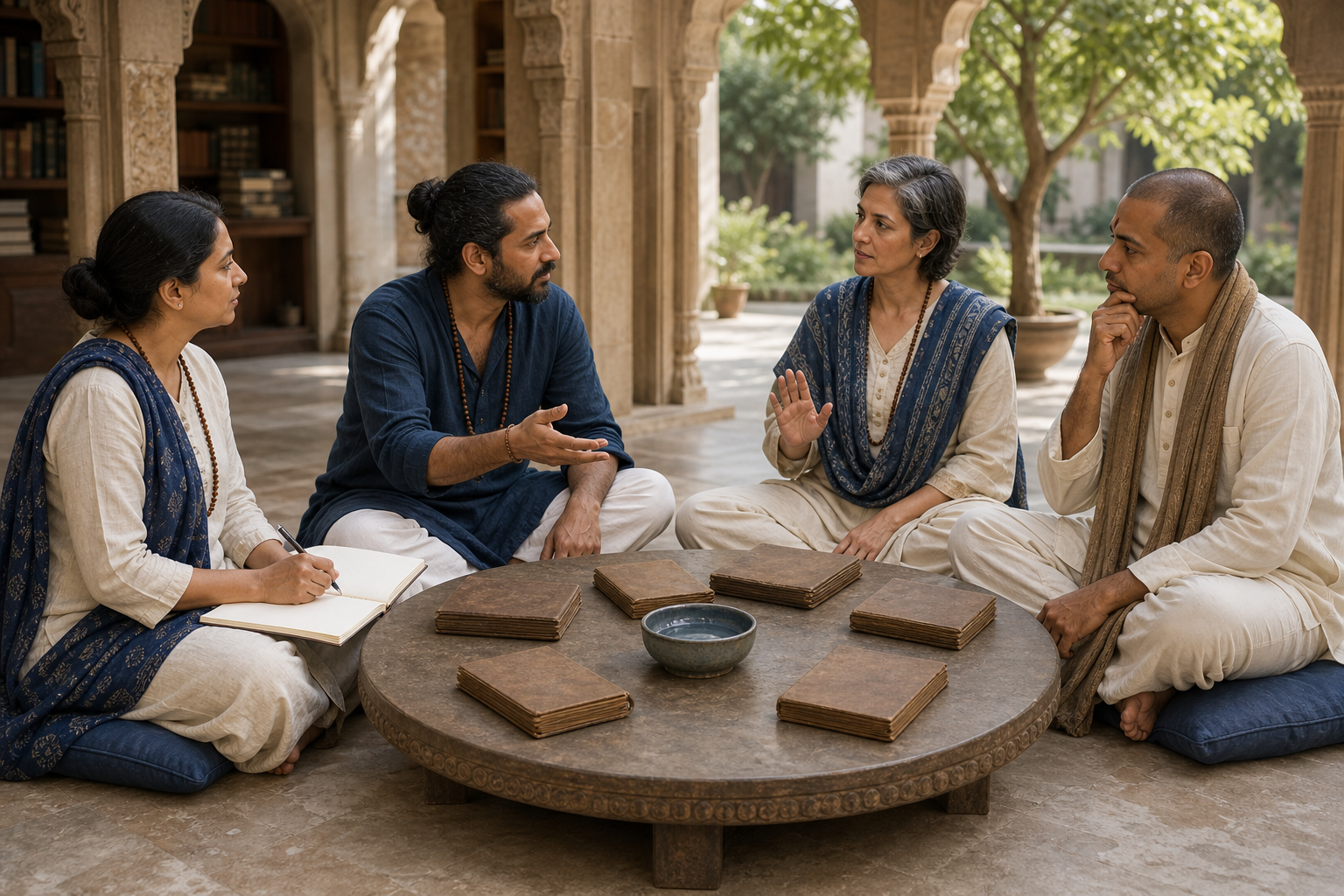
Most confused inter-dharmic conversations mix several levels at once. One person is making a metaphysical claim, another is describing a meditation method, and a third is pointing to a shared ethical value. They appear to disagree about everything because no one has identified the level of the disagreement.
When a discussion becomes tangled, sort the claims before trying to resolve them:
- Metaphysics asks what is ultimately real and how self, consciousness, karma, or liberation should be understood.
- Method asks what a practitioner actually does and why that practice is considered effective.
- Ethics asks how one should act, what should be restrained, and what is owed to other beings.
- Symbolism asks how a form, story, name, or image communicates meaning.
- Community asks how teaching, accountability, service, and belonging are organized.
Once the level is clear, compare precisely. Moksha, nirvana, kevala jnana, and a life centered in Naam should not be presented as automatic synonyms. Ahimsa, compassion, self-restraint, truthfulness, service, and justice can provide real grounds for cooperation, but shared ethical language does not prove identical metaphysics.
This precision improves ordinary family conversations too. Suppose one person says that all sacred forms reveal one reality, while another prefers meditation without devotional imagery. Do not force an immediate verdict about which person is more spiritual. Ask what each practice directs attention toward, what discipline it requires, and what transformation it seeks. Then identify the point of actual disagreement. It may concern ultimate reality, or it may only concern the most suitable method for a particular seeker.
If someone says, “All dharmic traditions teach the same thing,” replace that claim with three more accurate statements:
- Dharmic traditions share serious commitments to self-cultivation and ethical conduct.
- They do not always describe reality, authority, the self, or liberation in the same way.
- They can cooperate around non-harm, compassion, truthfulness, restraint, service, and justice without erasing those differences.
For a satsang, class, or inter-dharmic gathering, avoid asking participants merely to list similarities. Ask each person what problem a practice addresses, what discipline it requires, what fruit the tradition recognizes, and what outsiders most often misunderstand. Those questions produce understanding rather than ceremonial agreement.
Pluralism also sets a civic standard. Freedom of worship and inquiry should protect sincere differences, while communities remain free to transmit their disciplines and convictions. The boundary is coercion. A path can invite, teach, argue, exemplify, and correct; it should not need to extinguish every alternative in order to possess integrity.
Key takeaways and a practice you can begin now
- Dharmic pluralism is not the belief that every doctrine is identical or equally persuasive. It is disciplined respect for multiple paths without coercive uniformity.
- Different methods can serve different temperaments, but freedom does not remove the need for sustained practice, ethical standards, or correction.
- Use each tradition’s own vocabulary before comparing it with another. Similar ethical fruits do not automatically imply the same metaphysics.
- Read sacred symbols through devotional, philosophical, ethical, ecological, and personal layers, while stating the limits of any interpretation.
- Treat apparent parallels with modern science as metaphors unless the evidence supports a stronger historical claim.
- Judge pluralism by conduct: it should deepen clarity, restraint, compassion, service, honest inquiry, and the ability to disagree without dehumanizing.
Choose one symbol that matters to you. Write down its visible form, the disorder it addresses, the quality it cultivates, the conduct it asks of you, and one claim you should not make on its behalf. Then describe a practice from another dharmic tradition using that tradition’s own terms before comparing it with yours.
That small exercise turns pluralism from a slogan into a discipline. You keep your own ground, learn where another person is actually standing, and make space for both conviction and freedom.
References
- DharmaRenaissance Blog – Beyond Religious Rigidity: Dharmic Paths Realize the Divine Through Personal Freedom
- DharmaRenaissance Blog – Dashavatara Decoded: Ancient India’s Hidden Scientific Genius and Dharmic Unity
