

If you came to Dhruva because you saw his name in a temple, heard him identified with the Pole Star, or wondered why a child’s austerity matters to an adult, begin with the wound at the heart of his story. Dhruva wants recognition from his father. What makes him sacred is not that desire itself, but what his devotion becomes.
This distinction gives you a practical way to read Dhruva. His story neither dismisses wounded dignity nor permits it to rule the rest of your life. It shows how pain can be gathered into tapas, redirected toward Bhagavan Vishnu, and transformed into steadiness.
The movement from wounded dignity to tapas and grace
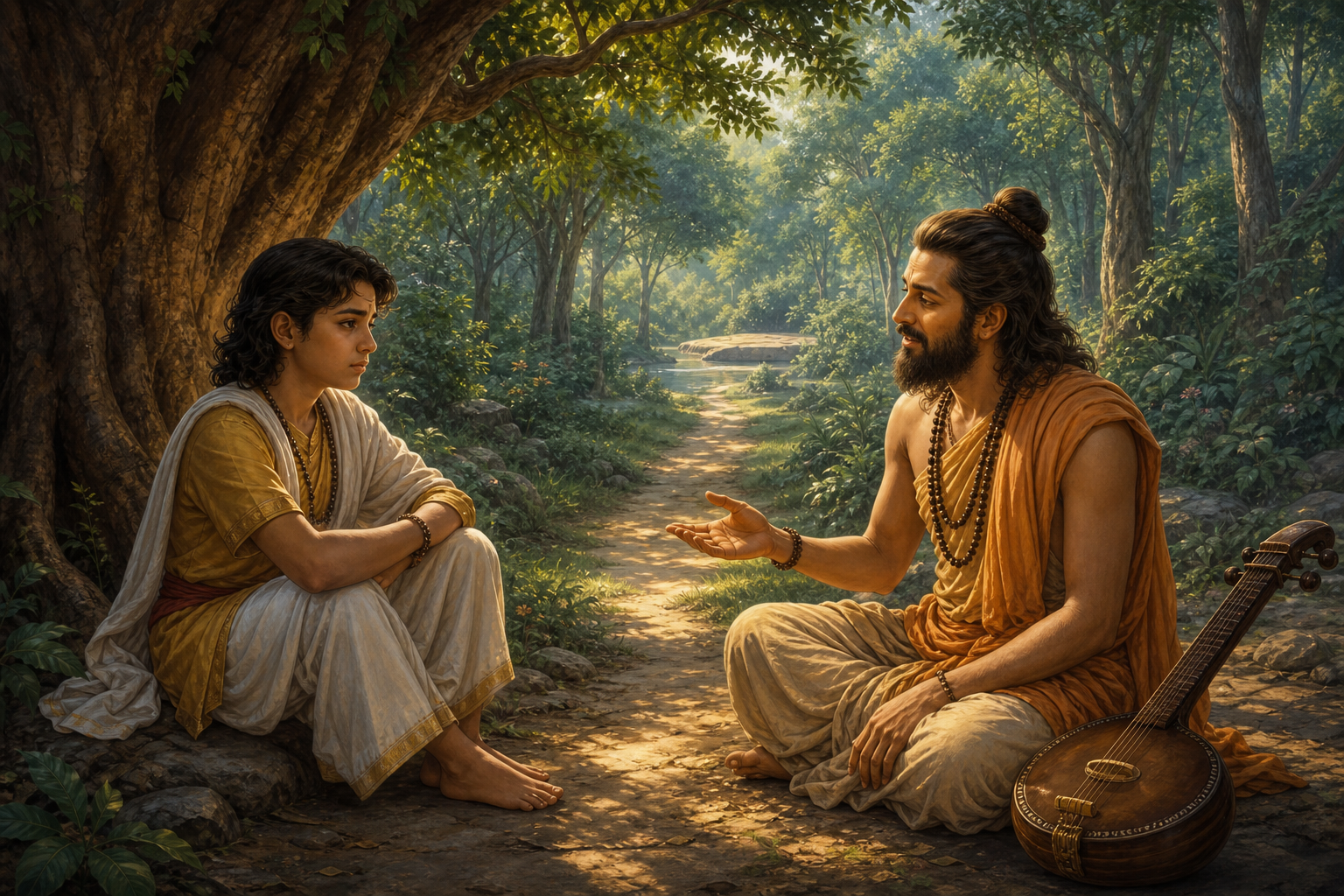
At the narrative’s center is a young prince who seeks recognition, undertakes intense tapas with unwavering devotion, and receives the grace of Bhagavan Vishnu. The sequence matters. Dhruva does not remain emotionally fixed on the person who withheld approval. His attention moves toward the Divine.
That movement keeps the story from becoming a fantasy of vindication. A shallow reading would make Dhruva’s greatness depend on finally proving his worth to another person. The sacred reading goes further: the recognition he first seeks within a family becomes the starting point for a relationship with Vishnu. His horizon expands beyond the original injury.
This is useful whenever you are tempted to build your life around an unanswered insult. You may have been overlooked, compared unfavourably, excluded, or denied affection. Hindu tradition does not require you to pretend that such treatment has no effect. Dhruva’s example asks a harder question: will the person who denied you recognition also determine the direction of your mind?
Tapas is the turning point. It concentrates a will that would otherwise circle endlessly around rejection. In a Dhruva-shaped reading of your own difficulty, discipline should reduce the offender’s control over your attention. If a practice merely rehearses the grievance, sharpens fantasies of superiority, or makes you contemptuous, it has not reproduced the story’s spiritual movement.
- Hurt says: “Someone else must confirm my value before I can stand.”
- Stubbornness says: “I will force the world to give me the response I want.”
- Tapas says: “I will gather my scattered attention and place it before what is higher.”
- Bhakti says: “Bhagavan, rather than the grievance, will become the center of my life.”
- Grace says: “The final meaning of this effort is not manufactured by ego or purchased through suffering.”
The last distinction protects the devotional heart of the narrative. Vishnu’s grace is not a wage mechanically earned by performing enough austerity. Tapas prepares and directs the person; grace cannot be reduced to a transaction. Read this way, Dhruva represents determination without the illusion that determination makes Bhagavan controllable.
Why the Pole Star is the right sacred symbol

The Pole Star appears steady while the visible night sky seems to turn around it. That makes it a remarkably precise symbol for Dhruva. The prince begins in a world where his sense of worth is moved by another person’s response. He becomes associated with a point of orientation that does not wander with every surrounding motion.
The title “the immovable one” therefore describes more than refusal to give up. Mere rigidity is not sacred. A person can persist in resentment, vanity, or adharma. Dhruva’s firmness acquires meaning through its direction: unwavering devotion to Vishnu. The object of steadfastness determines whether firmness becomes a virtue or merely a hardened ego.
This gives you a clean test for your own commitments. Do not ask only, “Am I being consistent?” Ask, “What is my consistency organized around?” Regular effort devoted to social approval still leaves approval at the center. Regular worship, truthful conduct, self-restraint, study, or seva can gradually establish a different center.
The celestial symbolism also clarifies what steadiness does not mean. It does not require emotional numbness, social withdrawal, or an inability to reconsider a mistaken decision. The sky remains full of movement. Dhruva’s image points to orientation amid movement: one stable reference by which other movements can be understood.
When circumstances change, you may need to change methods, schedules, or expectations. Sacred steadiness lies in preserving the governing relationship while making those adjustments. A vow to remember Vishnu can remain firm even when the outward form of practice must become simpler. That is constancy; clinging to an unsafe or unsuitable method is not.
How to read Dhruva in temple sculpture without guessing
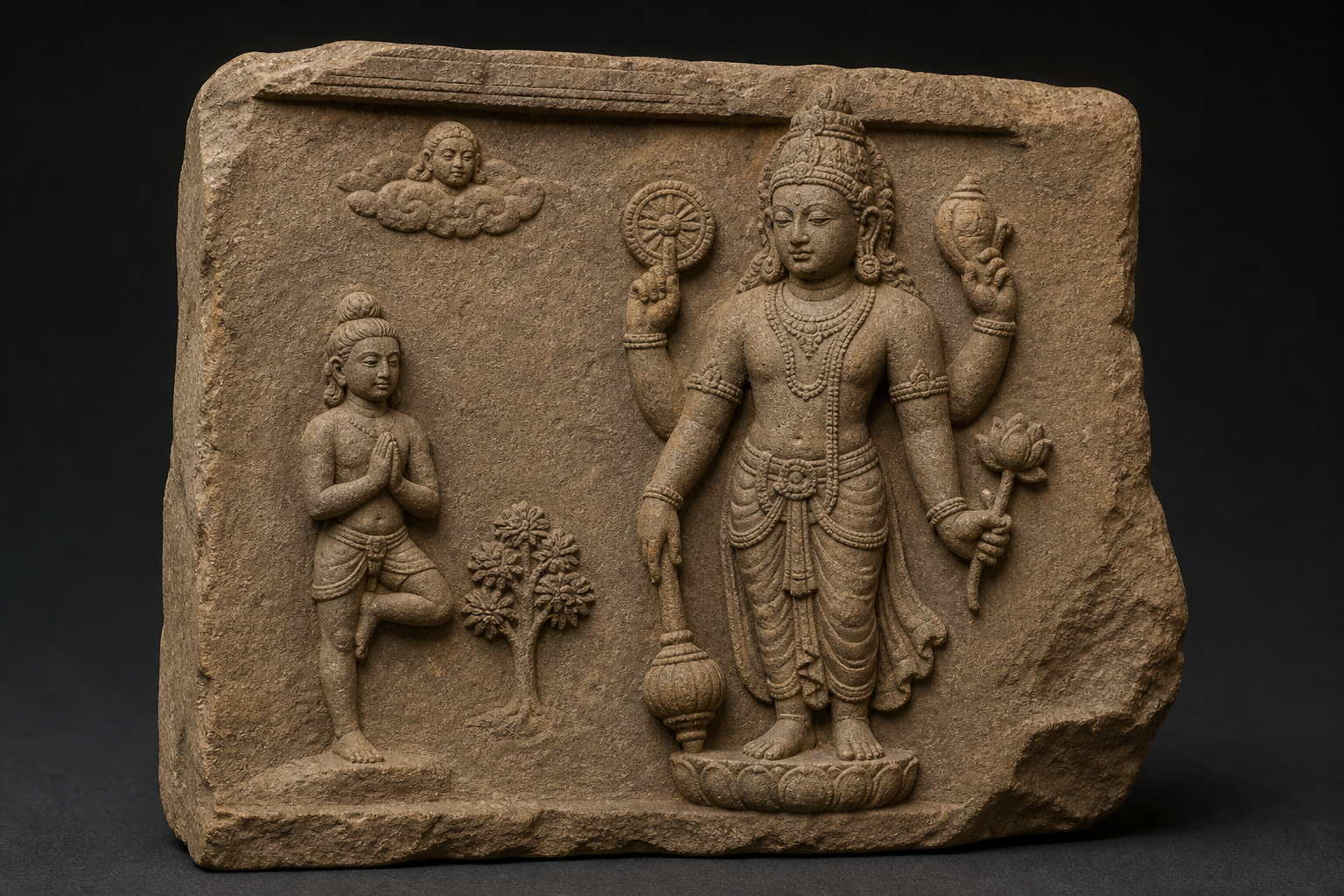
Temple sculpture does not merely decorate a narrative. It gives theological form to the relationship among the devotee, tapas, Bhagavan, and sacred permanence. A representation of Dhruva may direct your attention toward his youth, concentrated devotion, relationship with Vishnu, or association with celestial fixity. Which element is emphasized changes what the image is asking you to contemplate.
Do not identify a figure as Dhruva from resemblance alone. A youthful or ascetic-looking figure can belong to many sacred narratives. An inscription, a temple’s sthala account, its established guide, or an informed priest gives stronger evidence than a visual guess. If none is available, describe what you can actually see and keep the identification tentative.
- Begin with context. Notice the shrine, surrounding deities, narrative sequence, and the figure’s relation to Vishnu.
- Look for the governing emphasis. Is the composition drawing attention to austerity, devotion, divine encounter, or celestial permanence?
- Separate observation from interpretation. “The figure is shown in concentrated worship” is an observation; “this proves a particular episode” requires supporting context.
- Ask what remains stable. The deepest iconographic question is not simply who the figure is, but what principle the form establishes as the viewer’s axis.
- Verify locally. Temple traditions preserve meanings that a generic iconographic checklist can miss.
Once the identification is secure, resist treating the image as a frozen illustration. Stand before it long enough to notice the contrast it embodies: a young human figure, a severe act of concentration, the grace of Vishnu, and the vast symbolism of an enduring celestial point. The movement from vulnerability to sacred orientation is the theology of the form.
Key takeaways
- Dhruva begins with a real desire for recognition, but his sacred significance lies in moving beyond dependence on human approval.
- Tapas gathers the attention scattered by hurt and redirects it toward Bhagavan Vishnu.
- Vishnu’s grace should not be reduced to payment for austerity; devotion is a relationship, not a technique for controlling the Divine.
- The Pole Star symbolizes a stable spiritual axis amid movement, not inflexibility in every outward matter.
- Dhruva’s firmness is holy because of what it serves. Persistence centered on resentment is not the same as steadfast bhakti.
- In a temple, verify an identification through context and local tradition before assigning a name from appearance alone.
Turn Dhruva’s principle into a responsible practice
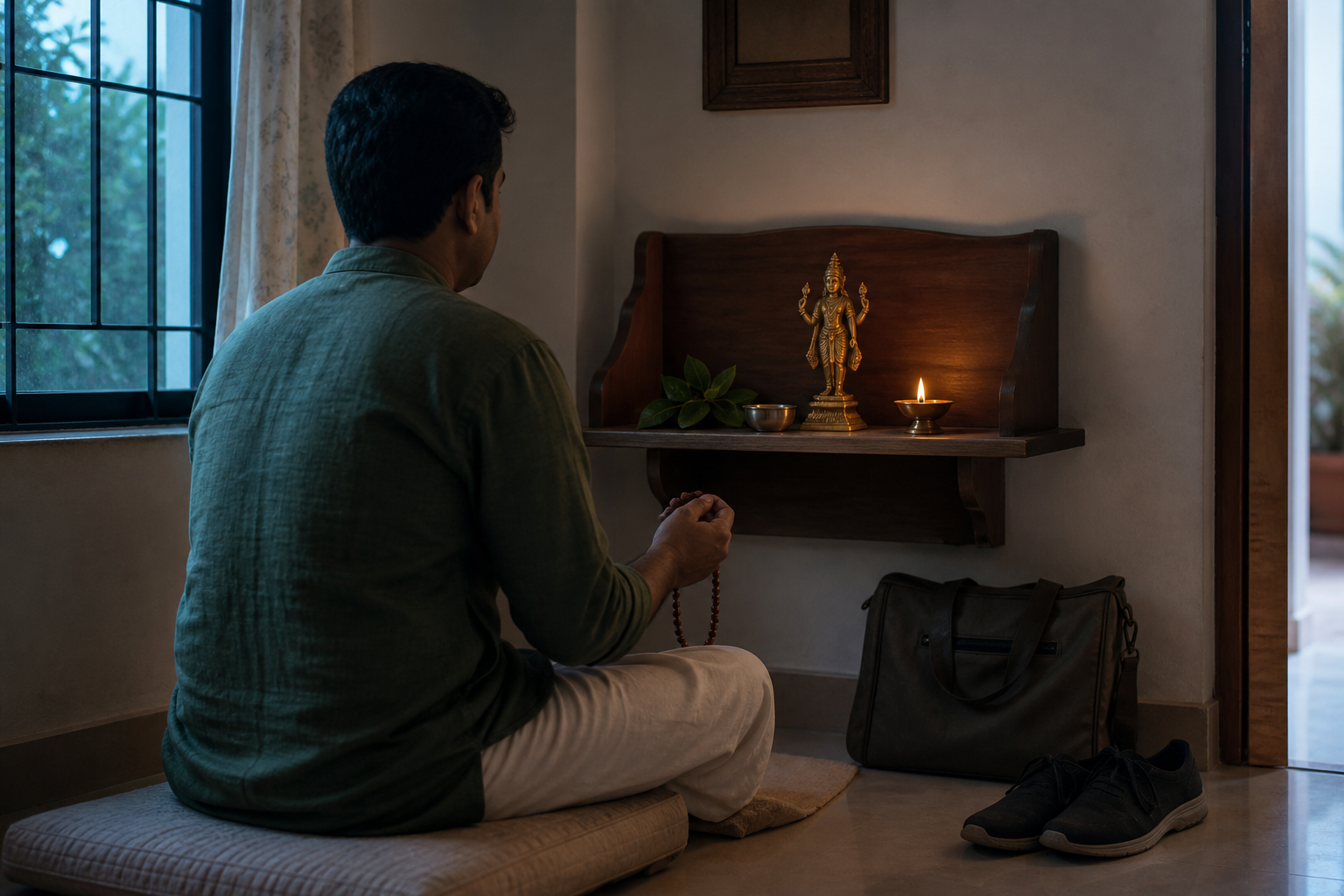
The following exercise is a contemporary application of Dhruva’s spiritual pattern, not a traditional Dhruva vrata and not a substitute for instruction within your sampradaya. Its purpose is to help you notice what currently occupies the center of your attention.
- Name the wound plainly. Complete this sentence without embellishment: “I wanted recognition from ___, and I did not receive it.” Do not turn the exercise into a prosecution of the other person.
- Separate remedy from dependence. Decide whether a practical response is still needed, such as a truthful conversation, a boundary, or correction of an injustice. Then distinguish that action from the wish to control how another person regards you.
- Choose your axis. At a consistent time and place, turn your attention toward Bhagavan Vishnu through a prayer, nama-japa, reading, or form of worship already familiar within your tradition. Do not invent an elaborate ritual merely to make the effort feel severe.
- Make tapas narrow and sustainable. Choose one discipline that reduces the grievance’s hold: restraint from hostile speech, regular worship, careful study, service, or another established practice appropriate to you.
- Watch the fruit. Ask whether the practice is making you less controlled by withheld approval, more capable of truthful action, and more attentive to Bhagavan. If it is feeding superiority or obsession, correct the direction rather than merely increasing the intensity.
Do not imitate the intensity of sacred tapas through improvised extreme fasting, sleep deprivation, exposure, or bodily harm. Such practices can injure you. Follow the discipline of your sampradaya, respect your health needs, and seek qualified guidance where austerity goes beyond ordinary worship and self-restraint. The part of Dhruva’s example available to every reader is not extremity; it is the refusal to let a wound remain the center.
The next time denied recognition begins organizing your thoughts, use Dhruva as a directional question: “What would change if Vishnu, rather than this grievance, became my fixed point?” Then make one modest act of devotion answer that question in practice.
References
