
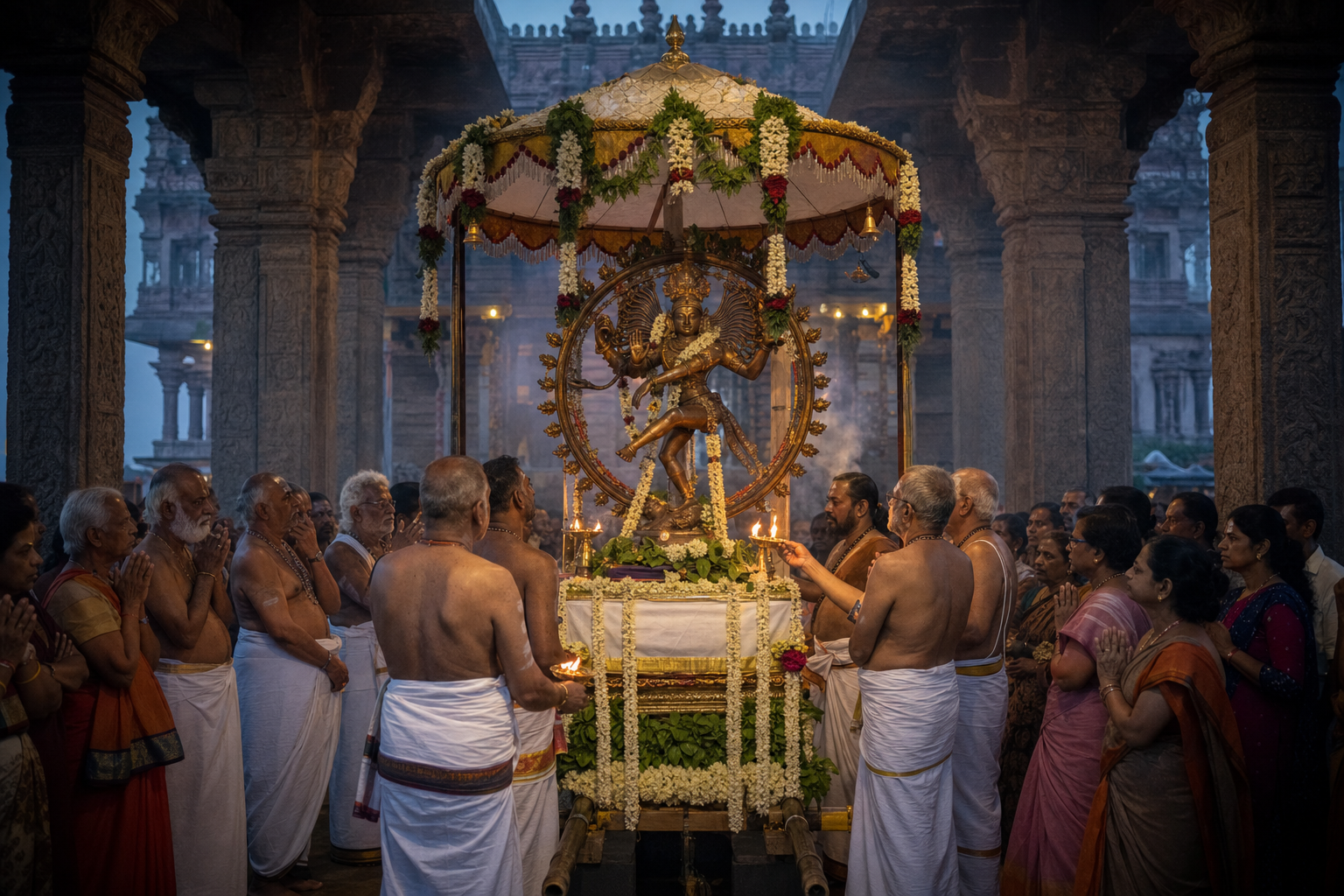
If you want to observe Thiruvathirai but are unsure whether to plan a pilgrimage, attend early temple worship, or mark the day at home, begin with one decision: identify the correct Ardra day in Margazhi and reserve a coherent period for Nataraja rather than assembling an elaborate checklist you cannot complete.
Your observance may centre on pre-dawn darshan and abhishekam at a Shiva kshetra. It may instead centre on a kolam, Panchakshari chanting, Thiruvathirai kali, and ezhu kari kootu at home. The scale can differ; the purpose remains disciplined attention to Shiva as Nataraja.
Know the names and get the date right
Several closely related names appear on calendars and temple announcements. They do not indicate competing festivals. Thiruvathirai is the Tamil name associated with Ardra, one of the 27 nakshatras traditionally personified as the consorts of Chandra Bhagavan. Arudra Darshan is the name commonly used when the emphasis falls on the sacred sight of Nataraja and his cosmic dance.
| Term | What it tells you |
|---|---|
| Thiruvathirai | The Tamil name connected with Ardra and a common name for the festival. |
| Ardra | The Sanskrit name of the nakshatra that determines the observance. |
| Arudra Darshan | The festival name emphasizing darshan of Shiva as Nataraja. |
| Margazhi | The Tamil month, roughly mid-December to mid-January, in which the festival occurs. |
The practical consequence is important: Thiruvathirai does not remain on one fixed Gregorian date. It is observed when the Ardra nakshatra falls within Margazhi, and the exact date can vary with the regional panchang. A date remembered from a previous year is therefore not enough.
- Check the panchang followed by your household, community, or intended temple.
- If two calendars differ, use the calendar governing the temple where you plan to worship rather than trying to combine incompatible timings.
- Confirm the temple’s special schedule separately. Major centres may extend worship hours or arrange ceremonies outside their ordinary routine.
- If you want the pre-dawn experience, prepare the kolam materials, clothing, transport, and meal ingredients beforehand. The quiet of the hour is lost when every practical decision is postponed until morning.
This calendar discipline is part of the observance. The conjunction of Margazhi and Ardra links celestial time, temple time, and household practice. Treating the festival as a convenient annual date removes precisely that relationship.
Choose a temple observance or a complete home practice
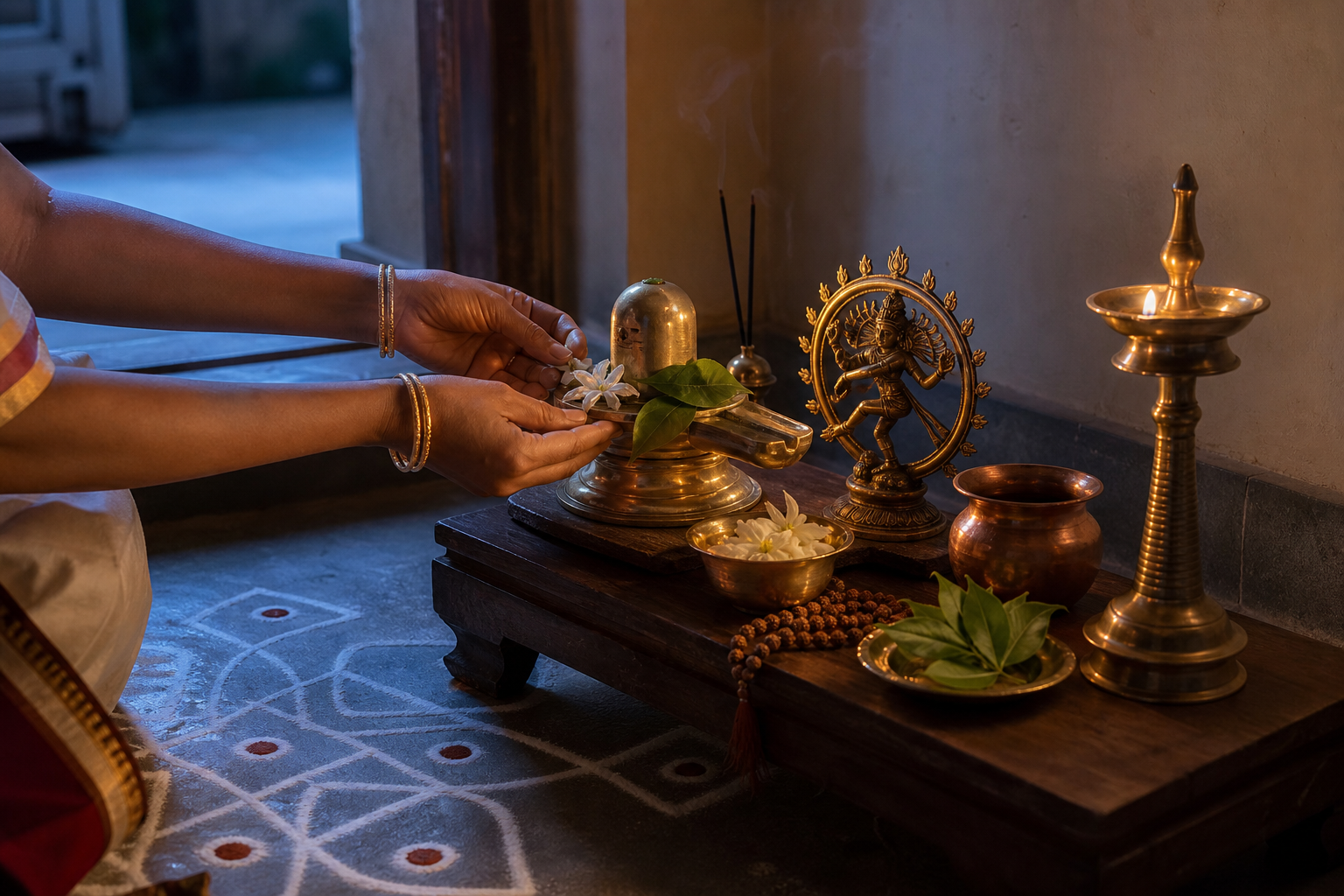
Thiruvathirai is not an all-or-nothing pilgrimage test. Temple worship and domestic observance support the same sacred day in different ways. Choose the form you can undertake attentively, then give it a clear beginning and end.
If you are going to a temple
Chidambaram Nataraja Temple and Thiruvalangadu Shiva Temple are especially associated with the celebration, while Shiva kshetras elsewhere also conduct special worship. The characteristic sequence includes early-morning abhishekam, deepa aradhana, and the recitation of hymns. Thiruvempavai has particular resonance during Margazhi in Tamil Nadu.
- Verify the opening time and festival programme directly with the temple before travelling.
- Arrive early enough to settle before the principal worship rather than entering only for its final moments.
- Listen to the hymns as part of the darshan. The sound of recitation, bells, and worship belongs to the experience alongside the visual form of Nataraja.
- Keep one familiar Shiva mantra ready for waiting periods. The Panchakshari gives the mind a simple centre when the temple is crowded.
- If a major pilgrimage is impractical, attend a nearby Shiva temple or observe at home. Distance from Chidambaram does not prevent you from keeping the day.
If you are observing at home
A home observance works best as a short, intelligible sequence. It need not imitate every element of temple ritual.
- Draw an auspicious kolam and prepare the prayer space before the chosen worship period.
- Begin with a settled interval of Shiva remembrance rather than fitting chants between unrelated chores.
- Chant the Panchakshari, recite hymns you already know, or include Thiruvempavai according to your family tradition.
- Prepare Thiruvathirai kali and ezhu kari kootu as the day’s characteristic food.
- Invite an elder to explain one song, recipe, story, or ritual detail. If children are present, give them one defined role instead of expecting them merely to watch.
If time is limited, keep fewer elements and complete them attentively. A kolam, a deliberate period of chanting, and the traditional meal form a more coherent observance than a long list performed in haste.
Use the traditional meal to preserve family memory
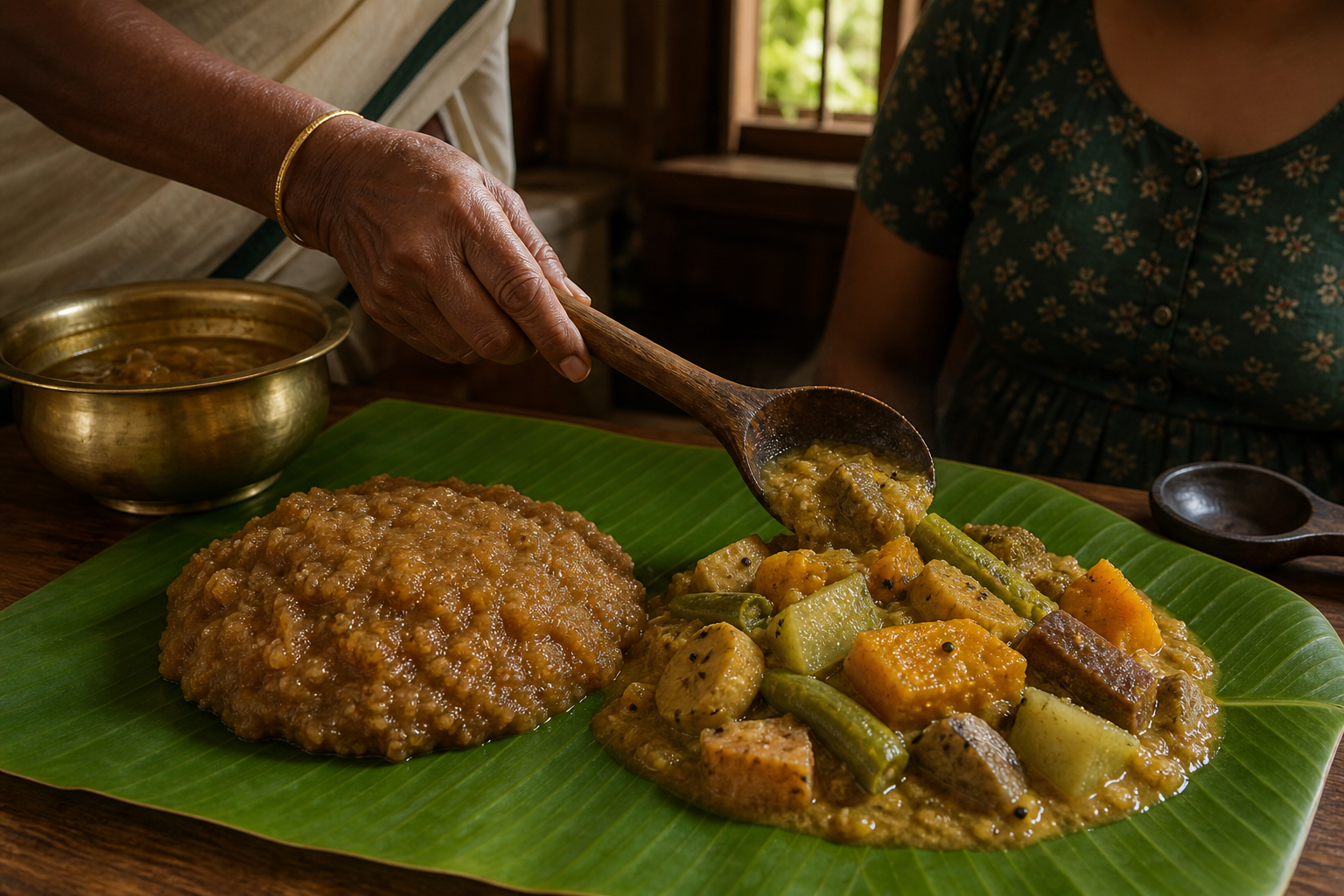
Thiruvathirai kali and ezhu kari kootu are not incidental festival dishes. Their annual preparation gives a household a repeatable way to remember the day. The kootu is built around seven vegetables, while the precise household method should come from the tradition you actually follow.
If your family has an inherited recipe, preserve more than its ingredient list. Ask which steps are considered essential, how the vegetables are selected, when the kali is prepared, and who taught the current cook. Record those details while the person who carries them can still explain them. That turns a recipe into cultural memory rather than an anonymous set of measurements.
- Decide on the household recipe before shopping so that all seven vegetables are available.
- Ask an elder to supervise one stage while a younger family member performs it.
- Let children count or name the vegetables, help with the kolam, or learn a short refrain connected with the worship.
- Write down regional or family variations without declaring one household method universally binding.
- Explain why the meal is being made before it is served. Repetition transmits tradition only when the next generation knows what it is repeating.
This is how a domestic observance becomes a living archive. Songs, cooking methods, pronunciation, ritual order, and family stories survive because someone is invited to participate before the knowledge becomes urgent to recover.
Contemplate the dance as a guide to dharmic action
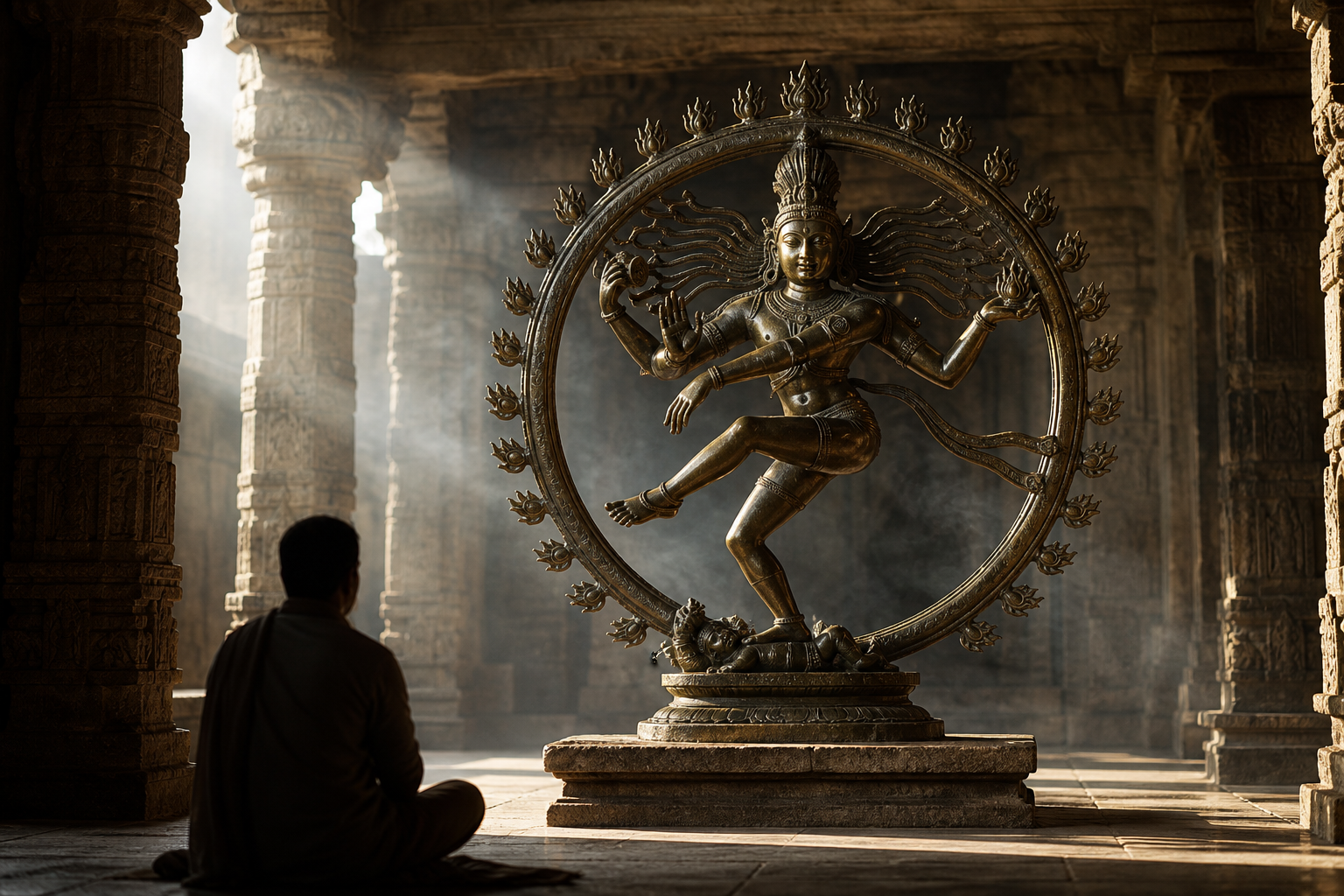
Nataraja’s dance expresses creation, preservation, and dissolution. Yet the image does not ask you to admire movement for its own sake. It holds cosmic rhythm together with inner stillness: activity has its proper place, but action without an inward centre becomes agitation.
You can turn those three movements into a focused reflection after worship. This is not a replacement for liturgy; it is a way to carry darshan into conduct.
- Creation: What worthy responsibility, practice, or act of service should you begin?
- Preservation: Which existing duty needs steadier attention rather than another new promise?
- Dissolution: Which resentment, distraction, or harmful habit should no longer govern your action?
Choose one answer that can change your conduct after the festival. Humility, gratitude, compassion, and responsibility toward the community are not decorations placed around worship; they are ways the vision of Nataraja becomes visible in ordinary life.
Arudra Darshan remains a specifically Shaiva Hindu observance, even as its themes resonate across the wider dharmic family. Hindu, Buddhist, Jain, and Sikh traditions each give importance to disciplined practice, sacred remembrance, and moral order through their own forms, including mantra, meditation, vrata, simran, and mindful observance. Kinship does not make those practices interchangeable. You can recognise a shared commitment to inner growth without erasing the distinct path from which each practice comes.
Key takeaways for a meaningful Thiruvathirai
- Use the Ardra nakshatra in Margazhi, not last year’s Gregorian date, to identify the festival.
- Follow the regional panchang used by your household or the temple you will attend.
- For temple worship, confirm the special schedule and plan around the early-morning rites.
- For home worship, build a complete sequence around a kolam, chanting, the traditional meal, and shared learning.
- Prepare Thiruvathirai kali and seven-vegetable ezhu kari kootu according to your family or community tradition.
- Carry Nataraja’s dance into one decision about what to begin, sustain, or relinquish.
Once the date is confirmed, put three things on your calendar: the worship time, the meal preparation, and the name of the person you will invite to share a song, recipe, or story. That small act of planning gives devotion, household memory, and dharmic reflection a real place in the day.
References
