
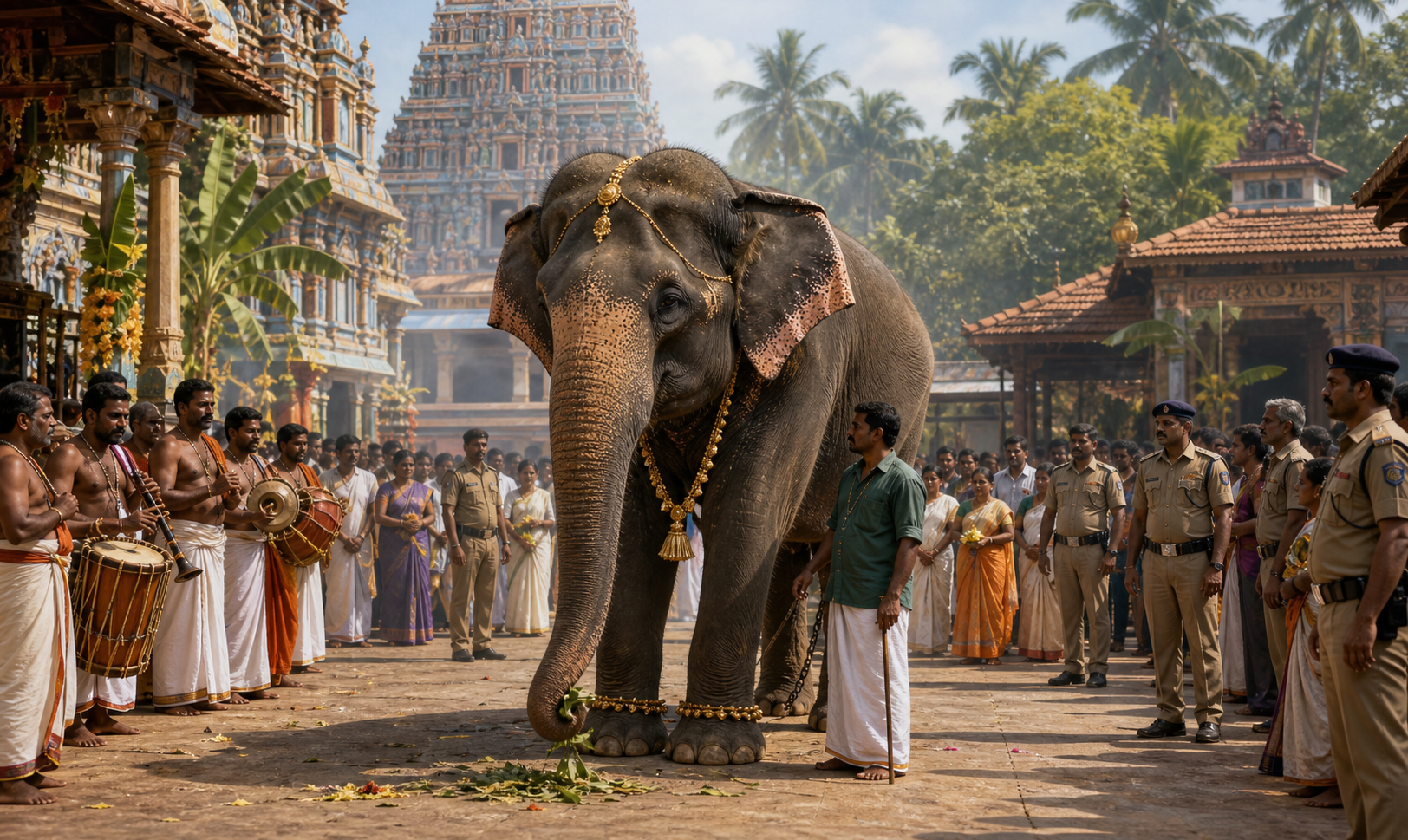
If you saw a caption claiming that a temple elephant punished a policeman for interrupting Hindu worship, pause before forwarding it. The incident at Kukke Subrahmanya Temple is real, but the dramatic story attached to it goes beyond what the video establishes.
You can appreciate the spontaneous moment without turning it into evidence of hostility, divine judgement, or political intent. Here is what you can responsibly say, what remains uncertain, and how to respond as both a devotee and a careful viewer.
What the video establishes – and where certainty ends
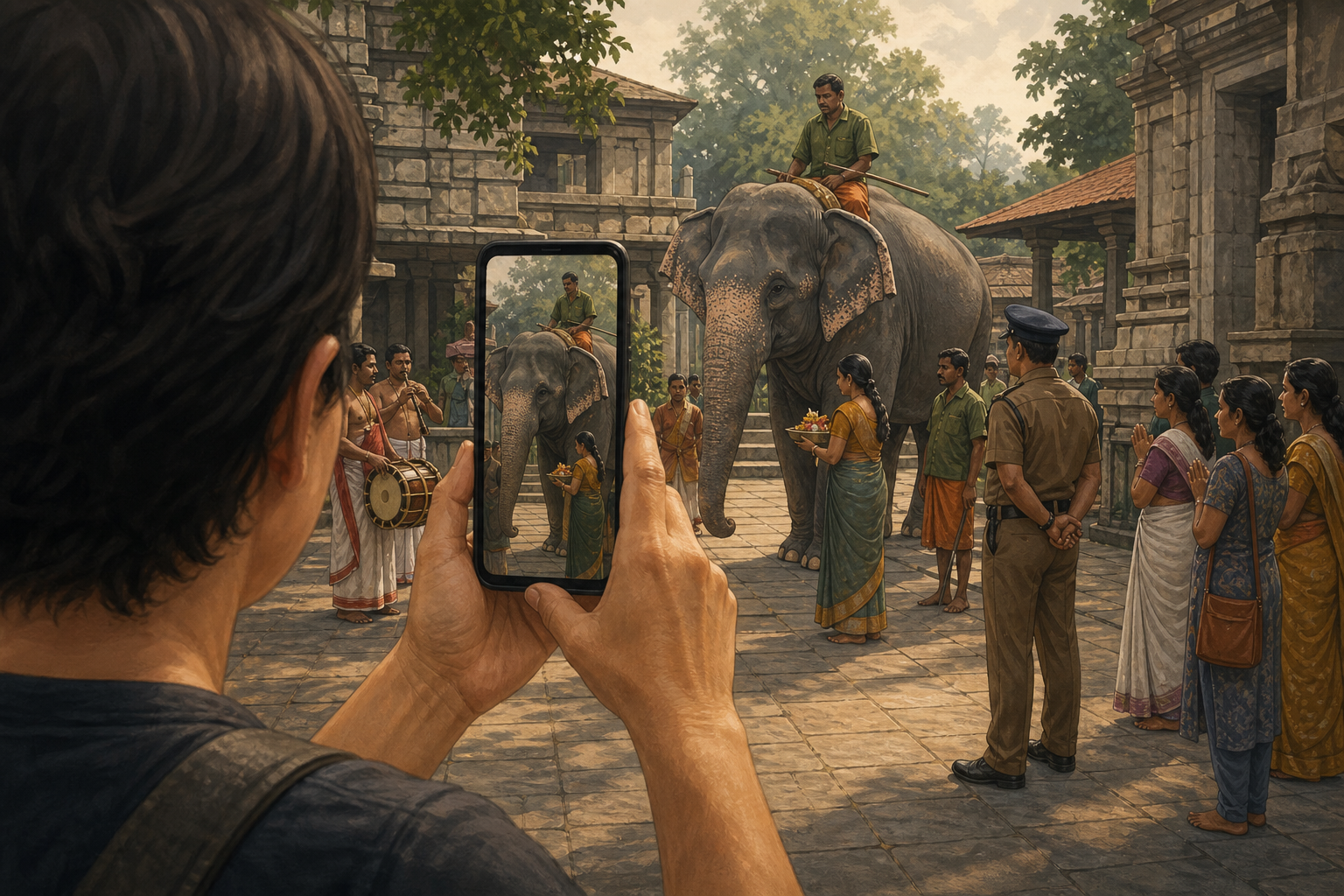
The scene comes from the final day of Neeru Bandi Utsavam at Kukke Subrahmanya Temple in Karnataka. During the water-related Theerthavaari observance, the temple elephant Yashaswini nudges a uniformed man into the water. The man has been described as either a policeman or a staff member, and no injury was reported.
That is the firm core of the event. The widely repeated claim that the man was disrupting prayers is not supported by the available evidence. His role at the ritual has been reported as routine crowd management, while his precise actions and intentions cannot be determined from the short clip.
A useful way to examine any viral religious video is to separate three layers. The first is what you can see: Yashaswini, a uniformed man, physical contact, water, and a crowded ritual setting. The second is contextual information: the festival, the Theerthavaari observance, the man’s reported crowd-management role, and the absence of a reported injury. The third is interpretation: that he opposed the devotees, that Yashaswini understood his purpose, or that she deliberately punished him. Only the first two layers have evidentiary support.
This distinction matters because a caption can change how you think you remember a video. Once someone labels the man a hostile policeman, an ambiguous movement begins to look like retaliation. Remove that caption, and the footage shows a brief interaction whose human and animal motives remain uncertain.
The ritual setting explains the energy, not the elephant’s mind
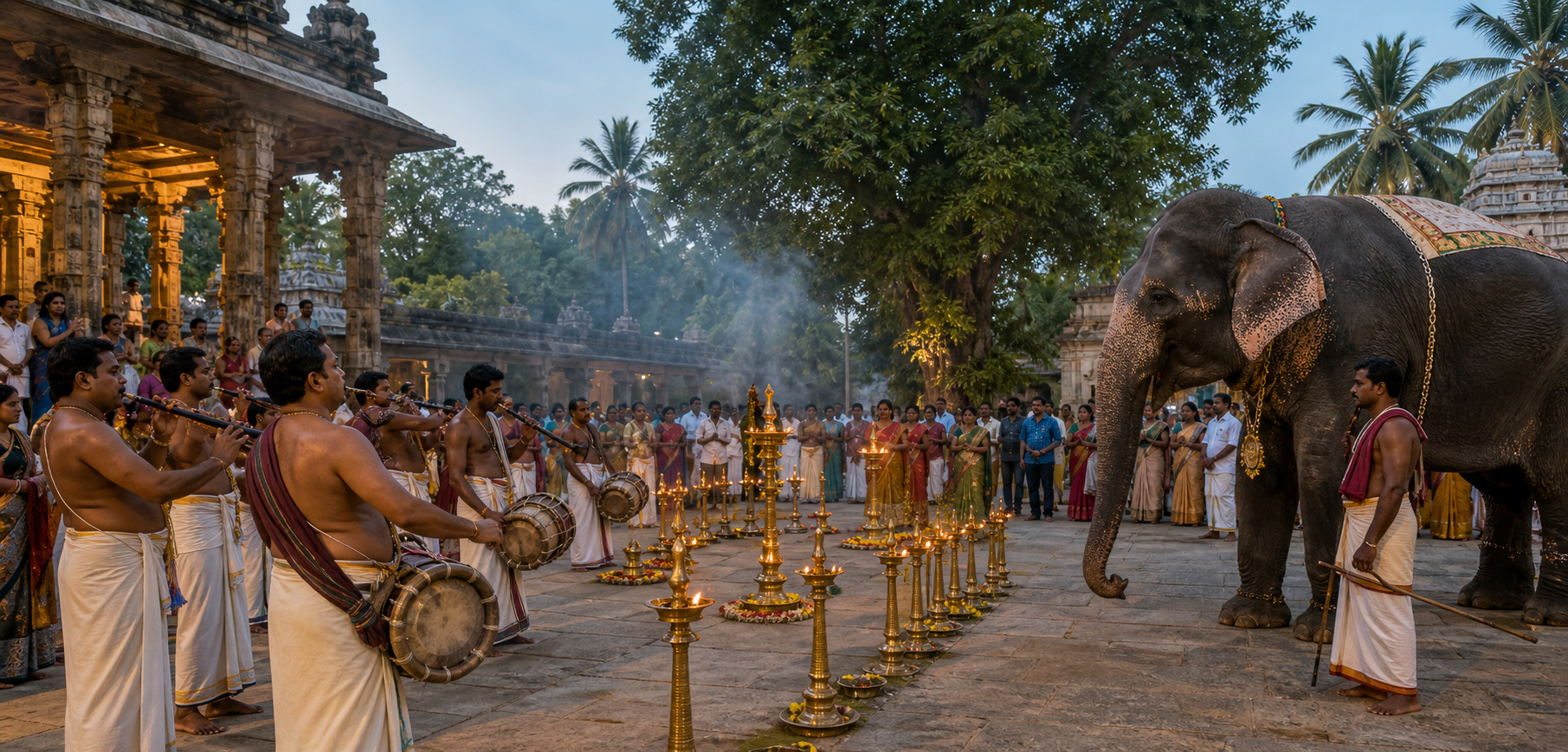
Neeru Bandi Utsavam has a celebratory atmosphere, and Theerthavaari brings devotees, ritual movement, water, and playful splashing into the same space. Temple elephants at Kukke Subrahmanya also engage with devotees during water-related observances. That context helps explain why the encounter occurred amid visible festivity rather than panic.
It does not reveal what Yashaswini intended. Noise, moving people, close physical proximity, and water activity create a high-sensory environment for an elephant. Reading her action as a boundary-setting nudge is plausible, especially because the incident remained contained. It is still an interpretation, not a verified account of her motive.
Calling her a defender of worship may feel emotionally satisfying, but it turns a living animal into a political character. The video cannot show that she understood the man’s official role, judged his conduct, or acted for an ideological reason. Affectionate humour about the moment is one thing; presenting that humour as fact is another.
For a dharmic audience, this is not a minor technicality. Truthfulness strengthens cultural confidence. Hindu traditions do not need an unsupported villain-and-hero narrative to make a temple ritual meaningful. The festival, the devotion, and Yashaswini’s presence have their own significance without an invented confrontation.
Respect for Yashaswini requires practical restraint
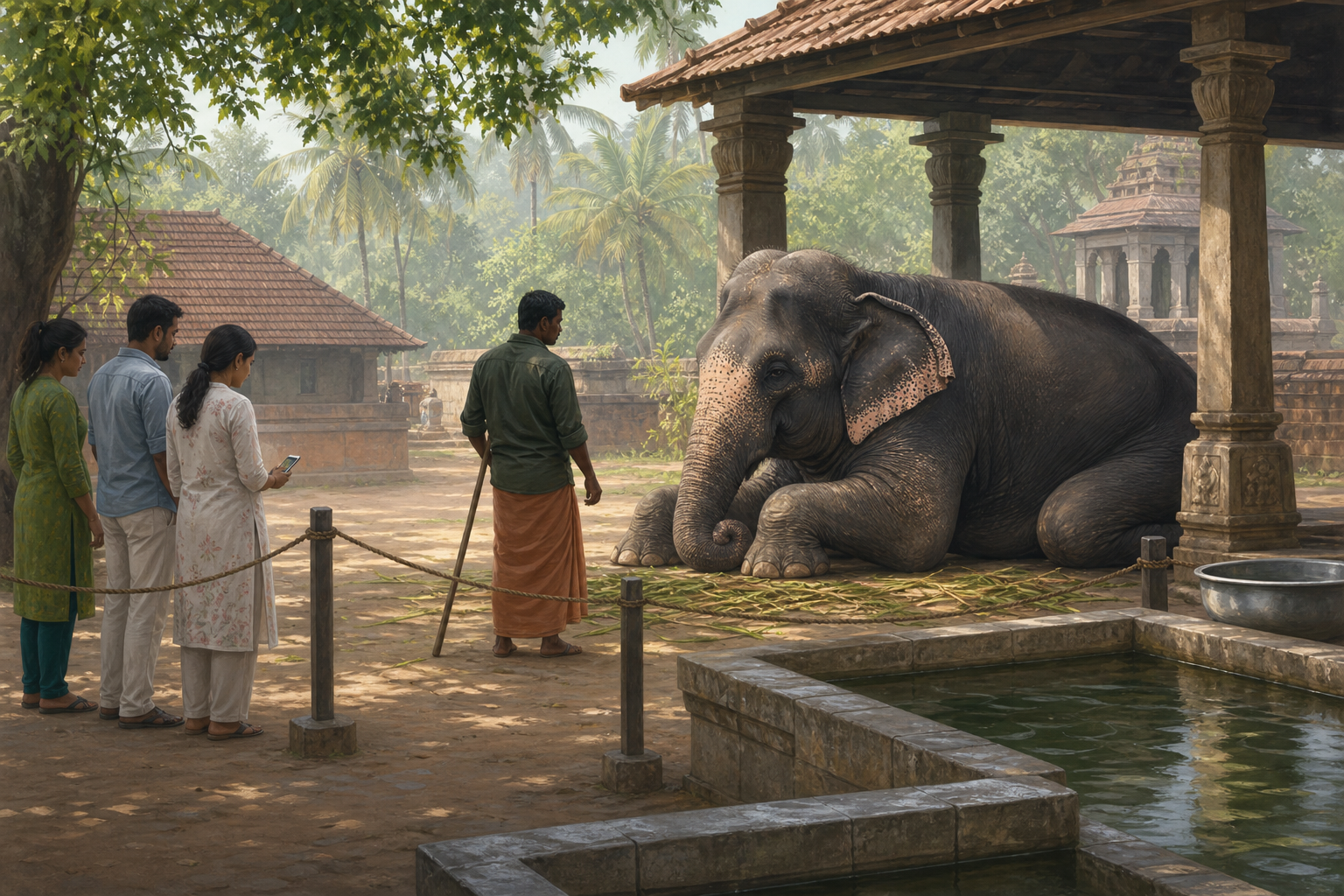
An elephant’s movement can look gentle on a phone screen while still carrying enormous physical force. The lack of a reported injury in this incident should not encourage anyone to imitate it, move closer for a photograph, or treat contact with a temple elephant as harmless entertainment.
If you attend a ritual involving an elephant, keep out of the animal’s movement lane, avoid clustering near the water’s edge, and follow directions from mahouts, security personnel, and temple organizers promptly. Do not reach toward the animal or step into its path because another devotee appears comfortable nearby. A festive atmosphere does not erase the need for distance.
Organizers carry the larger responsibility. Clear movement lanes, an adequate buffer between the elephant and dense groups, calm signals, and advance coordination among mahouts, security staff, and ritual personnel reduce confusion. The person managing the crowd and the person guiding the elephant need to understand the same route, especially where water, noise, and changing processions narrow the available space.
This is where ahimsa becomes concrete. Hinduism, Buddhism, Jainism, and Sikhism do not formulate every principle in identical terms, but compassionate regard for living beings is a shared dharmic concern. In a temple setting, that concern means protecting devotees, respecting workers, and refusing to make the elephant absorb avoidable crowd pressure.
Fairness to the uniformed man also belongs within that ethic. If he was performing routine crowd management, portraying him as an enemy of Hindu worship turns an ordinary duty into a false accusation. Reverence for Dharma is not served by assigning malice where the evidence does not establish it.
Key takeaways
- The video was recorded during the Theerthavaari observance on the final day of Neeru Bandi Utsavam at Kukke Subrahmanya Temple.
- Yashaswini, the temple elephant, nudged a uniformed man into the water; no injury was reported.
- The man has been described as a policeman or staff member involved in crowd management.
- The claim that he was disrupting Hindu prayers remains unsupported.
- A boundary-setting nudge is a plausible reading of Yashaswini’s behavior, but her motive cannot be verified from the clip.
- Devotees should keep a respectful distance, while mahouts, security staff, and organizers should maintain clear, coordinated movement lanes.
A responsible caption you can use when sharing
If you want to share the video, preserve the distinction between the recorded event and its online interpretation. You can use this wording:
Suggested caption: During the Theerthavaari ritual at Kukke Subrahmanya’s Neeru Bandi Utsavam, temple elephant Yashaswini nudged a uniformed man into the water. He has been described as a policeman or staff member engaged in crowd management. No injury was reported, and claims that he was disrupting worship remain unverified.
Avoid adding text that presents the incident as punishment, retaliation, or proof of anti-Hindu conduct. If the clip has been trimmed or overlaid with a sensational caption, link to the fuller context so viewers can distinguish the scene from the story imposed upon it.
The next time a temple video reaches you, take one minute before reacting: identify what is visible, mark what is merely reported, and refuse to promote whatever remains inferred. That small discipline lets you honour the ritual, the people serving within it, and the animal at its centre.
References
