
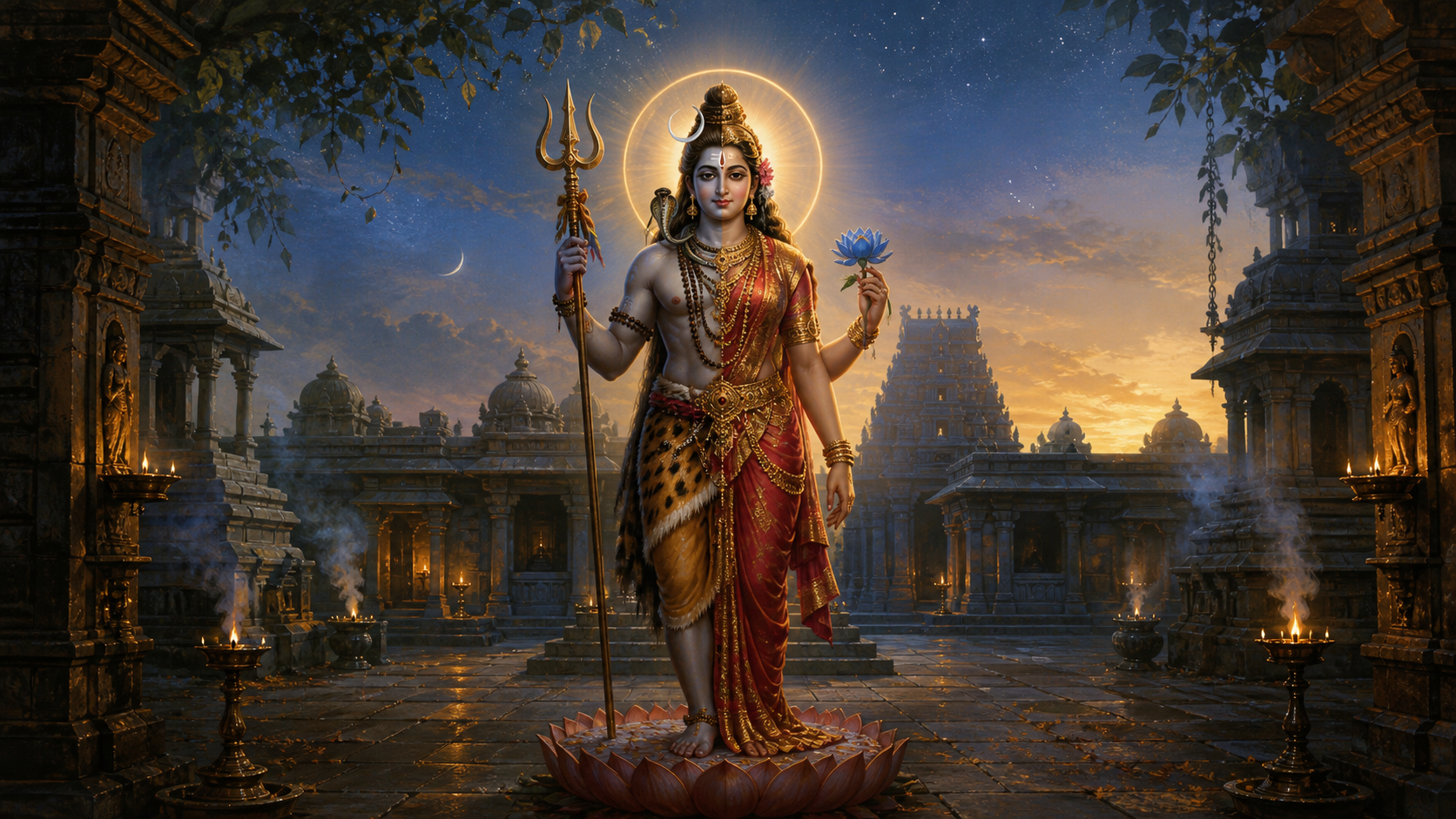
You may recognize Ardhanareeswara as the form that is half Shiva and half Parvati, yet still wonder what the image contributes to a reading of Manickavasagar. The key is to stop treating the divided appearance as a diagram of two competing powers. It is a disciplined way of seeing one Divine reality whose stillness and activity, majesty and tenderness, cannot be separated.
Manickavasagar gives this vision a devotional voice. Ardhanareeswara gives it a body. Read together, they help you recognize where one-sided ideas about God – and one-sided habits within yourself – need correction.
The central claim is difference without division
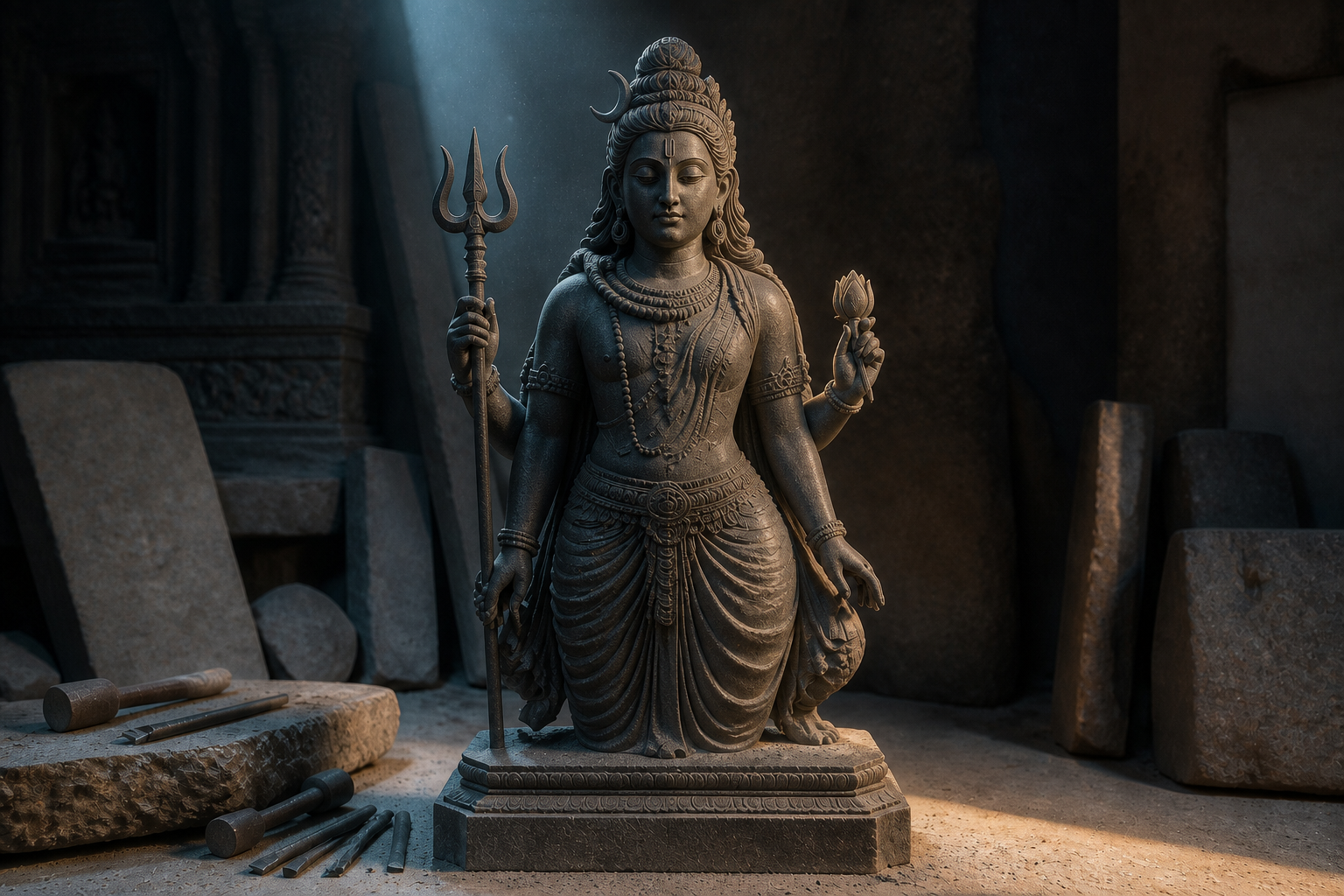
The name Ardhanareeswara means the Lord who is half woman. That translation describes the visible form, but it does not yet disclose its theology. The image does not show two incomplete beings sharing space because neither can stand alone. It shows a single sacred presence in which Shiva and Shakti remain distinguishable without becoming separable.
This distinction matters. If you see only sameness, Parvati’s identity disappears into Shiva. If you see only difference, the form breaks into two rival divinities. Ardhanareeswara refuses both mistakes. Unity does not require uniformity, and difference does not require conflict.
Shiva signifies consciousness, contemplative stillness, tapas and transcendence. Shakti signifies creative power, manifestation, fertility, auspiciousness and care. These are not sealed departments. Stillness without power would never become a living cosmos; power without consciousness would have no intelligible center. Their union is therefore not a negotiated compromise. It is the wholeness from which both distinction and relationship become possible.
Three common readings miss that point:
- The arithmetic reading: Ardhanareeswara is not fifty percent Shiva plus fifty percent Parvati. The body is one before you begin counting its features.
- The stereotype reading: The icon should not be reduced to a claim that every man must possess one fixed set of qualities and every woman another. Its concern is cosmic and theological before it is social or psychological.
- The erasure reading: Union does not make Shiva and Shakti interchangeable labels. Their recognizable differences are part of what the image asks you to contemplate.
When you encounter the murti, therefore, ask a sharper question than which half represents which deity. Ask why neither half can be understood correctly after the shared body has been forgotten.
Manickavasagar makes cosmic unity emotionally immediate
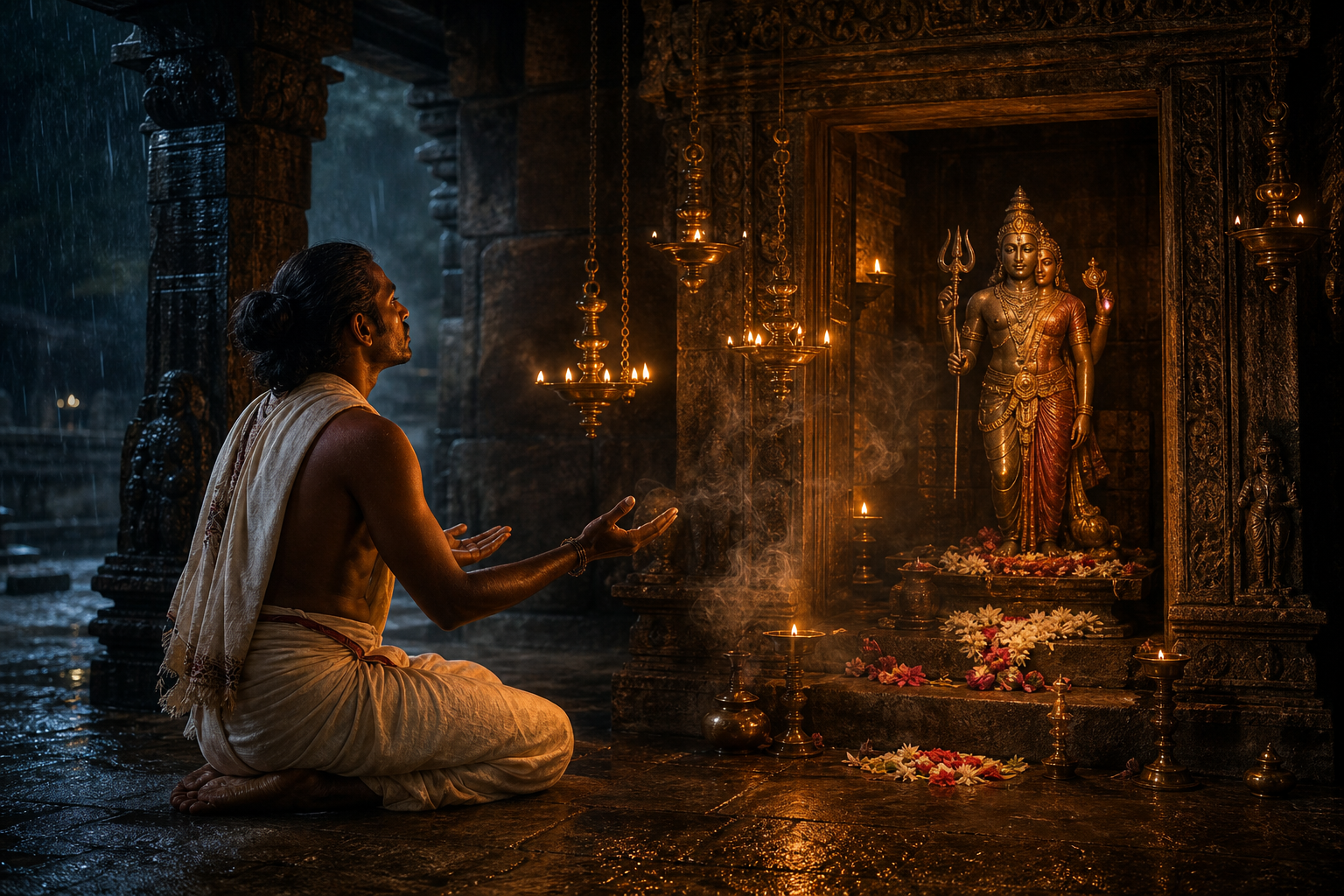
Manickavasagar’s Tiruvacakam does not approach Shiva as a remote proposition to be solved. Its devotional world brings the infinite near enough to be loved, addressed, sought and surrendered to. Shiva can be overwhelming in majesty and intimate in grace. The same Lord who exceeds the cosmos can enter the devotee’s inward life.
The expression annai appan – mother and father supplies the most direct key to the connection with Ardhanareeswara. Motherhood and fatherhood are not competing jurisdictions within the Divine. They name ways in which one Divine presence creates, protects, corrects, nourishes and receives the devotee.
This prevents two distortions of bhakti. The first imagines Shiva only as a distant patriarch whose authority leaves no room for tenderness. The second dissolves divine majesty into undemanding comfort. Manickavasagar’s devotional language holds nearness and transcendence together: Shiva is near enough to console you and vast enough to transform you.
Ardhanareeswara makes that double movement visible. The ascetic is not separated from the source of abundance. Maternal care is not separated from spiritual sovereignty. Renunciation and generativity occupy one form because the Divine is not forced to choose between withdrawing from the world and sustaining it.
This is why Manickavasagar’s Shiva-Shakti theology is best approached as lived devotion rather than gender arithmetic. The question is not whether God should be placed in a masculine or feminine category. The question is whether your category can contain a reality experienced as fatherly strength and motherly tenderness without diminishing either.
You can use that question to test your own prayer. If you approach Shiva only when you want protection, have you made too little room for correction and surrender? If you seek only consolation, have you excluded the tapas that changes you? If your idea of spiritual strength has no tenderness, or your tenderness has no courage, Ardhanareeswara exposes the imbalance.
The icon’s visual grammar teaches you how to look
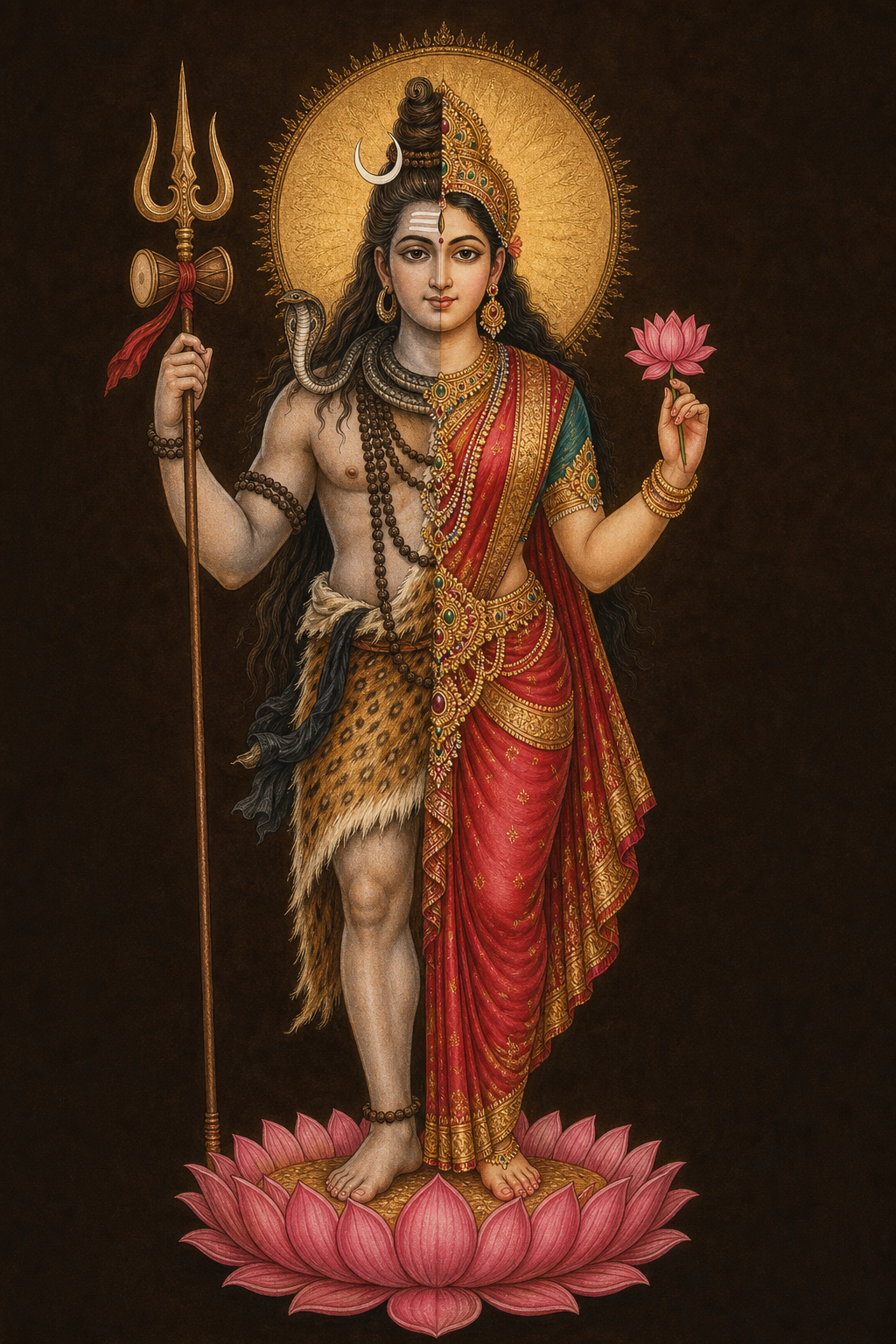
Temple iconography communicates through details rather than abstract definitions. In the familiar visual arrangement, Shiva occupies the right half and Parvati the left. Each side remains recognizable, but every feature belongs to a single standing presence.
- On Shiva’s side, matted locks, the crescent moon, rudraksha ornaments and the tiger-skin garment evoke ascetic discipline, transcendence and inward steadiness.
- On Parvati’s side, flowing hair, a sari, jeweled adornment and softer maternal contours evoke fertility, auspiciousness, beauty and affectionate care.
- Across both sides, one body prevents either set of meanings from becoming self-sufficient. Tapas belongs beside grace; abundance remains joined to spiritual depth.
The shared body is more important than the inventory of attributes. If you study the ornaments but mentally split the murti into two independent figures, you have recognized the symbols while missing their syntax. The icon first permits distinction and then denies separation.
A useful way to receive darshan is to look in three movements. First, notice the contrasts without rushing to explain them. Next, attend to the single posture and shared bodily presence. Finally, return to each half and see how its meaning has changed through union with the other. Shiva’s steadiness is no longer barren withdrawal; Parvati’s abundance is no longer mere material profusion. Each discloses the depth of the other.
This way of looking also protects you from turning Ardhanareeswara into a decorative slogan about balance. Balance can imply that two external forces have been adjusted until neither overwhelms the other. The murti goes deeper: Shiva and Shakti do not merely cooperate after beginning apart. Their relationship belongs to the way divine wholeness is revealed.
Use philosophical parallels without flattening the traditions
Ardhanareeswara can serve as an emblem of non-duality, but non-duality must not become a vague claim that every distinction is unreal or every school teaches the same metaphysics. Shaiva Siddhanta and Advaita Vedanta can both find the form suggestive while explaining ultimate reality, difference and liberation in their own ways. The image creates a field for contemplation; it does not erase the work of careful philosophy.
The pairing of Purusha and Prakriti can also help if it is used as an analogy: consciousness and creative power are not enemies fighting for control of existence. But a helpful analogy is not automatically an exact identification of distinct philosophical vocabularies. Keep the comparison at the level it can genuinely support – the refusal to isolate consciousness from the power through which life appears and acts.
Manickavasagar adds an indispensable devotional dimension. A concept of consciousness and power can remain intellectually tidy while leaving the worshipper untouched. Mother-and-father language turns the same unitive insight into a relationship of dependence, love, correction and grace. The Divine is not merely a metaphysical whole. The Divine becomes the presence to whom the devotee can entrust the divided self.
Comparable disciplines of integration appear across the wider Dharmic family. Buddhist practice holds wisdom and compassion together. Jain practice joins ahimsa with rigorous self-mastery. Sikh teaching brings temporal responsibility and spiritual sovereignty into the relation expressed by Miri-Piri. These are not interchangeable doctrines, and Ardhanareeswara should not be used to absorb them into Shaiva categories. Their value here is more precise: each warns that a virtue can become distorted when severed from its necessary partner.
- Wisdom without compassion can become cold; compassion without wisdom can lose direction.
- Nonviolence without discipline can remain an intention; discipline without nonviolence can harden into domination.
- Spiritual sovereignty without responsibility can become withdrawal; temporal power without spiritual orientation can become mere control.
- In the same way, strength without tenderness becomes harsh, while tenderness without strength may fail to protect what it loves.
The responsible comparison therefore concerns a shared civilizational resistance to one-sidedness. It honors resonance without pretending that doctrinal differences are superficial.
Carry Ardhanareeswara from contemplation into conduct
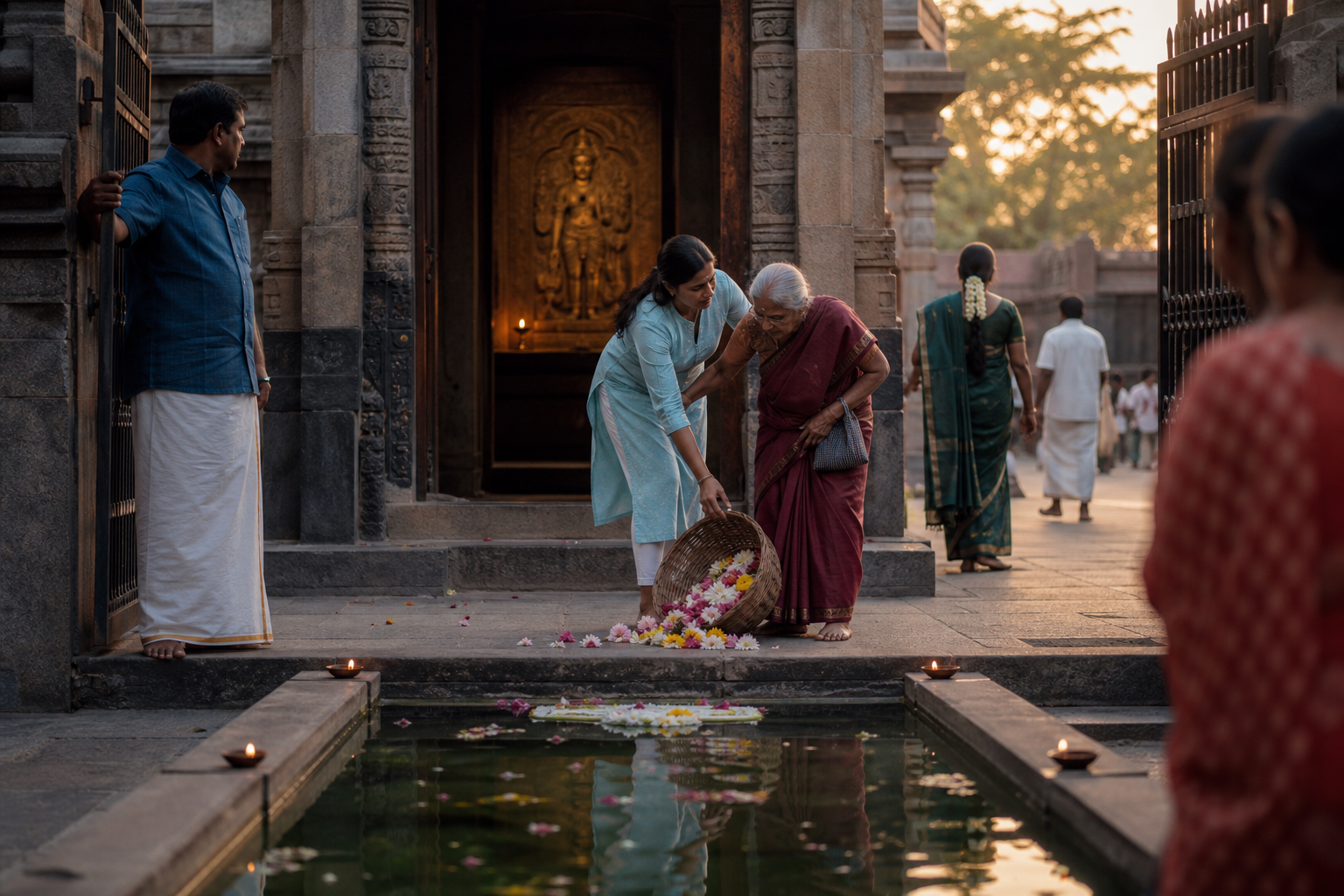
The icon becomes useful in daily life when it helps you identify a division you are actually living. Do not begin with an abstract ambition to become perfectly balanced. Begin with one situation in which a good quality has become distorted because its partner is absent.
- Name the tension. Choose a real pair active in your day: firmness and compassion, solitude and service, reason and empathy, responsibility and receptivity, or discipline and care.
- Identify your habitual side. Notice which quality you reach for automatically. The aim is not to condemn it but to see what it cannot accomplish alone.
- Contemplate the single form. Picture or behold Shiva and Parvati sharing one body. Let the unity challenge your assumption that honoring the neglected quality would betray the familiar one.
- Join the qualities in one action. Set a boundary without humiliation, offer care without abandoning discernment, make a decision without refusing to listen, or enter solitude so that you can return to service with greater clarity.
- Review the result. Ask whether strength became kinder and whether tenderness became more capable of action. If only one side was expressed, the practice is not finished.
In yogic contemplation, some seekers associate Ardhanareeswara with the harmonizing of ida and pingala nadis at the anahata, or heart, center. Use that framework as a contemplative symbol if it belongs to your established practice: alternating tendencies are gathered toward inner poise rather than allowed to pull the person apart. It need not be turned into a claim of guaranteed energetic effects.
The same method can clarify family and community life. A caregiver may need a boundary that protects care from exhaustion. A decision-maker may need empathy so that firmness serves people rather than ego. A contemplative may need service so that inward discipline does not become indifference. The point is not to occupy a neutral position between every pair. It is to let each quality become more truthful through relation with the other.
Key takeaways
- Ardhanareeswara presents Shiva and Shakti as distinguishable but indivisible, not as rival deities forced into a compromise.
- Manickavasagar’s language of Shiva as mother and father makes this unity intimate, devotional and transformative.
- The iconographic details matter, but the single body governs their meaning: ascetic stillness and creative abundance belong together.
- Philosophical and inter-Dharmic parallels should illuminate shared resistance to one-sidedness without erasing doctrinal differences.
- Contemplation becomes practical when you unite two separated virtues in one concrete act.
The next time you stand before Ardhanareeswara, take one unresolved tension with you. See both halves clearly, then attend to the life they share. Leave with one action in which courage protects compassion, stillness guides service, or discipline makes grace dependable. That is where Manickavasagar’s Shiva-Shakti vision begins to move from sacred poetry and temple form into your own conduct.
References
