
If you are trying to decide whether Monday, December 15, is the Ekadashi fasting day and when you should break the vrata, the short answer is clear: most regions observe Krishna Paksha Ekadashi on December 15. The detail that needs care is parana, because Ekadashi continues until 10:22 PM before Dwadashi begins.
Use the date and tithi below as your working plan, but confirm the final clock times for your city. Local sunrise, regional calculations, temple practice, and sampradaya rules matter more than a timetable copied from another location.
The day’s Panchang at a glance
| Panchang element | Practical reading for the observer |
|---|---|
| Civil date | Monday, December 15, 2025 |
| Paksha | Krishna Paksha, the waning half of the lunar month |
| Tithi | Ekadashi, the eleventh lunar day, until 10:22 PM in the stated calculation |
| After 10:22 PM | Krishna Paksha Dwadashi, the twelfth lunar day |
| Main observance | Upavasa, japa, dhyana, restraint, and compassionate conduct according to your tradition |
| Parana | After sunrise on Dwadashi, within the locally prescribed period and after Ekadashi has ended |
| Details requiring local verification | Exact tithi boundary, sunrise, parana window, nakshatra, Chandra Rashi, shubh muhurta, and temple schedule |
The distinction between a civil date and a tithi prevents the most common mistake. A civil date changes at midnight, but a tithi follows the lunar cycle and can end at any clock time. The transition to Dwadashi at 10:22 PM therefore does not automatically make 10:22 PM the time to eat. Tithi completion and the permitted parana period are separate considerations.
Build the vrata around restraint, not only food
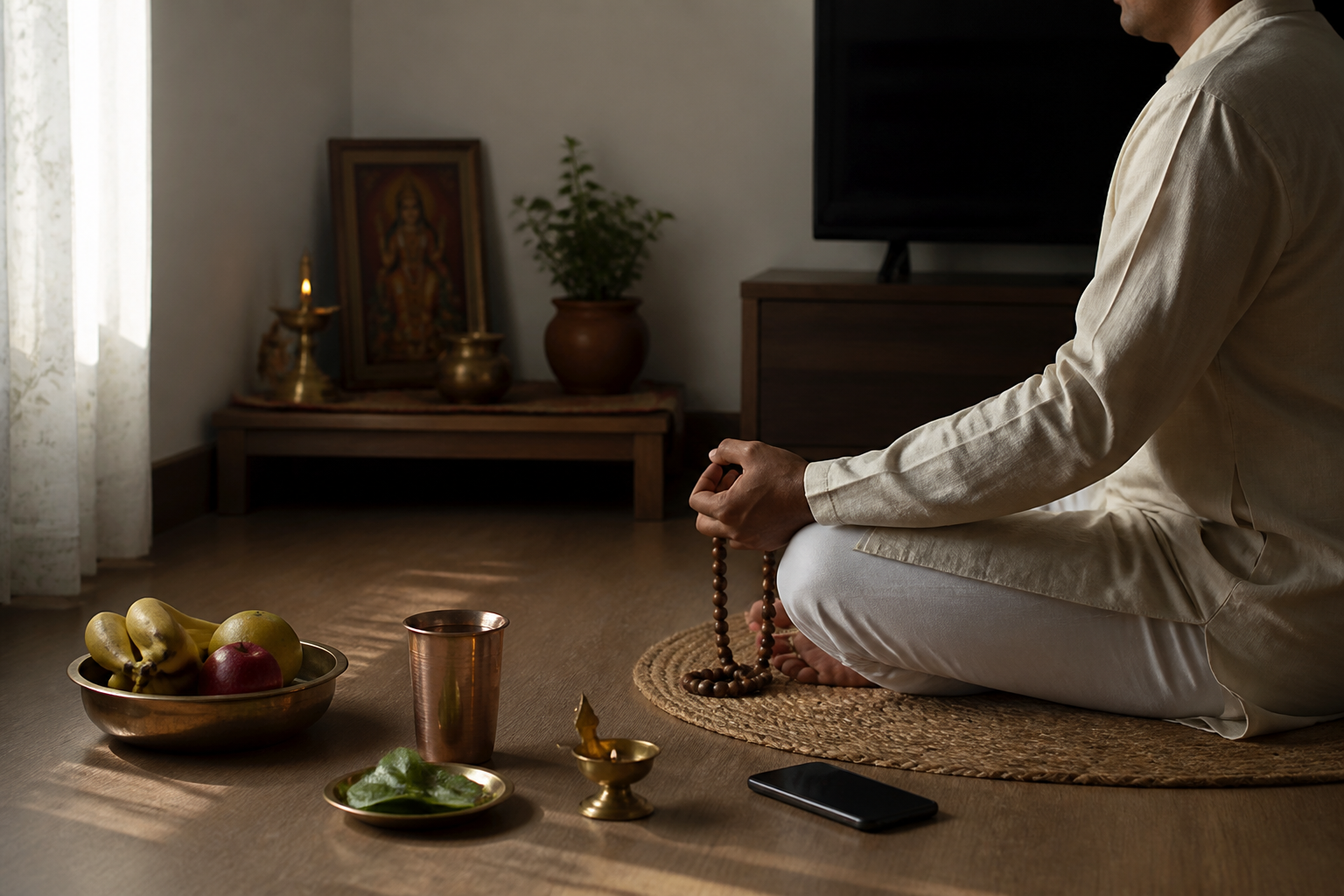
Ekadashi is more useful when you decide its form before the day begins. If your family, guru-parampara, or temple has an established practice, follow that form rather than assembling rules from unrelated calendars. Dietary customs and parana requirements can differ among sampradayas even when everyone is observing the same tithi.
- Choose the form of upavasa in advance. Follow the discipline appropriate to your tradition and physical capacity. Do not assume that the strictest form found online is the only valid one.
- Confirm the local date before making sankalpa. Use a Panchang calculated for your city, especially if you live outside Bharat or far from the location used by a printed almanac.
- Give japa and dhyana an actual place in the day. Reserve defined periods for them instead of treating them as optional additions if time remains.
- Carry restraint into speech and conduct. A fast accompanied by anger, needless argument, or contempt keeps the outer restriction while losing its ethical direction.
- Record the parana window before night. This removes uncertainty the following morning and helps the household complete the vrata together.
If severe restriction of food or water is unsafe for you, a generic religious timetable is not medical guidance. Choose a form your health permits, seek appropriate clinical advice where needed, and ask a trusted elder or temple authority how your sampradaya accommodates the situation. Japa, dhyana, moderation, and compassionate conduct should not be dismissed merely because a strict fast is unsuitable.
The deeper disciplines also reveal a wider Dharmic kinship. Mindfulness, ethical restraint, compassion, and ahimsa appear in different forms across Hindu, Buddhist, and Jain traditions. That shared civilizational vocabulary should deepen mutual respect without erasing the distinct ritual rules of each path.
Do not break the fast at 10:22 PM
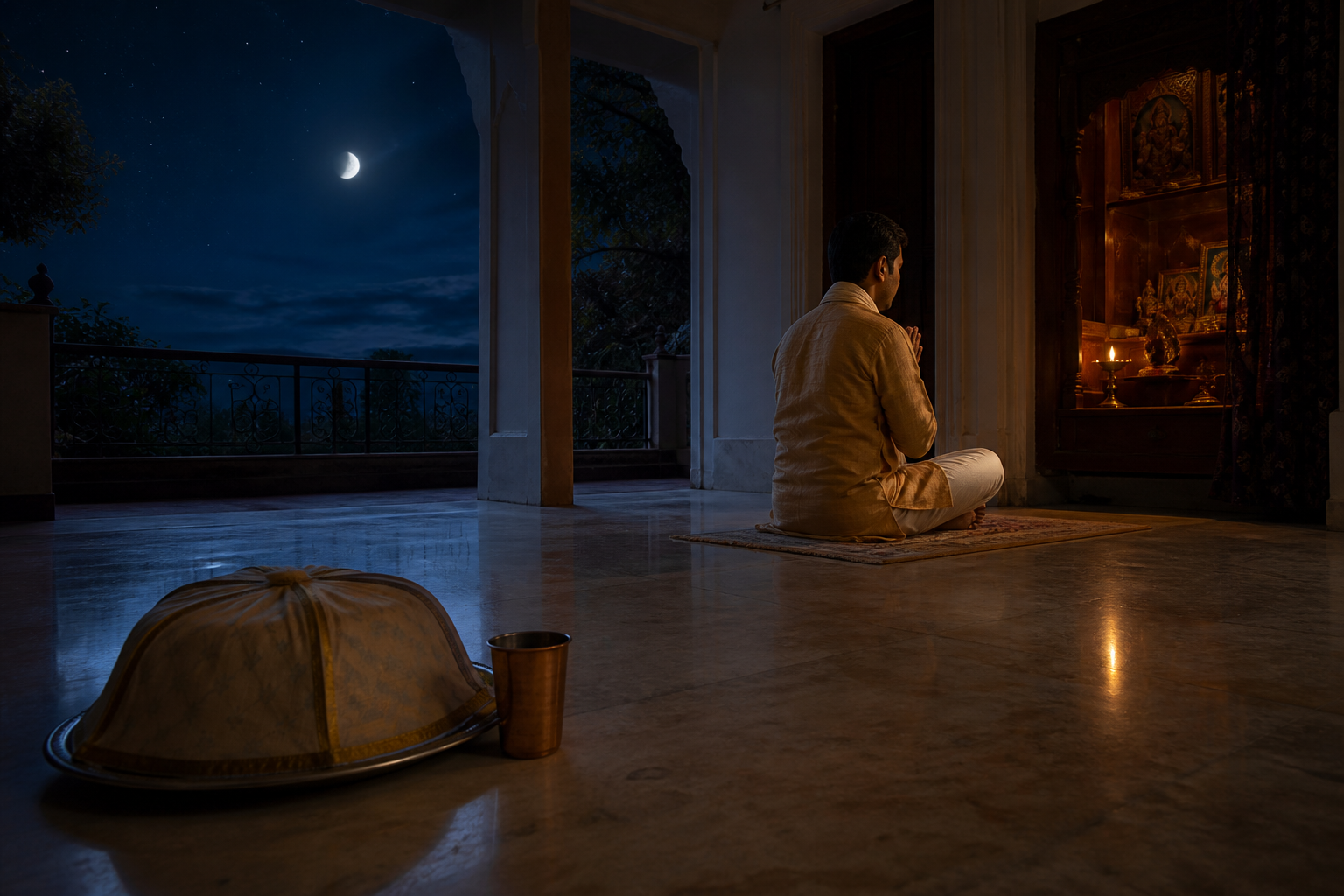
The late-evening change from Ekadashi to Dwadashi tells you that the lunar date has changed. It does not, by itself, establish parana. The customary sequence is to maintain the vrata through Ekadashi and perform parana after sunrise on Dwadashi, within the period accepted by your sampradaya.
For most observers following the December 15 calculation, this means preparing to break the fast on the morning of Tuesday, December 16, not late on Monday night. Treat that as a planning conclusion, not a universal clock-time ruling. Your local Panchang must still establish sunrise and the permitted window for your location.
- Check that the Panchang is set to your actual city and time zone.
- Confirm that Ekadashi has ended before the proposed parana period.
- Confirm that the period begins after local sunrise.
- Apply your sampradaya’s rules rather than borrowing a window from another tradition.
- If you will attend a temple, follow its announced schedule and ask which local calculation it uses.
If a household calendar and a temple notice differ, do not average the two times. Ask which location, sunrise, and parampara each one follows. Then use one coherent standard for both sankalpa and parana. Mixing the beginning rule from one calendar with the ending rule from another creates a precision that neither calendar actually supports.
Nakshatra, Chandra Rashi, and muhurta need a local check
A nakshatra is the lunar mansion occupied by the Moon, while Chandra Rashi is the Moon’s zodiac sign. Neither should be treated as an unqualified, all-day label when a transition may occur during the date. The same caution applies to shubh muhurta: a window calculated from local sunrise and location cannot simply be transferred to another city.
This matters most when you need exact wording for sankalpa, plan a temple ritual, or select a muhurta for a separate undertaking. In those cases, enter the correct city in a trusted Panchang and inspect the entry for the intended clock time. A calendar that lists only the civil date without a location is not precise enough for that decision.
Do not use 10:22 PM as a substitute for a shubh muhurta. It is the stated Ekadashi-Dwadashi boundary, not a general auspicious window. Tithi, nakshatra, Chandra Rashi, sunrise, and muhurta answer different questions; one timing cannot stand in for all of them.
For an ordinary home observance, you do not need to turn these variables into anxiety. Confirm the Ekadashi date, follow your customary vrata, and keep the correct local parana period ready. Seek finer astronomical precision when a ritual or decision genuinely depends on it.
Key takeaways for December 15

- Monday, December 15, 2025, is Krishna Paksha Ekadashi in most regions.
- The stated Ekadashi tithi ends at 10:22 PM, after which Dwadashi begins.
- The end of Ekadashi at night is not an automatic instruction to break the fast at that moment.
- Plan parana for Dwadashi after local sunrise and within the period prescribed by your sampradaya.
- Verify nakshatra, Chandra Rashi, shubh muhurta, sunrise, and temple timings with a location-specific Panchang.
- Let upavasa support japa, dhyana, compassion, ahimsa, and disciplined conduct rather than reducing the vrata to a food rule.
On the evening before the vrata, save the Panchang entry for your city and write down the accepted parana window. Once those details are settled, December 15 can remain focused on sadhana rather than last-minute arguments about the clock.
References
