
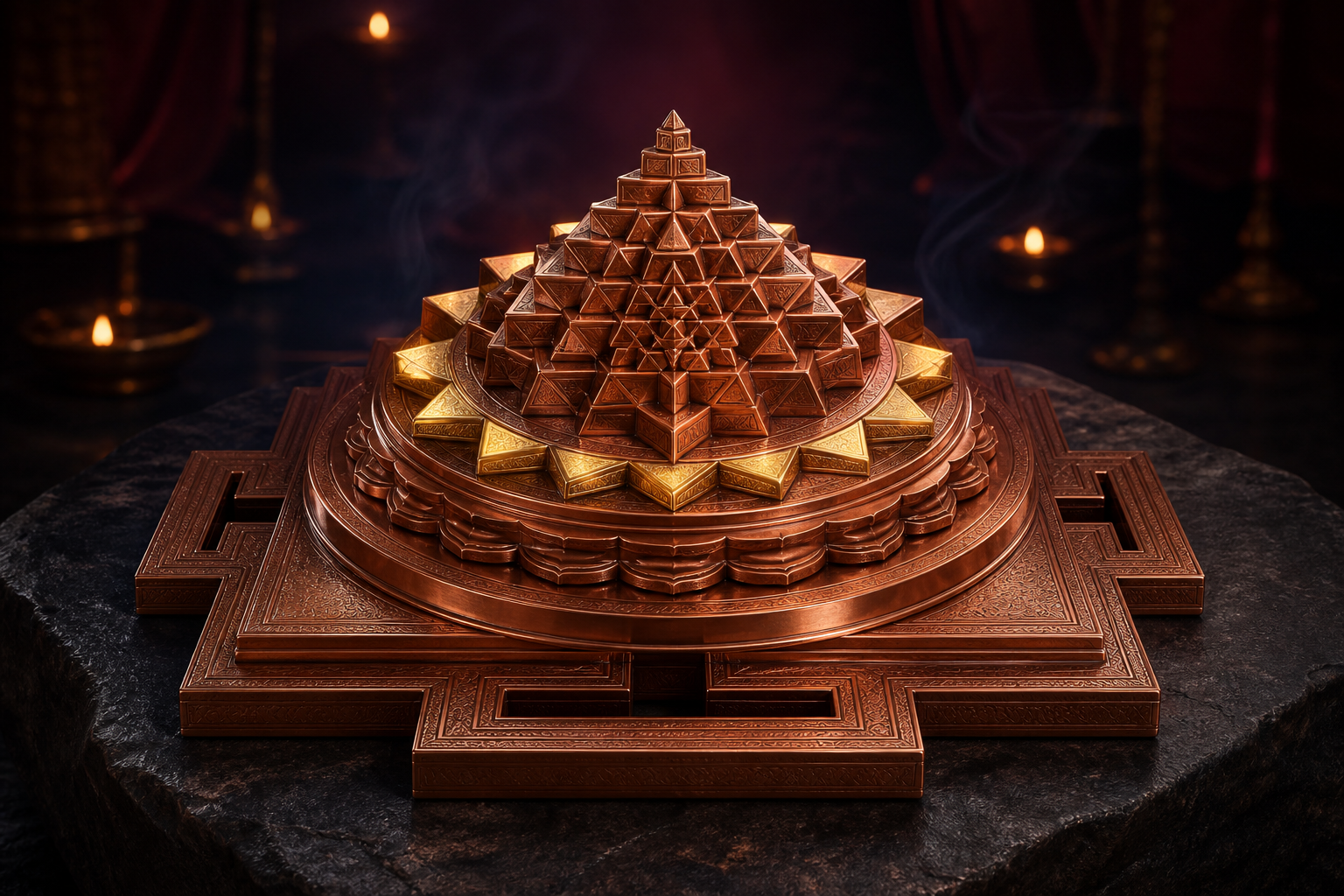
You may have reached this enclosure with two questions at once: What do the fourteen names mean, and may you simply chant them from a diagram? The useful answer is divided. You can study the names as a map of Shakti, but formal Sri Vidya worship belongs within a received paddhati. Learn the structure first; do not turn a glossary into a self-made ritual.
The fourth avarana is the fourteen-outer-triangle circuit of the Mahameru, known as the Sarva Saubhagya Dayaka Chakra, and its powers are called the Sampradaya Yoginis. Their sequence moves through forces such as agitation, attraction, delight, restraint, expansion, accomplishment, fullness, mantra, and the ending of duality. Understanding those relationships is more valuable than memorizing fourteen isolated English labels.
Locate the enclosure before memorizing its names

An avarana is an enclosure or circuit. When the Sri Chakra is approached from its outer boundary toward the bindu, this is the fourth complete enclosure. It is not the fourth individual triangle. It is the entire circuit formed by fourteen triangles. In the three-dimensional Mahameru, the same sacred arrangement rises as a tier rather than remaining a flat diagram.
Put four labels at the top of your study page: Fourth Avarana, Fourteen-Triangle Circuit, Sarva Saubhagya Dayaka Chakra, and Sampradaya Yoginis. This small discipline prevents a common confusion: lists from different enclosures can contain similar language, but their positions and ritual identities are not interchangeable.
Sarva Saubhagya Dayaka is commonly understood as that which bestows complete auspicious fortune. Do not reduce saubhagya to money, luck, or the success of a particular wish. The enclosure presents auspiciousness as the right ordering of powerful forces. Attraction must be governed. Delight must not become delusion. Accomplishment must not harden into possession. The sequence finally points beyond the pairs of opposites through which the ego divides experience.
The fourteen Sampradaya Yoginis, in sequence

The English phrases below are working senses, not complete translations and not ritual instructions. Sanskrit divine names carry more than a dictionary definition. Use each gloss to recognize the force named by the Shakti, then return to the Sanskrit name rather than replacing it with the gloss.
| Order | Shakti | Working sense | Question for study |
|---|---|---|---|
| 1 | Sarva Saṃkṣobhiṇī (Sarva Samkshobhini) | She who stirs or shakes all | What must be disturbed because inertia is masquerading as peace? |
| 2 | Sarva Vidrāviṇī (Sarva Vidravini) | She who loosens, melts, or disperses all | What rigidity must lose its hold before movement is possible? |
| 3 | Sarvākarṣiṇī (Sarva Akarshini) | She who draws or attracts all | Where is attention being drawn, and is that movement aligned with dharma? |
| 4 | Sarvāhlādinī (Sarva Ahladini) | She who gladdens or delights all | Can joy be received without immediately turning it into grasping? |
| 5 | Sarva Sammohinī (Sarva Sammohini) | She who enchants or bewilders all | Where do fascination and confusion look deceptively similar? |
| 6 | Sarva Stambhinī (Sarva Stambhini) | She who arrests, restrains, or stills all | What impulse must stop before right action can begin? |
| 7 | Sarva Jṛmbhiṇī (Sarva Jrimbhini) | She who opens or expands all | What capacity can unfold once restless movement has been restrained? |
| 8 | Sarva Vaśaṅkarī (Sarva Vashankari) | She who brings all under order or influence | Can your own energy be governed without trying to dominate another person? |
| 9 | Sarva Rañjinī (Sarva Ranjini) | She who colors, charms, or delights all | What is giving the present experience its emotional color? |
| 10 | Sarvonmādinī (Sarva Unmadini) | She who intoxicates or carries all beyond ordinary measure | Does intensity loosen self-centeredness, or does it merely excite it? |
| 11 | Sarvārthasādhinī (Sarvarthasadhini) | She who accomplishes every worthy purpose | Is the aim clear, dharmic, and pursued through fitting means? |
| 12 | Sarva Sampattipūriṇī (Sarva Sampattipurini) | She who fills or completes every form of prosperity | What form of sufficiency is being overlooked while more is demanded? |
| 13 | Sarva Mantramayī (Sarva Mantramayi) | She whose form is all mantra | Is sacred sound being approached as divine presence or merely as a technique? |
| 14 | Sarva Dvandvakṣayaṅkarī (Sarva Dvandvakshayankari) | She who brings the pairs of opposites to an end | Which rigid opposition still determines how experience is judged? |
Transliteration varies. You may see Saṃkṣobhiṇī written as Samkshobhini, Jṛmbhiṇī as Jrimbhini, or Dvandvakṣayaṅkarī divided into several words. Such differences do not automatically indicate different deities. At the same time, do not silently alter the spelling, order, or ritual placement given by your own sampradaya. If a modern list conflicts with a received paddhati, take the discrepancy to the person who teaches that paddhati.
Read the sequence as transformation, not a catalogue of powers

The repeated word sarva means all or the whole. That repetition matters. These are not minor abilities assigned to separate compartments of life. Each name presents a universal movement of Shakti. For study purposes, the sequence can be read in three movements. This is a memory aid and contemplative framework, not a replacement for a lineage’s ritual explanation.
The field is stirred, loosened, and drawn
The opening names prevent you from imagining spiritual life as permanent calm. Saṃkṣobhiṇī disturbs settled inertia. Vidrāviṇī loosens what the disturbance exposes. Akarṣiṇī then reveals the pull that directs attention. Ahlādinī introduces delight, while Sammohinī warns that attraction and pleasure can shade into enchantment and confusion.
When you study these names, look at the direction of movement. Being shaken awake is not the same as being destabilized for its own sake. Attraction is not automatically sacred merely because it feels powerful. Delight is not proof that a choice is dharmic. The practical question is always what the movement serves.
Energy is stopped, opened, and brought into order
Stambhinī interrupts momentum. Jṛmbhiṇī follows with opening or expansion. Placed together, they correct the assumption that restraint and growth are opposites. A force sometimes has to be arrested before its deeper capacity can unfold. Vaśaṅkarī then introduces governance, Rañjinī the coloring of experience, and Unmādinī an intensity that exceeds ordinary measure.
This part of the sequence is easily misread as permission to control, enchant, or overwhelm other people. An inward-first reading is more disciplined. Notice what governs your attention, what colors your judgement, and what happens when intensity outruns discrimination. A divine name associated with influence does not provide ethical permission to manipulate another person.
Purpose reaches fullness and then yields its duality
Arthasādhinī and Sampattipūriṇī concern accomplishment and fullness. Mantramayī then turns attention from the achieved object toward sacred sound as the form of Shakti. Dvandvakṣayaṅkarī closes the circuit by dissolving dvandvas, the pairs of opposites through which the ordinary mind organizes experience.
The ending changes how you should understand auspicious fortune. The sequence does not culminate in endless acquisition. It culminates in the weakening of rigid divisions such as gain and loss, pleasure and pain, approval and rejection, or success and failure. This does not erase dharmic discrimination. It exposes the ego’s habit of making its preferred side of every pair the measure of reality.
How to study the fourth avarana without inventing a ritual

First decide what you are actually doing. Cultural study, contemplation of divine names, and formal avarana puja are related, but they are not identical activities. Formal worship coordinates more than a list of names. Pronunciation, mantra, nyasa, mudra, visualization, offerings, direction, and sequence belong to a coherent practice. Removing one element from that setting and improvising the rest can produce something that resembles Sri Vidya externally while no longer following its discipline.
- Copy the enclosure’s four identifying labels before copying the names. This keeps the list connected to its place in the Sri Chakra.
- Choose one reliable transliteration for your study page. Add alternate spellings in parentheses instead of repeatedly changing the main form.
- For each name, record three things: the movement it names, the distortion that movement can take, and the dharmic discipline that redirects it.
- Study the names in order. Notice transitions between adjacent Shaktis instead of selecting only the names that promise attraction, influence, prosperity, or accomplishment.
- Keep interpretation distinct from claims of attainment. Recognizing agitation, delight, restraint, or dualistic thinking in ordinary life does not amount to mantra siddhi or ritual authorization.
- If formal Navavarana worship is your aim, take your written list to a qualified teacher in the sampradaya you intend to follow. Ask whether the order is correct in that paddhati, which pronunciations require correction, and which parts of the practice require initiation.
Three misreadings deserve special caution. Do not turn the Shaktis into methods for bending another person’s will. Do not make saubhagya synonymous with material gain. Do not treat the diagram as decoration while ignoring the ordered movement of its enclosures. Each error removes the names from the sacred architecture that gives them context.
Key takeaways
- The fourth avarana is one complete circuit of fourteen outer triangles, not a single triangle.
- It is the Sarva Saubhagya Dayaka Chakra, and its fourteen powers are collectively the Sampradaya Yoginis.
- The names describe universal movements of Shakti, ranging from agitation and attraction to accomplishment, mantra, and the dissolution of duality.
- English meanings are study aids. They are not substitutes for the Sanskrit names, authorized mantras, or a lineage’s paddhati.
- The safest and most fruitful interpretation begins with governing your own attention, desire, emotion, and action rather than seeking power over someone else.
Your next step is concrete. Put the fourth enclosure’s name at the top of a page, copy the fourteen Shaktis in sequence, and study the tension between each name and the one that follows it. If puja is your goal, bring that page to the teacher who transmits your paddhati and have the spelling, order, and pronunciation corrected before you turn study into practice.
References
