
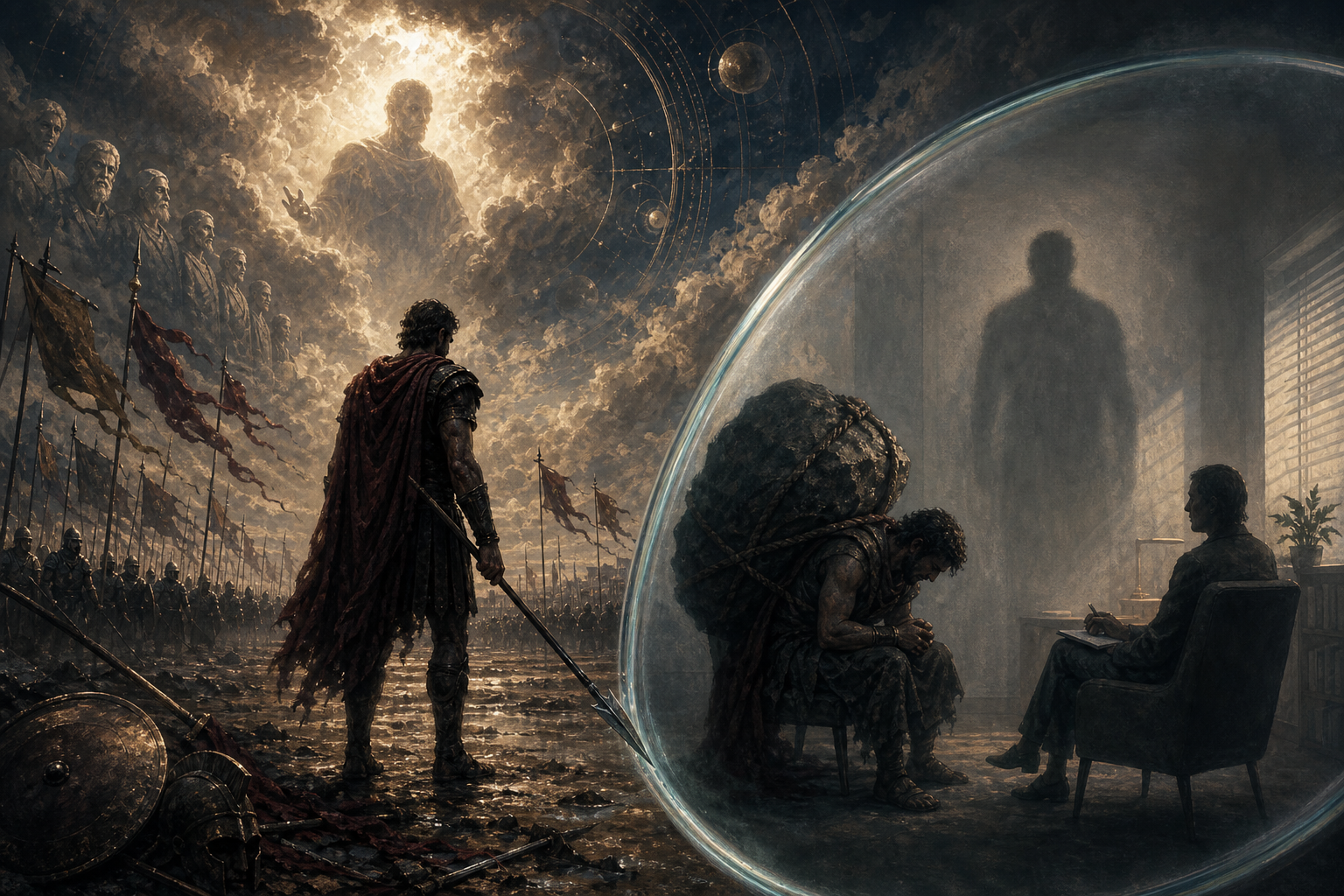
You finish a modern epic retelling and something feels wrong. The names, battles, and famous scenes are still there, but the hero now speaks in the moral language of a contemporary therapy room. Violence must produce guilt. A god becomes a projection of trauma. Duty becomes aggression, while reluctance becomes proof of enlightenment.
The useful question is not whether the adaptation changed the original. Every retelling changes something. The question is whether it has interpreted the epic’s moral conflict or quietly replaced it. Once you know where to look – motive, divine agency, consequence, and the ending – that replacement becomes much easier to see.
Key takeaways
- Guilt is not the only possible moral response to violence. An epic can present punishment, grief, duty, pride, or tragic loss without giving its hero a modern conscience.
- Identify the original diagnosis before evaluating a retelling. Homer’s central problem is Odysseus’s pride; the Bhagavad Gita identifies Arjuna’s paralysis with klaibyam and moha.
- When a real deity becomes a hallucination or metaphor, the adaptation has changed the story’s world, not merely its presentation.
- Test the new psychology against the ending. If supposedly transformative guilt has no effect on the hero’s later choices, it is probably decorative.
- For a Dharmic scripture, read at least one established commentary before accepting a modern political interpretation of an isolated scene.
Western guilt is a lens, not the natural meaning of war
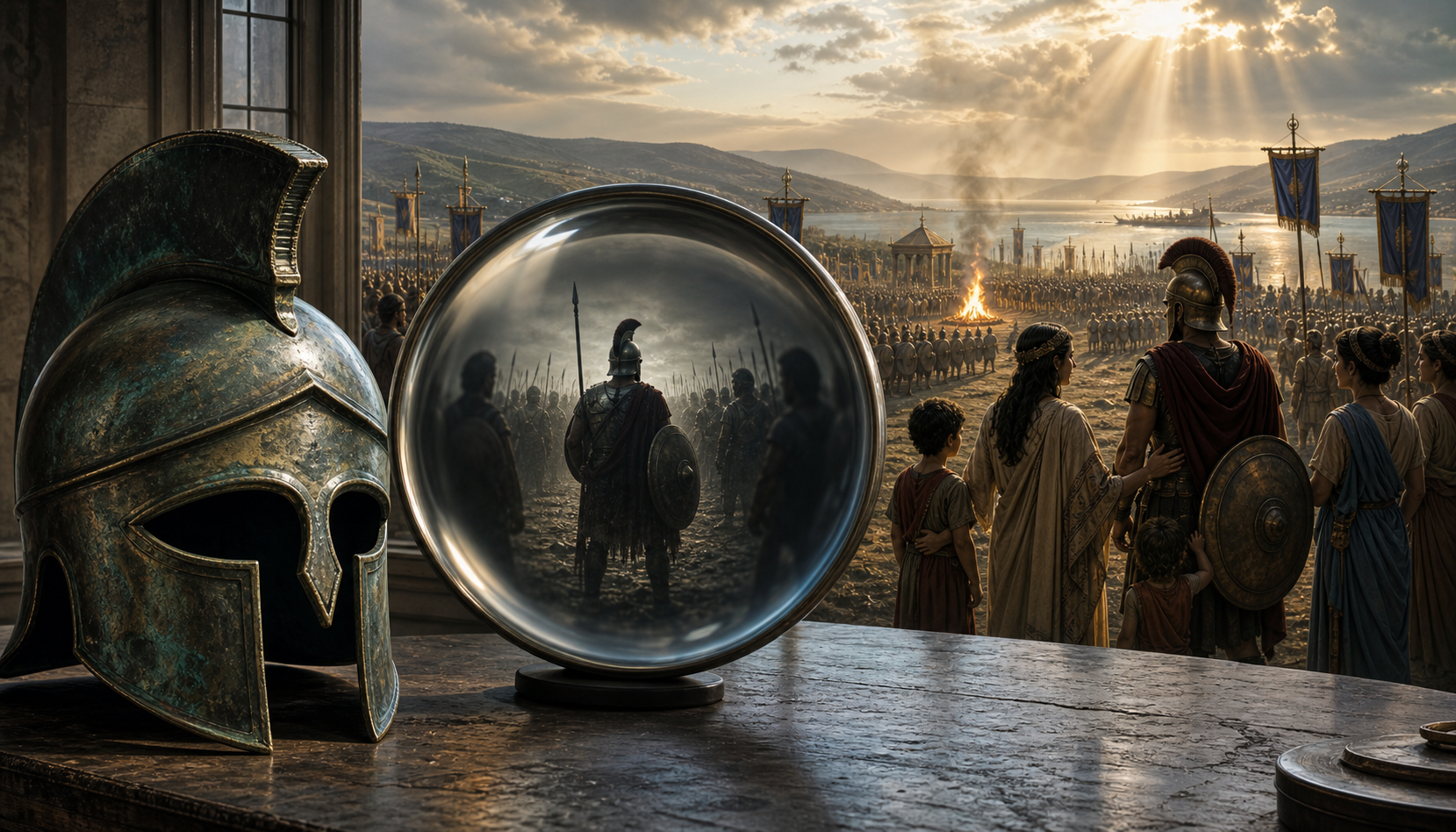
By “Western guilt,” we do not mean that every Western reader thinks alike, or that guilt is unique to the West. Homer himself belongs to the Western inheritance and resists this modern framework. The term names a narrower habit: the assumption that a morally serious story about war must culminate in remorse for having fought.
That habit has a history. Much modern Western reflection on war developed in the shadow of two world wars, the Holocaust, and the atomic bomb. Within that memory, suspicion of martial duty is understandable. The danger begins when one era’s suspicion becomes the compulsory conscience of every earlier civilization.
Guilt then starts doing more than interpretation. It becomes a certificate of humanity. The remorseful warrior is treated as morally complex; the warrior who acts without remorse must be primitive, propagandistic, or insufficiently examined. Yet an epic may locate moral failure somewhere else entirely: in arrogance, attachment, disobedience, appetite, broken obligation, or the misuse of rightful power.
You can avoid the category error by separating four questions. Did the hero suffer? Was the hero punished? Did the hero commit an injustice? Did the hero feel guilt? A modern screenplay often collapses these into one answer, but an ancient epic may answer each differently. Suffering is not automatically repentance, and divine punishment is not necessarily a demand for confession.
This distinction also prevents the argument from turning into a crude opposition between “the West” and “tradition.” Emily Wilson’s role in the new Odyssey is instructive: a line from her 2017 translation helped shape Nolan’s approach, yet she later criticized the resulting characterization. A Western classicist can resist the modern guilt template just as readily as a modern filmmaker can impose it. What matters is the reading, not the reader’s passport.
Changing Odysseus’s emotion changes the whole Odyssey
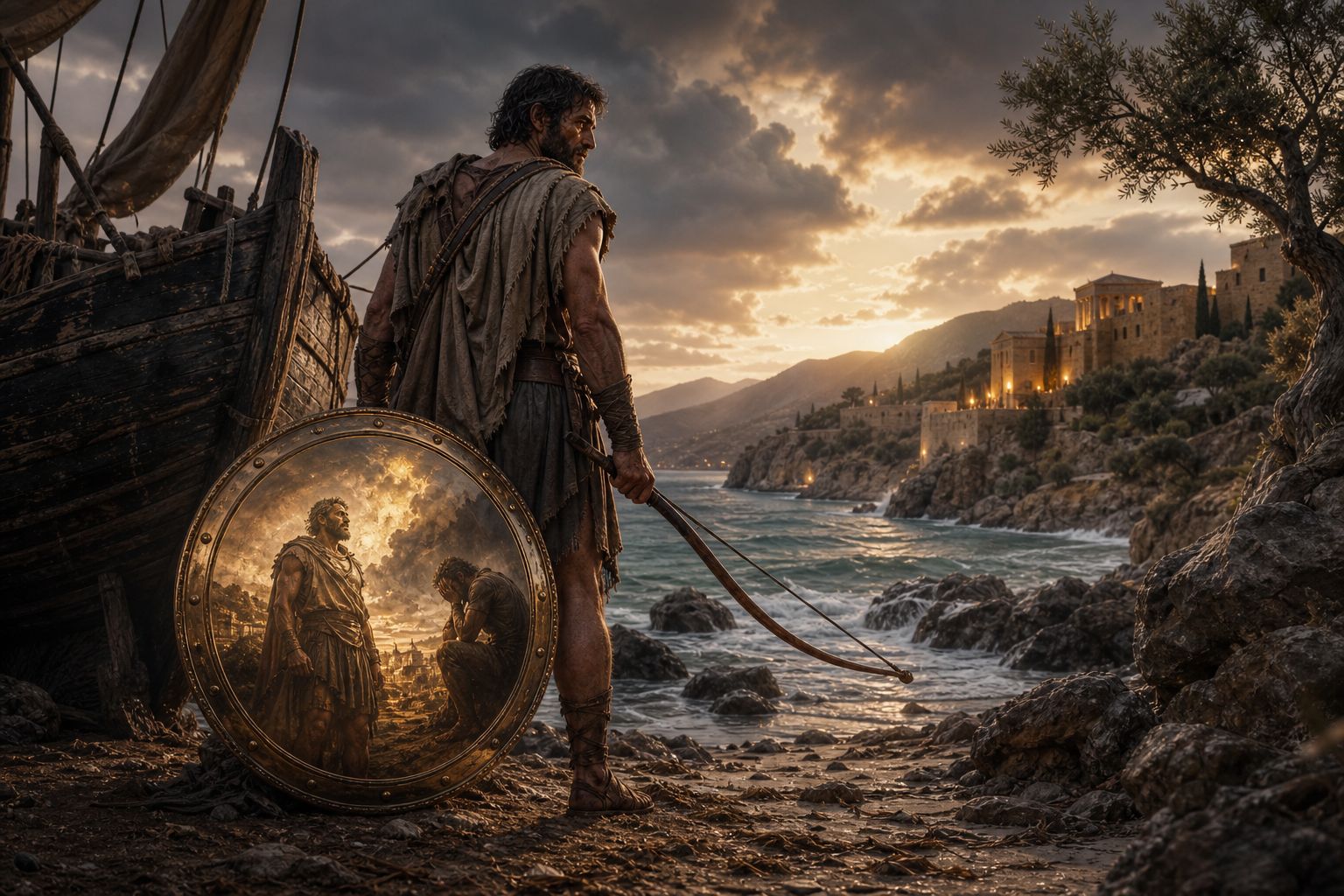
A guilt-centered Odysseus may initially seem like an ordinary update. Modern audiences understand trauma and moral injury, so why not use that vocabulary to make an ancient warrior accessible? Because the new emotion alters the causal structure of the story.
Homer’s Odysseus is resourceful, deceptive, proud, and capable of violence without the remorse expected from a modern anti-war protagonist. Poseidon’s hostility does not place him on a path toward atonement for Troy. It places a proud man inside forces he cannot command. Delay, shipwreck, dependence, and humiliation teach him that cunning does not make him sovereign over sea and god.
Once guilt replaces pride as the governing fault, every major element acquires a different function. The journey is no longer chiefly a humbling of self-assertion. It becomes psychological penance. Hardship no longer limits the hero’s power; it externalizes his conscience. Homecoming no longer completes a struggle against divine obstruction; it promises release from a remembered crime.
The change becomes still larger when Athena is reimagined. In Nolan’s version, Athena appears as the face of a Trojan girl whose death haunts Odysseus. A goddess who acts within the epic’s cosmos has become an image manufactured by the hero’s mind. That is not a costume change. It exchanges divine agency for psychological projection.
Whenever an adaptation makes this move, ask a direct question: what can now cause events? In the original world, a deity may know, command, protect, obstruct, or judge independently of the hero. In a psychologized version, the deity can reveal only something already inside him. Theology becomes memory, revelation becomes self-discovery, and cosmic order becomes mental health. The new version may still be compelling, but it is advancing a different account of reality.
The ending supplies the strongest test. Odysseus returns to Ithaca in disguise and kills the suitors occupying his hall. An adaptation can question that act, condemn it, or reconstruct the entire homecoming around it. What it cannot do coherently is spend most of its time making violence-induced guilt the hero’s governing psychology and then let him perform fresh violence without that psychology affecting his decision.
This is where convenient guilt reveals itself. It gives the audience a familiar sign of sensitivity but imposes no discipline on the plot. The emotion decorates the hero rather than governing him. Before calling such a portrayal “deeper,” write down what the alleged depth changes: Does the hero refuse an action, choose a different means, accept a cost, seek restitution, or reinterpret his duty? If the answer is nothing, the guilt is an accessory.
The Bhagavad Gita cannot be reduced to Arjuna’s reluctance
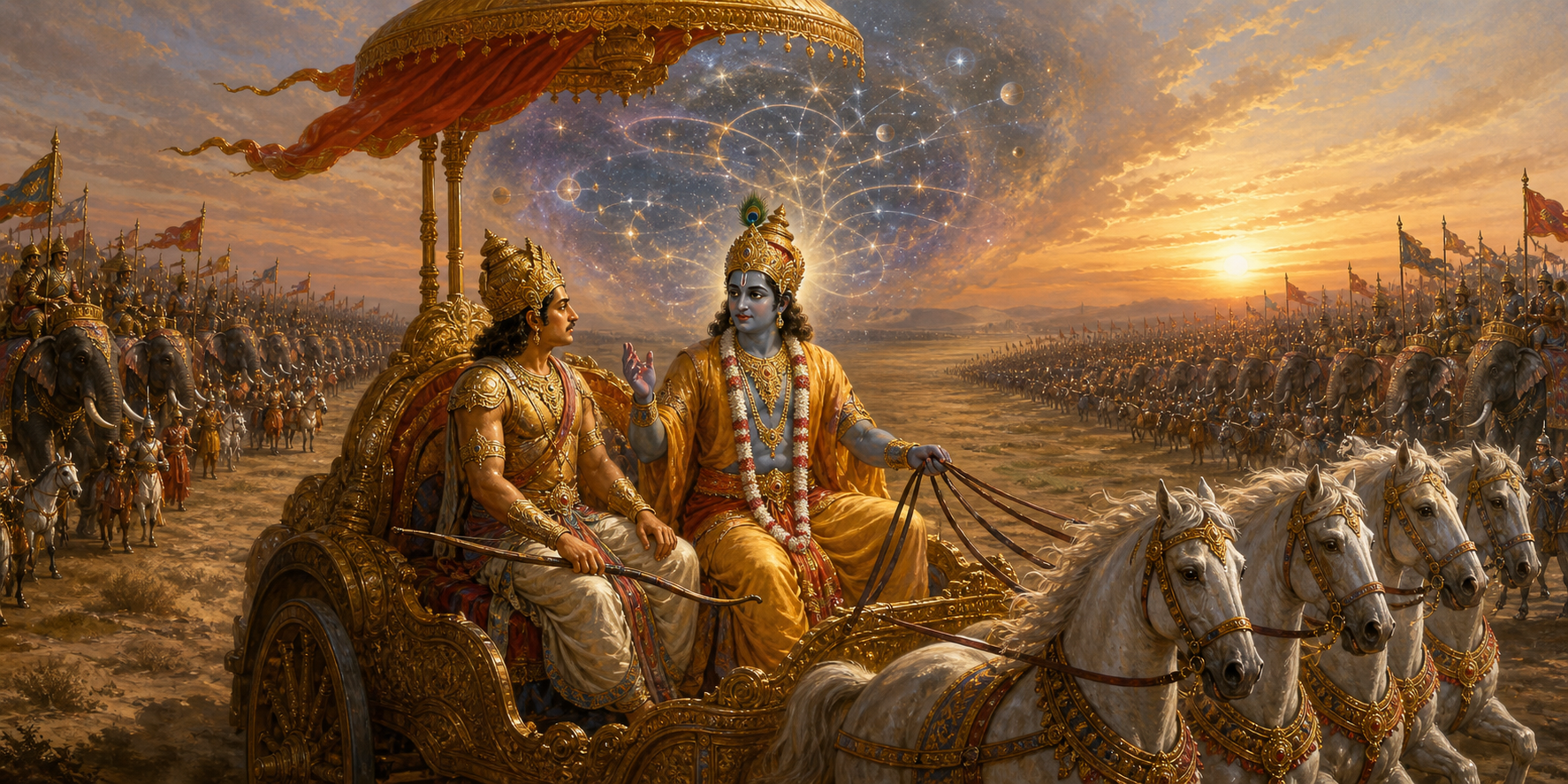
The same interpretive habit appears when the Bhagavad Gita is treated as a debate between an enlightened pacifist and a deity who pressures him into war. That reading selects the emotional surface of Arjuna’s collapse and supplies it with a modern anti-war conclusion. It does not begin with Krishna’s diagnosis.
Arjuna is not encountering violence for the first time. He has fought before. His paralysis arises when the opposing ranks contain his own relatives and teachers. Krishna calls the collapse klaibyam, a failure of nerve, and identifies moha, deluded attachment, within it. Arjuna’s language may sound compassionate, but the immediate question is whether his compassion expresses clear understanding or attachment to the people he personally cannot bear to confront.
That distinction matters because selective tenderness can imitate universal principle. A person may tolerate injustice until resisting it becomes personally costly. He may then rename his attachment “peace” and his fear “compassion.” Krishna refuses to judge Arjuna’s words by their gentleness alone. He examines the motive beneath them.
This does not make the Gita a celebration of bloodshed. Rejecting a pacifist rewrite is not the same as granting religious approval to every war. A Dharmic reading must still distinguish duty from appetite, protection from aggression, and disciplined action from cruelty. The point is that action cannot be judged merely by whether it allows the actor to feel innocent.
More than a millennium of commentary across competing darshanas gives you another safeguard. The acharyas disagreed about metaphysics, the nature of the self, devotion, knowledge, and the relation between jiva and Brahman. Yet the established commentarial inheritance approached the Gita as moksha shastra – teaching ordered toward liberation – rather than as a manifesto for conquest.
That history does not prohibit new interpretations. It does establish a burden of proof. If a modern reading claims that generations of philosophically opposed commentators all missed the work’s real purpose, the claim needs more than a few battlefield sentences detached from the rest of the teaching.
When you meet the claim that Krishna simply overcomes Arjuna’s moral objection to killing, ask three questions. Why does Krishna identify moha rather than praise renunciation? Why had Arjuna’s objection appeared specifically in front of his kin? And why did traditions interested in liberation, including traditions that valued ahimsa, not organize their readings around the claim that the Gita dishonestly excuses war? Those questions return the discussion to the text’s own categories.
A five-part test for the next epic retelling

You do not need to reject modern adaptations or demand scene-by-scene literalism. Use this test to decide what kind of work you are actually watching or reading.
- Name the original moral problem in one sentence. Use its own vocabulary where possible: hubris for Odysseus, moha and dharma for Arjuna. If your description begins with a concept supplied only by the adaptation, go back to the primary text.
- Trace cause and consequence. Ask why the hero suffers, who or what imposes the consequence, and what the suffering is meant to correct. Do not assume that pain means guilt or that punishment means atonement.
- Audit the metaphysics. Mark every place where a god becomes a dream, a vision becomes trauma, karma becomes social conditioning, or dharma becomes personal preference. These changes alter what the story says exists and how truth can be known.
- Stress-test the new motive against later action. If guilt, compassion, or anti-violence is presented as transformative, it should constrain a later choice. When the ending proceeds exactly as before, the added psychology may be designed to reassure the audience rather than explain the hero.
- Consult the reception history. For a Dharmic scripture, compare the modern claim with at least one commentary rooted in an established sampradaya. For Homer, compare the adaptation with the relevant episode in a complete translation. You are not required to accept every traditional conclusion, but you should know what the new reading had to displace.
An honest retelling can pass this test even when it changes almost everything. It can say, in effect, “We are using this epic to explore moral injury,” and then rebuild the character consistently around that choice. The problem is not creative freedom. The problem is borrowing the authority of an ancient name while concealing the replacement of its moral world.
Nor should fidelity become a demand that ancient epics be made morally comfortable. Their hierarchies, punishments, loyalties, and conceptions of order may remain alien to a modern reader. That distance is part of what they can teach. If every hero must affirm our assumptions before we listen, we never encounter another civilization; we encounter ourselves wearing its costumes.
The next time a retelling troubles you, do something small and concrete before joining the argument around it. Read the original scene, identify its diagnosis of the hero, and mark the adaptation’s changed motives. Then ask whether those motives survive the ending. Even a distorted retelling can become a doorway: new interest in the film has led readers back to Homer in translation. Take that final step yourself. Let the old story speak before allowing its modern replacement to speak for it.
References
