

If you have wondered whether Dharma leaves room for spies, secrecy, concealment, and hard bargaining, the Mahabharata offers a demanding answer. A kingdom may need hidden knowledge and guarded speech, but necessity does not make every method righteous.
The practical question is not whether strategy is pure or impure. It is whether power can learn enough to act without allowing suspicion, deception, pride, or cruelty to become the policy. Through charas, trusted envoys, concealed identities, diplomatic missions, and reconnaissance, the epic gives you a disciplined sequence: know before acting, test before believing, negotiate before using force, and keep every method answerable to Dharma.
The first battlefield is uncertainty
Intelligence and diplomacy solve different parts of the same problem. Intelligence reduces uncertainty about intentions, capabilities, alliances, and risks. Diplomacy uses communication to alter choices before those choices harden into conflict. Neither works well without the other.
A ruler who negotiates without intelligence may offer concessions to someone who never intended to settle. A ruler who gathers intelligence without diplomacy may know that conflict is approaching but fail to create an honourable way out. Information must therefore move toward judgement, and judgement must leave room for communication.
When you read a political episode in the Mahabharata, do not begin by asking which character is cleverest. Begin by mapping the uncertainty:
- Who knows the relevant fact, and who merely believes it?
- How was the information obtained: direct observation, testimony, rumour, or inference?
- Has another independent channel confirmed it?
- What decision becomes possible if the report is true?
- Who will suffer if the report is false or incomplete?
Those questions change how you see strategy. A dramatic message is no longer just a plot device. It becomes a test of provenance, interpretation, timing, and responsibility. Silence also becomes information: a missing reply, an unexplained change of allegiance, or an opponent’s reluctance to state a position can matter, but it remains an indicator rather than proof.
This reading also prevents anachronism. The Mahabharata depicts functions recognisable in intelligence work – observation, discreet reporting, verification, concealment, diplomatic communication, and reconnaissance. That does not establish that ancient kingdoms possessed bureaucracies identical to modern intelligence agencies. The meaningful parallel lies in the problems being solved, not in pretending that the institutions were the same.
Vidura-niti turns vigilance into a discipline

Vigilance can easily decay into paranoia. Vidura-niti points toward a more exacting practice by joining discreet information-gathering with corroboration, restraint, and protection of the innocent. The object is not to suspect everyone. It is to prevent rulers from making consequential decisions in ignorance.
Turn counsel into a verification routine
You can translate that principle into a five-part routine for evaluating any sensitive claim:
- Frame the decision first. Identify what must actually be known before action is justified.
- Trace provenance. Ask who observed the event, who transmitted the report, and where interpretation entered the chain.
- Seek independent confirmation. Repetition is not corroboration when several people learned the claim from the same origin.
- Mark uncertainty honestly. Separate confirmed fact, plausible inference, disputed claim, and unanswered question.
- Apply a harm test. If the claim is wrong, determine whether acting on it would injure innocent people or close a path to peace.
The distinction between repetition and corroboration is especially important. Three courtiers repeating the same whisper do not constitute three independent confirmations. Nor does confidence make a report reliable. A disciplined ruler asks whether the channels are genuinely separate and whether they could share the same error, fear, or interest.
It also helps to keep three statements separate: what was reported, what the report probably means, and what should be done. Confusing them produces avoidable mistakes. A messenger may accurately report a troop movement while an adviser misreads its purpose. Conversely, a correct inference may rest on evidence too fragile to justify irreversible action.
Vigilance, then, is not permanent distrust. Distrust begins with a verdict and searches for support. Intelligence begins with a question and tests competing answers. If you cannot state what evidence would change your judgement, you are defending a belief rather than assessing information.
Krishna’s mission shows intelligence-led diplomacy

The diplomatic missions of the Udyoga Parva are not ornamental preliminaries to an inevitable war. Krishna’s peace effort draws on knowledge of personalities, court dynamics, and regional alignments. The mission joins moral purpose to political awareness: seek peace, but understand the people and interests that determine whether peace is possible.
This corrects a common misunderstanding. Diplomacy is not merely speaking politely or displaying good intentions. It requires an accurate map of the decision-making environment. The formal recipient of a proposal may not be the only person shaping the answer. Allies, counsellors, rival factions, reputational concerns, and private ambitions can all affect what becomes acceptable.
Build a mission brief before sending the envoy
A usable mission brief drawn from this pattern should answer six questions:
- Outcome: What peaceful result are you trying to secure, and what principle cannot be abandoned to obtain it?
- Knowledge: Which facts about the other court are confirmed, and which remain assumptions?
- Audience: Who receives the message formally, and who can influence the actual decision?
- Mandate: What may the envoy explain, repeat, clarify, or promise, and what must return to the principal for approval?
- Sequence: Which offer should come first, what warning is necessary, and what fallback remains if the offer is rejected?
- Record: What response, behaviour, or change in alignment should the envoy observe and report?
Agreement is not the only possible value of a diplomatic mission. Even a failed negotiation can clarify demands, test willingness to compromise, reveal who controls the decision, preserve communication, and demonstrate that a peaceful settlement was genuinely attempted. That information matters because refusal after a credible offer is different from hostility merely assumed in advance.
Peace and firmness are not opposites
The Mahabharata does not reduce Dharma to avoiding force at any price. Peace is prioritised before Dharma-Yuddha, while strategic firmness remains possible when accommodation would reward or extend adharma. The order matters. Negotiation comes first so that force, if it becomes unavoidable, is not the product of impatience, wounded vanity, or untested suspicion.
This gives you a practical distinction. A concession that prevents suffering without surrendering justice can serve Dharma. A concession that merely allows aggression to continue can deepen the wrong. In the other direction, a firm warning can support peace when it establishes a credible boundary, but it becomes provocation when it is designed to humiliate the other side or eliminate every dignified path of retreat.
Before calling a stance either peaceful or strong, ask what behaviour it is likely to encourage. Labels are less useful than consequences.
Envoys and concealment reveal the human side of intelligence
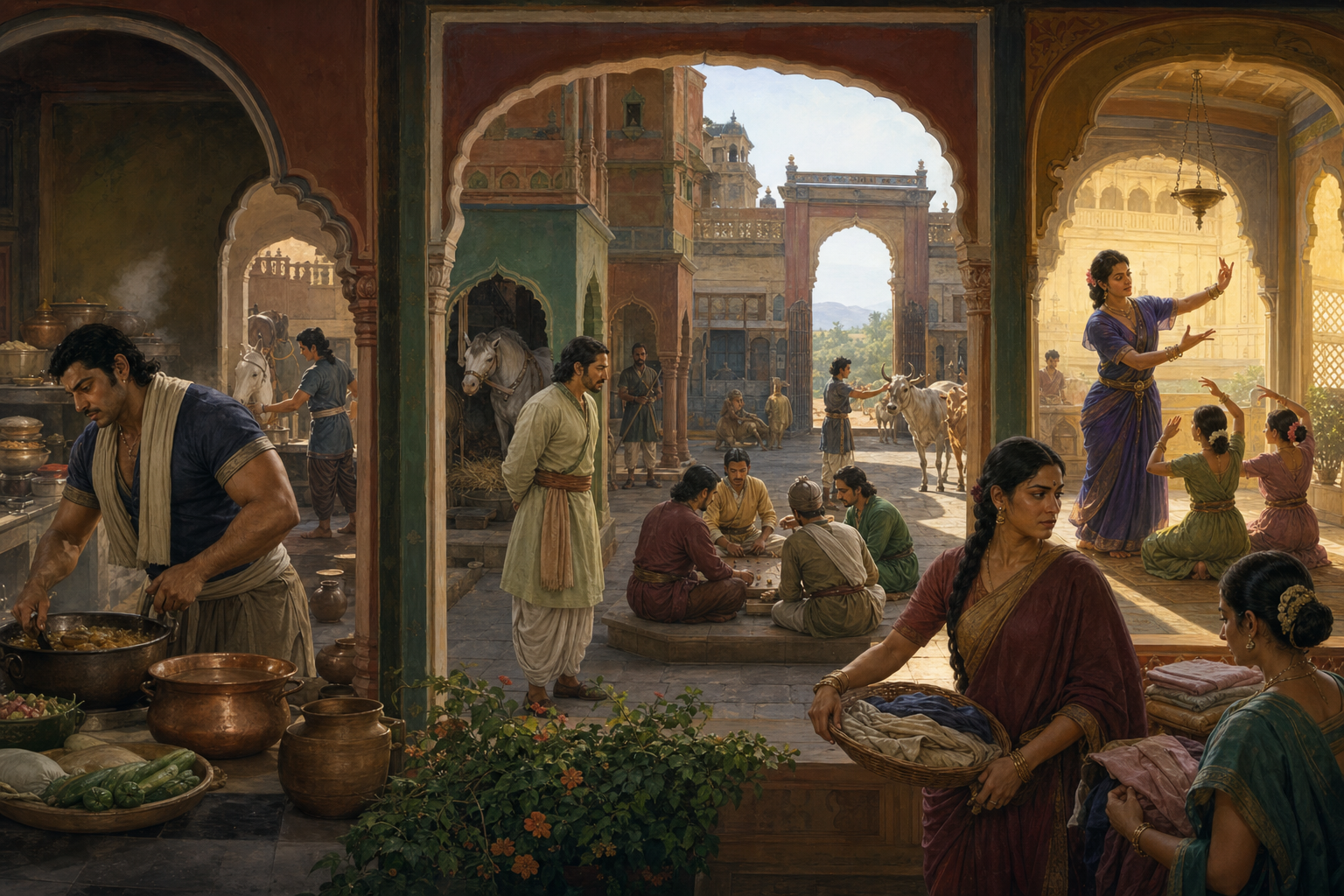
Sanjaya and Uluka show that an envoy can be more than a carrier of words. Such figures transmit offers or warnings, observe reactions, and return with knowledge of the rival camp. Their usefulness depends on trust in two directions: the principal must trust them to carry the intended message, and the receiving court must believe that communication through them is meaningful.
Do not collapse every diplomatic function into one role. A messenger delivers an authorised communication. An observer notices conduct and context. A negotiator may have permission to modify terms. One person can perform more than one function, but the functions should still be distinguished. Otherwise an envoy’s private interpretation may be mistaken for the principal’s policy, or an unauthorised promise may be treated as binding.
Debrief the envoy without turning impressions into facts
After a mission, sort the debrief into separate fields:
- The message the envoy was instructed to deliver.
- The message that was actually delivered, including any clarification.
- The reply received from the authorised decision-maker.
- Directly observed behaviour in the court or camp.
- The envoy’s interpretation of that behaviour.
- Questions that remain unresolved.
This separation keeps vivid impressions from outrunning evidence. An envoy may be an excellent judge of character, but an interpretation is still an interpretation. It deserves evaluation alongside other reporting, not automatic elevation into fact.
Protecting envoys is strategically important for the same reason. A functioning channel allows offers, warnings, corrections, and last-minute restraint to cross hostile lines. Destroying the channel does more than end a conversation; it increases the chance that both sides will act on fear and assumption.
Ajñātavāsa is also a lesson in counterintelligence
The Pandavas’ exile and incognito period place concealment, counterintelligence, and situational awareness inside a struggle for survival and eventual restoration. Concealment here is not simply an entertaining disguise. It preserves freedom of action while adversaries have an interest in discovery.
That setting invites a useful ethical distinction. Concealing information to protect life, fulfil a legitimate obligation, or prevent an unjust adversary from exploiting vulnerability is not automatically equivalent to deception for greed or domination. Purpose matters, but purpose alone is insufficient. You must also examine necessity, collateral harm, duration, and what happens when concealment ends.
When assessing a counterintelligence problem, ask:
- What identity, capability, plan, or relationship genuinely requires protection?
- Which routine, habit, intermediary, or loose word could expose it?
- Who needs the information to perform a legitimate duty, and who merely wants access?
- What will happen if concealment fails?
- Is there a clear point at which secrecy should end?
The broader strategic field extends beyond palaces and battle lines. Shifting loyalties, supply arrangements, intentions, and conditions in assemblies can all change the meaning of a plan. This is why situational awareness is continuous. A report that was accurate earlier may no longer support the same decision after an alliance changes or an opponent revises an intention.
A Dharmic test for intelligence and statecraft
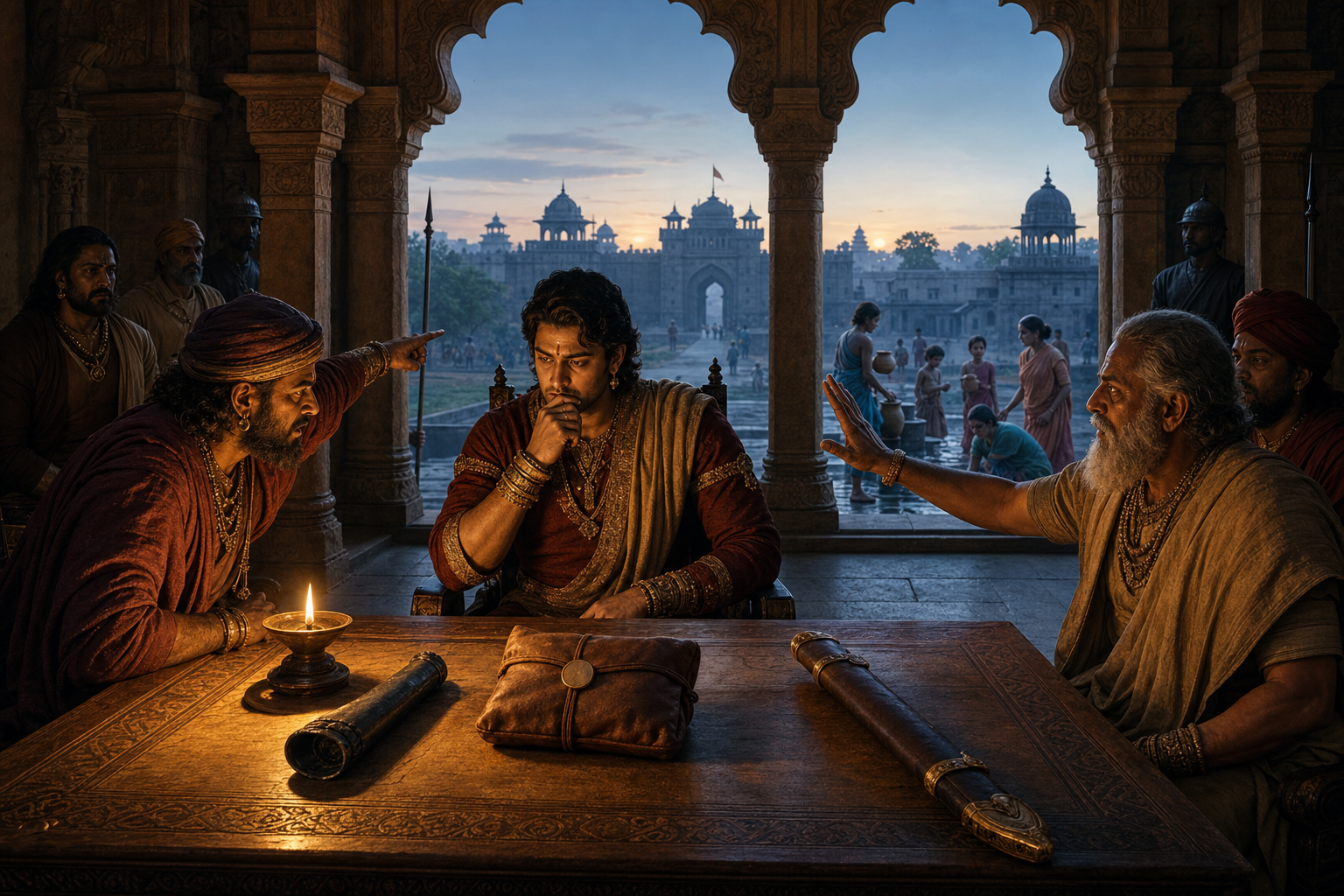
Intelligence is a capability, not a moral justification. Accurate knowledge can protect a kingdom, prevent a war, or restrain wrongdoing. The same capability can also feed coercion, factional revenge, and fear. Dharma enters by governing the purpose, method, interpretation, and use of information.
The following test is a practical reading framework rather than a claim that the Mahabharata supplies a modern procedural code. Use it whenever secrecy or strategic deception is defended as necessary:
- Legitimate purpose: Is the action protecting social order and resisting adharma, or merely advancing private ambition?
- Necessity: Is secret collection actually needed, or could open counsel and ordinary inquiry answer the question?
- Verification: Has the information been independently tested before it drives punishment, war, or another grave decision?
- Discrimination: Are innocent people protected from surveillance, accusation, manipulation, and retaliation?
- Proportionality: Is the intrusion or deception limited to what the danger reasonably requires?
- Accountability: Can the decision-maker explain why the method was used and accept responsibility for the result?
- Peaceful exit: Does the strategy preserve a route back to negotiation, normal relations, or public order?
A method that fails several of these questions should not be made respectable merely by calling it statecraft. Cleverness is not Dharma. Success is not proof of righteousness. Nor is a noble objective a blank cheque for every tactic pursued in its name.
The wider Dharmic family cannot be flattened into one political doctrine. Hindu, Buddhist, Jain, and Sikh traditions have their own texts, histories, and arguments about force and restraint. Yet wise counsel, proportionality, responsibility, and concern for suffering provide a meaningful shared vocabulary. That vocabulary demands more from power than victory alone.
Key takeaways
- Intelligence reduces uncertainty; it does not abolish uncertainty.
- Corroboration requires independent confirmation, not several repetitions of one rumour.
- Diplomacy works best when the envoy understands personalities, interests, alliances, and decision-making power.
- A failed peace mission can still clarify intentions and establish whether compromise was genuinely possible.
- Envoy reporting should separate authorised messages, direct observations, interpretations, and unresolved questions.
- Secrecy serves Dharma only when purpose, necessity, restraint, protection of innocents, and accountability travel with it.
On your next reading, choose one council, mission, or episode of concealment and draw the information chain. Note who knows, who reports, who interprets, who decides, and who bears the cost of error. Then ask where a peaceful option remains open.
That exercise will take you beyond admiring clever manoeuvres. It will show you the harder achievement at the heart of Dharmic statecraft: using knowledge without becoming ruled by suspicion, and wielding strategy without allowing strategy to replace Dharma.
References
