
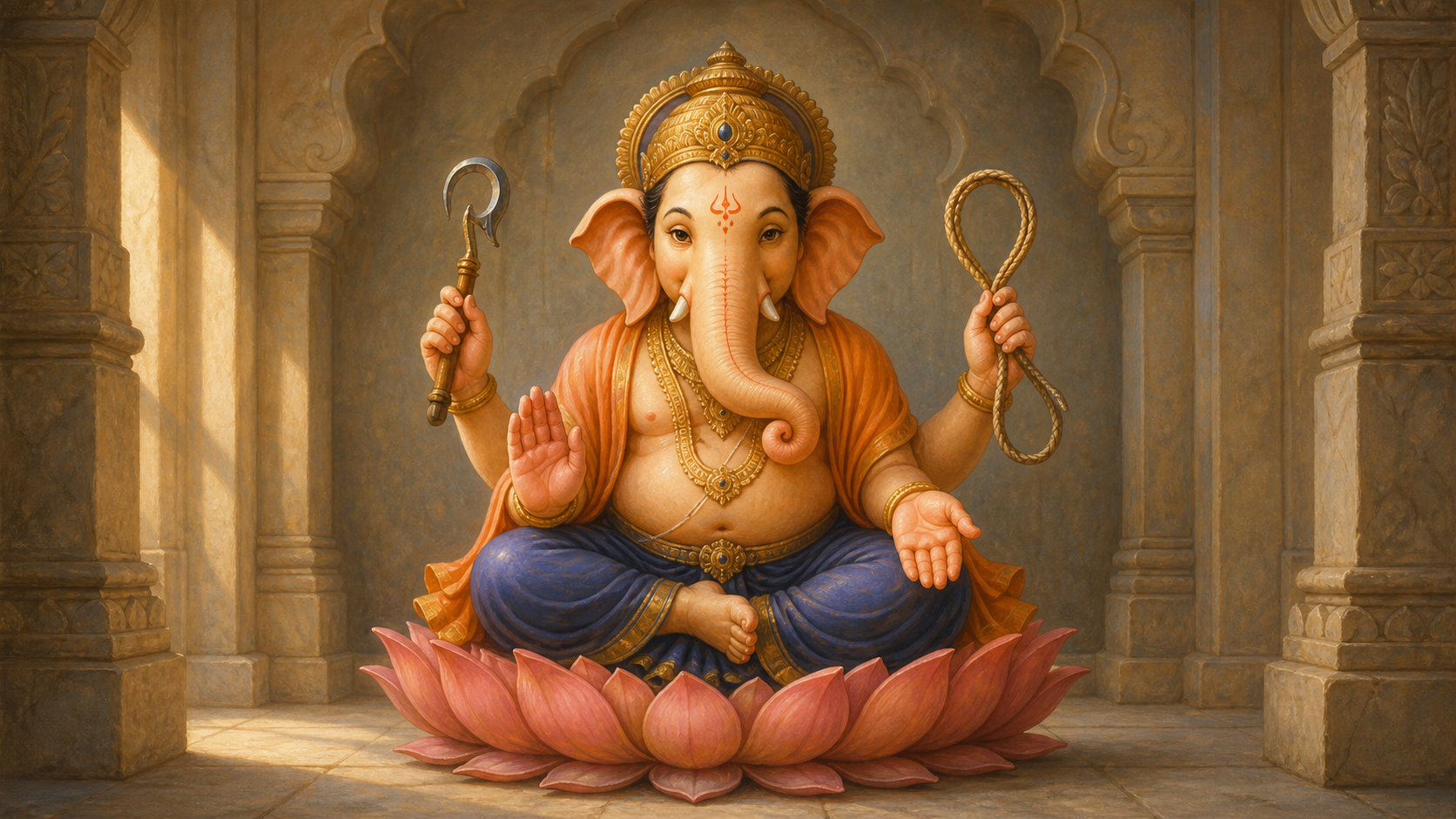
You recognize Gaṇeśa, but the small objects in his hands may be harder to read. A looped rope can look threatening, and an elephant goad can seem severe. Yet in Hindu iconography, these are not incidental accessories. They answer a practical question you face whenever thought, desire, or action drifts from dharma: what should be restrained, and what should be redirected?
The pāśa and aṅkuśa give you a disciplined way to make that distinction. One establishes the necessary boundary; the other supplies the next right direction. Understanding both prevents spiritual discipline from becoming either passive good intention or harsh self-control.
Begin with the relationship between the two symbols

Pāśa means a noose, rope, or binding loop. Aṅkuśa is an elephant goad, an implement for directing great strength. In deity images, the first concerns restraint, attachment, accountability, or drawing something near. The second concerns guidance, correction, and purposeful movement. Gaṇeśa is frequently depicted with both, making their relationship especially clear.
For practical reflection, you can read them as a sequence. The pāśa stops energy from continuing along a harmful route. The aṅkuśa then directs that energy toward a dharmic one. Restraint by itself can leave you inactive, frustrated, or preoccupied with the thing you are resisting. Direction without restraint can fail because the old impulse still controls the field. The pair addresses both problems.
This is not a claim that every murti encodes a fixed two-step procedure. Iconographic meaning depends on the deity and context. It is a disciplined way to bring the symbols into your own ethical examination: first contain what disorders you, then guide your attention and effort toward what should replace it.
The distinction also protects against two common errors. A boundary need not crush the person whose conduct is being restrained, including yourself. Guidance need not become domination. The spiritual purpose is restored alignment, not the display of force.
The pasha binds adharma, but it can also draw the seeker near

A noose naturally evokes capture, so it is easy to read the pāśa only as punishment or bondage. That reading is too narrow. Its meaning changes with the divine figure who bears it and with the function being emphasized.
- With Varuṇa, the pāśa expresses sovereignty over moral and cosmic order. It reminds you that conduct belongs within ṛta and dharma rather than private convenience.
- With Yama, the pāśa evokes time, mortality, and the inescapability of consequence. Action cannot be separated indefinitely from its result.
- With Gaṇeśa, the noose can restrain an obstacle or harmful impulse, gather a scattered mind, and draw the devotee into divine protection and relationship.
- In select forms of Devī and Śiva, the same implement extends these themes of binding, protection, and mastery into other theological settings.
The pāśa therefore has more than one direction. It can bind what should not be allowed to roam freely, but it can also gather what has wandered. It may signify the restraint of adharma, the bond between devotee and Deity, or the certainty that actions carry consequences. Before assigning a meaning to it, identify the deity and ask what kind of order that deity manifests.
You can use three questions when looking at an image: What is being contained? What is being brought nearer? What consequence or obligation cannot be escaped? These questions keep you from reducing the symbol to a weapon.
Applied to your own life, the pāśa is a boundary around a specific movement of adharma, not a declaration that you are irredeemably bad. If anger is driving harmful speech, bind the speech while acknowledging the anger. If distraction is consuming the time reserved for sādhana, close the channel through which the distraction enters. If a repeated excuse conceals a neglected duty, name the duty and make yourself accountable for it.
This is restraint rather than suppression. Suppression tries to deny that the impulse exists. Restraint sees it clearly and refuses to let it govern conduct. The first tends to hide disorder; the second limits its power while leaving room for understanding and correction.
The ankusha supplies direction after the boundary is set
The aṅkuśa answers the question that follows every sincere refusal: if not this, then what? Its function is not merely to oppose movement but to correct its direction. In Gaṇeśa’s hand, it conveys guidance firm enough to overcome inertia without making injury or humiliation the goal.
Psychologically, the symbol concerns mastery of manas, the active mind, and the indriyas, the faculties through which attention rushes toward objects and impressions. The aṅkuśa directs attention and energy toward sattva: greater clarity, balance, and fitness for dharmic action.
Its connection with pratyāhāra is useful here. Withdrawal of the senses is not mere blankness or hostility toward the world. It creates the freedom to stop following every stimulus automatically. The aṅkuśa represents the deliberate correction that brings attention back to its chosen center.
You can test whether your discipline includes this guiding function. If your instruction to yourself ends with stop, don’t, or never again, it has a pāśa but no aṅkuśa. Add an immediate alternative. Return to the chosen practice. Speak the truthful sentence that does not wound. Perform the duty you were avoiding. Place attention on the work actually in front of you.
The correction should be concrete enough to perform now and clear enough to repeat later. A vague command to be better gives the mind no direction. A small, defined movement toward dharma does. The symbol’s firmness lies in consistent redirection, not in the violence of the inner voice.
Use pasha and ankusha as a five-part discipline

The following exercise is a practical interpretation of the symbols, not a substitute for a lineage-specific ritual or teaching. Use it when you can see that a habit, reaction, or distraction is pulling you away from what you already recognize as your duty.
- Name the movement precisely. Replace a broad judgment such as I lack discipline with a description of the actual pattern: I abandon my chosen task whenever a new stimulus appears.
- Apply the pāśa. Establish the boundary that prevents the pattern from deciding your next action. Close the distraction, postpone the reactive reply, leave the harmful setting, or make the neglected commitment visible to someone who can hold you accountable.
- Name the dharmic direction. Decide what quality or duty should govern instead: truthfulness, non-harm, steadiness, responsibility, reverence, or focused practice.
- Apply the aṅkuśa. Choose the next observable action that expresses that direction. Return to the assigned work, begin the chosen practice, repair the damaged obligation, or formulate the response you can stand behind.
- Review the result without self-deception. Ask whether the boundary actually contained the harmful pattern and whether the correction moved you toward dharma. If either failed, adjust the boundary or make the next action more definite.
Three ordinary situations
- Reactive speech: the pāśa prevents anger from sending the message or uttering the insult. The aṅkuśa directs you toward a truthful response that addresses the wrong without multiplying it.
- Scattered sādhana: the pāśa closes competing channels of attention. The aṅkuśa returns the mind to the practice you deliberately chose rather than waiting to feel perfectly focused.
- Leadership and family responsibility: the pāśa stops conduct that is causing harm. The aṅkuśa states the acceptable next action and makes restoration possible. A prohibition with no route forward breeds fear or resentment; permissiveness with no boundary leaves the harm untouched.
The pair gives you a standard for judging authority as well as self-discipline. Restraint ceases to reflect the pāśa’s dharmic function when it exists mainly to humiliate, possess, or preserve someone’s ego. Direction ceases to reflect the aṅkuśa when it demands submission without reference to truth, responsibility, or the good of the person being guided. Sacred imagery does not turn coercion into dharma.
Key takeaways without flattening Dharmic traditions
Nooses and goads also occur with select deities and yakṣa-yakṣī figures in Buddhist and Jaina art, where they can participate in themes of self-mastery and compassionate guidance. Sikh thought does not depend on these particular implements, though discipline, ethical restraint, and benevolent direction are compatible with Gurmat. Shared ethical resonances do not make the traditions or their iconographies interchangeable.
- The pāśa can bind adharma, contain harmful impulses, express accountability, gather the distracted mind, or draw the devotee into a sacred bond.
- The aṅkuśa redirects strength, attention, and the senses toward clarity and dharmic action.
- The identity of the deity matters. Varuṇa’s pāśa, Yama’s pāśa, and Gaṇeśa’s paired attributes emphasize related but distinct dimensions of order, consequence, protection, and guidance.
- In practice, use the pāśa to define the boundary and the aṅkuśa to define the next right action.
- Restraint should target disorder rather than degrade the person. Guidance should create direction rather than serve domination.
The next time you stand before an image of Gaṇeśa, do more than identify the objects. Bring one real pattern to mind. Decide what must be contained, then choose the action that will redirect its energy toward dharma. That small act of honest alignment is where the symbolism becomes practice.
References
