
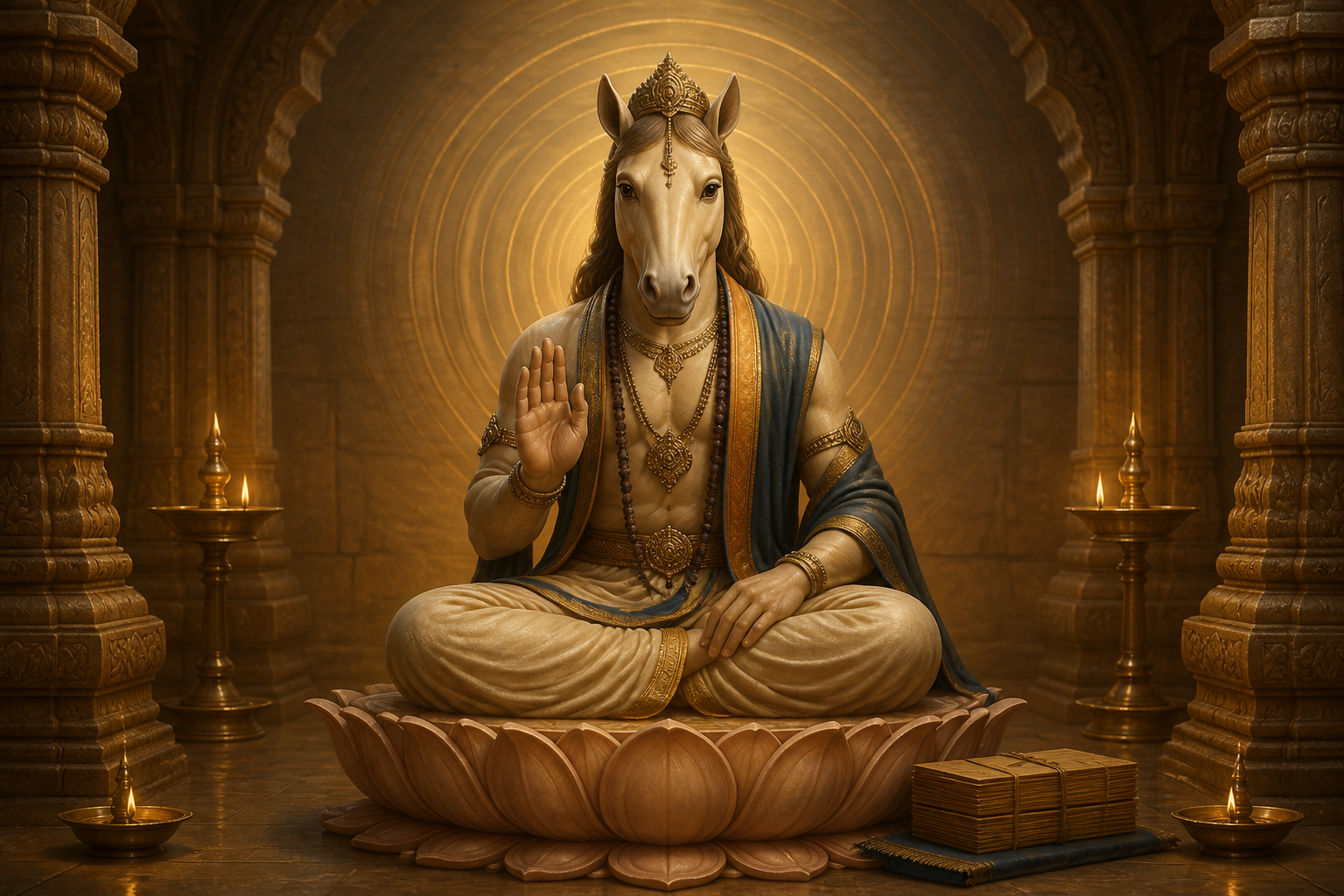
You have found a horse-faced sacred figure labelled “Sama Veda,” and you want to know what you are actually looking at. Begin with its function: this is a Veda made approachable through sacred form, not a portrait of a historical person and not merely an animal-headed ornament.
That distinction gives you a reliable way to read the image. First establish its identity from the surrounding context. Then interpret the horse face in relation to sacred sound. Only after that should you consider what the form may mean for worship, meditation, or study.
Begin with the Veda Murti, not the horse
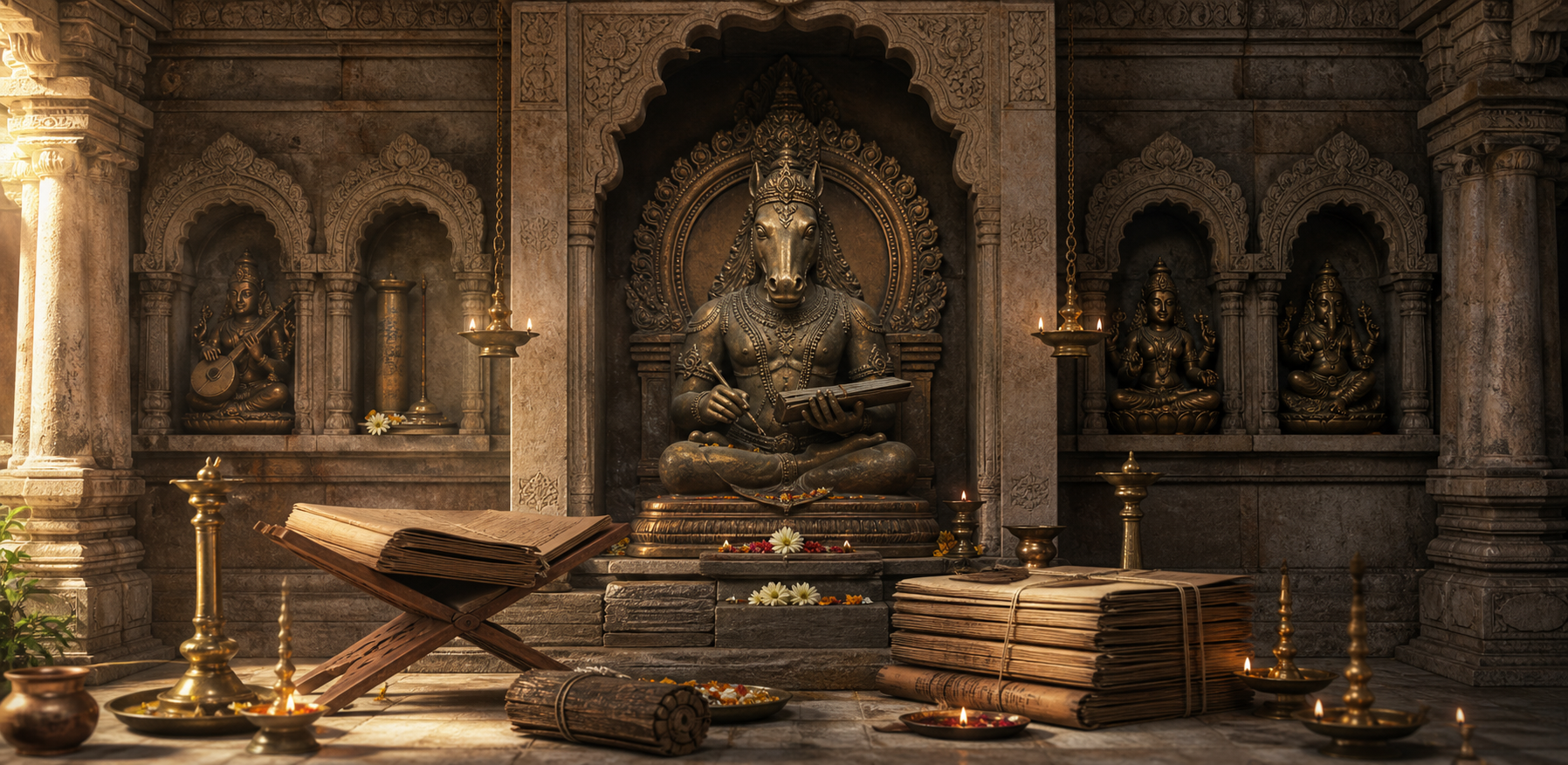
Hindu iconography does not restrict sacred presence to human-looking deities. A teaching, power, river, celestial body, weapon, or body of revelation can receive a visible form. In this case, the Vedas are personified as Veda Murtis so that a devotee can approach, contemplate, meditate upon, and worship what would otherwise remain abstract.
“Sama Veda Murti” therefore means the Sama Veda present in an embodied iconographic form. The visible body does not imply that the Veda was once an individual with an animal head. Nor does it reduce the Veda to a character in a story. The murti translates sacred knowledge into a form that can participate in darshan, ritual memory, and disciplined contemplation.
- It is not a portrait of an author. It personifies a sacred corpus.
- It is not simply a generic horse deity. The horse face belongs to a particular identification within a larger iconographic setting.
- It is not the same thing as a written manuscript. A manuscript preserves words on a page; a murti gives the Veda a presence that can be encountered devotionally.
This is the first correction to make when describing the image. Calling it only “a horse-headed god” leaves out the very thing the form has been created to disclose: the presence and authority of the Sama Veda.
A horse face is a clue, not a complete identification
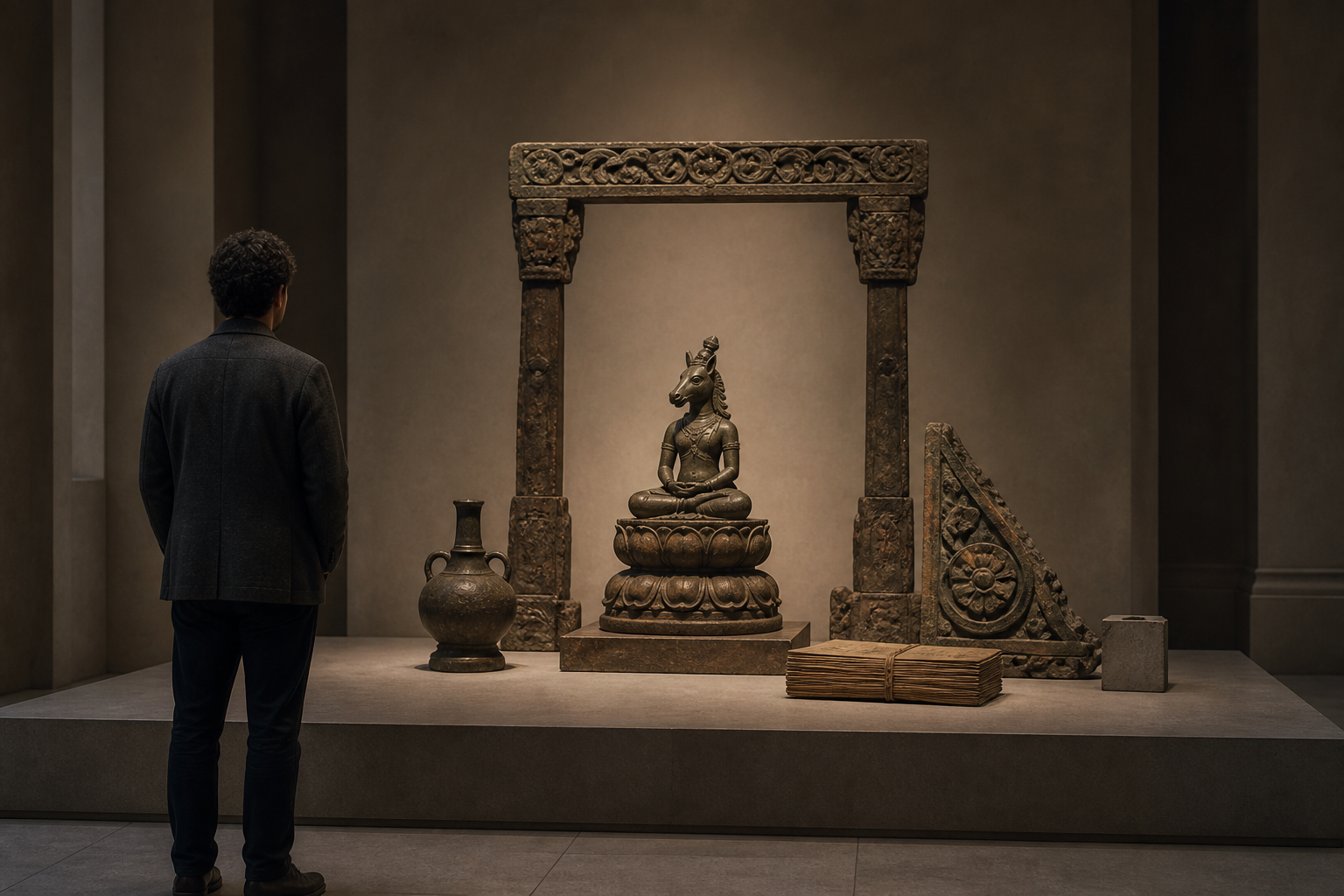
The Sama Veda Murti is represented with a horse face. That feature is memorable, but it should not be used in isolation. Hindu traditions also know Hayagriva, a horse-headed form associated with Vishnu and sacred knowledge. A cropped photograph of a horse-faced figure may therefore be impossible to identify responsibly without its label, setting, or companions.
Use the following order of evidence when you encounter such an image:
- Read the inscription or caption. Look for “Sama Veda,” “Samaveda,” or an equivalent name in the language used at the site.
- Examine the whole ensemble. If the figure belongs to an explicitly identified group representing the Vedas, that context carries more weight than the head alone.
- Notice the iconographic program. Nearby figures, panels, manuscripts, ritual objects, and the location within a temple or educational setting may explain what the image represents.
- Ask how the custodial tradition names the form. A temple priest, hereditary custodian, teacher, or reliable catalogue can preserve an identification that is not visually obvious.
- Use secondary details only when you have a documented local key. Colour, posture, hand-held objects, number of arms, and direction should not be assigned universal meanings merely because they appear in one example.
This method prevents two opposite mistakes. One is labelling every horse-headed figure as Hayagriva. The other is labelling every such figure as Sama Veda Murti because the name happens to be unfamiliar and intriguing. Context resolves what visual resemblance alone cannot.
If the evidence remains incomplete, let your caption preserve that uncertainty. “Horse-faced sacred figure, possibly a Veda Murti” is more responsible than a confident name unsupported by the setting. If you are documenting a temple, record the exact inscription, adjacent figures, location, and the name used by its custodians before isolating the image for publication.
Read the horse face at two different levels
Iconography works through both identification and contemplation. Confusing those levels produces elaborate explanations that sound authoritative but cannot be verified.
At the first level, the horse face is an identifying feature of the Sama Veda Murti described here. That is the firm iconographic point. It tells you that the figure is not an ordinary human personality and directs attention toward a sacred form whose identity must be read through tradition.
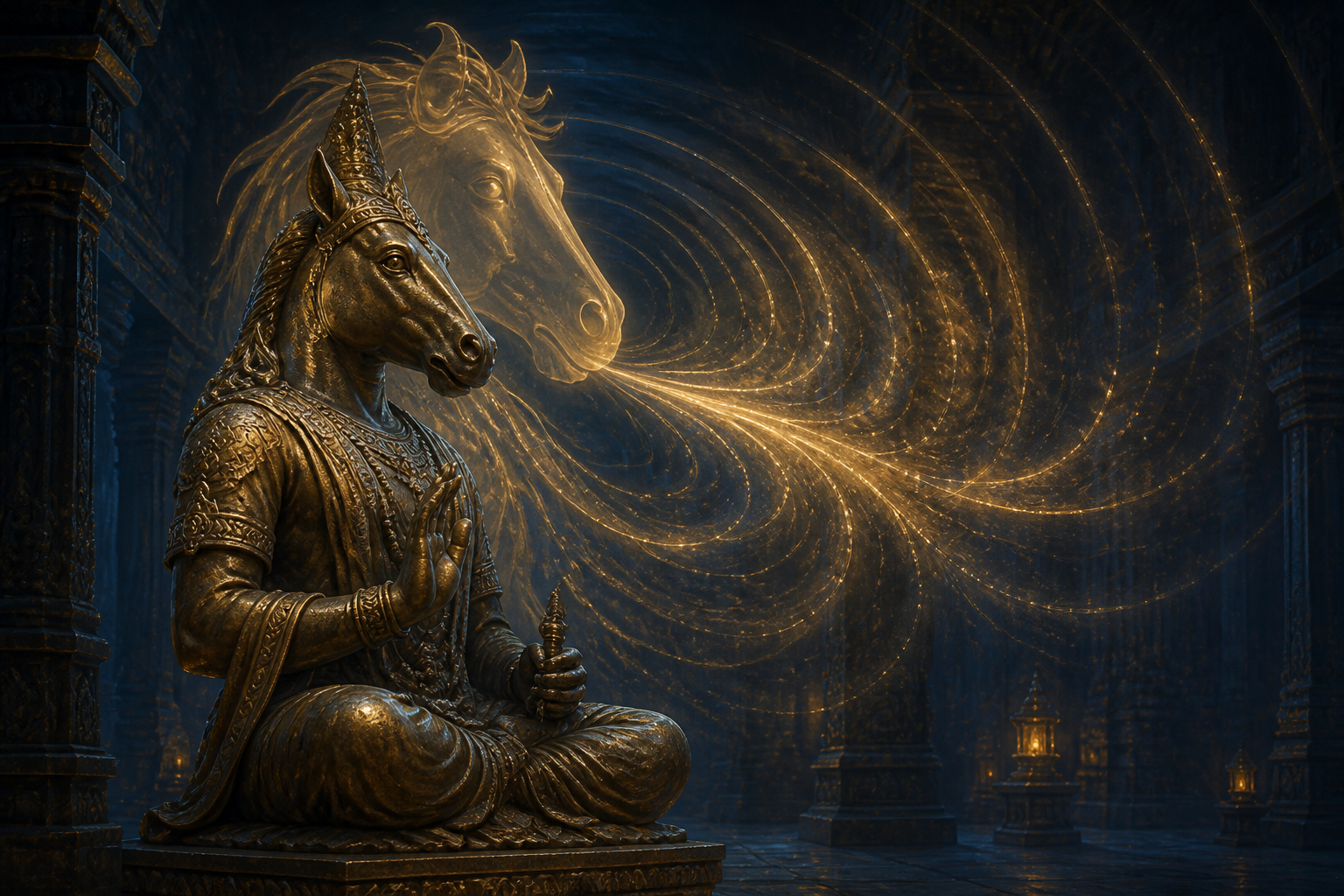
At the second level, the feature can guide contemplation. The Sama Veda is inseparable from the disciplined sounding of sacred words through chant. A face with a pronounced mouth naturally turns your attention toward voice, breath, resonance, and transmission. You may use those associations meditatively, provided you do not present them as the only inherited explanation of the horse head.
This boundary matters. Speed, vitality, alertness, memory, or the power of breath may enrich a devotee’s reflection on the horse form. They do not, by themselves, prove why a particular sculptor or lineage selected it. A useful interpretation should deepen attention to the Veda without pretending that every possible association is a fixed iconographic rule.
The safest question is therefore not, “What does a horse always symbolize?” Hindu iconography is too contextual for that. Ask instead, “What does this horse-faced form help me notice about the Sama Veda here?” In this setting, it moves your attention away from silent information and toward sacred knowledge made living through correctly transmitted sound.
Let sacred sound shape how you approach the murti
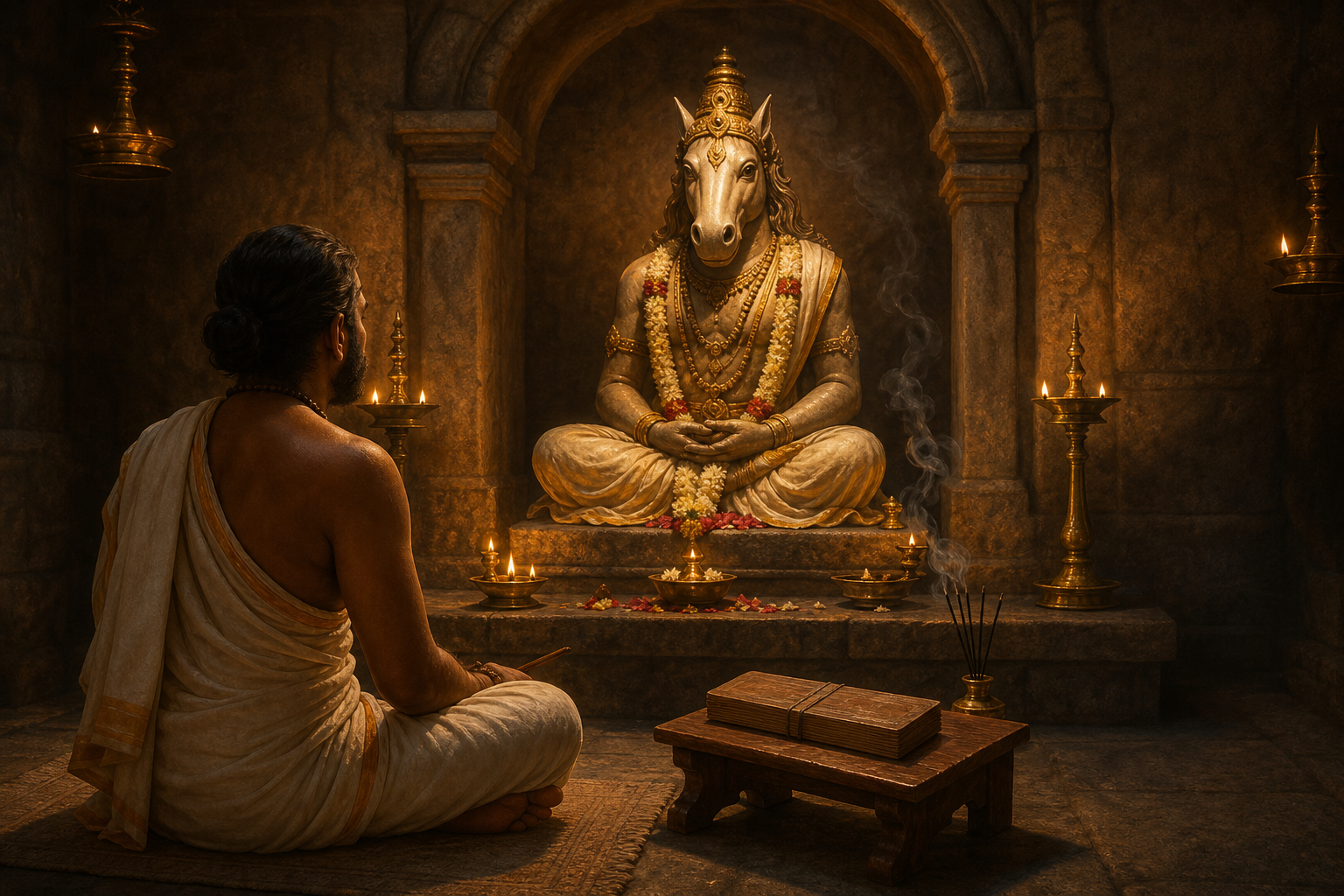
You do not need to invent a special mantra, offering schedule, or private mythology simply because the form is unfamiliar. The murti’s purpose already gives you a practical approach: move from seeing to listening, and from curiosity to disciplined attention.
- Confirm the identity before beginning a form-specific practice. If the murti is in a temple, follow the name and procedure preserved there.
- Begin with a respectful pause or pranam. Let the unusual face arrest casual looking rather than provoke speculation.
- Attend to sound. If a qualified practitioner is chanting, listen to pitch, continuity, restraint, and repetition instead of treating the recitation as background music.
- Do not improvise Samavedic recitation from a printed line or an online image. Vedic chanting belongs to an exact oral discipline and should be learned through proper instruction.
- Connect darshan with study. Learn what the Sama Veda is, how its sacred utterance is transmitted, and how the local community understands the murti.
If you have not received instruction in Vedic chanting, silence is a valid response. You can contemplate the relationship among knowledge, voice, disciplined memory, and transmission without pretending to perform a practice you have not learned. That restraint honours the very precision the murti represents.
The same principle applies in a museum, book, or digital archive. Do not treat the figure as an exotic curiosity detached from practice. Read its label, preserve the supplied identification, examine the complete composition, and distinguish what is visibly present from what you are inferring. Responsible seeing is itself a form of respect.
Key takeaways
- A Veda Murti gives visible, approachable form to a Veda; it is not a portrait of a human author.
- The Sama Veda Murti discussed here is horse-faced, but the head alone is not enough for a secure identification.
- Distinguish it from Hayagriva by checking inscriptions, companion figures, ritual context, and the name preserved by the local tradition.
- The Samavedic dimension concerns disciplined sacred sound, not music in a vague or merely aesthetic sense.
- Separate established iconographic identity from personal symbolic reflection. Both can be valuable, but they do different work.
- For practice, follow the temple or teaching lineage and do not invent Vedic recitation without instruction.
The next time you meet this form, do three things before settling on an interpretation: write down its exact label, inspect the figures around it, and ask how the community names it. Those simple acts turn a quick visual resemblance into an informed encounter with the Sama Veda as sacred sound made present.
References
