
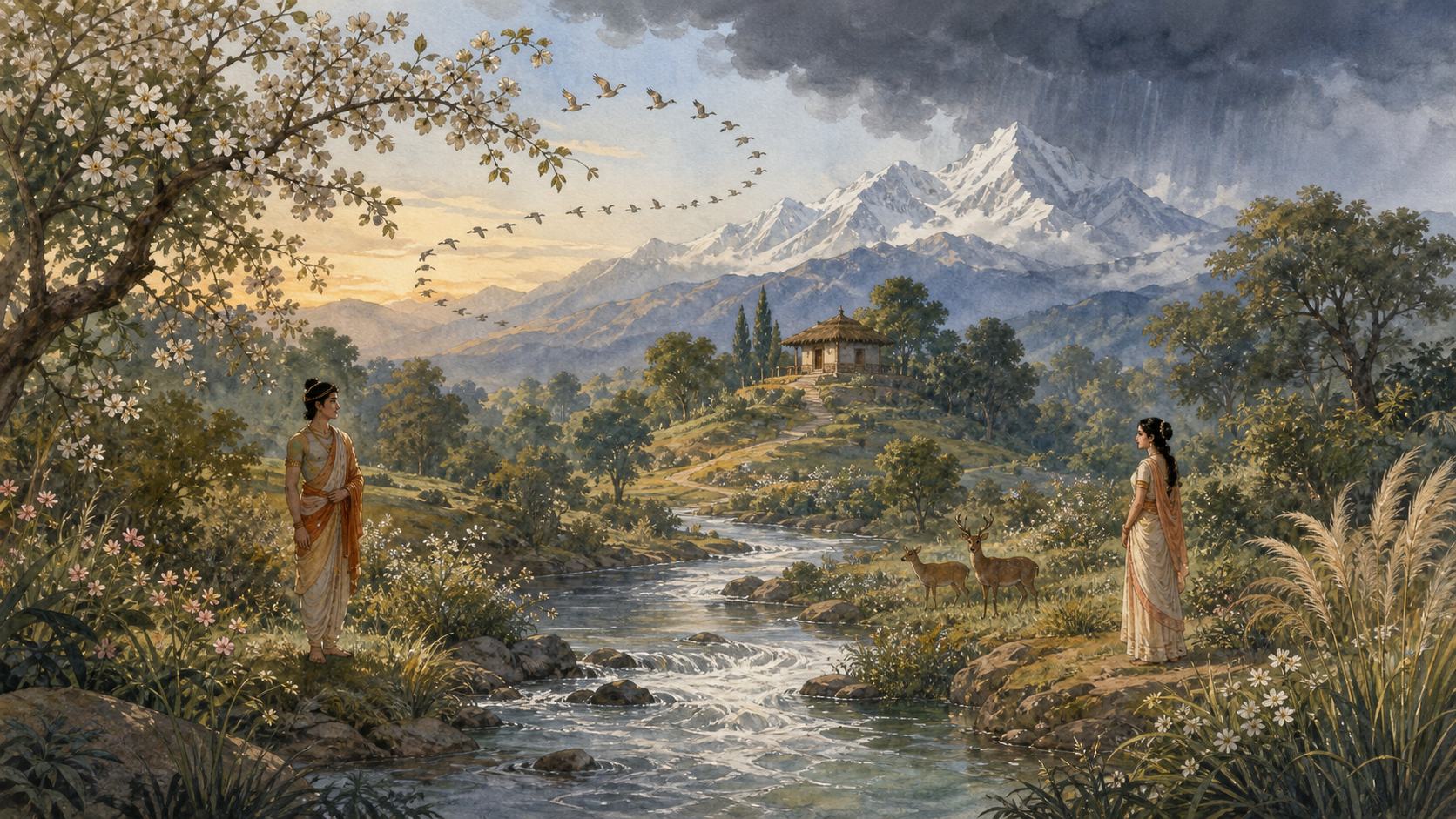
You may have opened Kalidasa for beauty and found yourself surrounded by moonlight, rain, birds, blossoms, mountains, and forest paths. The common mistake is to treat these descriptions as pauses in the human drama. Do that, and much of the poetry’s moral architecture disappears.
Track what the landscape does to human feeling instead. A clear pattern emerges: nature gives desire proportion, tapasya gives it strength, and dharma gives that strength a purpose. Once you can see this movement, Kalidasa becomes more than a poet of exquisite scenery. He becomes a guide to ordering emotion without deadening it.
Nature changes the scale of human feeling
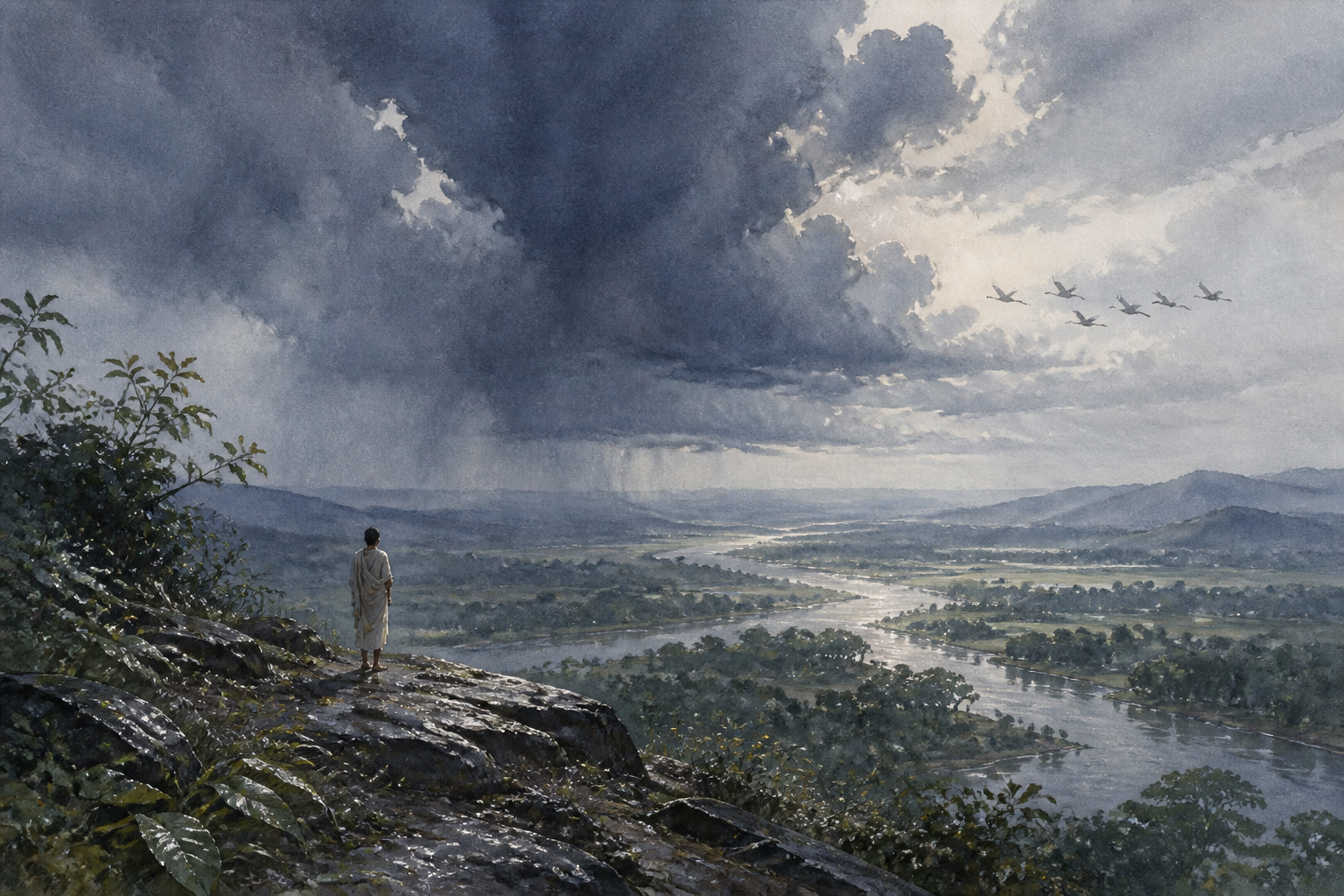
In Kalidasa, nature is rarely inert scenery. It affects the scale, timing, and moral meaning of an emotion. A lover’s longing may remain intense, but the surrounding season prevents that longing from pretending to be the whole universe.
Ritusamhara makes this especially easy to notice. Desire unfolds amid summer moonlight and waterfalls, rain-trembled Kadamba branches, autumn ducks and green paddy, and a spring wind moving through mango blossoms. These are not interchangeable ornaments. Each season creates a different field of sensation, movement, abundance, and restraint.
The practical distinction is between using nature as a symbol and seeing nature as a participant. In a merely symbolic reading, a blossom stands for romance and a storm stands for distress. In Kalidasa’s more expansive mode, plants, birds, water, wind, crops, and human bodies are all undergoing a seasonal change. The person’s emotion belongs to that change but does not possess it.
This is how nature moderates emotion without suppressing it. An isolated passion can become absolute: the beloved, the wound, or the immediate appetite seems to be all that matters. Once that passion is situated within a living order larger than the individual, it acquires proportion. Its depth remains, but its claim to sovereignty weakens.
When you encounter a natural description, pause before calling it decorative. Ask four concrete questions:
- What season, weather, or time of day governs the scene?
- Which plants, animals, waters, winds, or crops are active rather than merely visible?
- Does the landscape intensify the human emotion, steady it, delay it, or redirect it?
- What would become excessive or unintelligible if the natural setting were removed?
Those questions reveal an ecology of feeling. The point is not that nature automatically makes every desire virtuous. It gives desire a place, and having a rightful place is the beginning of moral order.
Desire must pass through tapasya before it becomes power
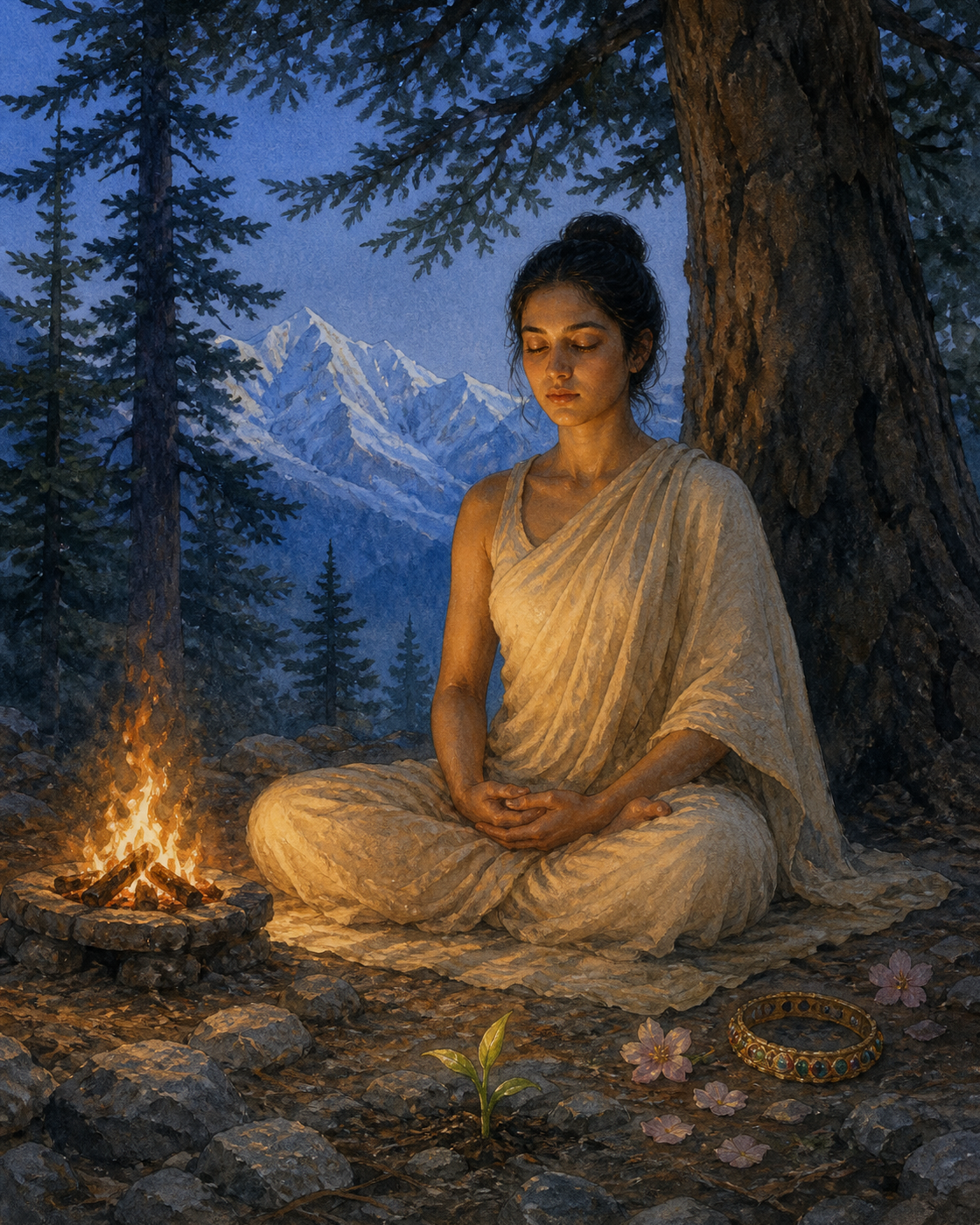
Ritusamhara is plausibly an early work, and its treatment of youthful union is more immediate than the self-purifying movement associated with Sakuntala and Kumara-sambhava. That difference should not be reduced to a crude opposition between bad desire and good renunciation. Kalidasa’s deeper concern is what desire can become when it accepts discipline.
Tapasya does not require hatred of beauty, affection, or embodied life. It tests whether feeling can endure restraint, time, and responsibility. Desire that cannot survive any limit remains appetite. Desire that passes through self-mastery can become dependable strength.
The third canto of Kumara-sambhava dramatizes this problem through the arrival of Cupid. The awakening between Shiva and Parvati is placed within Spring’s wider vitality. Passion is neither sealed inside two individuals nor treated as an embarrassing interruption of spiritual life. It appears as part of a universal quickening, even as its force must still encounter discipline and consequence.
The background of Taraka’s devastation changes the stakes. The question is no longer only whether desire is beautiful. It is whether powerful feeling can mature into a form of strength capable of answering disorder. Heroism, in this frame, does not arise from impulse alone. It requires energy that has been gathered, purified, and directed beyond private satisfaction.
You can test this movement in any major emotional passage by looking for three transitions:
- From isolation to proportion: the feeling is placed within a larger natural or cosmic setting.
- From intensity to discipline: longing encounters delay, restraint, tapasya, or another demand that prevents immediate possession.
- From private fulfillment to shared order: the resulting strength becomes relevant to a family, community, kingdom, or threatened world.
This also explains why sensuous refinement and moral seriousness coexist in Kalidasa. Beauty is not rejected as a distraction from dharma. It is asked to mature. Poetry, music, pleasure, and fine workmanship remain valuable, but polish alone cannot restore an endangered order. The beautiful must become answerable to the good.
The hermitage is a model of dharmic ecology
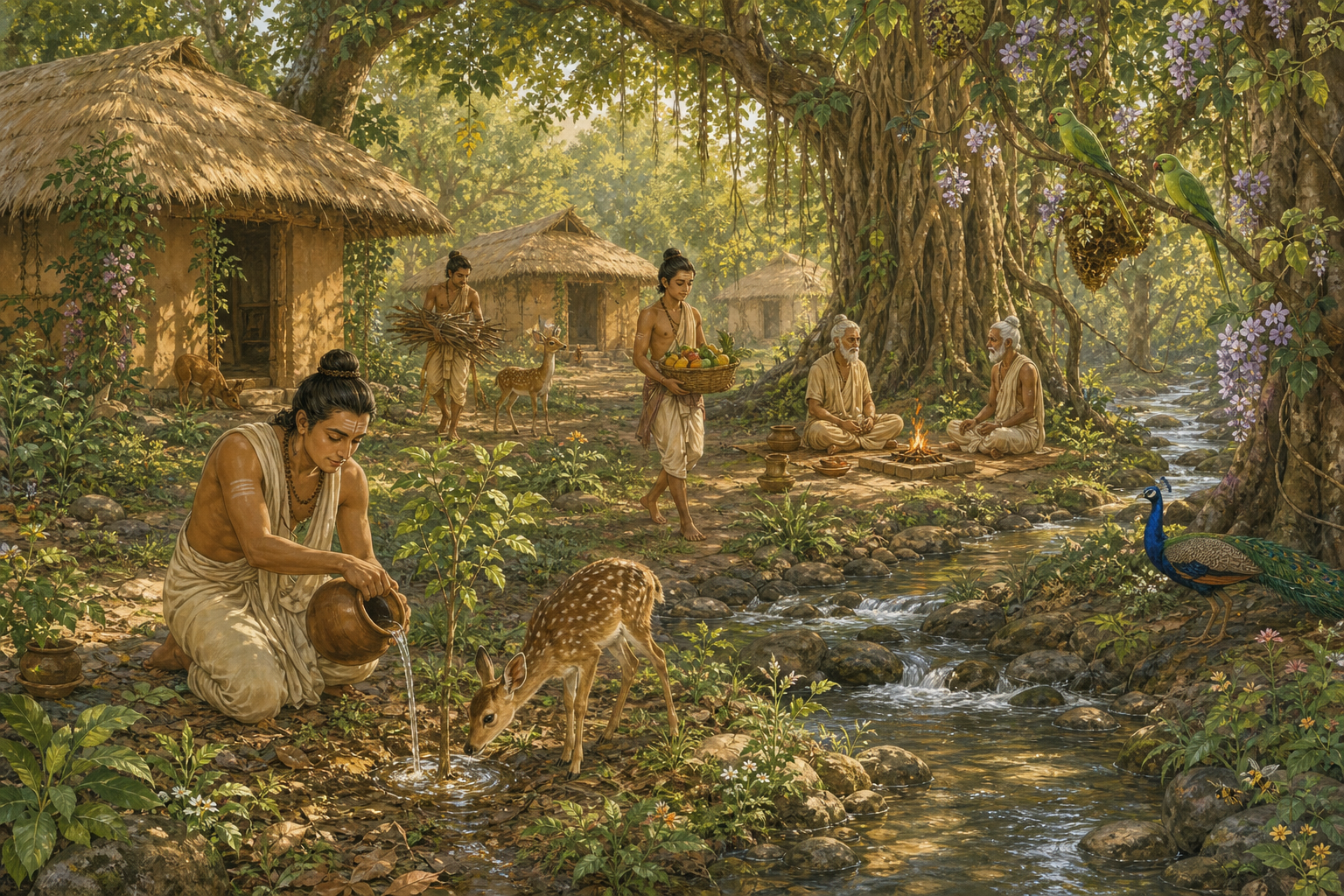
A revealing parallel from classical Sanskrit literature appears in the hermitage of Kadambari. Plants bend in the wind as though offering homage. Trees scatter leaves like a puja. Shyamak paddy dries in the courtyards, while fruits such as banana, amalak, labali, and badari gather in abundance. Young Brahmanas recite their lessons, and parrots reproduce Vedic sounds through repeated hearing. Jungle fowl eat from offerings, goslings nibble nibar paddy used in worship, and gentle does approach the hermit children.
This is neither untouched wilderness nor a settlement that has expelled every nonhuman life. It is a cultivated habitat in which study, food production, ritual, childhood, animals, and vegetation remain mutually present. Human beings shape the place, but they do not behave as though only human purposes count.
That distinction matters. A vague admiration for green scenery is not yet a dharmic ecology. The hermitage presents observable forms of coexistence:
- Sustenance without total exclusion: grain and fruit support human life while birds and animals continue to participate in the habitat.
- Learning that permeates the surroundings: recitation is so continuous that even the parrots echo it; knowledge is part of the place’s daily atmosphere.
- Ritual embedded in living relations: offerings are not sealed away from the creatures inhabiting the same environment.
- Familiarity without conquest: the animals’ ease around children signals a long practice of restraint, not a momentary display of sentiment.
Read beside Kalidasa, this hermitage clarifies a civilizational ideal: the disciplined human community does not become less human by admitting the wider living world. It becomes more capable of dharma because its habits continually remind each person that life exceeds private appetite.
Hindu, Buddhist, Jain, and Sikh traditions should not be flattened into a single doctrine of nature. Their metaphysics, disciplines, and historical forms differ. Yet harmony with living beings, self-restraint, compassion, and action for collective welfare provide a recognizably shared Dharmic vocabulary. The best way to use that kinship is as a family resemblance, not as an excuse to erase distinctions.
Key takeaways for reading Kalidasa
- Weather, seasons, plants, and animals often perform dramatic work; do not skim them to reach the human action.
- Nature gives emotion proportion. It neither abolishes passion nor automatically sanctifies it.
- Kalidasa’s movement from desire toward tapasya asks whether feeling can accept discipline without losing vitality.
- Heroism begins when cultivated strength is directed toward restoring an order larger than the self.
- The hermitage represents cultivated coexistence, not an escape from cultivation or an ideal of empty wilderness.
- Beauty becomes dharmic when it supports restraint, responsibility, and collective welfare rather than ending in self-enclosed pleasure.
Use this six-step method on your next passage
You do not need a large apparatus of theory to begin reading this way. Take one stanza or short scene and work through it in order:
- Record the physical facts. Note the season, weather, water, plants, animals, crops, light, and sounds before interpreting any symbol.
- Separate the actions. Identify what human beings do and what the nonhuman world does. This prevents the landscape from collapsing into a projection of the speaker’s mind.
- Name the human feeling precisely. Distinguish desire from affection, impatience from grief, and courage from aggression. A vague label such as emotion hides the poem’s movement.
- Find the regulating force. Look for timing, distance, duty, ritual, tapasya, seasonal change, or another limit that keeps the feeling from becoming absolute.
- Trace the outward consequence. Ask whether the feeling ends in private possession or develops into a capacity that affects other lives and a wider order.
- Apply the dharmic test. Does the passage refine energy into responsible action, or does appetite merely consume everything around it as scenery and means?
Apply the sequence to Cupid’s arrival in Kumara-sambhava. First notice Spring’s universal movement. Then identify the awakening of desire in relation to Shiva and Parvati. Finally, keep Taraka’s disruption in view. The scene then reads neither as a detachable romance nor as a rejection of desire, but as one stage in the formation of power adequate to a larger need.
On your next reading, resist underlining only the aphoristic or explicitly moral lines. Mark the wind, bird, crop, blossom, and change of season as carefully as the declaration of love or act of heroism. That is where Kalidasa often teaches you how feeling finds its place in dharma.
References
