

If you are a student or parent trying to decide what to do after seeing the Tirupati classroom clip, do not let two bad choices define your response: silence or an instant verdict. Ask a narrower question. Was teaching time or academic authority used to pressure students toward a particular faith? Then preserve the evidence, report what can be established, and insist on a fair review.
In mid-December 2025, a viral video reportedly showing a lecturer making faith-oriented classroom remarks prompted demonstrations by several Hindu groups at Sri Venkateswara Government Polytechnic in Tirupati. The concern deserves examination, but an allegation is not a finding. The sound response protects Hindu students and institutional neutrality without prejudging or targeting a lecturer because of religious identity.
Key takeaways
- Religious neutrality protects believers of every tradition as well as students who do not profess a faith. It does not require hostility toward religion.
- A classroom reference to religion is not automatically proselytization. Relevance, repetition, purpose, pressure and the teacher’s authority all matter.
- A viral clip can justify an inquiry, but the original recording and its surrounding context must be examined before any conclusion is reached.
- Students should record exact conduct, preserve original files and use a written grievance channel. They should not guess at motives or coordinate identical witness accounts.
- A credible college response needs a defined scope, an impartial reviewer, an opportunity for all sides to be heard, a stated timeline and a proportionate outcome.
Neutrality is a boundary on authority, not on private belief
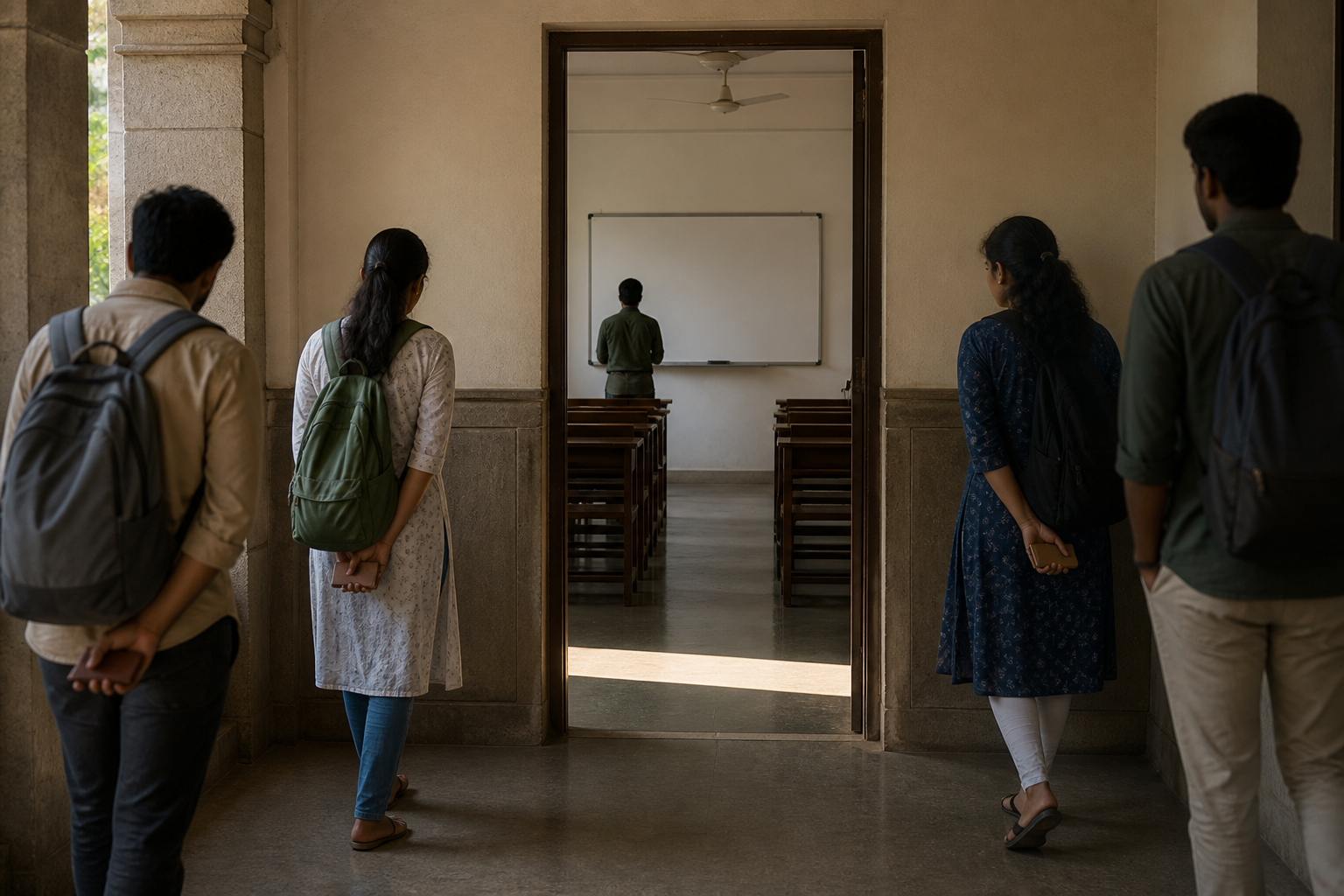
A lecturer in a government college does not surrender personal faith at the campus gate. Students do not surrender theirs either. The professional boundary appears when a teacher speaks through an official role to a class whose attendance, assessment or access depends on that institution.
This is why neutrality must be judged by conduct rather than identity. The relevant question is not, “What religion does this lecturer follow?” It is, “What did the lecturer do with the authority of the classroom?” Investigating the first question invites discrimination. Investigating the second protects every student.
India’s constitutional framework protects religious belief and non-belief while requiring state institutions to remain neutral. In practical classroom terms, neutrality means that no student should have to adopt, reject or perform a religious position to remain comfortable in the course or in the teacher’s good standing.
Not every mention of religion crosses that line. A course-relevant discussion of philosophy, history, literature, ethics or social practice may require serious engagement with religious traditions. A lecturer may also answer a student’s genuine question or briefly identify a personal viewpoint, provided the answer does not become pressure, recruitment or repeated advocacy unrelated to the syllabus.
Concerns become stronger when one or more of the following patterns appear:
- Students are asked to pray, affirm a creed, attend a religious activity or accept a truth claim unrelated to the course.
- A teacher repeatedly promotes one faith during instructional time without a clear academic purpose.
- Students are told or led to believe that agreement could affect marks, recommendations, attendance treatment or access to help.
- A student’s Hindu, Buddhist, Jain, Sikh, Christian, Muslim or non-religious identity is mocked, denigrated or treated as intellectually inferior.
- Classroom communication channels are used to circulate devotional or missionary material that is unrelated to teaching.
- Students face persistent personal invitations after expressing discomfort or declining to participate.
No single item should be detached from context and treated as automatic proof. A quoted religious passage in a literature lesson is different from an appeal to conversion. A spontaneous answer is different from a recurring campaign. The test is the combination of academic relevance, use of authority, persistence and pressure.
If you witnessed the conduct, build a record that can be tested

A strong complaint is not the angriest one. It is the one an impartial person can verify. If you were present, create a factual chronology while your memory is fresh. If you were not present, do not convert a forwarded clip or another student’s account into first-hand testimony.
- Preserve the original material. Keep the earliest available video or audio file unchanged. Do not crop it, add music, overlay captions or overwrite it with an edited copy. Record who supplied it and whether that person made the recording.
- Write down the setting. Note the date, class, subject, approximate point in the lesson, people present and what immediately preceded and followed the disputed remarks.
- Record words and actions, not assumed motives. Write “the lecturer asked students to…” or “the lecturer said…” as accurately as possible. Avoid claims such as “the lecturer secretly intended…” unless direct evidence establishes that intention.
- Separate direct knowledge from hearsay. Label what you personally saw, what appears in the recording and what somebody else told you. This makes the reliable part of the complaint harder to dismiss.
- Submit the account in writing. Use the department head, principal or designated grievance channel. Ask for acknowledgment of receipt, preservation of relevant evidence, information about the review process and protection against retaliation.
- Keep witness accounts independent. Students can report the same event separately without agreeing on identical language. Small differences are normal; copied wording can weaken confidence in otherwise genuine testimony.
- Protect privacy. Do not publish classmates’ phone numbers, addresses or personal details. Do not direct online followers toward the lecturer or a student. Public exposure can intimidate witnesses and make a fair inquiry more difficult.
A useful complaint subject line is: “Request for review of classroom remarks on [date and course].” The body can state the conduct, context, available evidence, witnesses who consent to be contacted and the remedy requested. The initial remedy should be an impartial review and a neutral classroom, not a predetermined punishment.
If a student reports a threat, loss of marks, attendance penalty or pressure to withdraw a complaint, document that as a separate event. Keep the message, order or assessment record in its original form and report it promptly through the appropriate institutional authority. Retaliation must not disappear inside the debate about the initial remarks.
A fair inquiry must authenticate, contextualize and decide

The college should treat the circulating clip as a lead, not as the complete case file. Social media rewards the shortest and most provocative extract. An institutional inquiry has a different duty: obtain the best available version, hear relevant witnesses and test competing explanations.
The review should answer these questions in order:
- Is the recording authentic? Identify the original file where possible and check whether the circulating version omits material before, after or between the recorded statements.
- What was the academic context? Establish the subject being taught, the question under discussion and whether the remarks had a defensible connection to the curriculum.
- What exactly was said or requested? Distinguish explanation, comparison and personal disclosure from devotional instruction, recruitment or disparagement.
- How was institutional authority used? Determine whether students could decline engagement without a reasonable fear of academic or social penalty.
- Was this isolated or repeated? Similar, independently documented incidents can change the assessment. Rumor and duplicated social-media claims cannot substitute for evidence.
- What is the lecturer’s explanation? Due process requires a chance to see the substance of the allegation and respond to the relevant evidence.
- Which existing rule applies? The finding should rest on a published professional, academic or government-college standard, not on the religious preferences of the loudest party.
Student discomfort matters, especially in a compulsory classroom, but discomfort by itself does not decide the case. Conversely, the absence of a public objection during class does not prove that no pressure occurred. Students may remain quiet because the teacher evaluates them. The inquiry must therefore consider both the conduct and the power relationship.
The institution should announce the scope and expected timeline of the inquiry without declaring guilt in advance. A conflict-free committee can include administrators, educators and people with relevant expertise in classroom ethics. Where policy permits community participation, that role should strengthen trust and student welfare, not turn the proceeding into a contest over whose theology is correct.
The outcome should match the finding. If the allegation is not substantiated, the college should say so clearly enough to prevent indefinite suspicion. If poor judgment occurred without coercion, written guidance, training and a reaffirmation of classroom boundaries may address the failure. If sustained proselytization, pressure, retaliation or denigration is established, formal action should follow the rules applicable to the institution. Proportionality is not softness; it is what makes accountability defensible.
Once the review is complete, the college should communicate the allegation examined, the standard applied, the broad conclusion and the corrective steps. Personal student information and protected personnel details should remain confidential. “The matter was handled” is too vague to restore trust, while releasing the entire case file may expose witnesses. A reasoned summary is the workable middle path.
Prevention should follow the decision. The college can publish a short classroom-neutrality rule, identify a confidential grievance channel, explain non-retaliation expectations, and train faculty on the line between personal conviction and professional speech. Students should receive the same orientation so that they know both their rights and the difference between academic discussion and religious pressure.
A Dharmic response should be firm without becoming indiscriminate

Hindu concern about proselytization in a government classroom should not be dismissed as intolerance. A public institution has a duty to prevent any teacher from turning educational authority into religious leverage. Asking for that boundary to be enforced is compatible with religious freedom because it leaves personal worship, voluntary association and private conviction intact.
Dharmic pluralism also places a discipline on how that concern is pursued. Hindu, Buddhist, Jain and Sikh traditions have long encountered different paths without requiring that disagreement become collective hostility. In this dispute, that inheritance calls for clarity: defend the student, examine the act and refuse to condemn an entire religious community for an allegation against one lecturer.
If you represent a parent body or Hindu organization, submit a short written demand with four concrete points: preserve the original recording, appoint an impartial review, publish a timeline, and communicate a reasoned outcome. Name one liaison to receive updates. This keeps the campaign focused on institutional conduct and reduces the chance that rumor, competing spokespeople or provocative slogans will overtake the grievance.
Firm advocacy rules out several tactics. Do not threaten the lecturer, expose private details, pressure witnesses, disrupt uninvolved classes or treat Christian students as responsible for the allegation. Do not insist that an inquiry itself proves guilt. At the same time, do not accept an appeal to private religious freedom as a complete answer to alleged conduct inside a government classroom. Private conviction and public duty are both real; the boundary between them is precisely what must be examined.
If you are involved in the Tirupati matter now, prepare a one-page chronology, retain the earliest available media, file the concern through a traceable channel and request the scope, timeline and eventual findings in writing. That record gives the college something it can act on and gives the community a fair basis for judging the response.
References
